

The enterprise AI pilot phase is over, and the results are sobering. Most organizations have discovered that basic Retrieval-Augmented Generation is a fragile bridge to true autonomy. You’ve witnessed the hallucinations in production. You’ve felt the friction of fragmented data silos. You’ve struggled with the black box of autonomous decision-making. These aren’t just technical glitches; they are symptoms of a systemic lack of context. Without a unified foundation, agentic workflow automation remains a theoretical exercise rather than a scalable operational reality. It’s time to move beyond the limitations of static prompts and isolated models.
You need a framework that ensures deterministic AI behavior across every vertical of your business. This guide demonstrates how to architect reliable, governed, and autonomous agents by leveraging a live enterprise context graph. We’ll examine the shift from passive observation to active execution. We’ll detail the requirements for seamless cross-system integration and explainable reasoning. By the end, you’ll possess a strategic roadmap for deploying a scalable, governed digital workforce that operates with total clarity and precision.
Key Takeaways
- Shift from reactive prompt engineering to proactive context engineering to eliminate the hallucinations that plague standard RAG implementations.
- Utilize a live enterprise context graph as a central nervous system, providing agents with the real-time operational memory required for complex decisioning.
- Architect agentic workflow automation that maintains strict governance through integrated Human-in-the-Loop systems and deterministic reasoning.
- Follow a technical roadmap to integrate disparate data silos into a unified entity hierarchy, ensuring every agent acts on a single source of truth.
- Leverage no-code platforms to rapidly deploy cross-system agents that execute tasks with the speed and reliability demanded by global enterprises.
Beyond RAG: Why Traditional Agentic Workflow Automation Fails
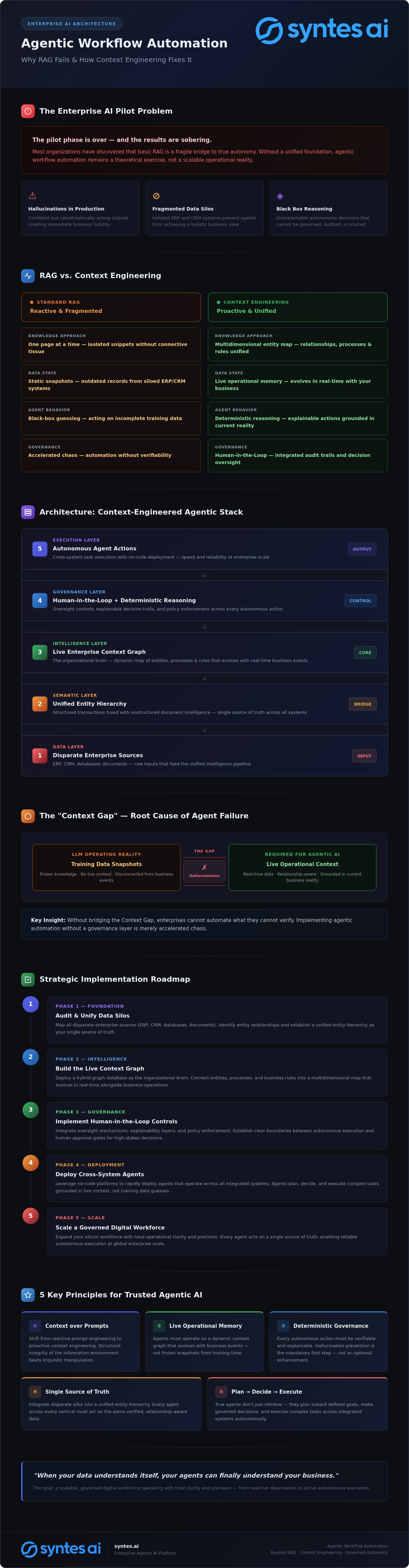
The promise of the autonomous enterprise often collides with the reality of fragmented data. True agentic workflow automation represents a fundamental shift in systems architecture. It is not a simple chatbot. It is a sophisticated intelligent agent capable of planning, deciding, and executing complex tasks toward a defined goal. However, most current deployments fail because they rely on an incomplete foundation. They lack a unified enterprise memory. This is the “Context Gap,” a structural void where Large Language Models (LLMs) are forced to operate without the full picture of business reality.
Standard Retrieval-Augmented Generation (RAG) is insufficient for high-stakes business logic. RAG functions like an open-book test where the student can only read one page at a time. It retrieves snippets of data but lacks the connective tissue to understand how those snippets relate to overarching organizational objectives. To move from passive observation to active, automated performance, enterprises must demand deterministic truth. They must bridge the gap between simple data retrieval and genuine operational intelligence.
The Hallucination Problem in Autonomous Systems
Autonomous agents are only as reliable as the data they consume. When data exists in disconnected silos, agents develop “black box” reasoning patterns that produce confident but catastrophic errors. An agent performing actions on flawed premises creates immediate liability. This makes preventing AI hallucination the mandatory first step toward any viable automation strategy. Implementing agentic workflow automation without a governance layer is merely accelerated chaos. You cannot automate what you cannot verify.
Fragmented Knowledge vs. Operational Intelligence
Static databases are the graveyards of enterprise intelligence. Traditional ERP and CRM systems house critical information, but they remain isolated, preventing agents from achieving a holistic view of the customer or the supply chain. This fragmentation is the primary bottleneck for reliability. Leading organizations are pivoting toward agentic ai platforms that provide systemic integration. These platforms replace static records with live operational context, ensuring that every decision is grounded in real-time relevance rather than outdated snapshots. The transition to a “silicon workforce” requires a central nervous system, not just a collection of disconnected tools.
The Architecture of Context-Engineered Agentic Workflows
Prompt engineering is a tactical bandage. It attempts to force intelligence through linguistic manipulation, often failing when faced with the complexity of real-world business logic. Context engineering is the necessary successor. It is a strategic architectural shift that prioritizes the structural integrity of the information environment where agents operate. To achieve reliable agentic workflow automation, you must build a foundation that integrates structured transactions with unstructured document intelligence. This creates a Live Operational Memory that evolves as your business grows, ensuring that agents aren’t just guessing based on training data, but acting on current reality.
The enterprise knowledge graph serves as the organizational brain in this architecture. It replaces flat, disconnected tables with a multidimensional map of your enterprise. This isn’t a static repository. It is a dynamic system that connects entities, processes, and rules, providing the essential grounding for every autonomous action. When your data understands itself, your agents can finally understand your business.
The Live Context Graph: A Unified Intelligence Layer
Modern enterprises are buried in data but starved for context. A semantic data layer for enterprise unifies these disparate systems into a single, navigable intelligence layer. It moves your architecture away from isolated records and toward relationship-based intelligence. By utilizing a hybrid graph database approach, you can manage complex enterprise relationships that traditional relational databases simply cannot represent. This layer acts as the translator, turning raw system outputs into actionable insights that agents can process with high fidelity. It eliminates the friction of cross-system data silos and provides a unified view of the truth. If you want to see how this architecture scales, you can explore the platform architecture through a technical walkthrough.
Contextualizing AI Reasoning for Trusted Execution
Trusted execution requires more than just better prompts; it requires GraphRAG. This advanced retrieval method allows for deeper reasoning by traversing the knowledge graph to find related concepts that standard vector searches miss. It bridges the gap between general LLM knowledge and your proprietary enterprise data. This process creates a continuously evolving operational context. As new transactions occur or documents are updated, the graph reflects these changes immediately. Agents remain grounded in the most recent version of the truth, allowing agentic workflow automation to handle edge cases and complex dependencies with a level of precision that was previously impossible.
Orchestration vs. Autonomy: Balancing Governed Agents
The debate between rigid orchestration and total autonomy is a false dichotomy. Most enterprises fear the “black box” of autonomous systems, yet they remain handcuffed by the limitations of rule-based logic. True agentic workflow automation exists on a spectrum. It requires a framework where agents can act independently within a defined boundary of governance. Without this balance, your digital workforce is either too restricted to be useful or too volatile to be trusted. Success lies in building systems that can pivot between human oversight and independent execution based on the risk profile of the task.
Achieving this balance is impossible while data remains fragmented. This makes solving enterprise data silos the non-negotiable prerequisite for agentic autonomy. If an agent cannot see the relationship between a contract renewal date and a customer’s support history, it cannot make an informed, autonomous decision. It is merely guessing. The transition from general “Agentic AI” to “Governed Agentic AI” marks the maturity of the enterprise stack, where execution is both independent and auditable. This ensures that agentic workflow automation delivers value without introducing unmanaged risk.
Governed Execution: Safety in Autonomous Loops
Enterprise operations demand accountability. You cannot permit an agent to execute a multi-million dollar procurement order without a verifiable reasoning chain. Governed execution applies business rules and compliance policies directly at the context layer, ensuring agents operate within authorized parameters. This is not about restricting intelligence; it’s about defining the field of play. Permission-based AI ensures that agents only access specific data points relevant to their current task, maintaining security while enabling performance. Auditability becomes the byproduct of this architecture. When you know exactly why an agent took an action, the “black box” disappears.
Operational Relationship Intelligence
Utility-based enterprise agents differ from simple reflex agents because they understand the value of their outcomes. They don’t just react to triggers. They navigate complex workflows by analyzing the relationships between customers, products, and regulatory rules. This operational relationship intelligence allows agents to collaborate across multiple business units without manual handoffs. By scaling this collaboration, a “swarm” of specialized agents can manage end-to-end processes, from supply chain logistics to financial reconciliation, with minimal human intervention. This is the ultimate goal of governed autonomy: a system that thinks, acts, and cooperates with the precision of a seasoned expert.
Implementing Agentic Automation: The Strategic Roadmap
Implementation is not a pilot project. It is a structural overhaul. To move agentic workflow automation from an experimental phase to a production standard, enterprises must follow a strategic roadmap that prioritizes context over raw computation. This process ensures that agents act as seasoned experts rather than simple algorithms. Transitioning to a silicon workforce requires a methodical reconstruction of how data informs action.
- Step 1: Connect Data. Integrate structured and unstructured data across the enterprise to ensure agents have a complete view of the operational environment.
- Step 2: Understand Semantics. Map business semantics and entity hierarchies so agents understand the relationship between a specific vendor and a global procurement policy.
- Step 3: Contextualize. Utilize a dynamic Syntes AI Context Graph as the engine of truth, providing the real-time grounding necessary for autonomous decision-making.
- Step 4: Govern. Embed security, permissions, and auditability into the architecture to ensure agents act only within authorized parameters.
- Step 5: Execute. Deploy agentic workflow automation over a foundation of trusted context, turning passive data into active, automated performance.
This roadmap is not merely a technical checklist; it is a shift in operational philosophy. By moving away from isolated scripts and toward a unified intelligence layer, you enable agents to handle edge cases that traditional automation would ignore. This transition requires a robust foundation that can handle the high-velocity data requirements of a silicon workforce. You aren’t just building tools; you’re architecting an ecosystem of trusted intelligence.
Architecting for Agentic Intelligence
Success depends on the integrity of your enterprise ai infrastructure. You must evaluate whether your current stack supports the high-fidelity data movement required for autonomous agents. This involves selecting two-way connectors that provide real-time system synchronization. Without bidirectional data flow, your agents operate on stale information, leading to the reasoning errors that derail production workflows. Prioritize use cases where the complexity is high but the logic is definable, such as supply chain reconciliation or financial services compliance.
Measuring ROI in Agentic Systems
The value of autonomous execution is strictly measurable. You quantify ROI by tracking operational efficiency gains and the significant reduction in the cost of AI errors. Manual data reconciliation often consumes thousands of man-hours; agentic systems eliminate this bottleneck entirely. By scaling your AI initiatives without increasing headcount, you transform your cost structure from linear to exponential. The goal is total operational clarity, where every autonomous action is a verifiable step toward greater systemic efficiency.
The Syntes Agentic Platform: Scaling Trusted Intelligence
The Syntes AI Platform is the definitive solution for organizations ready to transcend the limitations of fragmented data. It transforms isolated records into a unified intelligence layer, providing the necessary grounding for sophisticated agentic workflow automation. While competitors focus on generic development kits, Syntes prioritizes the integrity of the underlying context. This platform doesn’t just manage agents; it architects the information environment where they thrive. By utilizing No-Code AI Apps, business leaders can rapidly deploy specialized agents across departments without the traditional bottlenecks of custom software development.
Trusted execution is the core requirement for any enterprise-grade system. The Syntes platform ensures this through explainable reasoning and governed agents that operate within a shared context intelligence layer. You no longer have to choose between speed and safety. Every autonomous action is backed by a verifiable reasoning chain, allowing you to scale your digital workforce with total confidence. This architecture moves the enterprise beyond the “black box” era and into a state of total operational clarity.
Live Operational Memory: The Enterprise Advantage
Static knowledge is a liability in a high-velocity market. The Live Operational Memory within the Syntes ecosystem provides a continuously evolving model of your business. It ensures that AI agents always act on the most current operational events, whether it’s a sudden shift in supply chain logistics or a real-time update in a CRM record. This shift from static snapshots to live intelligence is the primary differentiator for the modern enterprise. Your agents don’t just remember the past; they understand the present. This real-time relevance is what allows agentic workflow automation to handle complex, shifting priorities with the precision of a human expert.
Partnering for Enterprise Transformation
Scaling AI requires a partner who understands the messy realities of global operations. Syntes AI helps firms move beyond consumer-grade limitations to build robust, scalable systems that integrate seamlessly with existing ERP, CRM, and cloud applications. We provide the tools to architect your agentic enterprise from the ground up, ensuring that autonomous execution becomes a core competency rather than a peripheral experiment. The transition to a context-engineered organization is not just a technical upgrade; it’s a strategic evolution. By unifying your data silos into a single, navigable context graph, you create the foundation for an autonomous future that is reliable, governed, and infinitely scalable.
Architecting the Autonomous Future with Contextual Intelligence
The shift from experimental AI to a fully autonomous enterprise requires more than better models; it demands a fundamental reconstruction of how data informs action. Relying on basic RAG is a strategic risk your organization cannot afford. By prioritizing context engineering and a live operational memory, you eliminate the hallucinations and fragmented knowledge that stall traditional initiatives. True agentic workflow automation is finally achievable through a unified intelligence layer that provides the deterministic truth required for high-stakes execution.
Syntes AI is the leader in Context Engineering and Enterprise Context Graphs. We provide the enterprise-grade governance and live operational memory needed for trusted AI performance. You have the strategic roadmap to move beyond passive observation. Now, it’s time to build.
The transition to a silicon workforce is an operational necessity. Architect yours on a foundation of absolute clarity and precision.
Frequently Asked Questions
What is the difference between an AI agent and an agentic workflow?
An AI agent is an autonomous entity designed to perceive its environment and take actions to achieve specific goals. In contrast, agentic workflow automation refers to the broader system where multiple agents, or a single agent through iterative loops, coordinate to execute complex business processes. While an agent is the “worker,” the workflow is the “architecture” that defines how those workers plan, reflect, and collaborate to deliver a final, verified outcome.
How does agentic workflow automation reduce AI hallucinations?
Hallucinations are primarily caused by a lack of grounding in proprietary truth. agentic workflow automation reduces these errors by utilizing a Live Context Graph that provides the AI with real-time operational memory. Instead of relying on the general patterns of a Large Language Model, the system forces the agent to reason over verified enterprise data. This deterministic approach ensures that every decision is backed by a specific, traceable fact rather than a statistical guess.
Can agentic AI platforms integrate with legacy ERP systems?
Yes, modern agentic AI platforms are specifically designed to bridge the gap between legacy infrastructure and autonomous intelligence. Syntes AI utilizes two-way connectors to synchronize data from ERP, CRM, and other siloed systems into a unified context layer. This integration allows agents to read from and write back to these systems in real time. It effectively transforms static legacy records into a dynamic, actionable intelligence source for the entire digital workforce.
What is the role of a Knowledge Graph in agentic automation?
A Knowledge Graph serves as the central nervous system for autonomous agents. It maps the complex relationships between customers, products, rules, and operational events, moving beyond the limitations of isolated tables. By providing this relationship-based intelligence, the graph allows agents to understand the “why” behind business logic. It acts as a shared enterprise memory, ensuring every agent operates from the same high-fidelity model of the organization’s current state.
Is agentic workflow automation secure for financial or healthcare data?
Enterprise-grade agentic systems are architected with security and compliance as foundational requirements. Governance-as-code allows organizations to embed strict permissions, data encryption, and auditability directly into the agentic loop. Agents only access authorized data points relevant to their specific task, maintaining compliance with regulations like HIPAA or GDPR. Every autonomous decision generates a verifiable reasoning chain, providing the total transparency required for high-stakes financial or healthcare operations.
How do I start implementing agentic AI in a large organization?
Implementation begins with a strategic roadmap focused on the five pillars of Context Engineering. First, you must connect disparate data silos through two-way integrations. Second, you discover the underlying business semantics and entity hierarchies. Third, you build a dynamic Context Graph to serve as the organizational brain. Fourth, you apply governance and security protocols. Finally, you execute workflows over this trusted context, starting with high-impact use cases like supply chain or financial reconciliation.
What is Context Engineering and why does it matter for AI agents?
Context Engineering is the specialized discipline of building, governing, and maintaining the business environment where AI operates. It is the necessary evolution beyond simple prompt engineering. While prompts attempt to influence the AI’s behavior through language, Context Engineering provides the structural integrity of the data itself. It ensures that agents have the “Live Operational Memory” required to reason accurately, handle edge cases, and perform governed actions with total precision.
How does Syntes AI ensure the explainability of its agentic workflows?
Syntes AI ensures total explainability by replacing the “black box” of standard LLMs with an audited reasoning chain. Every action taken by an agent is grounded in the Syntes AI Context Graph, which provides a traceable path from the data source to the final decision. This approach allows human operators to inspect the specific relationships and rules the agent used during its planning phase. It transforms autonomous execution into a transparent, verifiable process for the enterprise.