

Why are your most expensive AI investments still failing the basic test of enterprise truth? You’ve built the pipelines. You’ve scaled the lakes. Yet your agents remain tethered to probabilistic guesses rather than deterministic facts. It’s time to stop treating the knowledge graph vs data fabric debate as a binary choice between two competing technologies. You likely feel the frustration of fragmented knowledge leading to costly hallucinations. You’ve felt the weight of the bad data tax as manual reconciliation drains your engineering resources. It’s a systemic flaw that prevents the transition from passive observation to active, automated performance.
The path to agentic autonomy in 2026 requires a more sophisticated synthesis. This article provides the definitive architectural roadmap to help you move beyond simple RAG toward a system of Live Operational Memory. We’ll show you how to architect a trusted intelligence layer that transforms passive data collection into active operational reasoning. You’ll discover how to integrate metadata orchestration with semantic context to build an environment where AI reasoning is both explainable and governed. It’s time to architect for truth.
Key Takeaways
- Define the strategic distinction in the knowledge graph vs data fabric landscape to ensure your infrastructure supports both connectivity and semantic reasoning.
- Identify how to eliminate the “bad data tax” by transitioning from passive data lakes to an active, metadata-driven orchestration layer.
- Master the shift from prompt engineering to Context Engineering to provide AI agents with the governed, real-time context they need to execute tasks.
- Understand the necessity of Live Operational Memory in 2026 for building AI systems that are both autonomous and fully explainable.
- Establish a clear architectural roadmap that unifies disparate enterprise systems into a single, high-fidelity model of your business operations.
The Enterprise Datastrophe: Why Connectivity Alone Fails AI
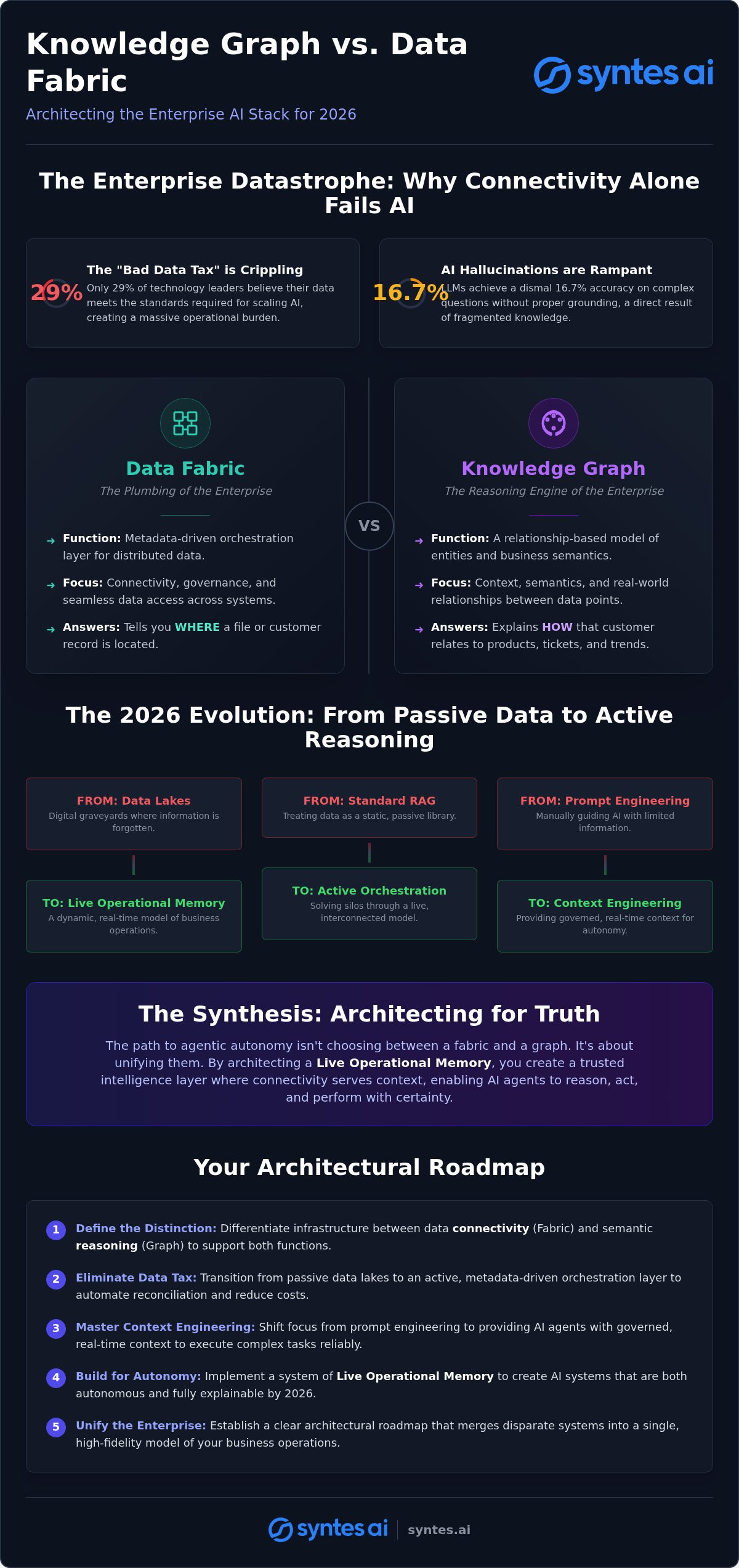
Connectivity is not intelligence. It’s just plumbing. By 2026, the “Bad Data Tax” has evolved into a crippling operational burden for the global enterprise. Only 29% of technology leaders agree their data meets the standards required for scaling AI, according to a May 2026 report by Promethium.ai. This represents a systemic failure. Enterprises have spent a decade collecting data without contextualizing it. They’ve built pipelines that lead nowhere. The current strategic debate surrounding knowledge graph vs data fabric highlights this exact tension. One connects the systems; the other defines the truth.
The Limitations of Modern Data Silos
Fragmented knowledge is the primary fuel for AI hallucinations. When your AI attempts to reason across disconnected ERP and CRM systems, it lacks the semantic glue to bridge the gaps. Research shows that Large Language Models (LLMs) answering complex questions without grounding achieve a dismal 16.7% accuracy. This failure isn’t a model problem. It’s a context problem. Disconnected metadata prevents your agents from understanding business intent. You’re paying for manual data reconciliation that should be automated. These silos don’t just hide data; they obscure the logic of your entire operation.
From Data Lakes to Operational Intelligence
The “central repository” model has failed the real-time requirements of 2026. Data lakes have become digital graveyards where information goes to be forgotten. Standard Retrieval-Augmented Generation (RAG) is insufficient because it treats data as a static library rather than a dynamic environment. To move toward agentic intelligence, you must focus on solving enterprise data silos through a live model of the business. This requires a Knowledge graph approach that maps relationships in real time. We’re witnessing a transition from the traditional DIKW pyramid to a model of autonomous execution. Your infrastructure must provide a system of Live Operational Memory that allows agents to act with certainty. Choosing between a knowledge graph vs data fabric isn’t about picking a winner; it’s about architecting a system where connectivity serves context.
Defining the Core: Data Fabric vs. Knowledge Graph
To architect for 2026, you must distinguish between the delivery of data and the comprehension of it. The distinction between a knowledge graph vs data fabric is often mischaracterized as a competition. In reality, they represent two distinct tiers of a mature enterprise ai infrastructure. One manages the logistics of information; the other masters its meaning. Understanding this structural divergence is the first step toward building a system that doesn’t just store data but actually reasons with it.
Data Fabric: The Plumbing of the Modern Enterprise
Data fabric acts as the metadata-driven orchestration layer for distributed environments. It’s the plumbing. It utilizes a virtual layer to connect disparate cloud and on-premise sources without the need for physical data movement. This architecture focuses on metadata discovery, automated governance, and seamless orchestration. It ensures that your data is accessible and compliant across the entire stack. It’s the definitive solution for data democratization and cross-platform access. However, while a data fabric is exceptional at finding and moving data, it lacks the inherent logic to understand the complex business relationships hidden within those files.
Knowledge Graph: The Reasoning Engine
A knowledge graph is the reasoning engine of the organization. It’s a relationship-based model that prioritizes entities and business semantics over simple file paths. This technology is the foundation for a high-fidelity semantic data layer for enterprise intelligence. It transforms raw data into a structured map of real-world concepts. While a data fabric tells you where a customer record is located, a knowledge graph explains how that customer relates to specific products, past support tickets, and current market trends. This level of contextual reasoning is what provides the grounding required for AI to function without hallucination. It moves the enterprise from simple retrieval to sophisticated logic.
These two architectures are complementary. The fabric provides the connectivity; the graph provides the context. In a functional 2026 stack, the data fabric serves as the high-speed delivery mechanism that feeds the knowledge graph. This integration creates a deterministic environment where AI agents can execute tasks based on verified relationships rather than probabilistic guesses. If you want to see how these layers integrate to drive autonomous performance, you can book a demo to explore a unified context architecture. The goal is total operational clarity through the synthesis of connection and comprehension.
Structural Divergence: Connectivity vs. Contextual Reasoning
Connectivity is the baseline. Intelligence is the goal. When evaluating the knowledge graph vs data fabric landscape, decision-makers often ask if this is simply another layer of expensive middleware. The answer is a definitive no. Middleware moves data; this architecture operationalizes it. While a data fabric provides the necessary pipelines to access distributed assets, it cannot interpret the nuanced business logic required for autonomous AI execution. You need a system that understands the “why” behind every data point to achieve true operational relationship intelligence.
The core of the issue lies in the difference between technical metadata and business context. Technical metadata tells you the format, size, and location of a file. Business context tells you that a specific “Project_ID” in your ERP is the same entity as a “Service_Ticket” in your CRM, and that both are currently at risk due to a logistics delay. A data fabric identifies the files. A knowledge graph understands the risk. This transition from passive observation to active reasoning is what defines a mature enterprise intelligence layer.
Metadata Orchestration in Data Fabrics
Data fabrics are designed to automate the heavy lifting of data engineering. They utilize AI-driven metadata analysis to streamline the ETL process, creating a unified view through sophisticated data catalogs. This approach is superior for “discovery.” It allows your teams to find distributed assets across a hybrid cloud environment without manual intervention. It’s an essential layer for governance and compliance. However, discovery is not reasoning. A fabric can identify a “Customer_ID” across ten systems; it cannot inherently understand the complex, shifting relationship between that customer’s lifetime value and a recent supply chain delay. It manages technical metadata, not business intent.
Semantic Reasoning in Knowledge Graphs
True intelligence requires an enterprise knowledge graph to act as a live, evolving model of the business. Unlike the “black box” nature of standalone LLMs, graph structures provide a transparent, deterministic framework for reasoning. They use relationship-based data models to map how entities interact in the real world. This structural precision is what allows an AI agent to move from simple retrieval to active operational intelligence. By defining these relationships, you eliminate the ambiguity that leads to AI hallucinations. You aren’t just connecting dots. You’re defining why they are connected. This shift from technical connectivity to semantic reasoning is the primary requirement for agentic AI in 2026. It’s the difference between having a list of ingredients and a master chef who understands how they combine to create a result.
The 2026 Evolution: Architecting for Agentic AI
What is the ultimate goal of your data strategy? In 2026, the answer is autonomous performance. The knowledge graph vs data fabric choice is now a question of agentic readiness. If your infrastructure can’t provide a reliable reasoning path, your AI is a liability. Passive data management is dead. Agentic AI demands a system that doesn’t just store records but maintains a Live Operational Memory of every business interaction. This is the only way to ensure your agents act with precision rather than probability.
We’re moving past the era of prompt engineering. Trying to “talk” an AI into accuracy is a fool’s errand. Instead, strategic leaders are mastering Context Engineering. This involves building a governed context layer that provides the deterministic truth necessary to prevent ai hallucination at the source. It moves the burden of accuracy from the user to the architecture itself. To build an agent-ready infrastructure, you must follow five specific steps: connect disparate systems, understand semantic relationships, contextualize real-time events, govern via strict business logic, and execute autonomous workflows.
Live Operational Memory: The New Enterprise Standard
Static databases are historical records. They tell you what happened yesterday. Modern agentic ai platforms require a continuously evolving context that integrates real-time events and business rules into the reasoning path. A unified context layer ensures that when an agent executes a task, it’s doing so with the most current operational state. This isn’t just about finding information; it’s about maintaining a live model of the business that reflects every change in your ERP, CRM, and cloud applications as they happen.
The Governance of Autonomous Agents
Governance is no longer a checklist; it’s an architectural constraint. Agents require guardrails rooted in semantic data models to ensure they don’t exceed their authority or misinterpret business intent. By implementing Human-in-the-Loop systems within a governed framework, you ensure total auditability. Every automated decision must be explainable through the relationships defined in your graph. This creates a safety layer where AI reasoning is transparent, predictable, and fully aligned with enterprise standards. You don’t just hope the AI is right. You know it is.
Syntes AI: Unifying Fabric and Graph into a Context Graph
Stop choosing between connectivity and context. The industry obsession with the knowledge graph vs data fabric binary is a strategic distraction from the real objective: execution. Syntes AI resolves this architectural conflict by unifying these layers into a single Context Graph. This is not a static repository. It is a live operational model of your business that provides the high-fidelity grounding required for autonomous agents to function safely across disparate systems. We bridge the LLM context gap through Operational Relationship Intelligence. This ensures your AI understands the specific business intent behind every record, transforming fragmented data into a unified intelligence layer.
The Five Pillars of Syntes Context Engineering
Success in the agentic era requires more than just a data pipeline. It requires a systematic framework that transforms raw information into actionable intelligence. The Syntes Context Engineering Framework is built on five critical pillars that move your data from storage to action:
- Connect: We provide seamless integration of structured and unstructured enterprise data through two-way connectors for ERP, CRM, and cloud applications.
- Understand & Contextualize: Our system discovers hidden hierarchies and maps entities to build a live graph that reflects the real-world state of your business operations.
- Govern & Execute: We enable AI agents to perform complex tasks with deterministic accuracy by applying semantic guardrails that ensure every action is auditable, safe, and aligned with enterprise logic.
This framework ensures that your AI agents don’t just find information. They understand the context of that information and possess the authority to act on it. You’re no longer managing data. You’re orchestrating intelligence.
Why Syntes AI is the Next Evolution
Standard RAG and prompt engineering are insufficient for the demands of 2026. They treat data as a retrieval problem rather than a reasoning opportunity. Syntes AI provides a dynamic Enterprise Intelligence Layer that moves your organization from passive observation to active, automated performance. This architecture is already delivering results in high-stakes environments within the retail, financial services, and manufacturing sectors. We provide the Live Operational Memory your business needs to lead in an increasingly autonomous market. It’s time to stop experimenting with fragmented tools and start architecting for truth.
Transform your enterprise data into Live Operational Memory with Syntes AI.
Architecting the Autonomous Enterprise
The strategic imperative for 2026 is clear. You must move beyond the binary choice of a knowledge graph vs data fabric to embrace a unified context layer. Connectivity is the plumbing; reasoning is the architect. Without a deterministic model of your business logic, your AI agents will remain confined to the realm of hallucination and operational risk. You need more than just access to data. You need the absolute ability to operationalize it.
Syntes AI bridges this gap with the Syntes AI Context Graph. We provide the Live Operational Memory required for a truly Governed Agentic AI framework. By delivering enterprise-grade explainable reasoning, we transform your data from a passive asset into an active, autonomous force. This architecture ensures that every action taken by your agents is grounded in truth and fully auditable. The transition from observation to execution starts here. You’ve built the infrastructure. Now, it’s time to give it a mind.
The future of enterprise intelligence belongs to those who prioritize truth over connectivity. Start building your roadmap to autonomous success today.
Frequently Asked Questions
What is the primary difference between a data fabric and a knowledge graph?
A data fabric serves as the metadata-driven orchestration layer focused on the delivery and discovery of distributed data. In contrast, a knowledge graph is a relationship-based model designed for semantic reasoning and context. While the fabric manages the logistics of data access across hybrid environments, the graph defines the meaning by mapping entities and business logic. The knowledge graph vs data fabric debate isn’t about choosing one, it’s about separating connectivity from comprehension.
Can a knowledge graph exist within a data fabric architecture?
Yes, a knowledge graph often functions as the semantic brain within a broader data fabric architecture. The data fabric provides the underlying connectivity and automated metadata discovery, while the knowledge graph sits atop this layer to provide the deep, relationship-based understanding required for AI reasoning. This synthesis allows enterprises to maintain a unified data access layer while simultaneously building a high-fidelity model of their business operations for autonomous execution. It’s a symbiotic relationship.
How does a knowledge graph improve AI grounding compared to standard RAG?
Standard RAG relies on retrieving isolated text snippets, which lacks the structural context needed for complex reasoning. A knowledge graph improves AI grounding by providing a deterministic map of relationships, often referred to as GraphRAG. This allows AI systems to understand how entities like customers, products, and policies interact. By grounding models in a structured context graph, enterprises reduce hallucinations and achieve far higher accuracy than probabilistic retrieval alone. It’s the difference between guessing and knowing.
Is a data fabric enough to support autonomous AI agents?
No, a data fabric alone is insufficient for supporting autonomous AI agents. While a fabric is excellent for finding and governing distributed data, it lacks the operational relationship intelligence required for agents to perform complex tasks safely. Agents need a live operational memory to understand business intent and consequences. Without the semantic layer provided by a knowledge graph, agents cannot execute governed actions or provide the explainable reasoning necessary for enterprise-grade automation. Connectivity is just the baseline.
What is Context Engineering, and why is it replacing prompt engineering?
Context Engineering is the technical discipline of building and maintaining the structured business context required for AI systems to reason accurately. It’s replacing prompt engineering because trying to “talk” an AI into accuracy is inherently unreliable. By architecting a governed Context Graph, enterprises provide the AI with a deterministic foundation of truth. This shift moves the burden of accuracy from the user’s prompt to the underlying system architecture, ensuring consistent, governed results across every automated workflow.
How do these architectures solve the problem of enterprise data silos?
These architectures solve the silo problem by moving away from physical data centralization toward virtualized connectivity and semantic mapping. A data fabric uses metadata to create a unified access layer across disparate systems like ERPs and CRMs. A knowledge graph then bridges the logic gap by identifying that a customer record in one silo is the same entity as a client ID in another. This unified context layer allows AI to reason across the entire organization without manual reconciliation.
What are the security implications of using a live operational memory for AI?
Security in a live operational memory environment is rooted in semantic governance and strict access controls. Unlike “black box” models, a governed Context Graph allows enterprises to apply business rules and permissions directly to the reasoning path. This ensures that AI agents only access authorized data and follow compliant logic. It also provides a complete audit trail, making every automated decision explainable and transparent. It’s the only way to meet 2026 regulatory standards for AI safety.
How long does it take to implement an enterprise knowledge graph in 2026?
Implementation timelines in 2026 have been drastically reduced through the use of two-way connectors and AI-driven metadata discovery. While a full-scale digital twin of a global enterprise is an ongoing evolution, an initial high-impact Context Graph can typically be operationalized within 90 to 120 days. This phased approach focuses on connecting core systems first, such as ERP and CRM, to establish a functional intelligence layer that provides immediate utility for agentic workflows and automated reasoning.