

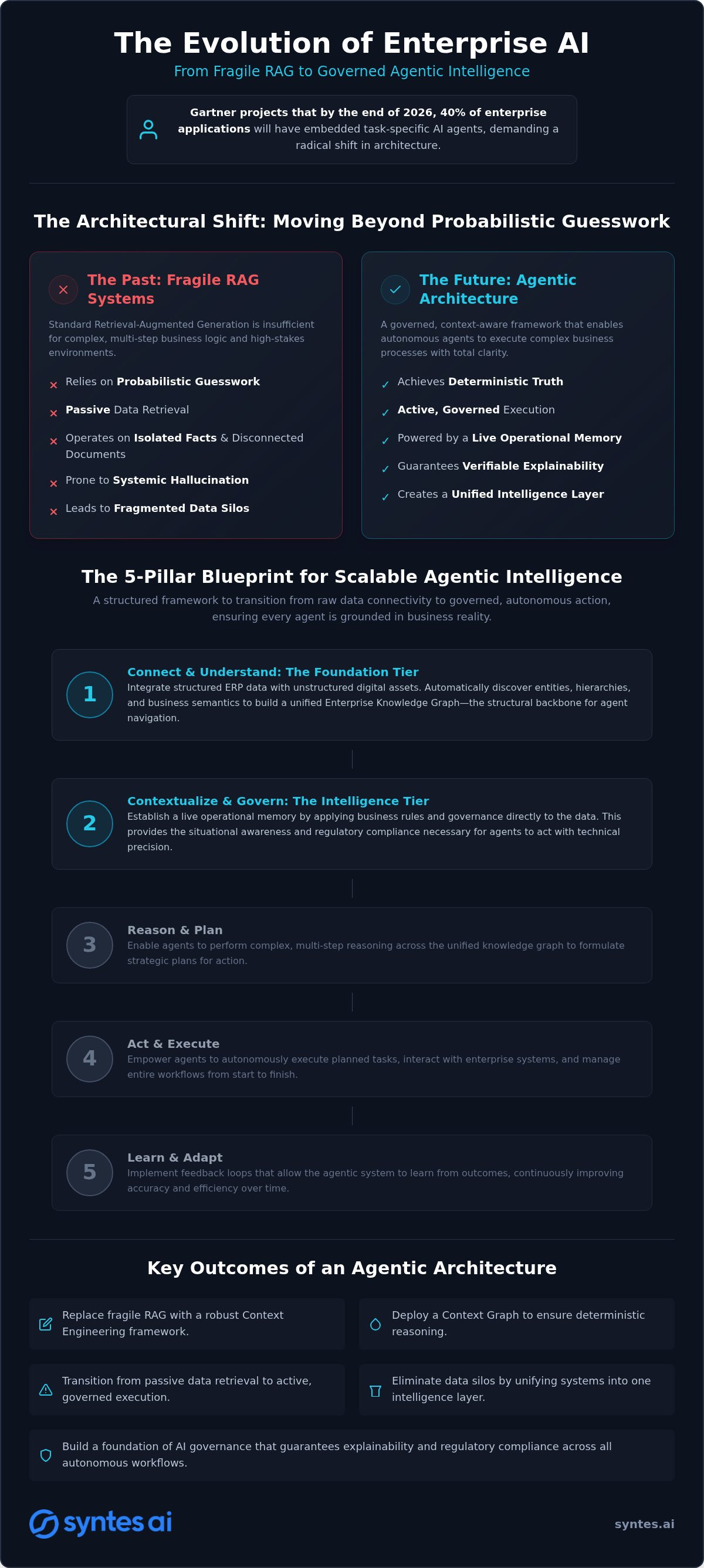
The era of the experimental AI chatbot is over. By the end of 2026, Gartner projects that 40% of enterprise applications will have embedded task-specific AI agents, necessitating a radical evolution in enterprise ai agent architecture. You’ve likely realized that standard Retrieval-Augmented Generation (RAG) is insufficient for complex, multi-step business logic. It lacks the systemic integration and situational awareness required for true autonomy. Fragile systems that merely fetch documents cannot handle the gravity of production-grade operations.
You need a framework that replaces probabilistic guesswork with deterministic truth. This article provides the architectural blueprint required to move beyond fragile RAG systems toward governed, context-aware agentic intelligence. We’ll examine the transition from passive data retrieval to active, automated performance via a live Context Graph. You’ll learn to architect a system that doesn’t just predict the next word, but executes business processes across your existing stack with total operational clarity and verifiable explainability.
Key Takeaways
- Replace fragile RAG systems with a sophisticated Context Engineering framework capable of handling complex business logic and multi-step reasoning.
- Establish a scalable enterprise ai agent architecture that transitions your operations from passive data retrieval to active, governed execution.
- Deploy a Context Graph to create a Live Operational Memory, ensuring your agents possess the semantic depth necessary for deterministic reasoning.
- Eliminate fragmented data silos through seamless cross-system integrations that unify legacy ERPs and modern cloud environments into a single intelligence layer.
- Build a foundation of AI governance that guarantees explainability and regulatory compliance across every autonomous workflow in your organization.
Beyond RAG: The Evolution of Enterprise AI Agent Architecture
The standard approach to AI is fundamentally broken. For years, organizations relied on basic Retrieval-Augmented Generation (RAG) to ground large language models. This first-wave strategy is no longer sufficient for the demands of 2026. Modern enterprise ai agent architecture must transition from simple document retrieval to a system of governed, autonomous entities capable of reasoning over complex business logic. It’s the difference between a bot that finds a file and an intelligent agent that understands the strategic implications of the data within it. We call this third-wave Context Engineering, a necessary evolution for any firm seeking true operational autonomy.
Black Box LLMs fail in high-stakes environments because they lack a proprietary context layer. Without this layer, these models are merely sophisticated predictors of the next token. They don’t possess Operational Relationship Intelligence. This is the architectural north star that defines how entities, business rules, and real-time data interact within your specific ecosystem. To move beyond the limits of generative AI, you must architect a system that prioritizes connectivity and real-time relevance over theoretical experimentation.
The Failure of Consumer-Grade Chatbots in the Enterprise
Consumer-grade chatbots are a liability in production. They operate on isolated facts and disconnected documents, a recipe for systemic hallucination. In high-compliance sectors like finance or healthcare, the cost of a single architectural error is catastrophic. You can’t build a global enterprise on probabilistic guesses. You need deterministic truth. This requires an immediate shift from assistive models that wait for human prompts to autonomous agentic models that proactively manage workflows. The goal is active execution, not passive conversation.
Defining the Live Operational Memory
Static databases are operational relics. A modern architecture requires a Live Operational Memory. This is a continuously evolving enterprise memory that bridges the gap between general LLM knowledge and your proprietary data. It provides the situational awareness necessary for agents to act with technical precision. Understanding how to prevent ai hallucination isn’t a luxury; it’s a foundational requirement of system integrity. By contextualizing data through a dedicated Context Graph, you transform passive observation into active, automated performance that scales without losing accuracy.
The 5-Pillar Blueprint for Scalable Agentic Intelligence
How do you transform a collection of disconnected models into a cohesive, high-performance system? The Syntes Context Engineering Framework provides the definitive answer. This holistic architectural standard moves beyond the limitations of simple data ingestion, focusing instead on deep semantic understanding. A robust enterprise ai agent architecture requires a structured progression from raw connectivity to governed, autonomous action. Without this blueprint, AI initiatives remain trapped in the experimental phase, unable to deliver measurable ROI or systemic reliability.
Success depends on a hierarchy of execution. You must first establish a foundation of connectivity before you can hope to achieve autonomous reasoning. This methodical approach ensures that every action taken by an agent is grounded in the reality of your business logic. By following this framework, organizations can align their Enterprise Agentic AI Architecture Design Guidance with practical, high-tech resolutions that solve the messy realities of large-scale operations.
Connect and Understand: The Foundation Tier
Data silos are the enemy of intelligence. You must integrate structured ERP data with unstructured digital assets to create a unified view of the enterprise. This tier focuses on the automatic discovery of entities, hierarchies, and business semantics. By building an enterprise knowledge graph, you create the structural backbone necessary for agents to navigate complex data environments with precision. It’s about moving from passive observation to active, real-time relevance.
Contextualize and Govern: The Intelligence Tier
Governance is not a checkbox; it’s a prerequisite for autonomy. This tier utilizes the dynamic Context Graph to create a unified model of the enterprise. Here, security, permissions, and business compliance rules are applied directly at the graph level. This ensures that AI actions are fully auditable and strictly follow organizational policies. When you govern the context, you eliminate the risk of unguided autonomous actions, providing the clarity and efficiency required for production-grade AI. If you’re ready to stabilize your AI strategy, explore the Syntes framework today.
Execute: The Autonomous Tier
The final pillar is the transition from theory to performance. Deploying agentic ai platforms allows for the execution of multi-step business processes without constant human intervention. This tier enables multi-agent collaboration via a shared context layer, moving the organization from “human-in-the-loop” to “human-on-the-loop” oversight. You aren’t just automating tasks; you’re architecting a system capable of independent reasoning and seamless cross-system automation.
The Role of the Context Graph in Agent Reasoning
Vector databases are blunt instruments. They excel at finding similarities but fail at understanding logic. To build a resilient enterprise ai agent architecture, you must move beyond the limitations of simple vector-only search and embrace GraphRAG. While traditional RAG retrieves disconnected fragments of information, a Context Graph maps the intricate, non-linear relationships between products, customers, and internal business rules. This creates a semantic data layer for enterprise that serves as the definitive source of truth for every autonomous agent in your ecosystem.
The technical superiority of graph structures lies in their ability to facilitate multi-hop reasoning. An agent shouldn’t just “find” a customer’s recent order. It must understand how that order relates to current inventory levels, regional shipping delays, and the specific terms of a service-level agreement. By traversing these nodes, the agent performs complex reasoning that mirrors human expertise but operates at machine speed. This isn’t just data retrieval; it’s the execution of systemic intelligence across your entire operational stack.
Operational Relationship Intelligence
Isolated data points are useless in a high-velocity business environment. You need Operational Relationship Intelligence to move from passive observation to proactive execution. By using relationship data, agents can predict operational impacts before they manifest as crises. For instance, when a supply chain disruption occurs, an agent doesn’t merely notify a manager. It traverses the Context Graph to identify every affected customer contract and automatically suggests alternative vendors based on real-time availability. This is the ultimate goal of Context Engineering: building relationship maps that transform fragmented silos into a holistic, actionable business model.
Achieving Explainable AI (XAI)
The “black box” approach is a liability that no global enterprise can afford. You need a clear, immutable audit trail for every action your agents take. The Context Graph provides this by offering “ground truth” evidence for every agentic output. If an agent triggers a high-value procurement order, the system doesn’t just cite a probability score. It provides a specific traversal path showing exactly which business rules and data relationships drove the decision. This eliminates the ambiguity that plagues consumer-grade AI. In high-stakes environments, explainability is the cornerstone of trust and the primary mechanism for maintaining total operational clarity.
Cross-System Integration: Building a Seamless AI Workflow
Data silos are the terminal illness of enterprise AI. Most organizations treat their knowledge bases as static repositories, effectively creating digital graveyards where information goes to die. To achieve true autonomy, your enterprise ai agent architecture must utilize two-way connectors that facilitate bi-directional data flow. This isn’t just about reading data. It’s about solving enterprise data silos by allowing agents to write back to the systems of record, ensuring that your ERP, CRM, and cloud-native databases remain in perfect synchronization.
The transition from passive data storage to active operational events marks the divide between legacy automation and modern agentic intelligence. We replace the “pull” model of data retrieval with a “push” model of real-time relevance. This is achieved through a Live Operational Memory. This mechanism ensures that as soon as a transaction occurs in your legacy ERP, the change is reflected across the entire intelligence layer. Your agents don’t work with yesterday’s reports; they work with the pulse of the business as it happens.
Architecting for Interoperability
Interoperability is not an accident. It’s the result of rigorous middleware design that translates high-level business rules into agent-executable code. In this architecture, the Context Graph serves as the essential translation layer between disparate enterprise systems. It maps the idiosyncratic schemas of a 20-year-old on-premise database to the modern requirements of an autonomous agent. Low-latency access to operational memory is mandatory. If an agent takes three seconds to retrieve the context of a customer interaction, the window for real-time response has already closed. Precision requires speed. This architectural approach ensures that agents operate with the most current operational parameters, allowing them to make decisions that are both technically sound and strategically relevant.
Event-Driven Agentic Workflows
True autonomy is event-driven. An agent shouldn’t wait for a human to ask a question. It should respond to real-time triggers, such as a sudden drop in inventory levels or a shift in market pricing. By architecting for autonomous problem-solving, you remove the bottleneck of manual intervention. The system maintains a “Live” state, where the intelligence layer is perpetually aware of operational shifts. When a trigger occurs, the agent evaluates the impact across the Context Graph and executes a resolution immediately, such as re-routing a shipment or adjusting a procurement order. This is the shift from observation to execution that defines the next decade of enterprise performance, turning a reactive organization into a proactive powerhouse.
Implementing the Syntes Agentic Platform: From Strategy to Execution
Theoretical blueprints must yield to operational reality. Adopting a robust enterprise ai agent architecture requires a structured roadmap that prioritizes immediate utility while maintaining long-term scalability. The Syntes AI Enterprise AI Platform is engineered to bridge this gap, transforming visionary concepts into production-ready intelligence. You aren’t just deploying software. You’re re-architecting the very fabric of your business operations to thrive in a high-velocity, autonomous economy.
One of the most critical strategic decisions involves enterprise ai infrastructure and the inevitable “Build vs. Buy” dilemma. Custom-built solutions often sink under the weight of maintenance and integration debt. In contrast, a specialized platform offers pre-integrated context engineering capabilities that would take years to develop in-house. By choosing the Syntes Agentic Platform, you bypass the friction of infrastructure assembly. You focus instead on the high-value logic of your specific industry. No-Code and Low-Code tools within the platform further accelerate this transition, empowering business units to deploy agents without overwhelming IT resources. The final result is a unified enterprise operating from a shared context layer where every action is informed by a total operational memory.
Scaling Agentic AI Safely
Scale without governance is chaos. Managing the lifecycle of governed agents across a global organization requires a rigorous framework that enforces AI safety at every node. We implement enterprise-grade governance that ensures compliance with the EU AI Act and other 2026 regulatory standards. Human-in-the-loop systems remain a vital component of the Syntes platform, providing the strategic oversight necessary for high-stakes decisions. It’s about empowering humans with superior intelligence, not replacing them with unguided scripts. This ensures that as you scale, your enterprise ai agent architecture remains both resilient and auditable.
The Future of the Agentic Enterprise
We are moving toward a future where every business process is inherently context-aware. The compounding advantage of a continuously learning operational memory cannot be overstated. As your agents execute, they refine the Context Graph, creating a virtuous cycle of increasing accuracy and technical precision. This is the ultimate evolution of the modern firm. Don’t let your organization remain tethered to the static data models of the past. It’s time to act. Transform your fragmented data into enterprise intelligence and claim your position at the forefront of the agentic revolution.
Mastering the Transition to Agentic Autonomy
The shift from passive retrieval to active execution is non-negotiable. Success in 2026 depends on a sophisticated enterprise ai agent architecture that prioritizes semantic depth over simple vector search. By integrating a proprietary Live Operational Memory, your organization achieves the deterministic truth required for high-stakes decisions. We’ve moved beyond the limits of first-wave AI into a realm of governed, systemic intelligence that scales across every business unit.
Syntes AI is trusted by global enterprises for operational intelligence. As a leader in Context Engineering and GraphRAG technology, we provide the tools to bridge the gap between fragmented data silos and autonomous performance. Our proprietary Live Operational Memory architecture ensures your agents possess the situational awareness necessary for flawless execution. We replace the uncertainty of black-box models with a foundation of technical precision and verifiable audit trails.
The era of theoretical experimentation has passed. It’s time to build a foundation of clarity, efficiency, and governed performance. Your future as an agentic enterprise begins with a commitment to operational excellence and the power of informed action. Step into the next evolution of intelligence today.
Frequently Asked Questions
What is the difference between a standard AI agent and an enterprise AI agent architecture?
A standard AI agent typically operates in isolation, while an enterprise ai agent architecture is a systemic framework that integrates with global data silos and business logic. Standard agents rely on general LLM knowledge. Enterprise architectures prioritize connectivity and governed execution across legacy and cloud stacks. This ensures agents don’t just chat but perform multi-step business processes with technical precision and situational awareness.
How does a Context Graph improve the accuracy of enterprise AI agents?
A Context Graph maps the non-linear relationships between customers, products, and internal rules, providing agents with a holistic business model. Unlike flat databases, the graph allows for multi-hop reasoning. Agents can understand how a specific transaction impacts inventory or shipping delays. By providing this relational depth, the system ensures that every output is grounded in proprietary truth rather than probabilistic guesswork.
Why is Context Engineering considered the next step after Retrieval-Augmented Generation (RAG)?
RAG is a passive document-fetching method that often fails at complex logic. Context Engineering is an active discipline focused on building and maintaining the semantic framework required for true autonomy. It moves beyond simply finding a file to understanding the strategic implications of data. This evolution ensures that AI systems possess the Operational Relationship Intelligence necessary to execute actions safely within a dynamic environment.
Can enterprise AI agents safely execute actions in legacy ERP systems?
Yes, provided the enterprise ai agent architecture utilizes bi-directional connectors and a governed context layer. These agents don’t just read data; they write back to systems of record like SAP or Oracle with deterministic accuracy. By translating high-level intent into agent-executable code through the Context Graph, the platform ensures that legacy integrations remain secure, auditable, and strictly aligned with existing business rules.
How do you ensure governance and security in a multi-agent AI architecture?
Governance must be applied at the graph level, not just the application layer. Every agent operates within a framework of security permissions and compliance rules defined in the Context Graph. This ensures that autonomous actions are auditable and restricted to authorized data domains. Multi-agent collaboration is managed via a shared context layer, preventing unguided scripts from performing unauthorized or conflicting business processes.
What are the core components of a Live Operational Memory?
Live Operational Memory consists of a continuously evolving Context Graph, real-time data connectors, and a unified semantic layer. It integrates structured ERP data with unstructured assets like documents and policies. Unlike static storage, this architecture responds to real-time triggers and operational events. It bridges the gap between general LLM training data and the proprietary, real-time pulse of your specific business operations.
How does explainable reasoning prevent AI hallucinations in the enterprise?
Hallucinations occur when models lack grounding. Explainable reasoning uses the Context Graph to provide a clear audit trail for every agentic output. Instead of providing black box results, the system offers ground truth evidence by showing the specific data nodes and business rules that drove a decision. This deterministic approach eliminates the ambiguity of consumer-grade tools, ensuring that AI responses are both accurate and verifiable.
What industries benefit most from a context-driven agentic platform?
Industries with high data complexity and strict regulatory requirements see the greatest ROI. This includes financial services, healthcare, manufacturing, and retail. In these sectors, the cost of a hallucination is catastrophic. Context-driven platforms provide the technical precision needed to manage supply chains, clinical data, or financial transactions. These organizations require the systemic integration and governed execution that only a robust agentic architecture can provide.