
Sixty percent of enterprise AI projects are destined for abandonment by the end of 2026. This isn’t a failure of vision. It’s a failure of data architecture. Most organizations rely on standard Retrieval-Augmented Generation that treats knowledge as disconnected text chunks, leading to hallucinations and a systemic lack of business logic. Integrating a knowledge graph for RAG is the necessary evolution to move from passive observation to active, automated performance. It transforms your data from a static library into a Live Operational Memory that understands the complex, multi-hop relationships within your business.
You’ve likely realized that vector databases alone can’t handle the reasoning or explainability your stakeholders demand. They lack the relationship-aware depth required for trusted enterprise intelligence. This article reveals how to transform standard RAG into a deterministic system for high-stakes environments. You’ll discover how a Context Graph serves as a unified context layer, replacing fragile prompt engineering with robust Context Engineering. We will examine the architecture needed to bridge disconnected silos and empower autonomous agents with the reasoning capabilities they need to execute with absolute certainty.
Key Takeaways
- Identify the systemic limitations of vector-only retrieval and understand why most generative AI projects fail to move beyond the proof-of-concept stage.
- Discover how a knowledge graph for RAG replaces probabilistic guesswork with deterministic truth by mapping the intricate relationships between enterprise entities.
- Shift your architecture from static databases to Live Operational Memory, creating a unified context layer that integrates both structured and unstructured data.
- Implement a scalable framework for Context Engineering that bridges the gap between legacy systems and modern AI requirements for total operational clarity.
- Leverage the Syntes Agentic Platform to deploy governed AI agents that provide explainable reasoning and trusted execution across your entire organization.
Beyond Simple Retrieval: Why Standard RAG Fails the Enterprise
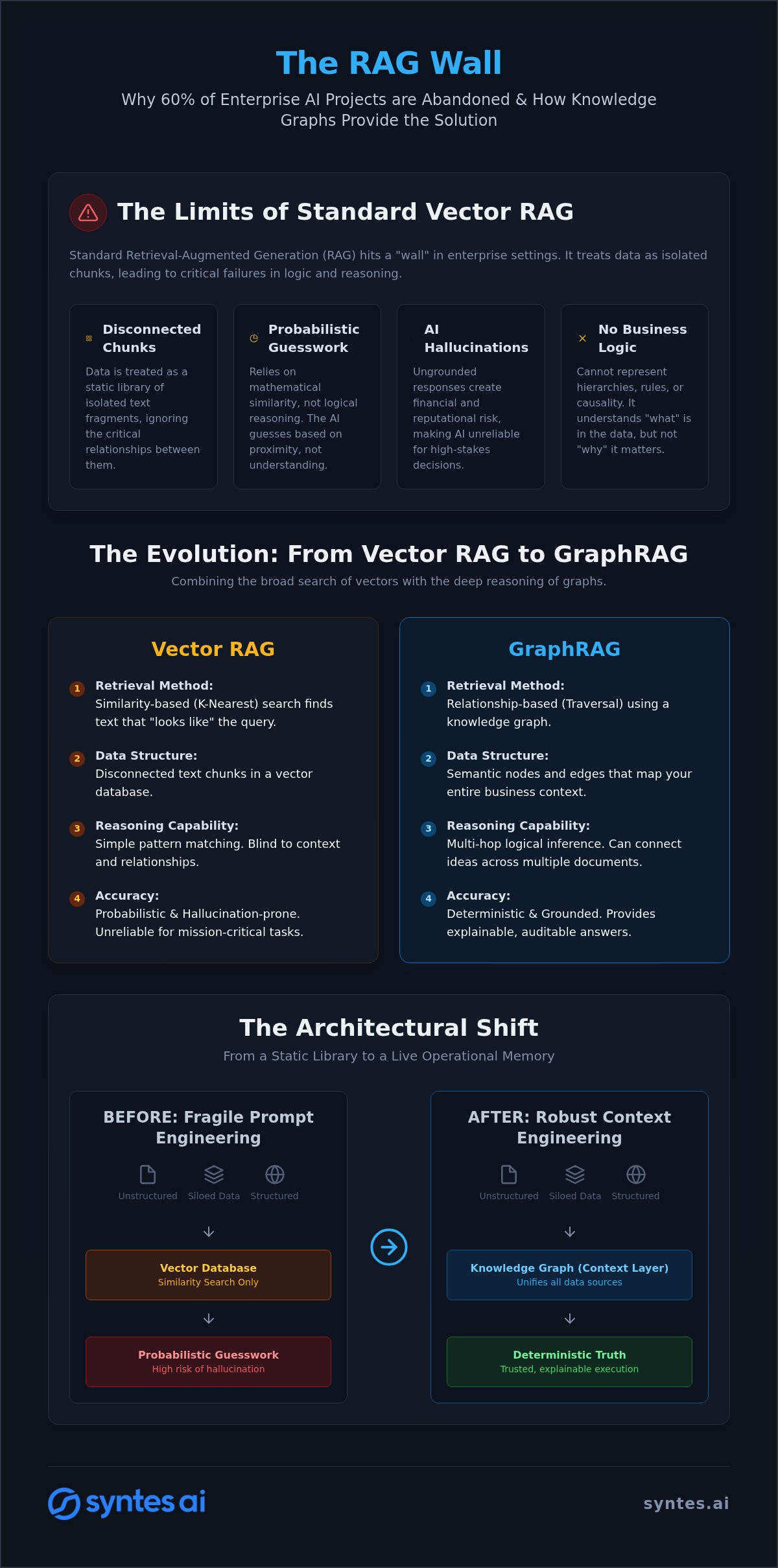
Standard Retrieval-Augmented Generation has reached its limit. While vector-based systems were a significant first step, they are now hitting the “RAG Wall.” This is the point where probabilistic retrieval fails to meet the demands of deterministic business logic. Most enterprise environments rely on vector databases that treat data as isolated chunks, ignoring the complex web of relationships that define a business. This structural flaw leads to “probabilistic guesswork.” When an AI system cannot logically connect a specific procurement policy to a vendor contract across multiple documents, it simply guesses based on proximity. Integrating a knowledge graph for RAG is the only way to move beyond this limitation and achieve the precision required for high-stakes operations.
The Limitations of Vector-Based Retrieval
Similarity search is not logical reasoning. Vector databases excel at finding text that “looks like” the query, but they are blind to the underlying architecture of your information. This leads to the “lost in the middle” phenomenon, where critical context buried within large document chunks is overlooked by the retrieval algorithm. Vectors represent mathematical proximity; they do not represent hierarchy, ownership, or causality. Vector databases cannot represent business rules or hierarchies because they lack the semantic structure to define how one entity influences another. By utilizing a Knowledge Graph, enterprises can map these connections explicitly, ensuring that the AI understands the “why” behind the data, not just the “what.”
The Cost of AI Hallucinations in Production
Hallucinations are more than just technical glitches. They are systemic liabilities that carry immense financial and reputational risks. In a production environment, a single ungrounded response can compromise a multi-million dollar decision or erode years of brand trust. To scale safely, decision-makers must understand how to prevent AI hallucination by architecting a “Ground Truth” layer. This layer must mirror real-world business entities, from product SKUs to organizational reporting lines. Without this deterministic foundation, AI remains a risky experiment rather than a reliable tool. Syntes AI views this as a fundamental context deficit. We believe AI is only as intelligent as the context it understands, and that context must be captured in a Live Operational Memory that evolves with your business. Shifting to a knowledge graph for RAG replaces fragile prompts with robust Context Engineering, providing the systemic integration necessary for trusted enterprise AI execution.
Architecting Truth: How Knowledge Graphs Provide Semantic Grounding
Vector-based retrieval offers fragments; GraphRAG provides a map. While standard RAG relies on the mathematical luck of similarity, a knowledge graph for RAG establishes a deterministic foundation by connecting entities, relationships, and attributes into a coherent whole. This architecture functions as a universal semantic layer. It unifies disparate data sources into a single source of truth, allowing AI systems to navigate complex information with surgical precision. By leveraging auditable graph traversals, organizations can finally achieve explainable AI, moving away from “black box” responses toward transparent, verifiable reasoning.
Vector RAG vs. GraphRAG: A Strategic Comparison
Why do hybrid approaches define the enterprise standard for 2026? Because they combine the broad search capabilities of vectors with the deep reasoning of graphs. The following table highlights the shift from probabilistic guesswork to deterministic intelligence.
| Feature | Vector RAG | GraphRAG |
|---|---|---|
| Retrieval Method | Similarity-based (K-Nearest) | Relationship-based (Traversal) |
| Data Structure | Disconnected text chunks | Semantic nodes and edges |
| Reasoning Capability | Pattern matching | Multi-hop logical inference |
| Accuracy | Probabilistic / Hallucination-prone | Deterministic / Grounded |
The Role of Context Engineering
Prompt engineering is a band-aid; Context Engineering is the cure. As outlined in The Executive Guide to Enterprise Knowledge Graphs, this discipline focuses on maintaining a robust business context layer rather than merely tweaking text inputs. Context Engineering ensures that every interaction is grounded in the current reality of your operations. It utilizes the Syntes Context Engineering Framework to transform raw data into actionable intelligence through five critical pillars:
- Connect: Ingest data from fragmented legacy systems and live streams.
- Understand: Identify entities and extract semantic meaning automatically.
- Contextualize: Map relationships to build a comprehensive Context Graph.
- Govern: Apply strict business rules and access controls to AI outputs.
- Execute: Trigger automated workflows based on trusted reasoning.
This systematic approach moves the organization beyond passive data storage toward a state of total operational clarity. If your current AI strategy lacks this depth, it’s time to explore how a Context Graph can ground your agents.
From Static Data to Live Operational Memory
A database is a passive repository. Live Operational Memory is a dynamic, execution-oriented asset. While traditional systems store records, an enterprise knowledge graph for RAG synthesizes them into a real-time intelligence engine. This shift is critical for moving beyond the limitations of static retrieval. By integrating structured data from ERP and CRM systems with unstructured knowledge found in PDFs and internal policies, organizations create a single, unified graph. This enables Operational Relationship Intelligence. It allows an AI agent to understand exactly how a specific customer relates to a product tier, a regional compliance rule, and a pending transaction simultaneously.
Continuous integration ensures this system remains relevant. Without it, your knowledge architecture quickly becomes a “data swamp” of outdated facts and conflicting logic. A knowledge graph for RAG must be fed by live streams to maintain its validity. This isn’t just about storage. It’s about maintaining a high-fidelity model of your business that evolves as fast as your operations do. When data is live, AI reasoning becomes deterministic rather than speculative. It transitions from a passive archive to an active participant in your business workflows.
Unifying Fragmented Enterprise Knowledge
Silos are the enemy of intelligence. Most organizations struggle with disconnected systems that prevent a unified “source of truth.” By solving enterprise data silos, businesses can establish the connectivity required for sophisticated AI performance. Two-way connectors bridge the gap between legacy environments and the AI data platform, ensuring that information flows seamlessly. This connectivity is the foundation for real-time decision-making. If your data is twenty-four hours old, your AI’s reasoning is already obsolete. True operational intelligence requires a system that reflects the current state of the enterprise at every moment.
Building the Enterprise Context Layer
The Syntes AI Context Graph serves as your organization’s collective memory. It moves beyond disconnected documents to provide a unified model of the entire business. This isn’t a mere search index. It is a sophisticated context layer that grounds every AI interaction in reality. Operational Context is the intersection of data and business logic. By maintaining this layer, you ensure that autonomous agents don’t just find information; they understand its significance within the broader corporate ecosystem. This systemic integration is what transforms a standard chatbot into a high-performance agentic system capable of trusted execution across the entire enterprise.
Implementing GraphRAG: A Strategic Framework for Enterprise AI
Scaling AI beyond a proof-of-concept requires more than just better prompts. It requires a methodology. Implementing a knowledge graph for RAG is a multi-stage strategic evolution that prioritizes systemic integration over isolated experiments. This framework moves the organization through a logical progression from raw data ingestion to governed, autonomous execution. By following a structured path, enterprises can ensure their AI systems are not only intelligent but also reliable and auditable.
The first stage is Data Connectivity. Connection is the primary hurdle. Without robust Cross-System Integrations to ingest data from fragmented legacy environments, your AI operates in a vacuum. Once connected, Semantic Discovery takes over. This process automatically identifies entities and hierarchies, transforming flat files into a multi-dimensional map of the business. Next comes Governance and Security. Applying granular permissions and business rules directly to the graph ensures that sensitive data is only accessible to authorized agents. Finally, Reasoning and Execution allow the system to move from passive retrieval to active performance, enabling agents to perform governed actions based on the relationships they uncover.
The Blueprint for a Governed Context Graph
Security cannot be an afterthought. It must be a foundational component of your data architecture. As detailed in The 2026 Guide to Enterprise AI Infrastructure, auditability must be baked into the graph from the start. This involves applying Master Data Management (MDM) principles to the AI data platform. By ensuring that every node in the knowledge graph for RAG has a verified owner and a clear lineage, you create a system that is transparent and ready for regulatory scrutiny. This level of systemic integration is what separates enterprise-grade solutions from fragile prototypes.
Optimizing for Agentic Workflows
Autonomous agents require a navigable environment. Structuring a graph for agentic navigation means defining clear paths and relationship types that an AI can follow to reach a logical conclusion. While agents can reason independently, Human-in-the-Loop systems remain essential for validating complex graph-based reasoning. These systems act as a final check, ensuring that the AI’s output aligns with high-level strategic goals. Business rules serve as the ultimate guardrails within the Knowledge Graph. They define the boundaries of what an agent can and cannot do, ensuring that execution remains within the limits of corporate policy and ethical standards.
Syntes AI: Orchestrating Agentic Intelligence with a Governed Context Graph
Syntes AI represents the final stage of the enterprise AI journey. It is the transition from theoretical experimentation to operational mastery. By integrating the Syntes Agentic Platform with a live Context Graph, organizations can finally orchestrate intelligence at scale. This isn’t about simple retrieval. It is about “Trusted AI Execution.” Standard systems provide answers; Syntes AI provides results. Every action taken by an agent is grounded in a deterministic knowledge graph for RAG, ensuring that reasoning is explainable, transparent, and fully auditable. This level of systemic integration is the only way to move from passive observation to active, automated performance.
The era of the passive chatbot is over. Businesses no longer need systems that merely talk; they need systems that perform. A unified context layer is the absolute prerequisite for scaling enterprise AI in 2026. Without it, agents remain blind to the shifting operational realities of the organization. Syntes AI provides the necessary infrastructure to unify fragmented data into a single, governed source of truth. We provide the tools to build a system that doesn’t just guess based on patterns but executes based on facts.
Empowering Autonomous Business Agents
Agents must reason across the entire technology stack. To be effective, an autonomous agent needs to pull context from an ERP, cross-reference it with a CRM, and execute a notification via Slack. This level of cross-system intelligence is only possible through Agentic AI Platforms that utilize a high-fidelity Context Graph. We are witnessing a fundamental shift from “Retrieval” to “Action” in enterprise workflows. In this new paradigm, the knowledge graph for RAG acts as the central nervous system, allowing agents to navigate complex workflows with the same nuance and logic as a human expert. It transforms disconnected data points into a coherent, actionable narrative.
The Future of Enterprise Intelligence
Syntes AI leads the industry as the pioneer of the Enterprise Context Layer. We’ve replaced fragile, probabilistic models with a robust, relationship-based intelligence architecture. This strategic shift is mandatory for any organization aiming for a long-term competitive advantage. Relationship-based intelligence ensures that your AI strategy remains resilient as data volumes explode and operational complexity increases. It’s time to stop experimenting with disconnected tools and start building a unified intelligence engine that understands the gravity of your business challenges. Success depends on moving beyond the “RAG Wall” into a state of total operational clarity.
Explore the Syntes AI Enterprise AI Platform
The Strategic Imperative for Context-Aware AI
The transition from probabilistic guesswork to deterministic truth is no longer optional. Standard retrieval systems have hit a wall, failing to provide the relationship-aware reasoning required for mission-critical operations. By implementing a knowledge graph for RAG, your organization establishes a high-fidelity Context Graph that eliminates hallucinations and provides the semantic grounding necessary for autonomous agents to execute with absolute certainty.
Trusted by Fortune 500 decision-makers, the Syntes AI platform transforms fragmented data silos into a unified Live Operational Memory. This architecture ensures that your AI agents don’t just find information; they understand the intricate web of business logic that drives your enterprise. It’s the shift from passive data storage toward active, governed intelligence that defines the next decade of competitive advantage. You possess the tools to bridge the gap between legacy complexity and agentic performance.
We look forward to helping you achieve total operational clarity and systemic integration.
Frequently Asked Questions
What is a knowledge graph for RAG?
A knowledge graph for RAG is a structured semantic layer that maps entities and their relationships to provide deterministic grounding for large language models. Unlike flat vector databases, it organizes enterprise data into nodes and edges, representing how customers, products, and business rules interact. This architecture transforms standard retrieval into relationship-aware intelligence, ensuring that AI responses are based on the actual structure of your business rather than probabilistic proximity.
How does GraphRAG differ from standard vector-based RAG?
Standard vector-based RAG differs from GraphRAG by relying on mathematical similarity between text chunks rather than explicit logical relationships. While vector search finds what looks similar, GraphRAG utilizes a knowledge graph to navigate interconnected data points. This enables multi-hop reasoning, allowing an AI to connect information across disparate documents or systems. It provides the precision required for complex enterprise queries that demand a structural understanding of your operational environment.
Why do LLMs hallucinate less when using a knowledge graph?
LLMs hallucinate less because a knowledge graph provides a deterministic ground truth layer that anchors the model’s output to verified facts. Instead of guessing the next word based on probabilistic patterns, the system retrieves specific, interconnected nodes from the graph. This semantic grounding ensures that the AI’s reasoning is anchored in actual business logic, effectively replacing guesswork with auditable, relationship-aware data that reflects your real-world operational reality.
Is a knowledge graph better than a vector database for enterprise AI?
Neither technology is strictly superior, but they serve distinct roles within a modern enterprise AI stack. Vector databases excel at broad similarity searches across unstructured text, while knowledge graphs are essential for logical reasoning and representing complex hierarchies. For most organizations, a hybrid approach is the standard. However, the knowledge graph is the critical component for achieving the explainability and deterministic execution that high-stakes business environments require.
What is Context Engineering in the context of RAG?
Context Engineering is the technical discipline of building, governing, and maintaining the specific business context required for AI systems to reason accurately. It moves beyond simple prompt engineering by focusing on the underlying data architecture. This process involves connecting fragmented systems into a unified Context Graph, ensuring that every AI interaction is grounded in a Live Operational Memory that reflects the current, real-time state of the organization’s knowledge.
How do AI agents use a knowledge graph to execute tasks?
AI agents use a knowledge graph as a navigational map to understand the dependencies and rules governing their tasks. By traversing the graph, an agent can identify which systems to access, which policies to follow, and how different entities are linked. This relationship-based intelligence allows agents to move from simple information retrieval to governed execution, performing complex workflows across ERP and CRM systems with total operational clarity.
Can I integrate my existing ERP data into a knowledge graph for RAG?
You can integrate existing ERP data into a knowledge graph for RAG using specialized two-way connectors that bridge legacy systems and the AI platform. This integration unifies structured transactional data with unstructured knowledge from documents and policies. By mapping ERP entities like SKUs, suppliers, and orders into the graph, you create a comprehensive enterprise memory. This ensures your AI reasoning is based on live, operational data rather than static archives.
What are the security benefits of using a governed context graph?
A governed context graph provides granular security by applying permissions and business rules directly to individual data nodes and relationships. This architecture ensures that AI agents only access information they are authorized to see. Unlike black-box systems, a governed graph offers full auditability, allowing stakeholders to trace the exact reasoning path an AI took to reach a conclusion. This approach incorporates Master Data Management principles to maintain data integrity across the enterprise.