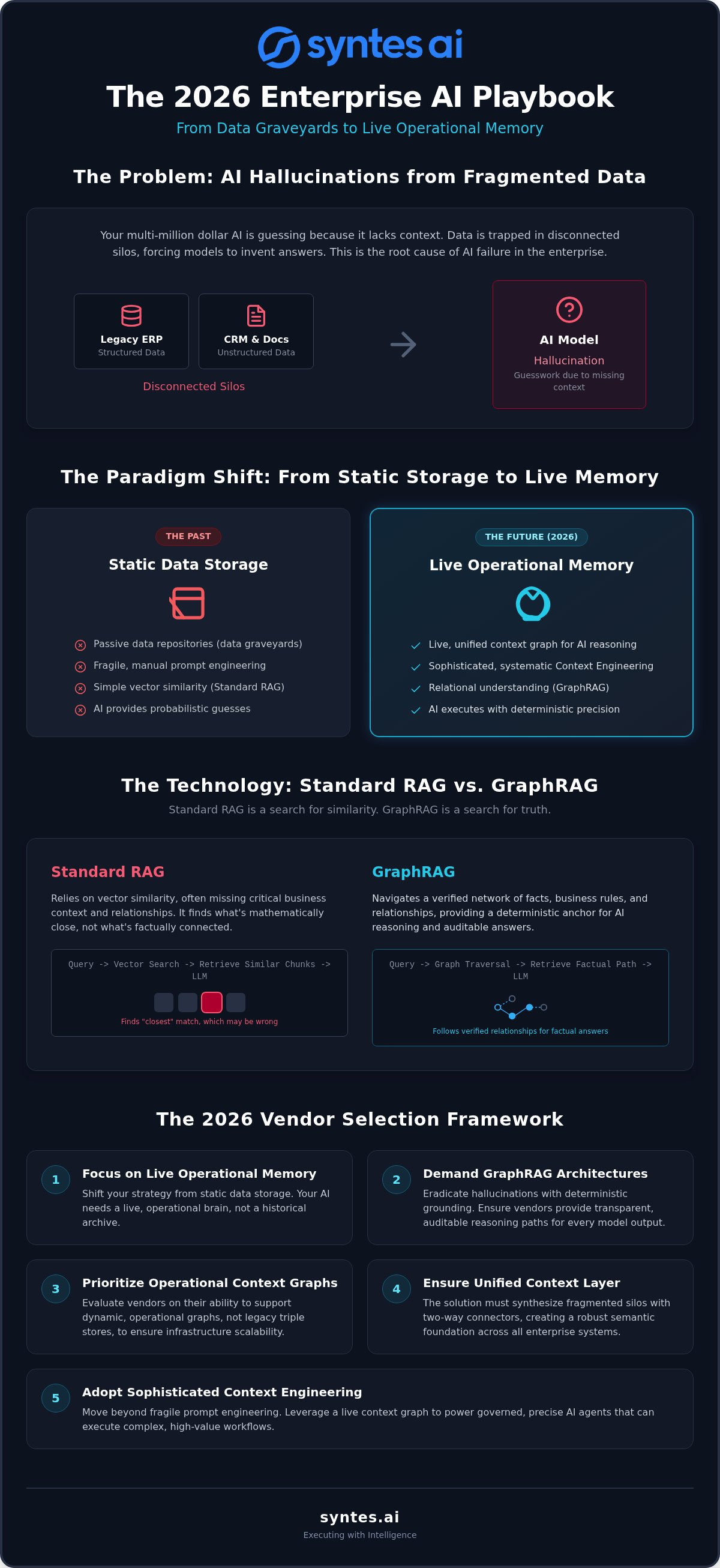
Why is your multi-million dollar AI investment still guessing when it should be executing? Most organizations treat their data like a graveyard of disconnected records buried in legacy ERP and CRM silos. This systemic fragmentation is the primary reason models hallucinate; it’s why your AI agents fail the moment they leave the controlled sandbox. When you evaluate enterprise knowledge graph vendors in 2026, you must stop looking for passive storage. You don’t have a model problem. You have a context problem.
Modern knowledge graph software has evolved into a live operational memory that serves as the authoritative ground truth for every automated decision. This guide explores how sophisticated context engineering moves beyond simple data retrieval to create the unified layer required for trusted, explainable AI reasoning. We will analyze the transition from basic RAG to high-performance GraphRAG architectures and provide the strategic roadmap for building a scalable infrastructure that supports complex agentic workflows across the global enterprise.
Key Takeaways
- Shift your strategic focus from static data storage to Live Operational Memory, the essential foundation for any high-functioning enterprise AI architecture.
- Eradicate AI hallucinations by implementing GraphRAG architectures that provide deterministic grounding and transparent, auditable reasoning paths for every model output.
- Evaluate enterprise knowledge graph vendors based on their ability to support operational context graphs rather than legacy triple stores to ensure infrastructure scalability.
- Synthesize fragmented data silos into a unified context layer by establishing two-way connectors across legacy systems, creating a robust semantic foundation.
- Transition from fragile prompt engineering to sophisticated Context Engineering, leveraging a live Context Graph to power governed AI agents that execute with precision.
Beyond Nodes and Edges: Defining Knowledge Graph Software in 2026
Is your AI actually reasoning, or is it just predicting the next token based on a partial picture? The answer lies in the context layer. Most enterprise knowledge graph vendors still market their solutions as passive repositories for interrelated data. This is a fundamental misunderstanding of the 2026 landscape. Knowledge graph software has evolved into a system that unifies disparate data into a structured, semantic layer, acting as the nervous system for the modern organization. It is no longer about storing nodes and edges; it is about creating a Live Operational Memory. This shift represents the transition from fragmented data silos to a unified intelligence that understands the “why” behind your business operations.
The Evolution of Enterprise Memory
LLMs are computationally brilliant but contextually illiterate. They require a steering wheel. Traditional RAG architectures are currently hitting a performance ceiling because they rely on simple vector similarity, which lacks the nuance of business logic. A Knowledge Graph provides the missing link by mapping the complex web of proprietary enterprise data into a format AI can actually understand. This shift introduces Operational Relationship Intelligence, a framework where data isn’t just retrieved; it’s understood within the specific gravity of your business rules. Consumer-grade chatbots operate on generalities. Enterprise-grade context layers operate on truth. By integrating structured ERP data with unstructured CRM notes, you create a foundation where AI can justify its reasoning through auditable, deterministic paths.
Why 2026 is the Year of the Context Graph
The era of passive search is over. Enterprise leaders are demanding active, agentic execution. Fragmented data remains the single greatest bottleneck for AI ROI, preventing models from moving beyond simple chat interfaces into high-value, automated workflows. This is why Context Engineering has emerged as the critical discipline for 2026. It moves beyond the limitations of fragile prompt engineering to maintain a unified, real-time intelligence layer. A Context Graph is a live, evolving model of business logic that enables AI agents to navigate the messy realities of large-scale operations with total clarity. The enterprise knowledge graph vendors that will win this decade are those that treat data as a dynamic stream rather than a static lake. They provide the infrastructure for agents to not only know your business but to execute within it with surgical precision.
Architecting the Ground Truth: How Knowledge Graphs Eliminate AI Hallucinations
Hallucinations aren’t a bug of Large Language Models; they’re a symptom of data homelessness. When an AI model lacks a structural map of the truth, it resorts to statistical guesswork to fill the gaps. This is where enterprise knowledge graph vendors differentiate themselves. By implementing GraphRAG (Graph-based Retrieval-Augmented Generation), organizations provide a deterministic anchor for AI reasoning. Instead of the model simply predicting the next most likely word, it navigates a verified network of facts, relationships, and business rules. This architecture ensures that every response is grounded in the actual reality of your enterprise operations rather than the generalities of its training data.
The core challenge for the modern enterprise is the persistent divide between structured SQL databases and the vast sea of unstructured documents. Traditional systems fail to bridge this gap, leaving AI models to hallucinate connections that don’t exist. Sophisticated knowledge graph software unifies these disparate sources into a single, semantic layer. It treats a line in a spreadsheet and a paragraph in a contract as interconnected entities. This unification allows for a level of precision that black-box AI simply cannot replicate. To see how this architecture translates into operational certainty, you can schedule a personalized walkthrough of the platform.
GraphRAG vs. Standard RAG
Standard RAG is a search for similarity. GraphRAG is a search for truth. Vector-only retrieval relies on mathematical proximity, which often misses the critical relational context needed for complex enterprise queries. If an AI doesn’t understand the hierarchy of your product lines or the dependencies in your supply chain, it will fail. Graph structures enable the AI to follow specific edges between nodes, allowing it to grasp complex organizational structures and multi-hop relationships. As organizations evaluate the next generation of enterprise graph technology, the focus has shifted from simple data ingestion to the enforcement of business logic at the retrieval level. Semantic grounding transforms the AI from a creative writer into a reliable analyst.
Governance and Explainable AI
Trust is built on transparency. In a regulated enterprise environment, “because the AI said so” is an unacceptable justification for a business decision. Knowledge graphs solve the “black box” problem by providing auditable reasoning chains. Every conclusion drawn by the system can be traced back through the graph to its source data, creating a transparent lineage of logic. This deterministic grounding is the only viable path for those learning how to prevent ai hallucination in high-stakes environments. By applying business rules and governance policies directly to the data layer, you ensure that your AI agents operate within the precise guardrails of your corporate policy. You move from hopeful experimentation to governed execution.
The 2026 Selection Framework: Evaluating Knowledge Graph Solutions
The market is saturated with legacy players masquerading as AI-ready innovators. Choosing between enterprise knowledge graph vendors in 2026 requires looking past cloud provider logos and focusing on the underlying engine’s ability to facilitate reasoning. You aren’t just buying a database; you’re selecting the foundational intelligence layer for your entire agentic strategy. While property graphs offer flexibility and RDF triple stores provide rigid semantic standards, the modern requirement has shifted toward the Operational Context Graph. This new category prioritizes real-time business logic over static data storage, ensuring that your AI doesn’t just “know” data but understands how to act upon it within your specific operational constraints.
The build versus buy dilemma has reached a tipping point. Attempting to stitch together open-source graph databases with custom middleware often results in a fragile, high-maintenance mess that lacks the necessary security and governance for production AI. Sophisticated vendors now offer out-of-the-box two-way connectors that ensure real-time synchronization between your graph and your core systems. This connectivity is the heartbeat of a Enterprise Knowledge Graph, preventing the “stale data” problem that plagues traditional RAG implementations. If your graph isn’t as live as your business, it’s already obsolete.
Technical Criteria for the Modern Stack
Scalability is non-negotiable. Your software must manage billions of entities and trillions of relationships without a whisper of performance degradation. In 2026, integration is no longer just about ingestion; it’s about orchestration. The platform must natively support agentic workflows, providing the hooks and triggers required for AI agents to navigate the graph autonomously. You should demand a system that bridges the gap between your ERP, CRM, and cloud applications seamlessly. For organizations utilizing monday.com for these workflows, Meta Lean provides the specialized automation and management solutions required to maintain a high-performance operational environment. If the integration requires months of custom coding, it isn’t an enterprise solution; it’s a liability.
Operational Context Readiness
Stop confusing a database with a platform. The primary differentiator in 2026 is the shift from simple storage to a comprehensive environment for enterprise ai infrastructure. This requires No-Code tools that empower domain experts to map business logic without a Ph.D. in graph theory. Security must be granular, operating at the node and edge level to ensure that sensitive data remains protected even as AI agents traverse the network. When evaluating enterprise knowledge graph vendors, look for those that treat governance not as an afterthought, but as a core architectural component. A platform that can’t enforce your permissions is a platform that can’t be trusted with your AI.
From Silos to Synthesis: Implementing a Live Operational Memory
The implementation of a live operational memory is not a one-time migration; it is a continuous synthesis of enterprise reality. Most enterprise knowledge graph vendors provide tools for data ingestion but stop short of the operational logic required for execution. This gap creates a “data lake” in graph form, which remains just as passive as the silos it intended to replace. True synthesis requires a transition from static storage to a dynamic context layer that lives and breathes alongside your business operations. By following a structured implementation path, organizations can transform fragmented records into a high-fidelity map of corporate intelligence.
Bridging the Gap Between ERP and AI
Legacy systems were never designed for AI. They were built for record-keeping, creating deep-seated silos that stifle innovation. While some enterprise knowledge graph vendors suggest a simple move from conceptual to physical models, they often ignore the brutal complexity of solving enterprise data silos across disparate legacy environments. Context Engineering bridges this gap by mapping proprietary business logic directly onto the data stream. It ensures that real-time updates from your ERP or CRM are reflected immediately in the graph, providing a foundation where AI models aren’t just guessing based on old data but are operating on the current state of the business.
The Five Pillars of Context Engineering
Success in the 2026 AI stack requires a commitment to the five pillars: Connect, Understand, Contextualize, Govern, and Execute. Execution is the ultimate goal of any enterprise knowledge graph; without it, you simply have a more expensive way to view your data. This framework ensures that data isn’t just stored, but is actively utilized to drive business outcomes.
- Connect: Deploy two-way connectors to bridge structured SQL and unstructured document data.
- Understand: Discover hidden entities and relationships to build a semantic foundation.
- Contextualize: Transform raw data into a dynamic enterprise model reflecting business logic.
- Govern: Apply security, permissions, and business rules at the node level.
- Execute: Deploy AI agents over the trusted context layer for autonomous workflows.
The process begins with the seamless ingestion of raw telemetry and records, followed by automated entity discovery and semantic contextualization, which eventually culminates in the deployment of governed AI agents capable of autonomous, trusted execution.
Executing with Intelligence: The Syntes AI Approach to Agentic Context
Data without execution is overhead. While most enterprise knowledge graph vendors focus on the aesthetics of data visualization, Syntes AI focuses on the utility of automated performance. The Syntes AI Enterprise AI Platform represents the necessary evolution of knowledge graph software, moving beyond the storage of facts to the engineering of context. We’ve identified a systemic flaw in the market: the belief that a database alone can drive intelligence. It can’t. You don’t need a passive map of your data; you need a motor that can navigate it. Our platform provides that motor, transforming your information from a static asset into a live operational force.
The Syntes AI Context Graph serves as the definitive ground truth for the modern enterprise. It isn’t a graveyard for records; it’s a Live Operational Memory that evolves with every transaction and interaction. By powering the Syntes Agentic Platform with this real-time context, we enable a shift from fragile, chat-based interfaces to governed AI agents that execute complex operational tasks. These agents don’t just answer questions; they solve problems. They operate with a level of precision that makes traditional RAG implementations look like primitive experiments. If you’re still relying on simple prompt engineering, you’re already behind the curve.
The Syntes Agentic Platform
Fragmented intelligence is no intelligence at all. The Syntes Agentic Platform allows agents to use the Context Graph as their primary nervous system, enabling autonomous collaboration across departments with a shared context layer. When an agent in procurement understands the real-time constraints of the supply chain, efficiency ceases to be a goal and becomes a baseline. This shared intelligence eliminates the friction of manual handoffs and ensures that every automated action is consistent with your broader business logic. For those seeking a deeper technical breakdown, our guide on agentic ai platforms provides the definitive roadmap for autonomous intelligence.
Trusted Execution at Scale
Intelligence is a function of context. Syntes AI prioritizes Context Engineering as the primary driver of enterprise AI because we know that a model is only as reliable as the data it can reason over. By establishing a unified semantic data layer for enterprise operations, we provide the architectural certainty required for agentic workflows at scale. You can’t scale what you can’t govern. Our platform ensures that every reasoning path is auditable and every action is deterministic. We don’t just offer a tool; we offer the infrastructure for a self-correcting, intelligent organization that moves faster than the competition.
Mastering the Evolution from Data Storage to Agentic Execution
Context is not a luxury. It’s the fuel for every automated decision your business will ever make. The transition from passive data storage to a Live Operational Memory is the only viable path for achieving trusted enterprise AI. By unifying disparate data silos into a structured, semantic layer, you provide the deterministic foundation required for AI models to reason with surgical precision and total governance.
The choice between enterprise knowledge graph vendors is no longer a technical preference; it’s a strategic mandate. Syntes AI stands as the pioneer of the Context Engineering Framework, offering the only platform designed to bridge the gap between legacy systems and autonomous agentic workflows. We provide seamless integration across structured and unstructured data silos, ensuring your AI agents operate with a comprehensive understanding of your business logic.
The era of fragmented data and AI hallucinations is over. It’s time to build the intelligent infrastructure your enterprise deserves.
Frequently Asked Questions
What is the difference between a graph database and knowledge graph software?
A graph database is a storage engine; knowledge graph software is a semantic intelligence layer. While databases focus on the technical storage of nodes and edges, knowledge graph software applies a sophisticated ontology to unify disparate data into a coherent business model. It’s the difference between a bucket of parts and a functioning machine. The software provides the logic, reasoning capabilities, and integration framework that a bare database lacks.
How does knowledge graph software help prevent AI hallucinations?
It provides deterministic grounding by replacing statistical guesswork with verified facts. Hallucinations occur when LLMs lack proprietary context and resort to predicting the next most likely token. Knowledge graph software maps your enterprise reality, forcing the model to traverse specific, auditable reasoning paths. This ensures every output is anchored in the actual state of your business rather than the generalities of the model’s training data.
Can knowledge graph software integrate with existing ERP and CRM systems?
Yes, it must integrate via two-way connectors to maintain real-time operational relevance. Top enterprise knowledge graph vendors prioritize seamless connectivity with legacy systems like SAP, Oracle, and Salesforce. This ensures the graph isn’t a static snapshot but a live reflection of your current business state. Without this connectivity, your AI is operating on stale information, which defeats the purpose of an operational context layer.
What is GraphRAG and why is it important for enterprise AI?
GraphRAG is a retrieval architecture that combines knowledge graphs with large language models to provide deep relational context. Standard RAG relies on vector similarity, which often misses complex hierarchies and dependencies. GraphRAG allows AI to understand multi-hop relationships and organizational structures. It’s the only way to ensure that your AI understands the “why” behind a data point, leading to more accurate and reliable reasoning.
How much data is required to start building an enterprise knowledge graph?
You don’t need a massive data lake to begin; you need high-impact data silos. Start with a specific operational problem, such as supply chain visibility or customer 360. As you connect your first few systems, the graph grows organically. The value increases with every new entity and relationship discovered. Most enterprise knowledge graph vendors recommend an iterative approach that focuses on immediate utility rather than total data ingestion.
Is knowledge graph software compatible with LLMs like GPT-4 or Claude?
Yes, it acts as the authoritative context layer for these models via API integrations. The graph doesn’t replace the LLM; it steers it. By providing a structured semantic foundation, you enable models like GPT-4 to produce results that are grounded in your specific business rules. This compatibility is what allows general-purpose models to function effectively within the high-stakes environment of a global enterprise.
What are the security and governance implications of using a knowledge graph?
Security is enforced at the node and edge level, ensuring granular control over sensitive data. Unlike black-box AI systems, a knowledge graph provides a transparent audit trail of every reasoning path. This allows you to apply corporate policies and regulatory requirements directly to the data layer. You gain total visibility into how your AI reaches its conclusions, ensuring that agents never exceed their authorized permissions.
How do AI agents use a knowledge graph to execute business processes?
Agents use the graph as a Live Operational Memory to navigate business logic and identify dependencies. Instead of just generating text, agents query the graph to understand the current state of operations. This allows them to execute tasks, like processing an order or flagging a compliance risk, with total situational awareness. The graph provides the map; the agents provide the movement, resulting in autonomous, trusted execution.