
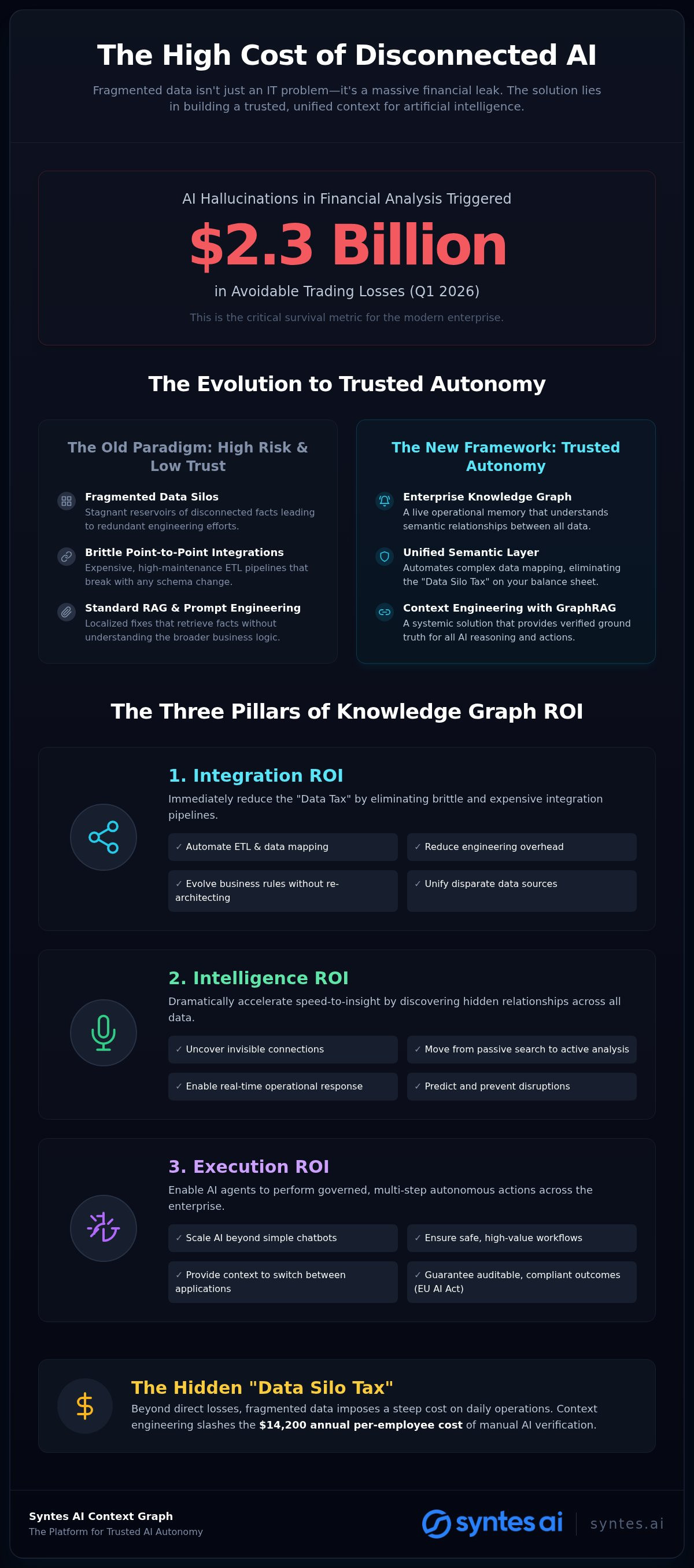
In the first quarter of 2026, AI hallucinations in financial analysis tools triggered $2.3 billion in avoidable trading losses. This isn’t just a technical glitch. It’s a massive, unmanaged financial leak. For the modern enterprise, calculating knowledge graph roi has shifted from a speculative R&D project to a critical survival metric. You already know that your current AI initiatives are hitting a structural wall. Fragmented data silos and the unsustainable maintenance costs of point-to-point integrations are stalling your progress while exposing you to significant operational risk.
This article provides the definitive framework to quantify the multi-dimensional value of Enterprise Knowledge Graphs. You’ll discover how context engineering slashes the $14,200 annual per-employee cost of AI verification while enabling autonomous agentic workflows. We’ll examine the transition from passive data storage to a live operational memory. This shift ensures your AI outcomes are trusted, auditable, and compliant with the strict transparency mandates of the EU AI Act. It’s time to move beyond theoretical experimentation and demand total operational clarity.
Key Takeaways
- Define value through relationship intelligence by transitioning from passive search tools to systems capable of trusted, autonomous execution.
- Eliminate the “Data Silo Tax” and reduce engineering overhead by implementing a semantic layer that automates complex ETL and data mapping processes.
- Quantify your knowledge graph roi by calculating the direct reduction in AI hallucination costs and the operational precision gained through GraphRAG.
- Scale agentic AI beyond simple chat interfaces into high-value autonomous workflows by providing the cross-system context required for multi-step execution.
- Accelerate your time-to-value (TTV) by adopting a unified context engineering platform rather than maintaining fragmented, point-to-point integrations.
The Strategic Framework for Knowledge Graph ROI in 2026
Data lakes have failed. They’ve become stagnant reservoirs of disconnected facts that require constant, manual intervention to yield value. In 2026, the enterprise doesn’t need more storage. It needs operational relationship intelligence. The true knowledge graph roi is no longer measured by how quickly you can find a document. It’s measured by how effectively your systems can execute autonomous workflows without human oversight. We’re shifting from passive observation to active, automated performance.
To achieve this, the infrastructure must evolve. A knowledge graph provides the essential structural foundation for this evolution. It allows machines to reason across disparate datasets by understanding the semantic relationships between entities. This is the difference between a static database and a live operational memory. One stores information; the other understands it. Why is 2026 the tipping point? The cost of AI failure, driven by hallucinations and disconnected logic, now far outweighs the price of building the necessary infrastructure.
Context Engineering: The Next Evolution of ROI
Prompt engineering has reached a point of diminishing returns. It’s a localized fix for a systemic problem. Standard Retrieval-Augmented Generation (RAG) often fails because it retrieves fragments without understanding the broader business logic. Context engineering is the necessary successor. It’s the technical discipline of maintaining a verified ground truth for AI reasoning. Isolated facts are expensive to maintain and risky to use. Interconnected business logic creates a compound knowledge graph roi by ensuring every AI interaction is grounded in reality.
The Three Pillars of Graph Value
Understanding the financial case requires looking at three distinct value drivers:
- Integration ROI: This is the immediate reduction of the “Data Tax.” Traditional point-to-point integrations are brittle and expensive. A semantic layer eliminates the need for manual mapping and complex ETL pipelines.
- Intelligence ROI: This focuses on speed to insight. It’s the ability to discover hidden relationships across silos that would otherwise remain invisible to human analysts or standard relational databases.
- Execution ROI: This is the ultimate value driver. It enables AI agents to perform governed, multi-step actions across the enterprise. Without a graph, agents lack the context to switch between disconnected applications safely.
Quantifying the Integration Dividend: Eliminating Data Silos
Data silos aren’t just an IT inconvenience. They’re a direct tax on your balance sheet. In large organizations, fragmented data leads to redundant engineering efforts, inconsistent reporting, and missed opportunities. Traditional ERP and CRM systems act as isolated vaults. They store records but fail to communicate the context between them. This is where knowledge graph roi begins to manifest. By creating a unified semantic layer, you stop paying the “Data Silo Tax” and start leveraging relationship intelligence as a force multiplier for your existing technology investments.
Reducing Technical Debt and ETL Costs
Traditional data integration relies on brittle ETL pipelines. These pipelines require constant manual mapping and break the moment a schema changes. A Context Graph utilizes a “Schema-on-Read” approach. This provides the flexibility to evolve business rules without re-architecting the entire database. Organizations can significantly reduce manual data mapping hours, redirecting expensive engineering talent toward higher-value initiatives. Effectively solving enterprise data silos transforms your data from a stagnant asset into a fluid, actionable resource that directly accelerates your bottom line.
Operational Efficiency through Relationship Intelligence
Batch processing is a relic of the past. A Live Operational Memory provides real-time connectivity, allowing your AI infrastructure to respond to changes as they happen. Consider the supply chain. By mapping the intricate links between suppliers, products, and customers, you can predict and prevent disruptions before they impact the P&L. This level of precision is only possible when you “Connect” and “Understand” your data through the Syntes framework. This methodology ensures that every node in your network contributes to a coherent operational picture.
As you look to improve your Return on AI Investments, the ability to onboard new systems into your AI architecture in days rather than months becomes a primary competitive advantage. Fast onboarding reduces time-to-value and ensures your AI remains relevant in a volatile market. If you’re ready to see how this architecture functions in a live environment, you can book a demo to explore our enterprise platform and begin your transition to an agentic future.
The Reliability Dividend: Reducing the Cost of AI Hallucinations
AI trust is not a “soft” metric. It is a hard financial boundary. In 2024, AI hallucinations resulted in global business losses of $67.4 billion. These aren’t just technical errors. They’re legal liabilities and operational failures. When a Large Language Model generates a probabilistic guess instead of a deterministic fact, the enterprise pays the price in litigation, lost customers, and wasted labor. Calculating knowledge graph roi requires a cold-eyed look at the cost of being wrong. Data is noise. Context is signal. A system that cannot explain its reasoning is a system that cannot be trusted with your balance sheet.
Deterministic Truth vs. Probabilistic Guesses
Probabilistic models are inherently unreliable for high-stakes execution. While standard Vector RAG might find relevant text fragments, it lacks the semantic map required to understand the underlying business logic. GraphRAG changes the equation. By grounding AI agents in a Context Graph, you provide a structural foundation that enforces truth. Effectively preventing AI hallucination saves millions in operational rework and eliminates the need for constant human oversight. Currently, employees spend an average of 4.3 hours per week verifying AI outputs. This verification tax costs organizations approximately $14,200 per employee annually. A Live Operational Memory reduces this overhead by ensuring the AI never reasons with outdated or disconnected information. It provides a single, verifiable source of truth that updates in real-time.
AI Governance and Compliance ROI
The regulatory landscape has shifted permanently. As of August 2, 2026, the high-risk obligations of the EU AI Act have begun to apply. Domestically, the Illinois Artificial Intelligence Safety Measures Act, enacted on July 6, 2026, and California’s CCPA regulations demand unprecedented transparency and risk management. Non-compliance is no longer an option. A governed context layer automates policy enforcement, providing the Explainable AI (XAI) required for high-stakes industries like healthcare and finance. The “Govern” pillar of context engineering isn’t just about security; it’s about auditability. It allows you to trace every AI decision back to a verified data node. This transparency builds the trust necessary for knowledge graph roi to scale from isolated pilot projects to enterprise-wide autonomous performance. By automating compliance, you don’t just avoid penalties. You create a foundation for safe, scalable innovation.
Agentic ROI: Scaling Autonomous Workflows
Chatbots are a distraction. They provide answers but fail to solve problems. In 2026, the focus has shifted from “Generative AI” to “Agentic AI,” where the primary value driver is autonomous execution. Real knowledge graph roi is generated when AI agents move beyond simple retrieval to performing multi-step business logic across disconnected systems. Without a structural foundation, these agents are context-blind. They fail the moment they encounter a data silo or an ambiguous business rule. To scale, an agent requires more than a prompt; it requires a brain.
How do you measure the value of an agent that actually works? You look at throughput and labor-saving orchestration. Research indicates that most autonomous workflow projects achieve an average 200% ROI in their first year. This isn’t magic. It’s the result of eliminating the high cost of manual process management. By leveraging agentic AI platforms grounded in a context graph, enterprises can deploy agents that reason over trusted data to execute governed actions in supply chain, retail, and finance.
From Retrieval to Execution
The “Execute” pillar of context engineering is where theoretical capability becomes operational reality. In a typical retail environment, an agent might identify a stock shortage, cross-reference supplier lead times, and initiate a purchase order autonomously. This level of orchestration requires a deep understanding of relationships between entities. Manual intervention in these workflows is a hidden drain on resources. When agents can navigate these paths independently, the knowledge graph roi scales exponentially across every business unit they touch. You aren’t just saving time; you’re increasing the velocity of your entire operation.
The ROI of Enterprise Memory
Efficiency in 2026 is often a matter of token management. Passing massive, unstructured text blocks into a Large Language Model’s context window is prohibitively expensive and technically inefficient. A context graph allows for “precision retrieval,” where only the relevant sub-graph is provided to the agent. This reduces the context window cost while improving reasoning accuracy. Furthermore, a Live Operational Memory enables continuous learning. As your agents interact with your systems, the graph captures that experience, turning every execution into a proprietary asset. This creates a competitive moat that cannot be replicated by competitors using generic, off-the-shelf models. Your context is your capital.
Maximizing ROI with the Syntes AI Context Graph
Execution is the only metric that matters. Many enterprises treat a knowledge graph as a glorified database or a complex storage solution. This is a strategic error. The Syntes AI Context Graph is a platform designed for context engineering, not just data persistence. It functions as a live operational memory that unifies structured and unstructured data into a single, coherent model. To realize a definitive knowledge graph roi, you must move beyond the collection of facts and toward the orchestration of intelligence. The roadmap to success begins by establishing an enterprise knowledge graph as your foundational infrastructure.
Accelerating Time-to-Value
The “Build vs. Buy” debate often ignores the hidden cost of delay. Building a custom graph infrastructure from scratch typically leads to multi-year development cycles and fragmented results. Syntes AI bypasses these bottlenecks. Our two-way connectors reduce implementation timelines by months, allowing you to synchronize data across disparate systems in real time. This immediate connectivity transforms your data from a stagnant asset into a fluid operational resource. By utilizing a no-code AI app layer, business units can deploy specialized intelligence tools rapidly without placing an additional burden on IT departments. The Syntes Agentic Platform integrates seamlessly with your existing technology stacks to protect legacy ROI while enabling the transition to autonomous performance.
Speed is a competitive advantage. When you reduce the time required to “Connect” and “Understand” your data, you accelerate the “Execute” phase of the framework. This rapid deployment capability ensures that your knowledge graph roi is measured in weeks, not years. You don’t have to wait for a total digital transformation to see results. You can start with a single high-value business unit and scale horizontally as the graph matures. This modular approach minimizes risk while maximizing immediate financial impact.
The Future of Enterprise Intelligence
Business Intelligence (BI) is no longer sufficient. BI is retrospective; it tells you what happened yesterday. We are entering the era of Enterprise Intelligence (EI). EI is active and predictive. It uses the relationship intelligence stored within your graph to execute what should happen next. This shift represents the long-term ROI of a continuously evolving business model. As your graph grows, it becomes more than a tool. It becomes a proprietary asset that powers every decision and every autonomous agent in your organization. If you are ready to move beyond passive observation, it is time to act. Experience the power of the Syntes AI Context Graph and redefine the boundaries of what your enterprise can achieve.
The Mandate for Operational Clarity in 2026
The era of speculative AI experimentation is over. Enterprise leaders now require a deterministic foundation that translates fragmented data into actionable intelligence. By implementing a Live Operational Memory, you eliminate the “Data Silo Tax” and drastically reduce the high cost of manual AI verification. Realizing a positive knowledge graph roi isn’t about better search; it’s about building the infrastructure for autonomous, agentic execution.
It’s time to stop observing your data and start executing with total certainty.
Frequently Asked Questions
How do I measure the ‘hard’ ROI of a Knowledge Graph implementation?
Hard ROI is measured by the direct reduction in data engineering hours and the elimination of the “Data Silo Tax.” You must quantify the delta between fragmented manual data mapping and automated relationship intelligence. Monitor the decrease in labor costs associated with AI output verification and the acceleration of process velocity. These metrics provide a clear financial justification for shifting from passive storage to active execution.
Can a Knowledge Graph replace our existing Data Warehouse or Data Lake?
A Knowledge Graph doesn’t replace your storage layer; it evolves it. While warehouses and lakes store raw facts in isolation, a Context Graph provides the semantic layer required to turn those facts into a Live Operational Memory. It acts as the reasoning engine that connects disparate data points across your existing infrastructure. Think of it as the brain that coordinates your organization’s various data organs.
What is the typical time-to-value for an Enterprise Context Graph?
High-value automation projects typically see a return on investment within 60 to 120 days. This rapid timeline is achieved by focusing on specific, high-stakes workflows rather than attempting a total data overhaul. Using a unified platform like Syntes AI accelerates this process through pre-built connectors. The goal is to move from initial data connection to autonomous execution in weeks, not years of custom development.
How does a Knowledge Graph reduce the total cost of ownership (TCO) for AI?
It slashes the TCO by reducing the labor-intensive requirements of manual data cleaning and complex prompt engineering. By providing a verified ground truth, the graph minimizes the need for expensive “Human-in-the-Loop” verification processes. Additionally, precision retrieval reduces token consumption in Large Language Models. This efficiency prevents redundant model training and ensures your AI infrastructure remains lean, scalable, and financially sustainable over the long term.
What is the ROI difference between standard RAG and GraphRAG?
The primary knowledge graph roi in this comparison is the transition from probabilistic guesses to deterministic truth. Standard RAG retrieves disconnected text fragments, often leading to hallucinations that require costly remediation. GraphRAG retrieves interconnected context and business logic. This precision leads to a 90% reduction in errors, ensuring that your AI outcomes are trusted, auditable, and ready for high-stakes enterprise execution without constant oversight.
Do we need a massive data engineering team to maintain a Context Graph?
How does a Knowledge Graph impact the ROI of our Agentic AI initiatives?
It serves as the essential memory and reasoning engine that agents require to scale. Without a graph, AI agents suffer from context-switching failures when moving between disconnected applications. A graph provides the cross-system visibility needed for agents to execute multi-step workflows autonomously. This capability transforms agents from simple chat interfaces into high-value workers that generate ROI through the independent execution of complex business processes.
Is the ROI higher for specific industries like Manufacturing or Finance?
ROI is exceptionally high in sectors with complex supply chains or strict regulatory mandates. In finance, the graph prevents trading losses by grounding analysis in real-time fact networks. In manufacturing, it optimizes supplier-product links to prevent operational disruptions. Any industry where the cost of an AI error is high or where data relationships are complex will see a faster, more significant return on their investment.