
Your custom knowledge graph project is likely failing before the first line of code is even written. While 78% of enterprise teams plan to build more custom software in 2026, the reality is that fragmented data silos and a lack of business context continue to derail internal initiatives. You recognize the stakes. Without a reliable semantic foundation, your AI agents remain untethered, generating hallucinations that compromise decision-making and erode trust. The build vs buy enterprise knowledge graph decision is no longer about mere procurement; it is a strategic choice between owning a static data structure or implementing a live, governed Context Engineering framework.
Key Takeaways
- Analyze the strategic build vs buy enterprise knowledge graph decision as the foundational architectural pivot for achieving ground truth in autonomous AI systems.
- Expose the hidden operational risks and maintenance overhead associated with custom context engineering and the manual integration of fragmented data silos.
- Discover how Live Operational Memory serves as a superior, real-time alternative to static graph structures, drastically accelerating time-to-market for enterprise AI initiatives.
- Utilize a definitive 5-point readiness framework to evaluate your organization’s technical maturity and determine if a custom build is a strategic asset or a systemic liability.
- Transition from passive data observation to active execution by deploying a governed agentic framework that ensures AI reliability through deep business context.
The Strategic Calculus: Why Build vs. Buy Matters for Enterprise AI in 2026
The enterprise knowledge graph is the only path to achieving ground truth in an era of autonomous intelligence. It is not merely a database; it is a semantic map of your business logic, relationships, and operational intent. For CTOs, the build vs buy enterprise knowledge graph decision has moved beyond technical preference. It is now a high-stakes C-suite priority that dictates the scalability of your entire AI strategy. A modern knowledge graph acts as the cognitive nervous system, ensuring that AI agents operate within a governed, accurate context rather than hallucinating in a vacuum.
We are witnessing a fundamental shift from static data retrieval to agentic ai platforms that execute complex workflows. These platforms require more than just raw data; they demand structured context. This requirement has birthed a new discipline: Context Engineering. It is the primary differentiator in 2026. If your data lacks the relational depth to support reasoning, your AI initiatives will inevitably stall at the pilot phase. You don’t just need data; you need a system that understands what that data means in the context of your specific business goals.
From RAG to Context Graphs: The Evolving Requirement
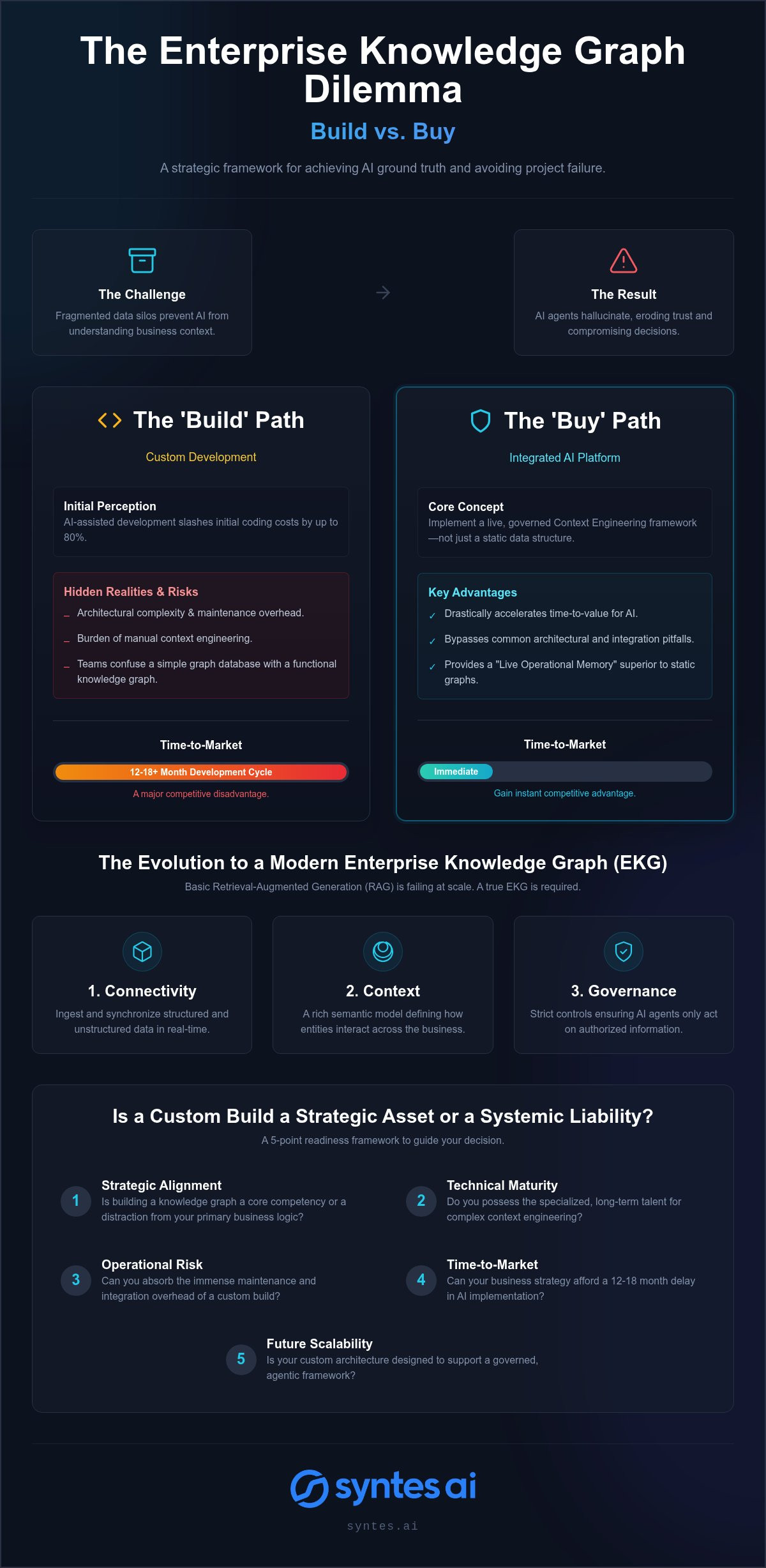
Basic Retrieval-Augmented Generation (RAG) is failing at scale. While vector databases excel at similarity searches, they lack the relational intelligence required for complex enterprise reasoning. To move beyond simple chatbots, organizations must implement a semantic data layer for enterprise logic. This layer provides the connective tissue between fragmented silos, allowing AI to understand the “why” behind the “what.” The modern EKG stands on three non-negotiable pillars:
- Connectivity: The ability to ingest and synchronize structured and unstructured data in real-time.
- Context: A rich semantic model that defines how entities interact across the business.
- Governance: Strict controls that ensure AI agents only access and act upon authorized information.
The Opportunity Cost of Internal Development
Time-to-Context is the new KPI for competitive advantage. Building a custom knowledge graph often involves a 12 to 18 month development cycle, a timeline that is increasingly unacceptable in a fast-moving market. Commercial platforms offer immediate deployment, bypassing the architectural pitfalls that cause most internal projects to fail. In 2026, every month of delayed implementation represents a compounding erosion of market share as agile competitors automate their cognitive workflows. Your engineering resources are better spent on proprietary logic than on reinventing foundational infrastructure that is already available as a high-performance platform.
The ‘Build’ Reality: Architectural Complexity and the Burden of Context Engineering
Building an internal solution seems attractive when AI-assisted development has slashed initial coding costs by up to 80%. However, the build vs buy enterprise knowledge graph debate often ignores the secondary infrastructure required for operational utility. Technical teams frequently confuse a graph database with a functional knowledge graph. One is a storage engine; the other is a living semantic map. While the benefits of knowledge graphs are clear, the architectural burden of solving enterprise data silos through manual mapping is immense. You aren’t just writing code. You are attempting to codify the fluid, often contradictory business logic of an entire organization. This “Engineer Bias” leads teams to underestimate the sheer weight of ontology maintenance.
Phase 1: The Infinite Loop of Ontology Design
Semantic discovery is the first point of failure. Departments use different vocabularies for identical concepts. A “customer” to Sales is an “account” to Finance and a “user” to Product. Reconciling these definitions into a custom ontology is a process of endless negotiation. These custom-built structures are notoriously brittle. They break the moment a business process evolves. The talent gap is a stark reality. Finding engineers who master the intricacies of the semantic web and graph architecture is difficult. Most internal projects end up as “Graph Silos.” They exist in isolation, failing to integrate with the real-time operational workflows they were intended to power.
Phase 2: The Maintenance Trap and Technical Debt
Maintenance is where the true cost of “Build” resides. Data cleaning and entity resolution are not one-time events. They are continuous operational requirements. When your custom graph falls out of sync with your live data, the result is catastrophic for AI reliability. This drift is a primary driver of how to prevent ai hallucination. Without automated synchronization, your AI agents will base their reasoning on stale, inaccurate context. The technical debt accumulates rapidly. SaaS pricing has increased 15-25% annually, but the cost of maintaining a broken internal graph can be far higher. If you want to see how to bypass this maintenance trap, you might explore our platform’s automated context engineering.
The ‘Buy’ Advantage: Accelerating Time-to-Value with Live Operational Memory
Choosing a commercial platform isn’t merely an outsourcing of labor. It is a strategic acquisition of an advanced cognitive architecture. While internal teams struggle with the 18-month build cycles discussed previously, a platform approach offers immediate deployment of Live Operational Memory. This is a fundamental shift. Static graphs are historical archives; Live Operational Memory is a real-time reflection of your enterprise’s state. It ensures your AI agents act on what is happening now, not what was documented six months ago. In the build vs buy enterprise knowledge graph debate, the primary advantage of buying is the elimination of architectural lag. You gain a pre-built enterprise ai infrastructure that has already solved the complexities of two-way synchronization between structured databases and unstructured document stores.
Unified Context Layers vs. Disconnected Data Points
Passive retrieval is no longer sufficient. Modern autonomous agents require Operational Relationship Intelligence to navigate complex workflows. A platform creates a single source of truth by implementing active context engineering. This process automatically surfaces the connections between disparate data points, transforming them into a unified context layer. Instead of your engineers manually mapping every new data source, the platform uses intelligent connectors to maintain a dynamic enterprise knowledge graph. This moves your team from the role of data plumbers to strategic architects of AI performance. Decisions are made faster because the context is always ready, always accurate, and always relevant.
Enterprise-Grade Governance and Security
Governance is often the silent killer of custom graph projects. Building robust role-based access control (RBAC) into a custom-built graph is an immense technical challenge that many teams underestimate. Commercial solutions provide out-of-the-box AI governance frameworks that are essential for regulated industries. These platforms don’t just store data; they provide a secure execution environment. When evaluating your options, you should leverage a structured decision-support for build vs. buy to quantify the risks of internal compliance failures. A platform approach ensures that every AI action is explainable and every data access is authorized. You gain a transparent, governed system that satisfies both the CTO and the Chief Risk Officer, allowing for rapid innovation without compromising security.
Decision Framework: Evaluating Your Organization’s Graph Readiness
The build vs buy enterprise knowledge graph decision is a strategic pivot that determines whether your AI initiatives will scale or stagnate. You must evaluate your internal readiness with clinical objectivity. It isn’t just about the initial development; it is about the long-term sustainability of the semantic architecture. Most organizations mistake a data warehouse for a complete solution. A data warehouse is a library, but a knowledge graph is a brain. If you lack the specialized talent to maintain a cognitive engine, building one internally is a recipe for systemic failure.
The Build vs. Buy Comparison Matrix
Your choice depends on how you allocate resources and tolerate risk. A “Build” strategy is a heavy Capital Expenditure (CapEx) play. It requires a dedicated team of semantic engineers and a multi-year commitment to infrastructure development. While it offers maximum flexibility for highly proprietary niche logic, it often lacks the reliability of a battle-tested platform. Conversely, a “Buy” strategy shifts the burden to Operational Expenditure (OpEx). It prioritizes speed and systemic integration, providing a reliable foundation for enterprise ai platform selection. You trade theoretical customization for immediate, governed execution.
The ‘Context Maturity’ Model
Where does your organization sit on the scale of data fragmentation? If your business logic is scattered across dozens of disconnected systems, the manual mapping required for a custom build will likely exceed your engineering capacity. High context maturity requires more than just storing data; it requires understanding the relationships between those data points in real-time. Organizations that prioritize reliability over experimentation should default to a commercial platform. Avoid “The Hybrid Trap” of trying to build the core graph while buying the agentic layer. This fragmented approach creates integration friction and wastes engineering resources on reinventing foundational components.
To determine if a “Build” scenario is even feasible, assess these five criteria:
- Talent Density: Do you have in-house experts in RDF, OWL, and graph query languages?
- Logic Propriety: Is your business logic so unique that no standard ontology can support it?
- Maintenance Roadmap: Can you fund the continuous entity resolution and data cleaning required for graph health?
- Integration Velocity: Does your team have the capacity to build and maintain two-way connectors for all enterprise systems?
- Risk Tolerance: Can your AI strategy survive a 12 to 18 month delay in deployment?
Beyond the Buy: Future-Proofing with the Syntes AI Agentic Platform
The build vs buy enterprise knowledge graph decision concludes at the threshold of the agentic era. Selecting a platform is no longer about procurement; it is about choosing a strategic partner to architect your cognitive future. Syntes AI provides the definitive enterprise AI platform for organizations that prioritize operational execution over theoretical experimentation. Our architecture moves beyond traditional, static data structures to provide a live Context Graph that acts as the operational memory for your entire business. This transition from passive observation to active, automated performance is achieved through our proprietary framework: Connect, Understand, Contextualize, Govern, and Execute.
Syntes AI does not just store facts. It architects the logic of action. By implementing a governed discipline of Context Engineering, we eliminate the high failure rates associated with custom-built projects. You bypass the typical 18-month development cycle, deploying a high-performance infrastructure that synchronizes structured and unstructured data in real-time. This is the shift from a “Black Box” AI approach to a state of total operational clarity, where every decision is grounded in the precise context of your business environment.
The Syntes AI Context Engineering Framework
Our platform automates the discovery of entities and hierarchies across your existing systems. Instead of manual mapping, Syntes AI utilizes two-way connectors to ingest and reconcile data from fragmented silos. This creates a living operational model that evolves alongside your business processes. Governed AI agents then leverage this trusted context to perform complex tasks with deterministic accuracy. By focusing on context engineering rather than simple prompt engineering, we provide a foundation for explainable enterprise intelligence. You gain the ability to audit every AI-driven action, ensuring compliance and reliability in high-stakes environments.
Realizing the ROI of Agentic Intelligence
Measuring the value of an enterprise knowledge graph requires looking beyond technical metrics to operational outcomes. Organizations using the Syntes AI Agentic Platform see a dramatic reduction in maintenance overhead and a faster time-to-market for AI initiatives. You are not just building a database; you are creating a continuously evolving enterprise memory that compounds in value over time. Automated operational tasks become more efficient as the platform deepens its understanding of your unique business logic. This systemic integration allows your team to focus on high-level strategy while our agentic framework handles the complexities of execution.
Architecting Your Enterprise Intelligence Foundation
The strategic pivot of the build vs buy enterprise knowledge graph decision defines your organization’s capacity for autonomous execution. You face a choice between the high failure rates of custom-built silos or the immediate utility of a platform designed for the agentic era. Success requires moving beyond static data structures. It demands a foundation that understands business logic in real-time. By leveraging a Governed Context Engineering framework, your enterprise can bypass the architectural debt of manual mapping. You gain a system where seamless cross-system integration is a standard, not a multi-year development project. This is the transition from passive observation to active, automated performance. Syntes AI provides the Live Operational Memory infrastructure required to anchor your AI agents in deterministic truth. Secure your competitive advantage by choosing a platform that evolves with your operational reality. The future of enterprise intelligence belongs to those who prioritize clarity and speed over reinventing foundational infrastructure.
The path to operational clarity is now open. We invite you to lead your organization into a future where data doesn’t just exist; it performs.
Frequently Asked Questions
Is it cheaper to build an enterprise knowledge graph internally?
No, internal builds are almost never cheaper once you calculate the compounding cost of technical debt and maintenance. While AI-assisted coding has lowered initial barriers, the ongoing burden of entity resolution and ontology maintenance creates a massive financial drag. A build vs buy enterprise knowledge graph analysis must account for the rising costs of specialized talent and infrastructure. You aren’t just building a tool; you’re funding a permanent engineering department.
How long does it take to deploy a commercial knowledge graph platform?
Commercial platforms allow for deployment in a matter of weeks. This speed is achieved through pre-configured connectors and automated context engineering frameworks. You skip the 18-month development cycle typical of internal projects. This rapid time-to-market ensures your AI initiatives begin delivering ROI while your competitors are still stuck in the architectural design phase. Speed isn’t just a convenience; it’s a strategic necessity in 2026.
What are the biggest risks of building a custom knowledge graph?
The most significant risk is the creation of a “Graph Silo” that fails to deliver operational utility. Custom projects often collapse under the weight of semantic complexity and departmental pushback. Without a governed framework, the resulting graph becomes brittle and disconnected from live data streams. This leads to high failure rates and wasted capital. You risk spending millions on a static data structure that your AI agents cannot effectively use.
Can a commercial EKG platform integrate with our existing legacy ERP systems?
Does ‘buying’ mean we lose control over our proprietary data and ontologies?
You retain absolute control over your proprietary logic and data assets. Commercial platforms provide the infrastructure, but you own the semantic definitions and the business context. Think of it as a secure execution environment for your unique intelligence. You aren’t buying a pre-made brain; you’re buying the nervous system that allows your specific business logic to function at scale and with total governance.
What is the difference between a graph database and an enterprise knowledge graph platform?
A graph database is merely a storage utility, whereas an enterprise knowledge graph platform is a complete cognitive architecture. Databases require manual labor to populate, map, and maintain. Platforms automate these processes through context engineering and live operational memory. If you only buy a database, your team is still responsible for building the complex logic layers required to make that data useful for autonomous AI agents.
How does an EKG platform help reduce AI hallucinations in 2026?
EKG platforms eliminate the context vacuum that causes models to fabricate information. By providing a live, governed context graph, the platform acts as a deterministic ground truth for AI agents. The agent no longer guesses based on training data; it reasons based on real-time enterprise relationships. This approach moves beyond simple RAG, ensuring that every AI-driven action is grounded in verified business facts and governed logic.
What kind of team is required to maintain a ‘Buy’ solution vs. a ‘Build’ solution?
Building requires a specialized team of semantic web engineers and graph architects who are difficult to recruit and retain. In contrast, a “Buy” solution is managed by your existing data architects and business analysts. The platform handles the foundational complexity, allowing your team to focus on high-value AI workflow automation. You trade a massive hiring burden for a lean, strategic oversight model that prioritizes execution over infrastructure management.