
Static data silos are the graveyard of enterprise AI ambition. You’ve consolidated your ERP and CRM systems, yet your generative models still hallucinate because they lack a grounded understanding of your specific business logic. It’s a systemic failure. Most organizations are attempting to power 2026-level agentic AI with 2010-level data structures. To move beyond passive observation into active, automated performance, you need more than a database. You need a scalable knowledge graph architecture that functions as a live operational memory.
We recognize the prohibitive costs of manual ontology engineering and the inherent risks of ungoverned AI execution. This article provides a definitive blueprint for designing a context-rich architecture that evolves alongside your business. You’ll discover how to bridge the gap between fragmented data and explainable reasoning, ensuring your AI agents operate within a governed, auditable framework. We’ll explore the transition from simple prompt engineering to sophisticated Context Engineering, providing the technical justification for a unified context layer that powers the next evolution of the intelligent enterprise.
Key Takeaways
- Eliminate the context gap by moving from static relational databases to a relationship-based intelligence system capable of powering autonomous agents.
- Architect a scalable knowledge graph architecture using the Connect-Understand-Contextualize framework to unify fragmented data across ERP and CRM systems.
- Replace standard RAG with GraphRAG to achieve deterministic truth, providing the explainable reasoning required for high-risk enterprise execution.
- Implement a governed context layer that maintains security and data integrity at billion-entity scale through automated, deterministic validation.
- Transform passive data into a live operational memory that continuously evolves with your business logic to support 2026-ready agentic AI.
Scalable Knowledge Graph Architecture: Why Traditional Data Models Fail in 2026
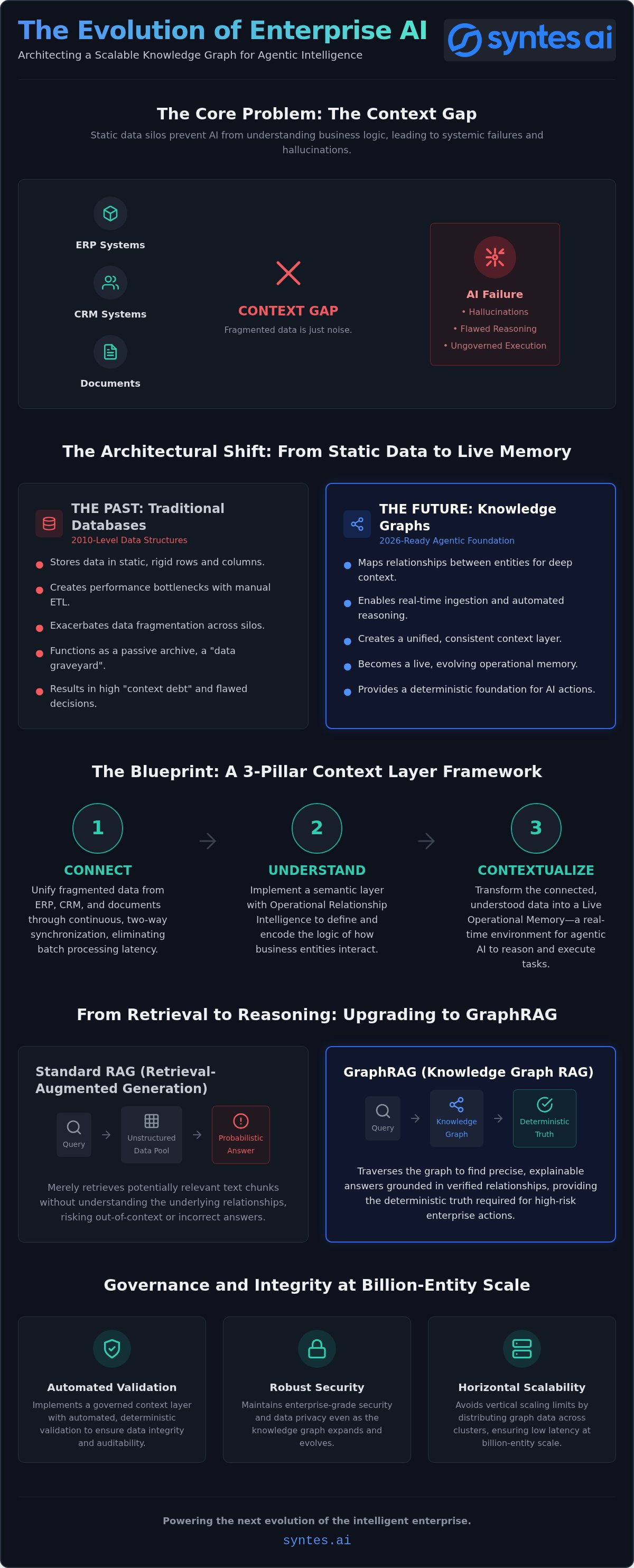
Traditional data models are no longer just obsolete. They are active liabilities. In the high-stakes environment of 2026, a scalable knowledge graph architecture is the only viable foundation for enterprise intelligence. Unlike static relational databases that store data in rigid rows and columns, a Knowledge Graph functions as a multi-layered system designed for relationship-based intelligence. It prioritizes the connections between entities, such as customers, products, and business rules, rather than treating them as isolated records. This architecture transforms data from a passive archive into a dynamic, interconnected map of your entire operation.
The “Context Gap” is the primary driver of AI failure. Organizations possess massive volumes of data, yet their AI models frequently hallucinate. This happens because high-volume data without relationship logic is effectively noise. Without a framework to understand how a specific contract relates to a specific regulatory update, AI cannot reason. It merely predicts the next token. We’re witnessing a fundamental shift in the industry: data is no longer a collection of passive records. It must become live operational memory that powers autonomous execution and provides a deterministic foundation for every AI-driven decision.
The Limits of Vertical Scaling and Manual ETL
Manual data engineering pipelines are breaking. The sheer velocity of data in 2026 makes manual ETL (Extract, Transform, Load) processes a bottleneck that stalls innovation. When you attempt to run deep traversals on traditional architectures, performance degrades exponentially. A scalable knowledge graph architecture resolves this through horizontal scalability. It avoids the pitfalls of manual sharding, which often leads to complex maintenance and data inconsistency. Instead, it utilizes automated distribution of graph data across clusters, ensuring that query latency remains low even as you scale to billions of entities. This architectural shift allows for real-time ingestion and reasoning, turning your data platform into a high-performance execution engine.
Fragmentation: The Silent Killer of Enterprise AI
Disconnected silos are the enemy of unified reasoning. When your ERP, CRM, and unstructured document repositories don’t speak the same language, your AI is effectively blind. This fragmentation creates “context debt,” a hidden cost that grows every time a business decision is made based on incomplete information. Solving enterprise data silos isn’t merely a data cleanup exercise. It’s a strategic prerequisite for building an agentic enterprise. A unified context graph bridges these gaps, allowing AI agents to navigate the complex web of enterprise relationships with surgical precision. This connectivity ensures that every automated action is grounded in the full, real-time reality of the business operation.
The Three Pillars of a Scalable Context Layer: Connection, Semantics, and Memory
Building a scalable knowledge graph architecture requires a fundamental shift from passive storage to active contextualization. We utilize the Connect-Understand-Contextualize framework to transform raw data into an execution-ready asset. Connection is achieved through two-way connectors that unify structured ERP data with the vast, unstructured world of corporate documentation. This isn’t a one-way migration. It’s a continuous synchronization that ensures the graph reflects the current state of the enterprise. By establishing these live links, you eliminate the latency inherent in traditional batch processing.
The semantic layer introduces Operational Relationship Intelligence. This isn’t just about labeling data; it’s about defining the logic of how entities interact. While a traditional data warehouse acts as a graveyard for historical records, a Live Operational Memory serves as a real-time reasoning environment. It’s the difference between knowing what happened last quarter and knowing what your supply chain must do ten minutes from now. To see these pillars in action, you can book a demo to explore our platform’s capabilities.
Automated Entity and Relationship Discovery
Manual ontology engineering is a relic of the past. Modern architectures leverage AI to propose schemas and resolve entities at scale, significantly reducing the time to value. Research into Scalable Knowledge Graph Construction demonstrates that automated extraction from text is essential for maintaining accuracy at billion-entity scale. We’ve moved beyond rigid, brittle schemas to flexible graph structures that evolve as your business logic changes. By integrating business rules and compliance policies directly into the graph edges, the architecture ensures that every relationship is governed by the actual constraints of your operation.
Architecting the Semantic Data Layer for Enterprise
The semantic layer acts as the critical bridge between Large Language Models (LLMs) and your proprietary data. It translates the fuzzy logic of natural language into the deterministic precision of a graph. Managing complex enterprise hierarchies in real-time is a non-negotiable requirement for 2026. This layer ensures that the Context Graph remains the organization’s shared truth, providing a unified context that prevents AI agents from operating on conflicting information. It’s a governed framework that allows for sophisticated reasoning across diverse data sets without sacrificing the integrity of the underlying systems.
GraphRAG and Deterministic Truth: Architecting for Agentic AI
Hallucinations are the inevitable tax on architectures that lack structural grounding. To achieve enterprise-grade reliability, you must understand how to prevent ai hallucination through a graph-based grounding architecture. Standard Retrieval-Augmented Generation (RAG) is insufficient for complex enterprise logic. It treats data as a flat list of text chunks, relying on semantic similarity that often lacks precision. In contrast, GraphRAG leverages a scalable knowledge graph architecture to provide a multi-dimensional map of facts. This enables AI to navigate the specific, high-stakes relationships that define your business operations with surgical accuracy.
The difference is one of reasoning capability. Standard RAG finds similar words; GraphRAG finds related truths. This shift provides the explainability required for high-risk environments. Instead of a “black box” output, you receive a transparent reasoning path that can be audited, verified, and contested. This is not a luxury for 2026. It is a fundamental prerequisite for trust. By architecting for deterministic truth, you ensure that AI outputs are grounded in the reality of your data, not the statistical probability of a language model.
The GraphRAG Advantage in Complex Reasoning
Vector databases are inherently limited to local similarity. They fail when a query requires multi-hop reasoning across disconnected data sources. For instance, connecting a specific shipping delay in one region to a force majeure clause in a vendor contract requires a traversal of entities, not just a keyword match. Research into Scalable Table-to-Knowledge Graph Matching highlights how modern systems automate the alignment of tabular data with these complex structures to maintain accuracy at scale. GraphRAG is the architectural bridge between retrieval and reasoning. It ensures that agentic workflows are grounded in a live operational context, creating a necessary safety net for autonomous performance.
From Retrieval to Autonomous Execution
The true value of a knowledge graph lies in its ability to support Agentic AI Platforms. We are moving beyond bots that simply answer questions. We are architecting systems where agents execute complex actions. These agents must perform cross-system integrations, such as updating an inventory record based on a predicted supply chain disruption, with absolute precision. The graph layer serves as the governance engine for these actions. By embedding business rules and policies directly into the scalable knowledge graph architecture, you ensure that AI agents operate within defined boundaries. The result is a system where execution is as reliable as the underlying data, turning theoretical intelligence into practical, automated utility.
Governance and Scalability: Maintaining Integrity at Billion-Entity Scale
Scaling to a billion entities requires more than raw compute. It demands a rigorous scalable knowledge graph architecture that integrates governance as a core functional requirement. We define the ‘Govern’ pillar as the mechanism for security, permissions, and compliance at the graph level. This isn’t a bolt-on feature. It’s the structural integrity of the system itself. In high-stakes enterprise environments, you can’t allow AI to update your source of truth without deterministic validation. While AI proposes graph updates, the system must prune these suggestions against established business rules to maintain absolute truth. Building a scalable knowledge graph architecture is a prerequisite for security at scale.
Trust is the primary currency of 2026. Every agentic decision needs a transparent audit trail. This ensures that when an autonomous agent executes a cross-system integration, the reasoning is explainable and the accountability is clear. Human-in-the-Loop (HITL) systems remain essential for the most critical junctions. They provide a safety layer where expert intuition validates automated speed. This balance of automation and oversight differentiates an experimental project from a production-ready enterprise AI platform. Static governance is dead. If your permissions don’t understand the context of a relationship, they’re useless.
Security and Permissions in a Unified Context Layer
Managing granular access control across a multi-tenant enterprise graph is a significant technical challenge. Permissions must exist at the relationship level, not just the entity level. This ensures that sensitive data remains protected while still contributing to the overall intelligence of the system. When integrating real-time operational events, the architecture must verify that the incoming data adheres to pre-defined security protocols. Compliance frameworks for AI-driven data engineering aren’t optional. They’re mandatory for any organization operating under the EU AI Act or NIST frameworks. These regulations require that data integrity be verifiable at every stage of the lifecycle.
The Role of the Ontology Governor
The architect’s role is undergoing a fundamental transformation. You’re no longer just a builder of schemas. You’re an ontology governor. As automated systems propose new relationships, the governor monitors for “semantic drift,” where the meaning of entities shifts over time in ways that could compromise reasoning. This requires a sophisticated balance between automated ingestion and expert-driven business logic. You must ensure that the graph evolves without losing its grounding in the messy realities of global enterprise operations. Clarity and efficiency are the goals. Theoretical experimentation is a luxury you can’t afford.
Implementing the Enterprise Knowledge Graph: The Syntes AI Approach
Transformation requires more than a new database. It demands a systemic evolution in how your organization processes reality. The Syntes AI Enterprise AI Platform is the definitive resolution to the architectural failures of the past decade. It isn’t a collection of disparate tools. It’s a complete scalable knowledge graph architecture designed to function as the central nervous system of the modern enterprise. By deploying the Syntes AI Context Graph, we provide a unified context layer that moves beyond static records to create a continuously evolving operational memory. This is where data becomes intelligence.
Our approach fundamentally shifts the focus from simple data storage to active Context Engineering. We’ve identified that the primary barrier to AI adoption isn’t a lack of data; it’s a lack of usable context. Our platform resolves this by unifying structured and unstructured assets into a single, high-fidelity reasoning environment. This architecture ensures that every AI-driven action is grounded in the deterministic truth of your specific business logic, providing the reliability that high-stakes operations demand.
The Syntes Context Engineering Framework
We’ve condensed the traditional multi-year ontology build into a streamlined, weeks-long cycle through our five pillars of Context Engineering. This framework allows for a seamless integration with your existing ERP, CRM, and cloud infrastructure without requiring a “rip and replace” strategy. The process is methodical:
- Connect: Establishing two-way synchronization across fragmented data silos.
- Understand: Automating entity discovery and semantic mapping at scale.
- Contextualize: Building the relationship logic that defines operational reality.
- Govern: Applying deterministic validation and granular security protocols.
- Execute: Powering agentic workflows that perform cross-system actions.
Trusted AI Execution in Practice
For the modern CIO, the path forward is clear. Fragmented data is a liability that leads to hallucination and systemic risk. A unified context graph is the only way to achieve the trusted enterprise intelligence required for 2026. It’s time to move beyond experimentation and build a foundation for autonomous performance.
Explore the Syntes AI Platform for your enterprise context needs
The Future of Enterprise Intelligence is Contextual
Passive data storage is no longer a viable strategy for the modern enterprise. To lead in 2026, organizations must bridge the systemic gap between fragmented silos and autonomous reasoning. We’ve established that a scalable knowledge graph architecture is the definitive foundation for this transition, providing the structural grounding that standard vector-based retrieval lacks. By implementing a system that prioritizes relationship logic, you transform your data into a live operational memory capable of powering trusted execution.
True competitive advantage requires a shift from superficial prompt engineering to a rigorous, expert-led Context Engineering Framework. This ensures that every automated action is auditable and aligned with your core business rules. Syntes AI possesses the technical mastery to turn this vision into a high-performance reality through our Syntes AI Context Graph and governed agentic AI capabilities.
The transition to a state of total operational clarity isn’t optional; it’s a strategic necessity. Build the architecture that moves your business from passive observation to active, automated performance.
Frequently Asked Questions
What is the difference between a graph database and a scalable knowledge graph architecture?
A graph database is merely the underlying storage engine for relationship-based data. In contrast, a scalable knowledge graph architecture is a comprehensive multi-layered system. It includes automated ingestion, semantic mapping, and an execution layer. This architecture integrates disparate sources like ERPs and CRMs into a unified context graph, transforming static records into a dynamic operational memory that supports autonomous reasoning across the enterprise.
How does a knowledge graph prevent AI hallucinations in enterprise settings?
Knowledge graphs eliminate hallucinations by grounding AI in deterministic facts rather than statistical probabilities. By using GraphRAG, the system provides a structural map of verified relationships that acts as a shared source of truth. This ensures that AI agents retrieve actual business logic and entities, preventing the model from inventing non-existent connections or providing incorrect data during the retrieval process.
What are the primary challenges when scaling a knowledge graph to billions of entities?
The most significant hurdles include maintaining low query latency and preventing semantic drift. Traditional systems often fail at this scale due to manual sharding bottlenecks and the performance degradation of deep traversals. Modern architectures resolve this through automated horizontal scaling and deterministic validation. These tools ensure the graph remains performant and accurate as it expands across global infrastructure without requiring manual intervention.
Can a knowledge graph architecture integrate with legacy ERP and CRM systems?
Integration is achieved through two-way connectors that synchronize structured legacy data with the graph layer in real-time. This doesn’t require replacing your current systems. Instead, it creates a unified context layer that sits on top of existing ERP and CRM platforms. For help with optimizing these source systems, check out INSIDEA for professional CRM and platform implementation. This allow AI to reason across fragmented silos without disrupting established operational workflows or requiring expensive data migrations.
Why is ‘Context Engineering’ considered the next evolution of RAG?
Context Engineering evolves beyond standard RAG by shifting the focus from simple text chunk retrieval to deep relationship mapping. While RAG relies on fuzzy semantic similarity, Context Engineering builds a structured environment where business rules and policies are embedded directly into the data. This creates a safer, more reliable foundation for agentic AI to perform complex, cross-system tasks with high-fidelity reasoning.
How do you ensure data security within a unified enterprise context layer?
Security is maintained through granular, relationship-level access controls rather than simple entity-based permissions. This ensures that sensitive data remains restricted even within a unified graph environment. Additionally, deterministic validation protocols prune unauthorized or incorrect updates. These measures maintain strict compliance with global frameworks like the EU AI Act and NIST RMF, providing an auditable trail for every data interaction.
What role do AI agents play in a scalable knowledge graph architecture?
AI agents function as the execution arm of the scalable knowledge graph architecture. They use the graph as a live operational memory to navigate complex tasks, such as supply chain orchestration or automated compliance audits. The graph provides these agents with the necessary context and boundaries to act autonomously. It ensures their actions are grounded in the full reality of the business operation.
How much does it cost to build and maintain an enterprise-scale knowledge graph?
Costs vary significantly based on data volume, entity complexity, and ingestion frequency. While manual builds were historically expensive and time-consuming, modern platforms utilize automated extraction to reduce the development cycle from years to weeks. Organizations should evaluate the total cost of ownership by considering the reduction in manual data engineering and the significant efficiency gains from trusted AI execution.