

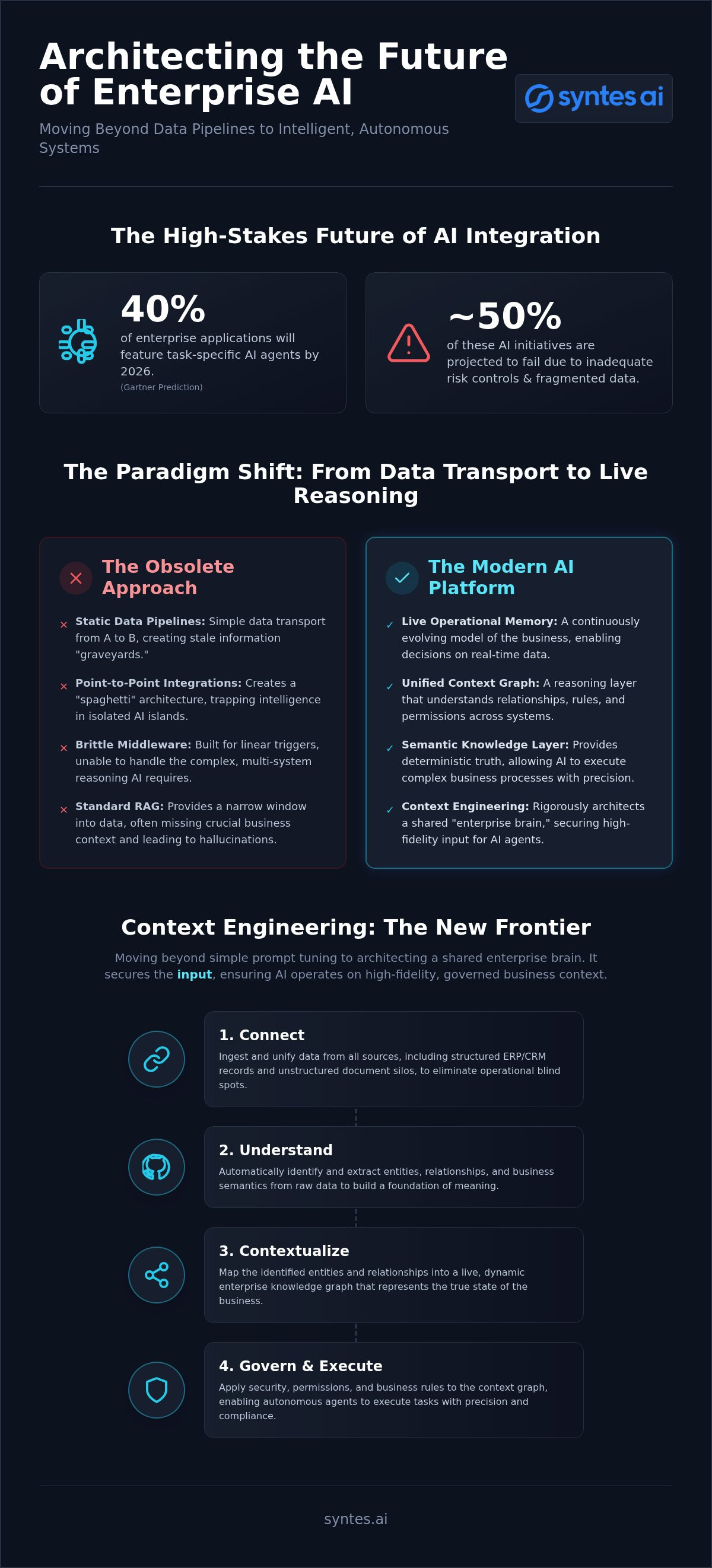
Gartner predicts that 40% of enterprise applications will feature task-specific AI agents by the end of 2026; yet, nearly half of these initiatives are projected to fail due to inadequate risk controls and fragmented data. Most organizations are still treating AI as a bolt-on feature rather than a systemic evolution. You’ve likely realized that a standard data pipeline is no longer enough to support autonomous reasoning. To achieve true operational intelligence, you need a sophisticated enterprise ai integration platform that functions as a live context layer rather than a passive conduit.
We understand the frustration of watching high-potential agents hallucinate because they’re grounded in stale, siloed information. It’s a systemic risk that undermines executive trust and stalls real-world deployment. This guide will demonstrate how to architect a unified context graph that provides deterministic truth for your AI workflows. We’ll explore the transition from simple retrieval to live operational memory, ensuring your agents execute business processes with absolute precision and governed security.
Key Takeaways
- Shift from simple data transport to a reasoning-centric architecture by deploying a modern enterprise ai integration platform that unifies fragmented knowledge.
- Move beyond the limitations of standard RAG through Context Engineering; this ensures your AI agents operate with high-fidelity business context rather than isolated data points.
- Replace brittle middleware with a semantic knowledge graph to provide the deterministic truth required for autonomous AI to execute complex business processes.
- Establish a Live Operational Model that bridges the gap between your ERP, CRM, and unstructured documents to create a single, governed intelligence layer.
- Implement a framework for secure, cross-system deployment that transforms AI from a passive observer into an active participant in your organization’s operations.
Beyond Data Pipelines: Defining the Enterprise AI Integration Platform in 2026
The enterprise data pipeline is an obsolete concept. In 2026, simply moving bits from point A to point B provides zero competitive advantage. A modern enterprise ai integration platform is no longer just a series of pipes; it acts as the strategic nervous system of the organization. It is the critical infrastructure that unifies fragmented data into a coherent reasoning layer. While traditional Enterprise Application Integration focused on data consistency and message passing, modern AI demands context synthesis. It requires a system that doesn’t just transport data but understands what that data means in the context of your specific business logic.
Why do traditional iPaaS solutions fail the AI test? They lack the semantic depth required for autonomous reasoning. Traditional middleware was built for linear triggers and actions. AI, however, requires a live context layer that can interpret complex relationships across disparate systems. Relying solely on a vector database is equally insufficient. While vector stores handle embeddings, they are blind to the intricate rules, permissions, and real-time states that define enterprise operations. You don’t need more storage; you need systemic intelligence.
The Failure of First-Wave Enterprise AI Integration
Point-to-point integrations have reached their breaking point. This “spaghetti” architecture creates isolated AI islands where intelligence is trapped within specific applications. The result is a staggering “Integration Tax” on innovation. Developers spend most of their cycles managing connectors instead of refining agentic behavior. Standard Retrieval-Augmented Generation (RAG) cannot bridge this gap. It provides a narrow window into data, often missing the broader business context necessary for complex, multi-step reasoning. Without a unified platform, your AI agents are essentially guessing.
From Static Data Lakes to Live Operational Memory
Static data lakes have become graveyards for enterprise information. AI agents cannot wait for a 24-hour ETL cycle to complete before making a decision. They require Live Operational Memory. This is a continuously evolving model of the business that captures real-time operational events as they happen. A unified context layer transforms passive data into an active reasoning asset. It eliminates the need for manual data cleaning by mapping relationships automatically. When your AI operates on live memory, it moves from passive observation to active, deterministic execution.
Context Engineering: The New Frontier of Enterprise AI Connectivity
Context is the currency of the modern enterprise. Most AI failures stem from a lack of grounding, not a lack of compute. Context Engineering is the rigorous discipline of architecting a shared enterprise brain. It moves past the trial and error of prompt engineering. While prompt engineering tries to fix the output, Context Engineering secures the input. A robust enterprise ai integration platform must facilitate this by synthesizing Operational Relationship Intelligence, the hidden web of dependencies that defines how your business actually functions.
Traditional Retrieval-Augmented Generation (RAG) often falls short because it relies on proximity rather than meaning. If your data is fragmented, your AI will be too. Context Engineering builds the bridge between raw information and actionable insight. It ensures that every autonomous agent understands the nuances of your specific operational environment, from hierarchy and permissions to historical performance and future projections.
The Five Pillars of Context Engineering
Building a reasoning layer requires more than raw data ingestion. It demands a structured approach to intelligence that moves through five specific phases:
- Connect: Ingest both structured ERP records and unstructured document silos to eliminate blind spots.
- Understand: Automatically identify entities, relationships, and business semantics within that data.
- Contextualize: Map these entities into a live enterprise knowledge graph.
- Govern & Execute: Apply strict business rules and logic to ensure autonomous actions remain compliant and accurate.
This framework ensures that AI isn’t just generating text; it’s navigating a verified map of your organization. You can see this framework in action to understand how it transforms raw data into a live context layer.
GraphRAG: Moving Beyond Simple Vector Search
Vector databases are excellent for finding similar things, but similarity isn’t truth. In an enterprise setting, close enough is a liability. GraphRAG provides the deterministic logic that vectors lack. It gives the AI the Why behind the data, revealing how a specific supply chain delay impacts a high priority customer contract. This level of explainable reasoning is mandatory for audit and compliance. It replaces probabilistic guesses with deterministic truth, ensuring your enterprise ai integration platform remains a trusted source of intelligence.
Without this graph-based foundation, AI remains a black box. Context Engineering opens that box. It provides the transparency required for high stakes decision making, turning your data from a passive archive into a live, actionable asset.
Architecting for Autonomy: Knowledge Graphs vs. Traditional AI Middleware
Traditional middleware is a relic of a linear era. It moves data but remains blind to the intent behind it. To build truly autonomous systems, you must move beyond the Enterprise Service Bus (ESB) and adopt agentic ai platforms that prioritize reasoning over simple connectivity. While a standard iPaaS might trigger an alert when a record changes, a modern enterprise ai integration platform understands the systemic impact of that change on your entire supply chain. It bridges the gap between the general knowledge of an LLM and the proprietary, high-stakes data of your organization.
The Role of the Semantic Data Layer
Autonomy requires a foundation of meaning. You must implement a semantic data layer for enterprise to serve as the blueprint for AI reasoning. This layer maps your unique business logic, internal policies, and operational constraints directly into the path of the AI. It eliminates data silos by focusing on relationships rather than tables. When your AI understands that a “Customer” in your CRM is the same “Entity” as a “Contract Holder” in your legal database, it can reason across those systems with deterministic accuracy. It transforms a collection of disparate data points into a unified, actionable intelligence asset.
Governed Agentic AI: Safety in Execution
An autonomous agent is only as safe as the context that governs it. Without strict guardrails, agents risk acting on stale data or violating internal compliance protocols. A governed enterprise ai integration platform prevents “rogue” behavior by embedding business rules into the execution layer. It ensures that every action is grounded in the current state of the business. You must also incorporate Human-in-the-Loop (HITL) systems for high-value or high-risk operations. This ensures that while the AI handles the heavy lifting of multi-step workflows, a human expert remains the final arbiter of truth. This balance maintains data integrity and operational security without sacrificing the speed of automation.
Operationalizing Intelligence: A Framework for Cross-System AI Deployment
Execution begins with a five-step deployment framework designed for the complexity of 2026 operations:
- Step 1: Map the Live Operational Model. Define the entities, processes, and rules that govern your business. You cannot automate what you haven’t modeled.
- Step 2: Connect Disparate Systems. Bridge your ERP, CRM, and SCM through a unified context layer. This creates a single source of truth for AI reasoning.
- Step 3: Solve Fragmentation. Implement strategies for solving enterprise data silos by prioritizing relationship-based data mapping over simple ingestion.
- Step 4: Establish Governance. With the EU AI Act enforcement beginning August 2, 2026, explainability protocols are now a legal requirement for high-risk AI systems.
- Step 5: Scale via Agentic Automation. Transition from manual prompts to autonomous workflows where agents execute multi-step processes based on real-time data.
Selecting the Right AI Integration Architecture
Architectural choices define your long-term scalability. A hub-and-spoke model offers centralized governance, which is ideal for highly regulated industries. Conversely, a data mesh approach may better serve decentralized organizations with diverse business units. When evaluating your enterprise ai infrastructure, the “build vs. buy” decision should favor speed and security. Buying a purpose-built enterprise ai integration platform allows your team to focus on high-value context engineering rather than the maintenance of fragile API connectors.
Measuring ROI: Beyond Efficiency to Operational Intelligence
Traditional metrics like “man-hours saved” are insufficient for the agentic era. Real ROI is found in “decisions optimized.” By understanding how to prevent ai hallucination through deterministic grounding, you directly reduce the costs associated with operational risk. Live Operational Memory is not merely a technical capability; it’s a strategic corporate asset. It captures the tribal knowledge of your organization and makes it available for real-time, automated execution, ensuring that your AI investments yield measurable EBIT impact.
The Syntes Agentic Platform: Unifying Fragmented Knowledge into Action
The Syntes Agentic Platform represents the definitive evolution of the enterprise ai integration platform. It does not merely facilitate data movement; it engineers intelligence. At its core lies the Context Graph, a sophisticated architectural layer that unifies fragmented organizational knowledge. This system bridges the critical gap between structured ERP data and the vast, unstructured reservoirs of corporate documents. By synthesizing these disparate sources, Syntes AI creates a high-fidelity map of your operations that allows AI to reason with the same nuance as your most experienced executives.
Operational clarity requires more than historical snapshots. The Syntes platform provides Live Operational Memory, a real-time modeling capability that ensures your AI reasoning is grounded in the current state of the business. This isn’t a passive data lake. It is an active, evolving model that enables agents to understand the immediate implications of every transactional change. This capability transforms AI from a descriptive tool into a prescriptive force, capable of executing complex business processes with deterministic accuracy and systemic relevance.
Trusted Execution with Governed AI Agents
Trust is the non-negotiable foundation of enterprise autonomy. Syntes AI eliminates the black-box risk through contextualized reasoning, providing clear, explainable paths for every decision an agent makes. These agents don’t operate in a vacuum. They execute actions within your existing security frameworks and governance protocols, ensuring that every automated workflow remains compliant and secure. Scaling from a single pilot to a fully agentic enterprise requires this level of architectural rigor. By embedding business rules directly into the context layer, we ensure that your agents act as loyal extensions of your corporate policy, not as unpredictable anomalies.
Start Your Context Engineering Journey
Transitioning to an agentic model is a strategic shift, not a technical patch. Your journey begins with a comprehensive Context Audit to identify the critical knowledge gaps within your current systems. Syntes AI acts as a strategic partner throughout this process, providing the expertise and infrastructure needed to bring order to operational chaos. We move beyond the vendor-client relationship to become an essential component of your intelligence stack. The era of fragmented silos is over. It is time to architect a future where every piece of data contributes to a coherent, actionable whole.
Transform your enterprise data into operational intelligence
Architecting the Unified Enterprise Intelligence Layer
The transition from passive data pipelines to active, agentic reasoning is no longer a choice; it’s a strategic mandate. You’ve seen how Context Engineering and Live Operational Memory redefine what’s possible, moving beyond the brittle triggers of legacy middleware. By prioritizing a semantic reasoning layer, you ensure that your AI agents operate with deterministic truth and governed precision. The era of fragmented silos has ended, replaced by a unified intelligence architecture that understands the nuance of your business logic.
Syntes AI stands as the national leader in Context Engineering and GraphRAG, offering a proven architecture for eliminating enterprise data silos. As a recipient of the Red Dot Award for Design Excellence in AI Systems, we provide the sophisticated enterprise ai integration platform required for this new era. We don’t just connect systems; we synthesize operational intelligence to ensure your autonomous agents execute with absolute clarity. It’s time to move beyond experimentation and into the realm of high-stakes, automated performance.
The opportunity to lead your industry through autonomous, governed intelligence is here. We look forward to helping you build a future where your data isn’t just stored, but actively executed.
Frequently Asked Questions
What is an enterprise AI integration platform?
An enterprise ai integration platform is a sophisticated infrastructure layer that unifies fragmented organizational data into a live context graph for autonomous reasoning. It moves beyond simple data movement to provide the semantic grounding required for AI agents to execute business processes. This platform acts as a central intelligence hub that bridges the gap between raw information and automated action.
How does an AI integration platform differ from a traditional iPaaS?
Traditional iPaaS focuses on linear data synchronization and point-to-point connectivity between applications. In contrast, an AI-centric platform prioritizes context synthesis and reasoning capabilities. While iPaaS moves records, an AI integration platform builds a semantic model of the business. It allows agents to understand the relationships between data points rather than just triggering simple webhooks.
What is Context Engineering and why does it matter for AI?
Context Engineering is the discipline of architecting a high-fidelity environment where AI agents can reason accurately. It matters because LLMs are blind to your proprietary logic and real-time operational states. By engineering context, you provide the deterministic truth required to eliminate guesswork. This process ensures that every agentic action is grounded in your unique business rules and hierarchies.
How do you prevent hallucinations in an integrated AI system?
Hallucinations are prevented by grounding AI responses in a Live Operational Memory rather than relying on probabilistic model weights. You must implement a retrieval mechanism that uses deterministic knowledge graphs instead of simple vector similarity. This ensures the AI only reasons with verified, real-time data from your systems of record. Grounding provides the explainable path necessary for enterprise-grade trust.
Can AI agents safely execute actions in my ERP or CRM?
Yes, provided the enterprise ai integration platform utilizes two-way connectors governed by strict security frameworks. You must embed Human-in-the-Loop (HITL) protocols for high-value transactions to maintain data integrity. Safety is achieved by mapping AI actions to existing permissions and business logic. This ensures that agents never exceed their authorized operational boundaries while performing multi-step workflows.
What are the core pillars of a successful AI integration strategy?
A successful strategy rests on five specific pillars: Connect, Understand, Contextualize, Govern, and Execute. You must first bridge data silos before automatically discovering the relationships between entities. Once contextualized in a knowledge graph, you apply governance rules to ensure compliance. Finally, you scale through agentic automation that transforms passive insights into active, cross-system performance.
How does a Knowledge Graph improve AI reasoning compared to RAG?
A Knowledge Graph provides a structured map of relationships that standard RAG lacks. While standard RAG retrieves isolated text chunks based on keyword proximity, GraphRAG understands the logic behind the data. It reveals dependencies between customers, products, and policies. This semantic depth allows AI to perform complex reasoning that is both accurate and fully auditable for compliance purposes.
What industries benefit most from enterprise AI integration platforms?
Industries with high systemic complexity and strict regulatory requirements see the most immediate ROI. This includes financial services, global supply chain management, and healthcare. These sectors manage hundreds of disparate SaaS applications and vast amounts of unstructured data. A unified integration platform allows them to automate high-stakes processes while maintaining the deterministic truth required for operational security.