

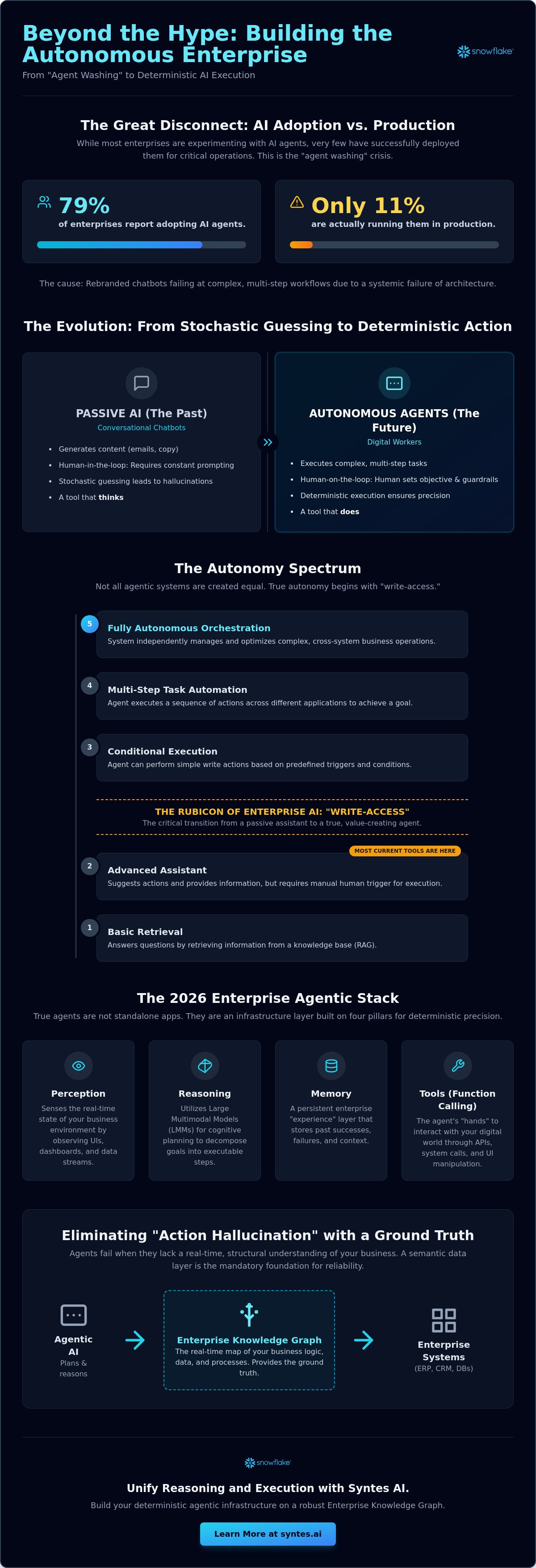
While 79% of enterprises report adopting AI agents, only 11% are actually running them in production environments. Most organizations are currently trapped in the “agent washing” phase, where rebranded chatbots are sold as autonomous workers but fail the moment they encounter a complex, multi-step workflow. You’ve likely seen the results: agentic ai tools that hallucinate, data silos that starve models of the ground truth, and the paralyzing security risk of granting an unpredictable system write-access to your core infrastructure. It’s a systemic failure of architecture, not a lack of intent.
You need a shift from stochastic guessing to deterministic execution. This guide demonstrates how to transition from passive AI assistants to autonomous systems that execute enterprise operations with absolute precision. We’ll explore how to break down data silos using an Enterprise Knowledge Graph and architect a multi-agent swarm that delivers genuine autonomy. You’ll discover a framework for seamless cross-system integration that reduces operational overhead without requiring a total stack overhaul. The era of the digital worker has arrived; it’s time to provide the infrastructure they require to succeed.
Key Takeaways
- Distinguish between stochastic content generation and deterministic task execution to move beyond simple conversational interfaces.
- Identify the four pillars of agentic infrastructure and the necessity of a unified semantic layer for operational reliability.
- Evaluate agentic ai tools by their capacity for massive parallel execution rather than basic low-code workflow orchestration.
- Eliminate the risk of “Action Hallucination” by grounding autonomous agents in a real-time map of your enterprise data environment.
- Utilize the Syntes Agentic Platform to unify reasoning and execution through a robust Enterprise Knowledge Graph.
The Evolution of Agentic AI Tools: Beyond Conversational Chatbots
The era of the digital conversationalist is over. For the past several years, enterprises have been mesmerized by Large Language Models that could summarize emails or draft marketing copy. This was the era of passive AI. In 2026, the market has matured. We’ve reached the inflection point where generative AI, which merely creates content, is being replaced by agentic ai tools designed for deterministic task execution. The novelty of chat has faded; the demand for autonomous action has taken its place.
True autonomy isn’t defined by the sophistication of a chatbot’s prose. It’s defined by the system’s ability to decompose a high-level business goal into a series of actionable sub-tasks without human intervention. While early AI required constant prompting, modern agentic systems operate on a “human-on-the-loop” model. The human provides the objective and the guardrails; the agent provides the execution. This transition marks the fundamental shift from tools that think to tools that do. It moves the workforce from the role of data entry clerks to strategic orchestrators.
This transition is not limited to corporate giants; for entrepreneurs and creators, Entourage Insider provides a strategic playbook for scaling online businesses using these same AI and automation principles.
To understand this evolution, we must look at the foundational concept of an Intelligent Agent. Historically, these were simple scripts or bots following linear logic. Today, they are sophisticated reasoning engines capable of navigating the messy, unstructured reality of global enterprise systems. They don’t just respond to data; they perceive their environment and take actions to achieve specific outcomes.
From LLMs to LMMs: The Reasoning Engine
The Autonomy Spectrum: Assistants vs. Agents
Not all agentic systems are created equal. We define five levels of AI autonomy, ranging from basic retrieval (Level 1) to fully autonomous operational orchestration (Level 5). Most current market offerings are actually “Level 2” advanced assistants. They can suggest actions, but they cannot execute them without a manual trigger.
The Rubicon of enterprise AI is “write-access.” A tool becomes a true agent only when it possesses the authority to modify data, trigger transactions, and commit changes across the tech stack. This transition requires a level of precision and security that legacy AI architectures simply cannot provide. If an agent cannot execute with deterministic certainty, it remains a liability, not an asset. True agents don’t just help you work; they perform the work for you.
The 2026 Enterprise Agentic Stack: Essential Components
Stop viewing agents as standalone applications. In 2026, the most effective agentic ai tools are architected as an integrated infrastructure layer. They aren’t merely “chatbots with plugins.” They’re systems of intelligence that require a robust, four-pillar foundation to operate with deterministic precision. Without this structural integrity, even the most advanced model becomes a liability. Your stack must be built for execution, not just conversation.
The architecture of a true agent consists of four critical components. Perception allows the system to sense the current state of your business environment. Reasoning provides the cognitive planning needed to achieve a specific goal. Stanford HAI on Agentic AI emphasizes that this goal-setting and planning phase is what separates true agents from basic automation. Memory systems have evolved from short-term context windows to persistent enterprise “experience” layers that store past successes and failures. Finally, Tools, or Function Calling, provide the agent with the hands to interact with your digital world through APIs and system calls.
The Semantic Data Layer: The Ground Truth
Agents fail without ground truth. It’s that simple. While Large Language Models provide the linguistic interface, they lack the structural logic required to navigate a global supply chain or a financial ledger. This is why a knowledge graph architecture is the non-negotiable foundation for agentic reliability. It provides the “map” of your enterprise. By mapping entities and their relationships, you eliminate the context gap that causes hallucinations. You provide the deterministic guardrails that ensure an agent doesn’t just act, but acts correctly.
Cross-System Integration: The Agentic Nervous System
An agent without connectivity is a brain without a body. To be useful, agentic ai tools must bridge the gap between their reasoning engines and your core systems of record. This means connecting to ERPs, CRMs, and legacy mainframes. We’ve moved past simple middleware. Modern orchestration requires real-time data flow that treats every system as a callable tool. Solving enterprise data silos is no longer just a data management goal; it’s a prerequisite for operational autonomy. If your data is fragmented, your agents will be paralyzed. Establishing this unified connectivity is the first step in deploying a Syntes Agentic Platform to reclaim your operational efficiency.
Evaluating Agentic AI Tools: Orchestration vs. Foundation
The market is currently flooded with “agent washing.” Vendors are rebranding legacy RPA scripts and linear triggers as autonomous systems. You must see through this noise. Evaluating agentic ai tools requires a fundamental understanding of the difference between simple orchestration and a foundational operational core. One ties existing tools together; the other provides the cognitive infrastructure for independent decision-making. As MIT Sloan explains Agentic AI, the real value lies in the economic shift toward agents that can manage entire processes without human hand-holding. This isn’t about better chatbots. It’s about a new class of digital labor.
Scalability is your first litmus test. Can your platform handle 10,000 parallel agents? Most “low-code” solutions crumble under the weight of enterprise-grade concurrency. Beyond scale, you face the “Black Box” problem. If an agent executes a trade or modifies a supply chain order, you need absolute observability. Auditability isn’t a feature; it’s a requirement. You need a security framework built on Role-Based Access Control (RBAC) specifically designed for non-human identities. If an agent has write-access to your ERP, it must be governed by the same rigorous permissions as your most senior administrator.
Orchestration Tools: The Logic Connectors
Tools like LangChain and CrewAI are excellent for building agentic prototypes. They allow developers to chain prompts and connect APIs quickly. However, they often rely on “if-this-then-that” logic. This linear approach fails in the dynamic environments of 2026. When variables change in real-time, rigid chains break. Use lightweight orchestrators for experimentation and narrow proof-of-concepts. Don’t rely on them for mission-critical execution where the cost of failure is high.
Foundational Platforms: The Operational Core
Selecting the right enterprise ai infrastructure is a strategic decision, not a tactical one. These platforms prioritize “Deterministic Execution.” They ensure that while the agent’s reasoning is flexible, its adherence to business logic is absolute. Governance must be baked into the infrastructure layer. A foundational platform manages the agent’s memory, its access to the ground truth, and its integration with core systems. It provides the stability that stochastic models lack. It’s the difference between a bot that suggests an answer and a platform that completes the work.
Deployment Strategy: Scaling Agents Without Hallucinations
A chatbot hallucinating a historical date is a minor inconvenience. An agent hallucinating a procurement order is a multi-million dollar liability. In the enterprise, the stakes of AI error have shifted from linguistic accuracy to operational integrity. We call this “Action Hallucination.” It occurs when agentic ai tools execute a technically valid command but apply it to the wrong data set or business context. To scale these systems, you must move beyond simple prompt engineering and into rigorous deployment architectures that prioritize safety over speed.
How do you ensure an autonomous fleet remains within its operational envelope? You start with an Agentic Sandbox. You wouldn’t grant a new human employee unrestricted access to your production environment on day one; you shouldn’t do it with an AI agent. Testing autonomous behavior requires a high-fidelity simulation of your enterprise stack where agents can plan and execute without real-world consequences. Once deployed, the focus shifts to AgentOps. This involves real-time monitoring of agent health, decision-tree auditing, and tracking the tangible ROI of autonomous workflows. If you can’t observe the reasoning process, you can’t govern the outcome.
Deterministic Grounding via Knowledge Graphs
The solution to action errors is semantic grounding. You must prevent ai hallucination by providing your agents with a deterministic map of your enterprise data relationships. This is the shift from Retrieval-Augmented Generation (RAG) to Retrieval-Augmented Action (RAA). In an RAA framework, the agent doesn’t just retrieve text to answer a question. It retrieves the specific business logic, constraints, and relationship paths required to execute a task. By grounding the agent in a Knowledge Graph, you ensure it understands the “Why” behind a process, preventing it from taking actions that violate systemic rules.
Security and Governance for Autonomous Agents
Autonomy requires a new breed of security protocols. You need digital “Circuit Breakers” for high-risk tasks like financial transfers or data deletion. These are hard-coded thresholds that force a human-on-the-loop intervention if an agent’s proposed action exceeds a specific value or departs from historical norms. Every decision must leave an immutable audit trail. In a regulated environment, being able to reconstruct why an agent chose a specific path is a compliance mandate. Managing agent identities and permissions is the final piece of the puzzle. Treat your agentic ai tools as non-human identities with restricted, role-based access. Secure your operational future by deploying the Syntes Agentic Platform to ensure every autonomous action is governed by deterministic truth.
Syntes AI: The Agentic Platform for Deterministic Enterprise Execution
The era of theoretical AI experimentation is over. To achieve true operational clarity, you need more than fragmented scripts or rebranded chatbots; you need a unified infrastructure that bridges the gap between reasoning and result. The Syntes Agentic Platform provides this essential layer. It is the definitive solution for organizations ready to move beyond “agent washing” and into production-grade autonomous operations. By consolidating reasoning, memory, and tool-use into a single governed environment, we eliminate the fragility common in early-stage agentic ai tools. We don’t just provide a tool; we provide the architectural foundation for the next generation of enterprise labor.
This emphasis on high-performance infrastructure is a cross-industry priority; for example, Wedison utilizes advanced SuperCharge technology to deliver the speed and efficiency required for modern electric vehicle performance.
Can your current AI infrastructure handle the weight of real-world complexity? Most systems fail because they lack a grounding mechanism. Syntes AI solves this through our proprietary Enterprise Knowledge Graph. This isn’t a simple database; it’s a dynamic map of your enterprise truth. It provides the 360-degree view required for deterministic execution, ensuring that every autonomous action is grounded in your specific business logic and relationship paths. We’ve built the platform to scale with your complexity, not just your prompt volume. This means your agents remain reliable whether they’re managing a single task or orchestrating a fleet of 10,000 parallel processes.
Why Syntes AI is the Strategic Choice for 2026
Success in 2026 requires a platform that prioritizes governance over mere ease-of-use. Syntes AI delivers built-in security features designed specifically for highly regulated industries. We recognize that granting an agent write-access to your core systems is a high-stakes decision. Our platform treats every agent as a non-human identity, governed by rigorous Role-Based Access Control and immutable audit trails. You get the speed of autonomy with the safety of deterministic guardrails. It’s a system designed for the gravity of global operations, providing the certainty you need to deploy AI in mission-critical environments.
The Path to Autonomous Intelligence
The roadmap to autonomy begins with the unification of your data environment. Syntes AI enables the deployment of specialized agents across your most critical departments, from supply chain optimization to financial reconciliation and HR orchestration. We provide the Cross-System Integrations necessary to connect your legacy stack to modern AI reasoning engines. This allows you to transition from stagnant data silos to a state of total operational intelligence without a total stack overhaul. You don’t have to wait for the future; you can architect it today. Experience the future of autonomous operations with the Syntes Agentic Platform and move your agentic ai tools from the laboratory to the production line.
The Architecture of Operational Certainty
The transition from passive assistance to autonomous execution is no longer a strategic choice; it’s an operational necessity. We’ve moved beyond the era of stochastic chatbots. The true potential of agentic ai tools lies in their ability to navigate complex business logic with absolute precision. This requires a fundamental departure from “agent washing” and a commitment to robust, foundational architecture. Success in 2026 depends on grounding your agents in a unified semantic layer that eliminates the context gaps plaguing legacy systems.
Syntes AI provides the infrastructure required to bridge this gap. Our platform leverages an enterprise-grade Knowledge Graph to ensure deterministic, hallucination-free execution across your entire software stack. We offer the deep cross-system integration capabilities needed to connect legacy environments with modern reasoning engines. Don’t leave your operational future to chance. It’s time to move from experimental prototypes to production-grade autonomous fleets that deliver measurable ROI. Deploy Deterministic AI Agents with Syntes AI and reclaim your operational clarity today. You have the vision; we provide the tools to make it reality.
Frequently Asked Questions
What is the difference between agentic AI tools and traditional RPA?
Traditional RPA follows rigid, “if-this-then-that” scripts that break when UI elements shift or data formats change. Agentic ai tools utilize reasoning engines to navigate ambiguity and achieve complex goals through dynamic planning. While RPA automates repetitive tasks, agentic AI orchestrates entire processes. It adapts to real-time variables, making it a cognitive evolution rather than a simple mechanical mimicry of human keystrokes.
How do enterprise knowledge graphs improve agentic AI performance?
Knowledge graphs provide the deterministic “map” that autonomous agents require to navigate complex data environments with precision. They move beyond flat databases by mapping the semantic relationships between entities, such as products, suppliers, and contracts. This structural truth prevents the stochastic guessing that leads to hallucinations. By grounding reasoning in a graph, you ensure the agent understands the systemic context of every action it takes.
Are agentic AI tools secure enough for financial or healthcare data?
Security depends entirely on the underlying infrastructure layer. Enterprise-grade platforms implement Role-Based Access Control (RBAC) and immutable audit trails to govern every autonomous decision. These systems treat agents as non-human identities with strictly defined permissions. For highly regulated sectors like finance and healthcare, this level of observability ensures compliance with data privacy mandates while allowing the system to execute high-stakes transactions with total transparency.
What are the most common use cases for agentic AI in 2026?
In 2026, enterprises deploy agents to manage multi-step workflows that previously required significant human oversight. Common use cases include autonomous supply chain reconciliation, real-time financial fraud detection, and complex HR onboarding orchestration. These systems don’t just surface information; they execute the underlying tasks. They modify procurement orders, update employee records, and resolve billing discrepancies across disparate systems without manual intervention.
How do you prevent an AI agent from “going rogue” in a production system?
Prevention requires a multi-layered governance strategy. You must implement “Circuit Breakers” that trigger a human-on-the-loop intervention if an agent proposes an action exceeding specific financial or operational thresholds. Every agent should be tested in a high-fidelity sandbox before production deployment. Constant monitoring via AgentOps allows you to track reasoning paths in real-time, ensuring the system remains within its defined operational envelope at all times.
Can agentic AI tools integrate with legacy on-premise software?
Connectivity is no longer limited by modern API availability. Advanced agentic ai tools utilize Large Multimodal Models (LMMs) to interact with legacy software UIs just as a human operator would. They bridge the gap between on-premise mainframes and cloud-native intelligence layers. Through robust cross-system integrations, these agents act as a cognitive middleware, unifying your entire technology stack into a single, actionable operational environment.
What is the expected ROI for implementing an agentic AI platform?
ROI is realized through the radical reduction of operational overhead and the acceleration of process throughput. By automating the “reasoning” phase of work, enterprises eliminate the bottlenecks associated with human decision-making in routine workflows. You gain the ability to scale operations without a linear increase in headcount. Most organizations see immediate value in the reduction of manual error costs and the reclaimed bandwidth of strategic personnel.
How does “grounding” differ from standard AI training?
Standard training imbues a model with general linguistic patterns and broad knowledge. Grounding provides the model with your specific, real-time business truth. It connects the reasoning engine to your Enterprise Knowledge Graph, ensuring the agent uses your actual data to inform its decisions. While training teaches a model how to speak, grounding teaches it what is true within the context of your specific organization.