

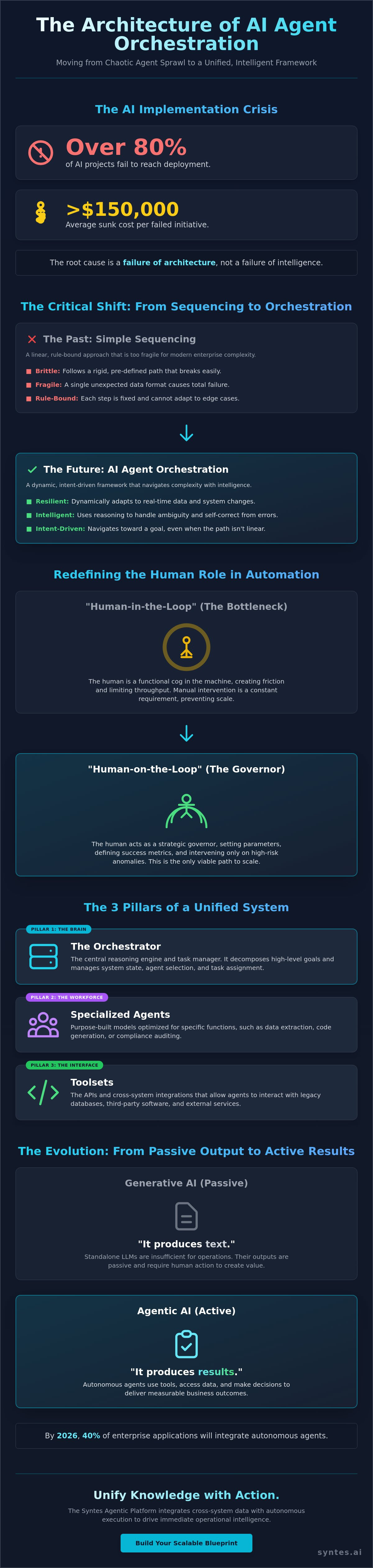
Over 80% of AI projects fail to reach deployment, resulting in an average sunk cost exceeding $150,000 per initiative. This isn’t a failure of intelligence; it’s a failure of architecture. Most enterprises currently face a chaotic landscape of agent sprawl where disconnected tools hallucinate in isolation. You likely recognize the friction of trying to force autonomous agents to interact with rigid legacy data sources. It’s a systemic bottleneck that turns promising innovation into operational debt. Effective ai agent orchestration isn’t just about sequencing tasks; it’s about building a unified, reliable framework that ensures every autonomous action is grounded in enterprise reality.
We’ll provide the definitive strategic architecture required to coordinate specialized agents into a cohesive system. You’ll master the logic of multi-agent coordination and learn to integrate autonomous execution with your existing enterprise knowledge. This guide moves beyond theoretical experimentation to provide a scalable blueprint for 2026, ensuring your transition from passive observation to active, automated performance is both seamless and profitable.
Key Takeaways
- Define the critical distinction between basic task sequencing and true ai agent orchestration to reclaim control over autonomous workflows.
- Identify the specific multi-agent coordination patterns required to manage state and logic across long-running enterprise processes.
- Eliminate systemic hallucinations by grounding agentic reasoning in a unified semantic layer through an Enterprise Knowledge Graph.
- Execute a high-level CIO roadmap to audit your existing data infrastructure and target high-complexity operational bottlenecks for automation.
- Discover how the Syntes Agentic Platform integrates cross-system data with autonomous execution to drive immediate operational intelligence.
Defining AI Agent Orchestration in the Modern Enterprise
Static workflows are dead. Modern enterprise complexity has outpaced the capability of simple, linear automation. True ai agent orchestration represents the strategic management of intent-driven autonomous systems. It isn’t just a technical layer; it’s an operational imperative. While simple sequencing follows a rigid, pre-defined path, agentic orchestration dynamically adapts to real-time data and edge cases that would break traditional scripts. This shift marks the transition from “Human-in-the-loop” oversight, where manual intervention is a constant bottleneck, to “Human-on-the-loop” governance. Here, enterprise leaders supervise high-level outcomes while the system handles the granular execution logic.
Distinguishing between simple sequencing and true orchestration is vital for strategic decision-makers. Sequencing is typically a series of fixed steps. It’s brittle. If a data source returns an unexpected format, the sequence fails. In contrast, ai agent orchestration leverages reasoning to handle ambiguity. It evaluates the environment, selects the optimal tool, and self-corrects when encountering errors. This intelligence allows for the coordination of a multi-agent system where specialized agents interact to solve complex problems. Each step is intent-driven rather than rule-bound, allowing the system to navigate toward a goal even when the path isn’t linear.
The transition to “Human-on-the-loop” (HOTL) is the only viable path to scale. In a “Human-in-the-loop” model, the human is a functional cog in the machine. This creates friction and limits throughput. In a HOTL model, the human acts as a strategic governor. They set the parameters, define the success metrics, and only intervene when the orchestrator flags a high-risk anomaly. This allows the enterprise to execute thousands of autonomous workflows simultaneously without a linear increase in headcount or operational overhead.
The architecture of a unified system rests on three fundamental pillars:
- The Orchestrator: The central reasoning engine and task manager that decomposes goals and manages state.
- Specialized Agents: Purpose-built models optimized for specific functions, such as data extraction, code generation, or compliance auditing.
- Toolsets: The APIs and cross-system integrations that allow agents to interact with legacy databases and third-party software.
Beyond Chatbots: The Evolution to Agentic Systems
Standalone LLMs are insufficient for the gravity of global operations. They produce text; they don’t produce results. Generative AI outputs are passive. Agentic AI outcomes are active. The core differentiator is autonomy. Modern orchestration frameworks empower agents to use tools, access databases, and make decisions within a governed architecture. By 2026, 40% of enterprise applications will integrate these agents, moving the needle from conversational interfaces to autonomous execution engines that deliver measurable business value.
The Orchestrator as the Enterprise Control Plane
The orchestrator functions as the system’s brain. It decomposes high-level business goals into actionable tasks. This control plane manages agent selection and task assignment, ensuring the right specialist handles the right request. It utilizes various AI agent orchestration patterns like prompt chaining and parallelization to maintain system integrity. Reliability is non-negotiable. Therefore, the orchestrator must implement deterministic checkpoints within non-deterministic AI workflows. This ensures that even when an agent’s reasoning path varies, the final output aligns with strict enterprise standards and business logic.
Multi-Agent Architecture: Coordination Patterns and Logic
Complexity is the enemy of execution. In a multi-agent environment, the way agents interact determines the system’s ultimate reliability. High-level enterprise tasks don’t exist in a vacuum; they require specific ai agent orchestration patterns to manage the transition from raw data to actionable intelligence. Different organizational functions demand distinct interaction models. For example, a financial audit requires a rigid, centralized structure for compliance, while real-time supply chain monitoring thrives on a more decentralized, responsive approach.
The choice between centralized and decentralized models is a strategic pivot point. Centralized orchestration provides a single source of truth and tighter governance, making it ideal for regulated industries. Conversely, decentralized models allow for faster, localized decision-making but often struggle with global state consistency. To bridge this gap, sophisticated AI agent architectures must incorporate Agentic Memory. This isn’t just a database; it’s a persistent, shared context that ensures consistent cross-system performance, preventing agents from re-learning facts they’ve already processed.
State management is the silent backbone of long-running workflows. Without it, an agentic system is merely a series of stateless API calls prone to failure. Managing the state allows the system to pause, wait for human-on-the-loop input, and resume without losing context. For enterprises looking to deploy these systems at scale, the Syntes Agentic Platform provides the necessary infrastructure to maintain this operational continuity across diverse environments.
Sequential vs. Concurrent Execution
Precision requires patience. Chained refinement, or sequential execution, is the gold standard for high-stakes tasks like legal document review or complex code generation. Each agent builds upon the previous output, refining and validating as it goes. However, when speed is the priority, concurrent execution becomes essential. This model processes multiple data streams simultaneously to provide real-time insights. Concurrent execution drastically reduces system latency by distributing the computational load across specialized agents.
Dynamic Delegation and Handoff Patterns
No agent is an island. A critical component of ai agent orchestration is the ability for an agent to recognize its own limitations. When a technical support agent identifies a request that requires financial authorization, it must execute a seamless handoff. This isn’t just a transfer of control; it’s a transfer of context. Effective handoff patterns preserve the entire conversation history and reasoning chain, ensuring the next agent doesn’t start from zero. This preservation is vital for maintaining the user experience and operational velocity in complex, multi-step business processes.
Why Orchestration Fails Without Semantic Grounding
Coordination is not intelligence. You can build the most complex multi-agent workflow in the world, but if your agents lack a reliable source of truth, they will fail. Hallucinations aren’t just minor bugs; they’re structural failures of context. Without semantic grounding, ai agent orchestration is merely sophisticated guessing. It’s a high-stakes gamble where the enterprise pays the price for data drift and operational errors. True execution requires more than just a sequence of prompts. It demands a “Ground Truth” that agents can query, verify, and act upon with absolute certainty.
Enterprise data is notoriously fragmented. Silos within ERP and CRM systems create blind spots that agents can’t navigate independently. When agents operate in a vacuum, they lose the ability to execute cross-departmental tasks. As highlighted by the U.S. Government Accountability Office on AI Agents, these technologies offer immense potential for workplace productivity, yet they require robust operational frameworks to ensure accountability. Orchestration fails when it ignores the “garbage in, garbage out” reality of siloed enterprise environments. To move beyond pilot programs, leaders must implement a semantic layer that bridges the gap between raw data and agentic reasoning.
The Knowledge Graph as the Agents Compass
The knowledge graph serves as the structural foundation for agentic reasoning. It transforms static, disconnected data points into a dynamic web of actionable relationships. By implementing enterprise knowledge graphs, organizations provide their agents with a definitive compass for decision-making. This eliminates the “black box” nature of LLM reasoning. Instead of predicting the next token based on probability, the orchestrator verifies facts against the graph. This grounding links agent tools to a unified data fabric, ensuring every autonomous action is relevant, accurate, and aligned with real-time business logic.
Cross-System Integration: Connecting the Silos
True autonomy requires agents to transcend the boundaries of individual applications. They must operate seamlessly across ERP, CRM, and legacy databases. The primary hurdle here is “Agentic Translation.” Different systems use disparate schemas and languages. An agent optimized for Salesforce won’t naturally understand the nuances of a legacy SAP instance. Our approach at Syntes AI focuses on unifying these complex environments. Through deep Cross-System Integrations, we resolve schema conflicts and provide a clean, actionable format for the orchestrator. This connectivity ensures that agents don’t just talk about work; they execute it across the entire enterprise stack.
Implementing an Orchestration Strategy: A CIO Roadmap
Strategy is execution. Without a rigorous roadmap, your AI initiatives will join the 80% of projects that fail to reach deployment. CIOs must move beyond the “experimentation” phase where disconnected tools operate in silos. Success in 2026 requires a systemic approach to ai agent orchestration that prioritizes architectural integrity over temporary novelty. This roadmap provides the definitive path to transforming fragmented AI efforts into a unified, high-performance execution engine.
- Step 1: Identify High-Value Bottlenecks. Don’t automate for the sake of automation. Target operational friction points in supply chain, finance, or customer success where complexity currently outpaces human capacity.
- Step 2: Audit for Semantic Readiness. Determine if your enterprise data is reachable and structured. A system is only as capable as the knowledge it can access.
- Step 3: Select a Unified Infrastructure. Choose an agentic AI platform that offers deep cross-system integration. It must bridge the gap between legacy databases and autonomous reasoning.
- Step 4: Establish Governance Guardrails. Define “Human-on-the-loop” checkpoints. Ensure compliance with emerging regulations like the EU AI Act by building transparency into every agentic decision.
- Step 5: Scale Through Specialization. Start with core agents and expand. Use iterative feedback loops to refine agent performance and reduce the 15% to 30% annual maintenance cost typical of unmanaged systems.
The “Build vs Buy” debate is over. Building a custom orchestrator from scratch is a multi-million dollar gamble that often ignores the long-term total cost of ownership. The strategic imperative is to leverage a platform that provides the orchestration logic while allowing for custom, deep-tissue integrations into your unique business logic. To see how this architecture functions in a live environment, you can explore the Syntes Agentic Platform today.
Security and Governance in Autonomous Workflows
Autonomy requires accountability. Managing agent permissions is as critical as managing human access. You must implement identity and access management (IAM) protocols specifically for agents to prevent unauthorized data exfiltration. Furthermore, cost-control guardrails are non-negotiable. Without them, recursive agent loops can rapidly consume LLM tokens, leading to unexpected infrastructure surcharges. Every action must be recorded in an immutable audit trail, providing the transparency required for both regulatory compliance and continuous system optimization.
Measuring ROI: From Efficiency to Intelligence
The Syntes Advantage: Unifying Knowledge with Action
Theoretical frameworks don’t drive revenue. Only execution does. While much of the industry remains distracted by prompt engineering and model selection, the true bottleneck for the modern enterprise lies in the underlying architecture. ai agent orchestration at scale requires more than just clever scripts. It requires a platform built to withstand the gravity of global operations. The Syntes Agentic Platform provides this foundation. It bridges the gap between fragmented data silos and autonomous execution, ensuring that your AI agents aren’t just generating text, but performing high-value business tasks with absolute precision.
Our unique advantage stems from the deep, native synergy between our Enterprise Knowledge Graph and our orchestration framework. This isn’t a bolt-on solution. By providing agents with a unified, semantic view of your entire organization, we eliminate the primary cause of system failure: the lack of grounded context. Agents powered by Syntes AI don’t guess based on probability. They query the graph, verify the logic, and execute across systems with certainty. This is the definitive choice for organizations that have outgrown pilot programs and are ready for full-scale autonomous intelligence.
The Syntes Agentic Platform delivers several core pillars of operational intelligence:
- Systemic Integration: Seamlessly connect autonomous agents to legacy ERP, CRM, and custom databases.
- Semantic Grounding: Eliminate hallucinations by anchoring agentic reasoning in a persistent Enterprise Knowledge Graph.
- Governed Autonomy: Maintain total control through “Human-on-the-loop” checkpoints and deterministic guardrails.
- Scalable Execution: Reduce operational overhead by coordinating multiple specialized agents into a single, cohesive system.
Built for Enterprise Scale
Consumer-grade chatbot tools are toys. They lack the security, governance, and connectivity required for serious business logic. Syntes AI takes an infrastructure-first approach. We prioritize Cross-System Integrations that allow agents to reach into your most sensitive data environments without compromising integrity. This focus on operational gravity ensures that your agentic workflows are resilient, compliant, and capable of handling the messy realities of large-scale data environments. Stop experimenting with isolated tools. It’s time to build a unified engine for growth. Deploy your agentic infrastructure with Syntes AI to secure your competitive advantage in the 2026 landscape.
Your Partner in the Agentic Evolution
We aren’t just a software vendor. Syntes AI acts as a strategic expert guide for enterprises navigating the shift toward total operational clarity. Our vision is a fully integrated, autonomous enterprise where data moves seamlessly from observation to automated action. This transition is inevitable. The only question is which organizations will lead it. Systemic integration is no longer a luxury; it is the prerequisite for relevance. Choose a partner that understands the complexity of your environment and possesses the sophisticated tools to bring order to them. The future of ai agent orchestration is here, and it is powered by Syntes AI.
Securing the Future of Autonomous Execution
The transition from passive AI observation to active, automated performance is no longer a choice; it’s a prerequisite for survival. Enterprises that continue to rely on fragmented, siloed agents will inevitably succumb to operational debt and hallucination-driven errors. Mastering ai agent orchestration requires a fundamental architectural pivot toward connectivity and semantic grounding. By unifying specialized agents with a robust Enterprise Knowledge Graph, you transform raw data into a dynamic engine for growth. This evolution demands more than simple automation. It requires a system designed for operational intelligence.
It’s time to move beyond the experimental phase and deploy infrastructure built for the gravity of global operations. Our Syntes Agentic Platform provides the deep cross-system integration and reliability required to manage non-deterministic workflows with absolute certainty. Don’t leave your automation strategy to chance. Request a technical deep dive into the Syntes Agentic Platform to see how systemic integration can redefine your competitive edge. The era of the autonomous enterprise has arrived. Secure your place at the forefront of this evolution.
Frequently Asked Questions
What is the primary difference between AI orchestration and AI agent orchestration?
Traditional AI orchestration manages the flow of data between static models and fixed pipelines. It follows a pre-defined script. In contrast, ai agent orchestration manages autonomous intent. It coordinates multiple agents that possess the reasoning capability to select their own tools, self-correct, and adapt to environmental changes. One is a rigid sequence; the other is a dynamic execution engine driven by high-level business goals.
Can AI agent orchestration work with my existing legacy systems and ERP?
Integration is the foundation of operational intelligence. True orchestration requires deep Cross-System Integrations to bridge the gap between modern reasoning engines and rigid legacy databases. The Syntes Agentic Platform is designed specifically to reach into SAP, Oracle, and other on-premise or cloud ERP systems. Without this connectivity, agents remain isolated chatbots. With it, they become functional extensions of your enterprise workforce.
How does a knowledge graph improve the performance of an AI agent orchestrator?
A knowledge graph provides the semantic grounding necessary to eliminate hallucinations. It acts as a definitive source of truth that agents query before taking action. Instead of predicting the next token based on probability, the orchestrator verifies facts against the graph’s structured relationships. This ensures that every autonomous decision is contextually accurate and aligned with your specific enterprise logic and real-time data.
What are the biggest risks associated with multi-agent AI systems?
Complexity and cost are the primary hurdles. Multi-agent systems can be 5 to 10 times more expensive than single-agent setups due to the overhead of shared memory and failure handling. There’s also the risk of non-deterministic behavior where agents diverge from intended outcomes. Managing these risks requires a robust framework that implements deterministic checkpoints and strict governance guardrails to maintain system integrity.
Do I need to build my own orchestration framework or buy an enterprise platform?
Strategic leaders prioritize speed and reliability. Initial development often represents only 25% to 35% of the total three-year cost of ownership for an AI agent. Building from scratch forces you to manage infrastructure, monitoring, and security internally. Buying an enterprise platform like Syntes allows you to focus on your unique business logic while leveraging a battle-tested architecture for ai agent orchestration and cross-system connectivity.
How do you prevent “infinite loops” where agents keep talking to each other without results?
Recursive dialogue is a failure of governance. You must implement cost-control guardrails and deterministic timeout limits within the orchestrator. These systems monitor agent interactions and trigger a “Human-on-the-loop” intervention if a goal isn’t reached within a set number of steps. Goal-verification layers ensure that agents are moving toward a resolution rather than cycling through redundant reasoning paths without delivering measurable outcomes.
Is human oversight still necessary in an orchestrated agentic system?
Accountability cannot be automated. While agents handle granular execution, human oversight remains vital through a “Human-on-the-loop” model. Humans set the strategic parameters, define success metrics, and manage high-risk anomalies. This approach allows the enterprise to scale autonomous workflows while ensuring that every action remains compliant with internal policies and external regulations like the EU AI Act.
What industries benefit most from AI agent orchestration in 2026?
Regulated industries see the most significant ROI. Healthcare and finance lead the market because they require the high levels of transparency and grounding that orchestration provides. Supply chain and logistics also benefit through massive increases in throughput and real-time error correction. North America currently remains the leading market for these technologies, driven by a need to reduce operational overhead in complex, data-heavy environments.