
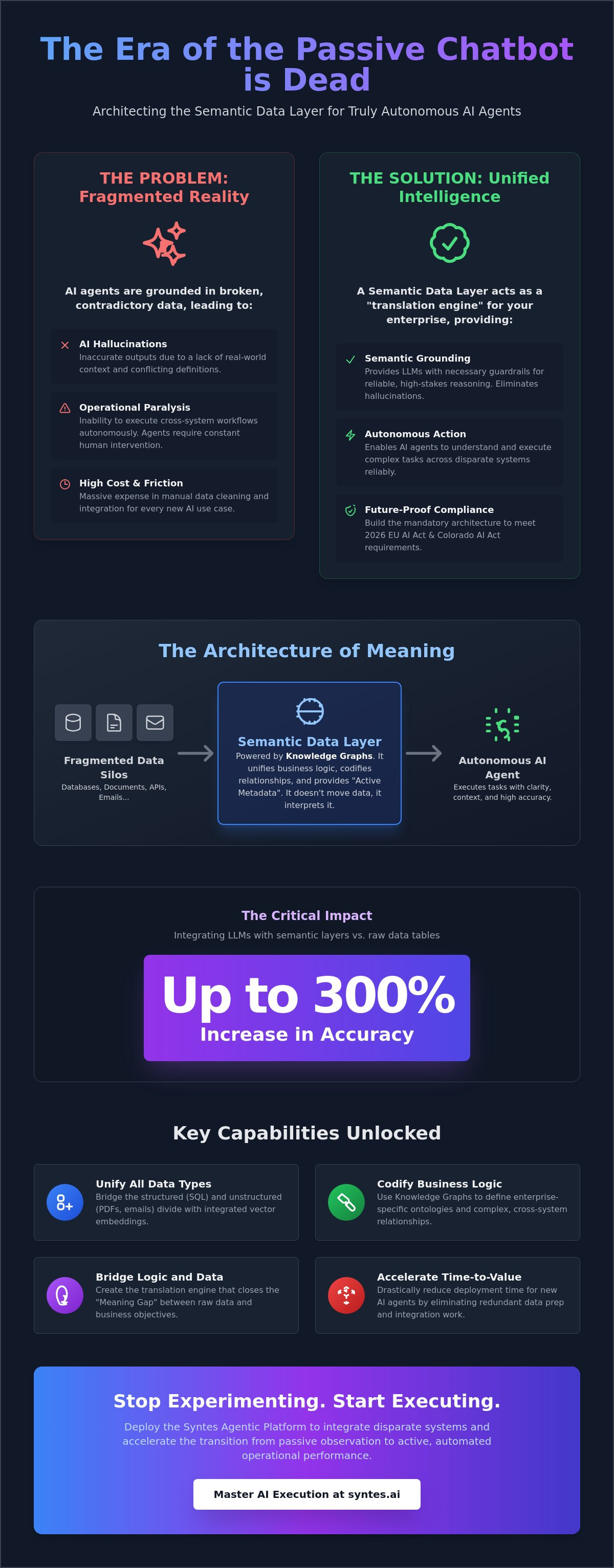
The era of the passive chatbot is dead. If your AI can’t execute a cross-system workflow without constant human intervention, you don’t have an agent; you have a liability. You understand the friction of fragmented data silos. You’ve seen the high cost of manual data cleaning for every fresh use case. It’s a systemic failure that leads to hallucinations and operational paralysis. A robust semantic data layer for enterprise is the only way to move past these bottlenecks. It’s the mandatory architecture for any organization that intends to meet the 2026 regulatory requirements of the EU AI Act and the Colorado AI Act with confidence.
Industry data confirms that integrating LLMs with semantic layers can increase accuracy by up to 300% compared to raw data tables. This article demonstrates how to transform your fragmented silos into a unified intelligence framework. You’ll discover how to architect a system where business logic is consistent across all platforms. We’ll show you how to build reliable AI agents capable of autonomous action and how to drastically reduce your time-to-value for new deployments. It’s time to stop experimenting with theory and start mastering execution.
Key Takeaways
- Bridge the critical gap between raw data and business logic by establishing a translation engine that moves beyond the limitations of traditional data warehousing.
- Architect a robust semantic data layer for enterprise to transform fragmented silos into a unified, actionable intelligence framework for autonomous agents.
- Leverage Knowledge Graphs as the definitive architectural structure for codifying complex, cross-system relationships and enterprise-specific ontologies.
- Eliminate AI hallucinations by implementing semantic grounding, providing LLMs with the necessary guardrails for reliable, high-stakes reasoning.
- Deploy the Syntes Agentic Platform to integrate disparate systems and accelerate the transition from passive observation to active, automated operational performance.
Beyond the Silo: The Strategic Necessity of an Enterprise Semantic Layer
Data hoarding is not a strategy; it is a burial. For decades, the enterprise moved data from one physical location to another, hoping that proximity would breed clarity. We built massive lakes and sophisticated warehouses, yet the fundamental problem remained unsolved. Centralization is not comprehension. A Semantic layer acts as the critical translation engine that bridges the chasm between raw technical schemas and high-level business logic. In 2026, a semantic data layer for enterprise is the only way to move beyond the limitations of rows and columns toward a framework of actionable meaning. AI agents do not need more data. They need context.
The Failure of the Single Version of Truth
Physical consolidation failed because it ignored the human element of definition. You can move every byte into a single cloud environment, but if Marketing defines a “lead” differently than Sales, your “single version of truth” is a fiction. This “Meaning Gap” persists because technical schemas are built for machine efficiency, while executive requirements are built for strategic execution. A semantic layer provides logical unification without requiring a total physical overhaul. It maps disparate data points to a shared vocabulary, ensuring that when an agent queries “revenue,” it retrieves a value that is governed, consistent, and universally understood across every department.
From Passive Analytics to Active Operational Intelligence
Legacy Business Intelligence was designed for the human eye. It was a rearview mirror, offering a static glimpse into the past through dashboards that required manual interpretation. Modern agentic AI demands a different fuel. We are shifting from passive observation to active, automated performance. This transition relies on “Active Metadata,” the dynamic context that informs an AI agent about the relationships, permissions, and business rules governing data in real time. Without a semantic data layer for enterprise, your AI is merely a sophisticated interface for broken data. It will hallucinate not because the model is weak, but because its grounding is non-existent. To achieve operational clarity in a post-2026 landscape, you must architect for execution, not just reporting. Understanding the full scope of solving enterprise data silos is the essential first step toward building that execution-ready foundation.
The Architecture of Meaning: How Semantic Layers Unify Complex Landscapes
Meaning is not found in the storage of data. It is found in the relationships between data points. A semantic data layer for enterprise serves as the logical center of gravity, positioned decisively between the decentralized data mesh and the final application tier. It does not move data; it interprets it. By adopting a “Metadata-First” approach, organizations can achieve a level of agility that physical migration projects never could. This architecture ensures that regardless of where a byte resides, its business context remains intact, governed, and ready for machine execution.
IBM provides an authoritative perspective on the strategic necessity of this layer, highlighting its role in standardizing business logic across complex, multi-cloud environments. The core mechanism here is query federation. Instead of forcing data into a monolithic lake, the semantic layer accesses information where it lives. It translates a high-level business question into the specific technical dialects of various underlying systems. This eliminates the latency of traditional ETL processes while maintaining a unified view of the enterprise truth.
Bridging the Structured and Unstructured Divide
Modern AI agents don’t distinguish between a SQL table and a PDF contract. They shouldn’t have to. A sophisticated semantic framework treats emails, documents, and structured databases as a single knowledge source. By integrating vector embeddings within the semantic model, enterprises can ground their AI in both hard numbers and nuanced textual context. To understand the technical requirements for this synthesis, you can explore how to unify structured and unstructured data for agentic AI. This unification is the only path to comprehensive operational intelligence.
Cross-System Integration: The Connective Tissue
The semantic layer acts as the connective tissue across ERP, CRM, and legacy systems. It utilizes “Semantic Wrappers” to normalize disparate outputs into a coherent enterprise vocabulary. This normalization is critical for agentic reliability. If an agent triggers an action in a CRM based on data from an ERP, the definitions must be identical. Real-time synchronization ensures that the agent is never acting on stale or misinterpreted information. Establishing this level of cross-system integration is the mandatory prerequisite for any organization seeking to deploy autonomous AI at scale. Without it, your agents are merely guessing.
Knowledge Graphs vs. Traditional Frameworks: Choosing the Core
Is connectivity enough for autonomous reasoning? No. While Data Fabrics and Data Meshes provide the essential wiring for the modern enterprise, they lack the cognitive structure required for agentic performance. A semantic data layer for enterprise built on a relational foundation is fundamentally limited by the rigid, two-dimensional nature of tables. AI agents don’t just need to find data; they need to traverse it. Knowledge Graphs represent the only architectural core capable of mirroring the complex, non-linear reality of global business logic. They don’t just store values; they codify the relationships that give those values meaning.
Leading platforms recognize this shift toward relationship-centric models. A robust semantic layer is now viewed as the foundational infrastructure for AI, providing the grounding necessary to move beyond simple pattern matching. Relational models fail when dealing with high-dimensional AI queries. They require expensive, complex joins that degrade performance and obscure context. In contrast, graph structures enable “explainable AI” by tracing logic across interconnected nodes. This provides a clear, auditable trail of reasoning, allowing human operators to verify exactly why an agent reached a specific operational conclusion.
Why Data Fabric Alone is Insufficient for Agentic AI
Data Fabric is about plumbing. It excels at moving data and managing access, but it doesn’t understand what the data represents. Agentic AI requires a world model, not just a pipeline. You can explore the technical nuances in our deep dive on data fabric vs knowledge graph to see why reasoning requires a graph-based foundation. While the fabric connects the systems, the graph provides the map that allows an agent to navigate them. Connectivity is passive; reasoning is active.
Master Data Management (MDM) Redefined
Traditional Master Data Management is a relic of the static reporting era. It focused on deduplication and record matching, often resulting in “golden records” that were disconnected from real-time business context. The Knowledge Graph is the modern evolution of this discipline. By implementing a knowledge graph for master data management, enterprises can automate the reconciliation of conflicting records through semantic logic. This creates a dynamic, self-healing truth. A semantic data layer for enterprise powered by a graph ensures that your AI agents are acting on the most accurate, contextually relevant version of your business entities, regardless of which system they originated from.
Eliminating Hallucinations: Semantic Grounding for Agentic AI
Hallucinations are not a creative quirk of large language models. They are a catastrophic failure of grounding. When an AI agent generates a false statement or executes a flawed command, it is because the system lacks a verifiable “Ground Truth” to anchor its reasoning. A semantic data layer for enterprise provides the mandatory guardrails that prevent these cognitive drifts. While most organizations treat the semantic layer as a mere “view” for human analytics, the future of AI demands we treat it as the agent’s brain. It transforms the Retrieval-Augmented Generation (RAG) workflow from a simple search-and-summarize exercise into a sophisticated logic-driven operation. By grounding the model in a unified business vocabulary, you ensure that every output is derived from governed, enterprise-specific facts.
The impact of this architectural shift is quantifiable. According to research from Kaelio in April 2026, integrating LLMs with semantic layers can increase their accuracy by up to 300% compared to using raw data tables. This isn’t just a marginal improvement; it is the difference between a prototype and a production-ready system. Agents use these semantic definitions to determine their own “Action Space.” They don’t just read data; they understand the permissions and business rules that dictate what they are allowed to do with it across your various systems. Organizations that have committed to solving enterprise data silos through agentic intelligence consistently report the most dramatic gains in both accuracy and operational throughput.
The Grounding Mechanism: Linking LLMs to Enterprise Reality
Agents don’t understand SQL schemas. They understand intent. The semantic layer acts as the interpreter, mapping natural language queries to precise technical execution across your entire stack. This is achieved through “Semantic Discovery,” a process where the agent identifies the correct tools and datasets for a given task. Activating this capability requires an enterprise data catalog with knowledge graph, which serves as the agent’s internal directory of business meaning. It ensures the AI navigates your data landscape with the same precision as your most seasoned analysts.
Ensuring Reliability in Autonomous Operational Tasks
An autonomous agent cannot guess your business rules. If it attempts to calculate a discount or approve a credit limit based on a probabilistic hunch, the results are unpredictable. The semantic layer enforces “Deterministic Logic,” ensuring that AI consistency is maintained regardless of the underlying model. This provides significant security benefits, as the layer enforces governance at the logic level. You can deploy the Syntes Agentic Platform to establish these rigid semantic guardrails and ensure your AI remains a strategic asset rather than an unguided risk. Reliability is not optional when agents are empowered to act.
Scaling Operational Intelligence with the Syntes Agentic Platform
Theory has its limits. Execution is the only metric that matters. While the market for agentic AI and semantic layers is projected to reach 1.07 billion dollars in 2026, most organizations remain trapped in the experimental phase. They’re struggling with fragmented tools that fail to communicate. The Syntes Agentic Platform provides the all-in-one infrastructure required to operationalize the semantic data layer for enterprise. It’s not a collection of disconnected features; it’s a unified engine designed for high-stakes execution. By making the platform available on the Microsoft Azure Marketplace as of December 11, 2025, Syntes AI has ensured that global enterprises can deploy these capabilities with the security and scale they demand.
At the heart of this platform lies the Enterprise Knowledge Graph. It serves as the definitive engine for cross-system unification, translating the messy realities of your technical stack into a coherent world model. This allows for the deployment of agents that don’t just talk; they do. These agents navigate the graph to understand business context, verify permissions, and execute complex workflows across disparate systems. You don’t need another chatbot that summarizes documents. You need an autonomous workforce capable of triggering actions in your ERP, CRM, and legacy databases simultaneously. Syntes AI makes this a reality in weeks, not years, bypassing the traditional integration debt that cripples most AI initiatives. Organizations serious about this transition should review the 2026 guide to enterprise AI infrastructure to understand the full architectural blueprint required for agentic intelligence at scale.
The Syntes Advantage: Unifying Knowledge and Action
The synergy between the Syntes Knowledge Graph and the Agentic Framework is what separates operational intelligence from mere analytics. Most platforms require you to stitch together a semantic layer from one vendor and an agentic tool from another. This creates latency and logic gaps. Syntes AI handles the complexity of cross-system data synchronization natively. It ensures that every agent is grounded in real-time truth, backed by enterprise-grade security and a metadata-first architecture. This isn’t a prototype; it’s a foundation for systemic integration. These high-level principles of intelligence-driven operations are also being adapted for specialized sectors, with resources like AI Powered Network Marketing providing a roadmap for integrating AI into strategic marketing frameworks.
Your Roadmap to Autonomous Enterprise Operations
The window for theoretical experimentation is closing. As regulatory deadlines like the Transparency in Frontier AI Act take effect in 2026, the need for auditable, grounded AI logic is non-negotiable. You must move away from consumer-grade chatbots and toward a robust agentic infrastructure. Start by mapping your core business entities into a graph-based model. Then, authorize agents to perform specific, governed tasks across your systems. You can contact Syntes AI to architect your enterprise semantic layer and begin the transition from passive observation to active, automated performance. Clarity is the prerequisite for action.
Architecting the Future of Autonomous Action
The window for experimentation with superficial chatbots has closed. By 2026, the distinction between market leaders and laggards will be defined by their ability to translate raw data into autonomous, governed action. Implementing a semantic data layer for enterprise is no longer a technical luxury; it’s the strategic bedrock for any organization that values operational clarity over theoretical potential. You’ve seen how Knowledge Graphs provide the reasoning engine that traditional relational models lack. You understand that grounding AI in deterministic business logic is the only path to eliminating the hallucinations that cripple trust and execution.
It’s time to stop observing and start performing. You can scale your AI initiatives with the Syntes Agentic Platform today. Our enterprise-grade Knowledge Graph infrastructure and seamless cross-system integration provide the foundation you need to deploy agents that actually deliver. With a proven reduction in AI hallucination rates, Syntes AI transforms your fragmented silos into a unified intelligence framework. The future of enterprise AI is agentic. The foundation is semantic. It’s time to build for the next era of intelligence.
Frequently Asked Questions
What is a semantic data layer for enterprise?
A semantic data layer for enterprise is the logical architecture that translates technical data schemas into a standardized business vocabulary. It acts as a translation engine. This framework ensures that every department and AI agent interprets terms like “customer” or “revenue” identically. It eliminates the friction of fragmented silos by providing a single, governed source of truth for business logic across the entire organization.
How does a semantic layer differ from a data warehouse?
A data warehouse is a physical storage solution focused on data centralization. In contrast, a semantic layer is a logical framework that defines the meaning and relationships within that data. Warehouses solve the storage problem; they don’t solve the “Meaning Gap.” The semantic layer sits above your storage tier. It allows you to govern business logic without moving or duplicating the underlying physical records.
Can a semantic layer really prevent AI hallucinations?
Yes. Semantic layers provide the deterministic guardrails necessary for reliable AI grounding. Hallucinations occur when an LLM lacks a verifiable “Ground Truth” to anchor its reasoning. By mapping natural language queries to precise semantic definitions, you ensure the model retrieves governed facts rather than generating probabilistic guesses. This grounding mechanism is the only way to achieve production-grade reliability in enterprise environments.
What is the role of a Knowledge Graph in a semantic layer?
The Enterprise Knowledge Graph serves as the cognitive engine of a modern semantic layer. Unlike rigid relational tables, a graph structure codifies the complex, non-linear relationships between business entities. This allows AI agents to traverse the enterprise landscape with human-like reasoning. It’s the architectural core that enables explainable AI by tracing logic across interconnected nodes. It provides an auditable trail for every automated decision.
How do I implement a semantic layer without moving all my data?
You implement this architecture through query federation. This approach allows the layer to access data exactly where it lives, whether in a legacy ERP or a modern cloud warehouse. You don’t need a massive migration project. Instead, the semantic layer uses “Semantic Wrappers” to normalize outputs from disparate systems in real time. This metadata-first strategy accelerates deployment while maintaining your existing infrastructure investments.
Is a semantic layer compatible with my existing BI tools like Power BI or Tableau?
How does a semantic layer support autonomous AI agents?
It defines the agent’s “Action Space.” Autonomous agents require more than just data access; they need to understand the business rules and permissions governing that data. The semantic layer provides the dynamic context that informs an agent about what it can and cannot do across systems. Without this logical foundation, agents are merely unguided scripts. They lack the situational awareness required for cross-system execution.
What are the security implications of a centralized semantic layer?
Centralizing the semantic data layer for enterprise actually strengthens your security posture. It allows you to enforce governance and access control at the logic level rather than managing thousands of individual table permissions. You can define security policies once within the semantic model. These policies are then applied consistently across every application and AI agent. This ensures that sensitive data is only accessible within the context of authorized business workflows.