Most enterprise AI deployments aren’t failing because of the models. They’re failing because the agents have no idea what’s actually happening inside the business. Fragmented data, siloed systems, and ungoverned autonomous decisions aren’t edge cases; they’re the default state of first-wave agentic deployments at scale.
If you’ve felt that tension, you’re not alone. The promise of agentic ai tools is compelling: autonomous systems that reason, act, and adapt without constant human intervention. But at enterprise scale, that promise collides hard with the reality of hallucinations in production, agents operating without full operational context, and decision-making that nobody can audit or explain. The gap between a compelling demo and a governed, production-ready deployment is wider than most vendors admit.
This article cuts through that gap. You’ll walk away with a clear framework for evaluating enterprise-grade agentic platforms, a concrete understanding of why context is the single most critical variable in agent reliability, and a vetted list of tools built to operate at the complexity and governance standards that large-scale enterprises actually require.
Key Takeaways
- Not all agentic ai tools are built for enterprise scale — understanding the critical difference between consumer-grade assistants and governed agentic platforms determines whether your deployment succeeds or stalls.
- Context Engineering, not model selection, is the decisive variable in agent reliability; without a dynamic operational memory, even the most capable LLM will fail against proprietary business logic.
- Standard RAG architectures are insufficient for complex enterprise reasoning — discover why a Context Graph is the structural foundation that separates production-ready deployments from costly proof-of-concept failures.
- Open-source frameworks like CrewAI and LangChain offer flexibility for custom development, but enterprise platforms deliver the governance, auditability, and cross-system integration that large-scale operations demand.
- The Syntes Agentic Platform introduces a unified infrastructure layer that addresses the fragmentation, hallucination risk, and ungoverned execution that define first-wave agentic deployments at scale.
Defining the Landscape: Task-Specific Tools vs. Enterprise Agentic Platforms
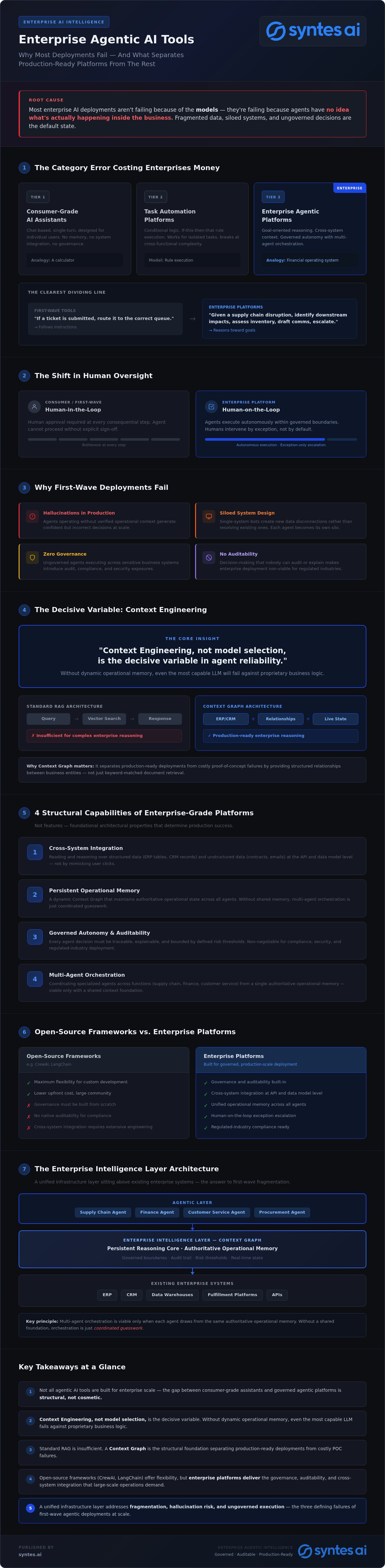
There’s a category error embedded in most conversations about agentic ai tools, and it’s costing enterprises real money. The market conflates three fundamentally different things: consumer-grade AI assistants, task automation platforms, and true enterprise agentic systems. Treating them as equivalent is like comparing a calculator to a financial operating system. The inputs and outputs might look similar on the surface; the underlying architecture is incomparable.
2026 marks the year that distinction stops being academic. Enterprises that ran proof-of-concept deployments through 2024 and 2025 are now confronting a hard operational truth: tools built to automate discrete tasks don’t scale into systems capable of autonomous, cross-functional reasoning. The gap between a well-prompted chatbot and a governed agentic platform isn’t a feature gap. It’s a structural one.
The clearest dividing line is how a system handles goals versus instructions. First-wave tools operate on conditional logic: if a user submits a ticket, route it to the correct queue. That’s rule execution. Enterprise agentic platforms operate on goal-oriented reasoning: given a supply chain disruption, identify downstream impacts, assess inventory positions, draft supplier communications, and escalate decisions that exceed defined risk thresholds. No human writes that workflow step by step. The agent reasons through it.
The shift in human oversight follows the same logic. Consumer tools require a human in the loop at every consequential step. Enterprise platforms move toward a human-on-the-loop model, where agents execute autonomously within governed boundaries and humans intervene by exception rather than by default. That’s not a reduction in control; it’s a redesign of where control actually lives.
The Limitations of First-Wave AI Tools
Single-purpose chatbots and workflow automation platforms share a common architectural flaw: they’re designed around individual systems, not operational reality. A procurement bot that can’t read inventory data from the ERP, or a customer service agent that can’t access live order status from the fulfillment platform, doesn’t reduce complexity. It adds a new layer of disconnection. Cross-departmental workflows require cross-system context, and without it, every agent interaction creates a new data silo rather than resolving an existing one. Governance compounds the problem; ungoverned agents executing across sensitive business systems introduce audit, compliance, and security exposures that most first-wave deployments simply weren’t designed to address.
The Rise of the Agentic Intelligence Layer
The response to first-wave fragmentation isn’t more tools. It’s a unified infrastructure layer that sits above existing enterprise systems and provides agents with coherent, governed, real-time operational context. This is the Enterprise Intelligence Layer: a persistent reasoning core that integrates with ERP, CRM, and data warehouses at the API and data model level, not by mimicking user clicks. Multi-agent orchestration becomes viable only when each agent draws from the same authoritative operational memory. Without that shared foundation, orchestration is just coordinated guesswork.
This is the architectural reality that separates platforms built for enterprise scale from tools that simply carry the “agentic” label.
Core Capabilities of Enterprise-Grade Agentic Tools
Capability checklists for agentic ai tools are everywhere. Most of them measure the wrong things. Counting API integrations or listing supported LLMs tells you nothing about whether a platform can reason reliably over your actual business environment. The capabilities that determine production success are structural, not cosmetic, and they operate at a level of architectural depth that most vendor comparisons never reach.
Four capabilities separate intelligence infrastructure from task automation. Not features. Foundational architectural properties that determine whether an agent can reason with precision or only execute with speed.
- Cross-System Integration: True integration means reading and reasoning over both structured data (ERP tables, CRM records, financial ledgers) and unstructured data (contracts, emails, support tickets) within a unified semantic layer. Connecting to an API endpoint is not integration. Reconciling data models across heterogeneous systems so an agent can reason across them coherently is.
- Context Engineering: Building a dynamic, continuously updated model of the business that agents reason over, not a static knowledge base they retrieve from. The distinction determines whether an agent understands operational intent or simply pattern-matches against indexed documents.
- Live Operational Memory: Static databases decay the moment data changes. Production-grade platforms maintain a continuously evolving data graph that reflects the current state of the business, so agents act on operational reality rather than yesterday’s snapshot.
- Deterministic Execution: Autonomous reasoning must operate within defined boundaries. Business rules, compliance protocols, and risk thresholds aren’t optional constraints; they’re the guardrails that make autonomous execution safe to deploy at scale.
Context Engineering vs. Prompt Engineering
Prompt engineering optimizes how a question is asked. Context Engineering determines what the model actually knows when it answers. For isolated, well-defined tasks, a well-crafted prompt is sufficient. For complex enterprise reasoning, it’s categorically insufficient. An agent asked to assess supplier risk can’t compensate for missing inventory data with a better prompt. It needs a unified Context Graph: a structured, semantically rich representation of the business that provides authoritative ground truth for every autonomous decision. Without it, agents hallucinate not because the model is weak, but because the information environment is incomplete. Context Engineering is the discipline of building and maintaining that graph, and it’s the single most consequential investment an enterprise can make in agent reliability. Platforms like the Syntes Agentic Platform are built around this principle, treating the Context Graph as the foundational layer rather than an optional enhancement.
Governance and Explainability in Agentic AI
Regulated industries don’t get to treat auditability as a nice-to-have. Every consequential agent action must produce an explainable reasoning chain: what data was accessed, what logic was applied, what decision was made, and why. Permission-based access controls ensure agents operate only within their authorized data perimeter, eliminating the exposure risk that comes with broad system access. For decisions that exceed defined risk thresholds, human-on-the-loop escalation isn’t a failure mode; it’s a deliberate governance design. If you’re evaluating platforms for financial services, healthcare, or any compliance-sensitive environment, explore how governed agentic execution actually works in practice before committing to an architecture that can’t explain itself.
Evaluating the Top Agentic AI Tools and Frameworks for 2026
The market for agentic ai tools has fractured into two distinct categories, and conflating them is an expensive mistake. On one side: open-source orchestration frameworks built for developers who want maximum flexibility and are willing to engineer their own production path. On the other: enterprise platforms designed to operate at infrastructure scale, with governance, integration depth, and operational context built into the foundation. Choosing between them isn’t a technical preference. It’s a strategic commitment with real consequences for deployment timelines, security posture, and long-term scalability.
Orchestration Frameworks for Developers
CrewAI and LangChain dominate the developer-first landscape for good reason. Both frameworks accelerate prototyping, offer extensive community libraries, and provide genuine flexibility for teams building custom agentic workflows. AutoGPT demonstrated early that autonomous, goal-driven agents were architecturally viable. These tools proved the concept.
The problem surfaces at the production boundary. Moving from a Python script to a governed enterprise agent requires capabilities that open-source frameworks don’t ship with by default: persistent operational memory, role-based access controls, audit logging, and deterministic execution within compliance boundaries. Teams routinely underestimate the engineering overhead required to close that gap. What begins as a six-week prototype becomes a twelve-month infrastructure build. Understanding how these frameworks fit within a broader enterprise AI infrastructure is essential before committing to a custom development path.
Enterprise Agentic Platforms: Syntes AI and Industry Leaders
Enterprise platforms operate at a fundamentally different layer. Where frameworks give developers building blocks, platforms deliver pre-engineered infrastructure. The distinction matters most when evaluating integration depth. Connecting to an API is a feature. Maintaining a live, semantically coherent data model across ERP, CRM, and unstructured data sources simultaneously is an architectural capability, and it’s the threshold that separates genuine agentic AI platforms from sophisticated workflow tools.
The Syntes Agentic Platform addresses this through its Context Graph and Live Operational Memory, providing agents with a continuously updated, authoritative representation of the business rather than a static knowledge base. IBM Watsonx offers governance tooling and model management suited to regulated industries, though its integration architecture differs significantly from a purpose-built Context Engineering approach.
When evaluating any platform, three criteria cut through vendor noise:
- Scalability: Can the system maintain reasoning coherence as agent count, data volume, and workflow complexity grow concurrently?
- Integration depth: Does the platform reconcile data models across heterogeneous systems, or simply pass API calls between them?
- Security posture: Are permission boundaries enforced at the data layer, with full audit trails for every agent action?
Operational Relationship Intelligence, understanding how entities across the business relate to each other in real time, is the capability that distinguishes platforms worth deploying from those worth demoing. No-code environments lower the barrier to entry but rarely deliver this depth. Developer-first frameworks provide the control but demand the engineering investment to build it. Enterprise platforms like Syntes are built around it from the ground up.
The Implementation Gap: Why Most Agentic Tools Fail Without a Context Graph
Hallucinations in production aren’t a model problem. They’re an information problem. When an agent reasons over incomplete, disconnected, or contextually flat data, it fills the gaps with probabilistic inference. In a consumer context, that’s a nuisance. In an enterprise environment managing procurement cycles, financial risk, or patient data, it’s an operational liability. The LLM itself is rarely the failure point; the architecture surrounding it is.
Proprietary business logic compounds this directly. No foundation model ships with knowledge of your pricing tiers, your supplier contracts, your internal escalation thresholds, or the specific relationships between your product lines and your customer segments. That context lives inside your systems, not inside the model. Agents that can’t access it don’t reason about your business; they reason about a generic approximation of it.
Beyond RAG: The Move to Graph-Based Grounding
Standard Retrieval-Augmented Generation was a meaningful step forward. Connecting an LLM to a document corpus reduces hallucinations on factual recall. But it doesn’t solve enterprise reasoning. Retrieving a document and understanding a relationship are categorically different operations. A RAG system can surface a supplier contract. It cannot reason about how a clause in that contract interacts with a live inventory shortfall, a pending regulatory filing, and a customer SLA simultaneously. That requires structural and semantic clarity that flat document retrieval can’t provide.
A semantic data layer for enterprise functions as a map for AI reasoning, encoding not just what data exists but how entities relate, depend on, and constrain each other across the business. GraphRAG is the bridge between LLMs and structured enterprise truth, grounding model outputs in a semantically rich, relationship-aware representation of operational reality rather than a ranked list of retrieved text chunks. The difference in reasoning quality is structural, not incremental.
Solving Enterprise Data Silos for Agentic Success
Solving enterprise data silos isn’t a data governance project that precedes agentic deployment. It’s a prerequisite for it. Agents operating across disconnected systems don’t synthesize information; they collide with it. The transition from disconnected data to a Live Operational Memory means building a continuously updated, unified representation of the business that agents reason over in real time, not a static snapshot they query on demand.
Leveraging a knowledge graph for LLM grounding is what closes the accuracy gap that standard agentic ai tools can’t bridge. When every agent action traces back to an authoritative, relationship-aware data structure, the answer to the most common enterprise objection becomes concrete: you know the agent won’t make a critical mistake because its reasoning is anchored to verified operational truth, not probabilistic inference over incomplete inputs. Governed execution boundaries handle the rest.
See how the Syntes Context Graph eliminates hallucination risk in enterprise deployments.
Syntes AI: The Infrastructure for Governed Agentic Intelligence
Every architectural argument made in this article converges on a single operational question: which platform actually delivers governed, context-aware agentic execution at enterprise scale? The Syntes Agentic Platform is built as the answer to that question, not as a feature addition to existing infrastructure, but as a purpose-built intelligence layer designed around the premise that context is the decisive variable in agent reliability.
The platform’s core is its Context Graph: a continuously evolving, semantically rich representation of the enterprise that encodes not just data, but relationships, hierarchies, business rules, and live operational events. Where static knowledge bases decay between updates and standard RAG architectures retrieve without reasoning, the Context Graph maintains a dynamic operational memory that agents reason over in real time. The result is a system that understands your pricing logic, your supplier dependencies, your compliance thresholds, and your organizational structure as a unified, interconnected model rather than a collection of disconnected records.
Governed execution is structural, not bolted on. Every agent action within the Syntes platform operates within defined permission boundaries, produces an explainable reasoning chain, and triggers human-on-the-loop escalation when decisions exceed configured risk thresholds. That’s Trusted AI Execution: autonomous reasoning that can be audited, explained, and defended to a compliance officer or a board.
Context Engineering as a Competitive Advantage
Deploying agentic ai tools without a coherent operational context is the root cause of most enterprise AI failures. The Syntes platform inverts that dynamic. Pre-built cross-system connectors reduce integration overhead significantly, enabling agents to reason across ERP, CRM, and unstructured data sources from day one rather than after months of custom engineering. Agents understand organizational hierarchies, business rules, and live operational events because that structure is encoded directly into the Context Graph. The competitive advantage isn’t the model; it’s the operational memory the model reasons over. Enterprises that build on a live operational model don’t just deploy faster; they future-proof their AI strategy against model changes, system migrations, and evolving business logic.
Getting Started with Governed Agentic AI
The path to full-scale multi-agent orchestration begins with an honest assessment of data maturity. Fragmented systems, ungoverned data pipelines, and undefined escalation protocols don’t disappear when you deploy an agent; they become the agent’s constraints. The Syntes approach starts with that assessment, maps the highest-value pilot use cases against your existing data architecture, and builds toward enterprise-wide orchestration incrementally rather than through a single high-risk deployment. Pilots prove the reasoning model. Governance structures prove the deployment is safe to scale.
For enterprises evaluating agentic ai tools that can operate at the complexity, auditability, and integration depth that large-scale operations actually require, the infrastructure decision is the strategy. Explore the Syntes Agentic Platform and see what governed agentic intelligence looks like when context engineering is the foundation, not an afterthought.
The Infrastructure Decision That Defines Your AI Strategy
The central argument of this article holds: selecting agentic ai tools without addressing the underlying context problem doesn’t accelerate enterprise AI, it scales the failure. The model isn’t the bottleneck. The information environment the model reasons over is.
Three conclusions are worth carrying forward. First, governance isn’t a feature to add later; it’s a structural requirement that determines whether autonomous execution is safe to deploy at scale. Second, standard RAG architectures don’t solve enterprise reasoning; graph-based grounding does. Third, the gap between a compelling proof of concept and a production-ready deployment closes only when agents operate over a live, unified operational memory, not disconnected data sources.
The Syntes Agentic Platform is trusted by global enterprises precisely because it treats Context Engineering as the foundation, not an afterthought. Deterministic reasoning via the Syntes Context Graph and Live Operational Memory for real-time decisioning aren’t positioning statements; they’re the architectural commitments that separate governed intelligence from sophisticated guesswork.
Frequently Asked Questions About Agentic AI Tools
What is the difference between an AI agent and a traditional automation tool?
Traditional automation tools execute predefined rules: if this condition, then that action. An AI agent reasons toward a goal. It can assess a situation, determine the sequence of steps required, act across multiple systems, and adapt when conditions change, without a human scripting each decision. That’s not an incremental improvement over workflow automation; it’s a fundamentally different operational model.
The practical consequence is scope. A traditional tool handles the task it was built for. An AI agent handles the outcome it was given, navigating the complexity between the current state and the desired result autonomously, within governed boundaries.
How do agentic AI tools integrate with legacy ERP systems?
Integration depth varies significantly across platforms. Surface-level integrations pass API calls between systems without reconciling the underlying data models, which means agents retrieve data but can’t reason across it coherently. Enterprise-grade platforms build a semantic layer above the ERP, normalizing structured records into a unified operational model that agents can reason over alongside CRM data, contracts, and live operational events simultaneously.
The critical question to ask any vendor isn’t whether they connect to your ERP. It’s whether their architecture can maintain semantic coherence across your ERP and every other system your agents need to reason over concurrently.
Why is a Knowledge Graph necessary for agentic AI success?
A Knowledge Graph encodes not just what data exists, but how entities relate to each other across the business. An agent reasoning over a flat database can retrieve a supplier record. An agent reasoning over a Knowledge Graph can understand how that supplier’s contract terms interact with current inventory positions, pending purchase orders, and active customer SLAs at the same time. That relational awareness is what separates genuine reasoning from sophisticated retrieval.
Without it, agents fill structural gaps with probabilistic inference. In enterprise environments, that inference becomes operational liability, not acceptable uncertainty.
What are the biggest security risks when deploying agentic AI tools?
The primary risks are ungoverned data access, non-auditable decision chains, and autonomous execution without defined escalation boundaries. An agent with broad system permissions and no enforced data perimeter can access, act on, or expose information well beyond its intended operational scope. In regulated industries, that’s not a theoretical concern; it’s a compliance exposure with direct legal consequences.
Governed platforms address this through permission-based access controls enforced at the data layer, full audit trails for every agent action, and human-on-the-loop escalation for decisions that exceed configured risk thresholds. Security architecture should be evaluated before deployment, not retrofitted after an incident.
Can agentic AI tools operate without human supervision?
Yes, within defined boundaries, and that distinction matters. Enterprise-grade agentic ai tools are designed for a human-on-the-loop model: agents execute autonomously for decisions within their authorized scope, and escalate to human review when a decision exceeds configured risk or compliance thresholds. That’s not a limitation; it’s a deliberate governance design that makes autonomous execution safe to deploy at scale.
Full autonomy without escalation logic isn’t a feature. It’s an architectural risk. The goal is governed autonomy, where the boundaries of independent action are explicit, auditable, and adjustable as operational confidence grows.
What is Context Engineering and why is it replacing prompt engineering?
Prompt engineering optimizes how a question is framed. Context Engineering determines what the model actually knows before it answers. For simple, isolated tasks, a well-crafted prompt is sufficient. For complex enterprise reasoning, it’s categorically insufficient because no prompt can compensate for missing inventory data, undefined business rules, or disconnected system records.
Context Engineering is the discipline of building and maintaining a dynamic, continuously updated operational model that agents reason over rather than retrieve from. It’s replacing prompt engineering as the primary lever for agent reliability because the information environment the model reasons over is more consequential than the instruction it receives.
How does GraphRAG improve the reliability of AI agents?
Standard Retrieval-Augmented Generation surfaces relevant documents. GraphRAG grounds model outputs in a relationship-aware, semantically structured representation of enterprise data. The difference is the difference between retrieving a contract clause and understanding how that clause interacts with three other active business conditions simultaneously. Flat document retrieval can’t produce that reasoning; graph-based grounding can.
For enterprise deployments, this translates directly into reduced hallucination risk. When an agent’s reasoning traces back to an authoritative, relationship-encoded data structure rather than a ranked list of text chunks, the accuracy gap that plagues standard agentic deployments closes structurally, not incrementally.
What industries benefit most from agentic AI platforms in 2026?
Industries with high operational complexity, strict compliance requirements, and large volumes of cross-system data see the most immediate return. Financial services benefits from governed decisioning and audit-ready reasoning chains. Healthcare gains from agents that can reason across clinical, administrative, and regulatory data without exposing sensitive records beyond authorized boundaries. Supply chain and manufacturing benefit from real-time operational intelligence across procurement, inventory, and logistics systems simultaneously.
The common thread isn’t industry; it’s data complexity and governance requirements. Any enterprise operating across heterogeneous systems with compliance obligations and high-stakes decisions is a strong candidate for a purpose-built agentic platform rather than a general-purpose automation tool.