

Organizations will abandon 60% of AI projects this year. They’re built on a fractured foundation. While leaders obsess over model parameters, the true cost of data silos has evolved into a catastrophic intelligence tax that paralyzes autonomous agents. You’ve seen the symptoms. Your engineers waste millions on redundant pipelines while your agents hallucinate because they lack fundamental business context. This isn’t just a storage problem. It’s a reasoning crisis that costs the average organization $7.8 million annually in lost productivity.
We’ll dismantle the surface-level assumptions to expose the hidden financial and operational burdens of fragmented knowledge. You’ll gain a definitive framework for calculating your specific intelligence tax and a technical roadmap to Context Engineering. We’ll demonstrate why a Context Graph architecture is the necessary evolution for any enterprise serious about deploying reliable, autonomous AI. It’s time to bridge the context gap. This guide provides the strategic blueprint to transform disconnected data into live operational memory and total systemic clarity.
Key Takeaways
- Define the “Intelligence Tax” as the cumulative loss of AI reliability and accuracy caused by fragmented enterprise knowledge.
- Calculate the hidden cost of data silos by accounting for human re-contextualization time and the operational drain of redundant datasets.
- Recognize why traditional data lakes fail to support agentic AI because they lack the relationship-based intelligence required for complex business logic.
- Master the five pillars of Context Engineering to transform structured and unstructured data into a unified, high-fidelity context layer.
- Transition toward a Governed Context Graph to provide autonomous agents with the live operational memory required for safe, explainable execution.
The 2026 Intelligence Tax: Redefining the Cost of Data Silos for the Agentic Era
The cost of data silos has shifted. In the previous era, fragmentation was an operational drag. Today, it is a catastrophic failure point for agentic AI. When knowledge is trapped in disconnected systems, your AI agents operate in a vacuum. They lack the high-fidelity context required to make autonomous decisions. This architectural paralysis creates an “Intelligence Tax.” It is no longer about the price of redundant storage. It is about the price of incorrect reasoning. Quantifying the cost of data silos requires looking beyond IT budgets and into the heart of your AI reasoning engine.
The classic information silo has evolved from a productivity hurdle into a strategic blocker for autonomous operations. Organizations lose millions when AI makes decisions based on incomplete snapshots. We must distinguish between “Passive Data” and “Active Context.” Passive data sits stagnant in a warehouse; it is a record of the past. Active context is the live, interconnected memory that enables an agent to understand why a customer is churn-prone, not just that they are. Without this context, your AI strategy is built on a fractured foundation.
From Storage Inefficiency to Reasoning Failure
Enterprise AI models often default to general knowledge when proprietary data is inaccessible. This is the root of the hallucination problem. If an agent cannot access a specific service level agreement hidden in a legacy PDF, it will guess based on public training data. This lack of specificity leads to expensive operational errors. The Intelligence Tax is the cost of AI errors derived from incomplete business context. When agents encounter fragmented knowledge, they fail to maintain a coherent state. This leads to redundant engineering costs as teams attempt to patch context gaps with brittle, manual logic.
The Collapse of the Single Source of Truth
The traditional “Single Source of Truth” is dead. It was designed for human reporting, not machine execution. Agents require a Unified Context Layer that maps relationships between entities in real time. Rows and columns in a data lake cannot capture the nuance of business logic. They represent isolated events, not complex relationships. Moving toward this standard is the only way to ensure Solving Enterprise Data Silos leads to actual operational intelligence. A Unified Context Layer replaces stagnant repositories with a dynamic graph that mirrors the complexity of your actual operations. It transforms the cost of data silos from an inevitable burden into a solved architectural challenge.
Quantifying the Invisible: The Operational and Financial Impact of Fragmented Context
Financial drain from fragmented data is rarely a line item. It’s an invisible leak. While spreadsheets track direct expenditures, they often fail to capture the thousands of hours human workers spend manually bridging gaps between disparate systems. Verified research indicates that employees waste an average of 12 hours per week searching for information across disconnected applications. This isn’t just a productivity dip. It’s a fundamental failure of enterprise memory. The true cost of data silos manifests as a massive re-contextualization tax, where workers must act as the “glue” for systems that refuse to speak the same language.
Beyond human labor, the “Shadow Data” cost is staggering. Fortune 500 companies lose an estimated $31.5 billion annually due to knowledge-sharing failures. Organizations currently manage an average of 897 applications, yet only 29% are integrated. This leaves up to 90% of enterprise data unstructured and locked in silos. For an enterprise attempting to scale AI, this dark data is a liability. It forces AI agents to operate on outdated business rules, creating severe compliance risks and governance gaps. If you can’t see the data, you can’t govern the agent.
The Context Engineering Gap
Many firms treat prompt engineering as a solution. It isn’t. It’s a band-aid for broken architecture. Attempting to “prompt” your way out of a data silo creates immense technical debt through brittle, point-to-point AI integrations. Traditional Retrieval-Augmented Generation (RAG) often fails here because it lacks a structured knowledge foundation. It retrieves snippets without understanding the underlying business logic. This architectural shortcut results in high hallucination rates and stalled digital transformation. To see how a more robust architecture functions, you can explore the impact of live operational memory in real-world environments.
Operational Friction in Autonomous Workflows
Silos create “dead ends” for AI. When an agent hits a wall because it lacks real-time access to a specific database, it requires human intervention. This shatters the promise of autonomous execution. The impact on customer experience is immediate. Agents provide vague or conflicting answers because they lack a unified view of the customer journey. Executives must audit their “Context Debt” to understand the scale of this friction. Consider this checklist for your current AI strategy:
- Does your AI agent have real-time access to cross-departmental data?
- Is your business logic hard-coded into prompts or stored in a flexible graph?
- How many human-in-the-loop interventions are caused by “missing context”?
- Can your system explain the relationship between two disparate data points?
The Failure of First-Wave Integration: Why Data Lakes and Warehouses Can’t Bridge the Gap
First-wave integration focused on physical proximity. It assumed that moving data into a single repository would resolve the cost of data silos. This was a strategic error. Proximity does not equal connectivity. Centralization without semantic understanding creates a “Data Swamp” where context goes to die. While traditional warehouses excel at historical reporting, they are fundamentally incapable of supporting the real-time reasoning required for agentic AI. Rows and columns cannot represent the complex, non-linear business logic that defines modern operations. They are snapshots of the past. AI requires a map of the present.
The relationship gap is the primary reason why centralized storage fails. Traditional architectures rely on rigid schemas that force data into predefined boxes. This strips away the “why” behind the information. When an AI agent attempts to navigate these systems, it encounters a fragmented landscape of disconnected tables. To move from passive observation to active, automated performance, enterprises must transition toward an architecture that prioritizes relationships over mere storage.
Data Lakes: The Graveyards of Context
Context is stripped away during the ETL (Extract, Transform, Load) process. When data is transformed to fit a warehouse schema, the subtle relationships between disparate entities are often discarded to optimize for storage efficiency. Traditional databases struggle with “multi-hop” retrieval. Asking a relational system to identify the connection between a specific supply chain delay, a contract liability clause, and a priority client requires complex, high-latency joins. This architectural friction is why visionary leaders are moving toward an Enterprise Knowledge Graph. Unlike static lakes, a graph preserves the inherent links between data points, providing the high-fidelity grounding necessary for reliable AI reasoning.
The Semantic Disconnect
The semantic gap remains the most pervasive obstacle in modern data environments. Marketing defines a “customer” through engagement metrics; Sales defines them by contract status; Finance defines them by billing cycles. In a traditional data lake, these remain disconnected records. This disconnect leads to conflicting AI outputs and operational confusion. A robust Semantic Layer is required to unify these definitions across both structured and unstructured data. We introduce the Context Graph as the solution to this disconnect. It acts as the Live Operational Memory of the business, ensuring that every agent operates from a unified, real-time understanding of the enterprise. Static data is dead weight. Live context is the fuel for autonomous execution.
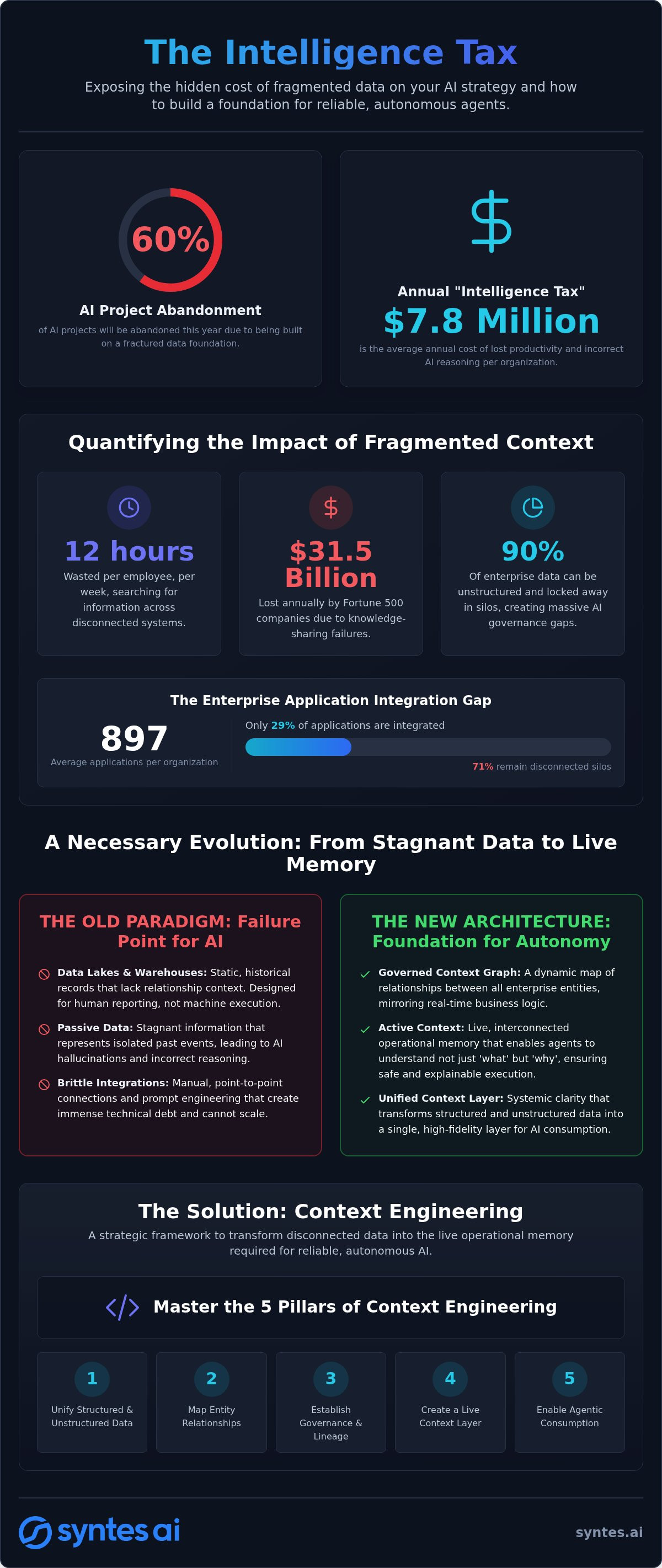
Beyond Connectivity: The 5 Pillars of the Syntes Context Engineering Framework
Traditional data integration is passive. It moves data from one location to another without addressing the underlying intelligence gap. Context Engineering is the strategic discipline of building trusted enterprise context. It’s a proactive architecture designed specifically for the reasoning requirements of agentic AI. To mitigate the cost of data silos, organizations must move beyond simple connectivity and toward a structured framework that prioritizes relationship-based intelligence. This framework ensures that every autonomous agent operates with the same depth of understanding as your most seasoned human experts.
The Syntes framework is built upon five foundational pillars:
- Connect: We integrate structured databases and unstructured document stores across the entire technical stack.
- Understand: Our platform discovers entities, maps complex relationships, and extracts deep business semantics.
- Contextualize: We build the live Context Graph, creating a dynamic enterprise model that reflects reality.
- Govern: Security, permissions, and business rules are applied directly at the context layer to ensure safety.
- Execute: We enable AI agents to reason over this trusted context to perform high-stakes operational actions.
This methodology transforms fragmented data into a unified asset. It replaces guesswork with deterministic logic. By engineering context at the architectural level, you eliminate the friction that typically stalls AI deployments.
Engineering Truth: How to Prevent AI Hallucination
The “Execute” pillar is where strategy meets performance. Governed agents don’t just retrieve text; they use enterprise memory to perform validated actions. This is the only path to truly Explainable AI. When an agent makes a decision, it must be able to trace its reasoning back to specific, governed business rules. This transparency is vital for high-stakes enterprise decisions where errors have significant financial consequences. You can learn more about How to Prevent AI Hallucination by architecting for deterministic truth. We prioritize reliability over probability.
Building a Live Operational Memory
Static repositories are snapshots of the past. A Context Graph evolves in real-time with every business event, transaction, and communication. This represents a fundamental shift from “Search” to “Reasoning” in enterprise AI platforms. Instead of merely finding a document, the platform understands how that document relates to current project timelines and budget constraints. Live Operational Memory is a continuously evolving graph of enterprise relationships that provides the high-fidelity grounding required for autonomous execution. It’s the only way to permanently lower the cost of data silos and reclaim your strategic momentum.
The Syntes AI Solution: Unifying Enterprise Intelligence with a Governed Context Graph
The fragmentation of knowledge is no longer a manageable inefficiency; it is a strategic liability. The Syntes AI Enterprise AI Platform serves as the definitive bridge between siloed data and autonomous execution. While competitors focus on passive data governance, we deliver Operational Relationship Intelligence. This isn’t about merely collecting data. It’s about understanding the complex web of dependencies that drive your business logic. By establishing a Governed Context Graph, we provide the high-fidelity grounding required to permanently eliminate the cost of data silos.
What is the fundamental difference between data intelligence and relationship intelligence? Traditional platforms tell you what happened. Syntes AI tells you why it happened and how it impacts your next move. This systemic awareness transforms the cost of data silos from a recurring expense into a competitive advantage for organizations that master their context. We provide the Enterprise Context Layer that allows agents to reason, not just retrieve. It’s time to move beyond the limitations of basic RAG and architect for true Agentic Intelligence.
Architecting for the Future of Agentic AI
How does an organization transition from fragmented repositories to a unified intelligence layer? Syntes AI integrates seamlessly with your existing ERP, CRM, and legacy systems to ingest both structured and unstructured information. We don’t require you to rip and replace your infrastructure. Instead, we apply Context Engineering to transform your dark data into a live Context Graph. This allows you to scale AI initiatives safely. Every agent operates within a strictly governed environment, ensuring that autonomous actions align with corporate policy and real-time operational reality.
Explore the Syntes AI Platform
Why Enterprise Leaders Choose Syntes AI
Enterprise leaders prioritize reliability over probability. Syntes AI delivers Trusted AI through explainable reasoning. Every action taken by our platform is traceable to a specific relationship within your proprietary Context Graph. This transparency is the cornerstone of our 100% enterprise-grade, governed infrastructure. Why settle for probabilistic guesses when you can have deterministic truth? The ROI is clear. By eliminating the “Intelligence Tax,” you reclaim the productivity lost to manual re-contextualization and failed AI reasoning. Syntes AI provides the Live Operational Memory required to turn fragmented knowledge into a singular, high-performance asset. We bring order to the messy realities of large-scale operations through sophisticated tools and informed action.
Reclaiming Strategic Momentum in the Agentic Era
Organizations can no longer afford the mounting cost of data silos. The transition from passive storage to active reasoning is the defining challenge for the modern enterprise. Traditional repositories served their purpose for human reporting, but they starve autonomous agents of the high-fidelity context required for execution. By implementing the five pillars of Context Engineering, you replace probabilistic guesswork with deterministic truth and systemic clarity.
The Syntes AI platform provides the Live Operational Memory and Governed Agentic AI framework necessary to scale safely. It ensures every decision is backed by Enterprise-grade Explainable AI. This architecture doesn’t just centralize information; it unifies intelligence across your entire operational stack. You possess the sophisticated tools to transform fragmented data into a singular, high-performance asset. It’s time to bridge the context gap and secure your competitive advantage.
The path to total operational clarity begins with a single architectural shift. We’re ready to help you lead it.
Frequently Asked Questions
What is the primary financial cost of data silos in 2026?
The primary financial cost of data silos in 2026 is the “Intelligence Tax,” which costs organizations an average of $7.8 million annually. This figure stems from lost productivity and failed strategic initiatives. Fortune 500 companies lose a combined $31.5 billion per year due to knowledge sharing failures. You’re essentially paying for human workers to act as the manual glue between disconnected systems. It’s a massive drain on resources that prevents the deployment of high-value AI agents.
How do data silos cause AI hallucinations in enterprise models?
Data silos cause AI hallucinations because they starve models of the specific business context needed for accurate reasoning. When an agent can’t access your proprietary data, it defaults to the general knowledge it learned during training. It starts making probabilistic guesses to fill the information gap. Without a unified context layer, the agent lacks the ground truth. This leads to confident but incorrect outputs that can cause significant operational damage in high-stakes environments.
Can a data lake solve the problem of fragmented data silos?
A data lake isn’t a solution for silos because it focuses on storage proximity rather than semantic connectivity. Simply moving data into a central repository doesn’t mean your AI understands the relationships between those data points. ETL processes often strip away the very context that makes the information useful for reasoning. You end up with a “data swamp” where knowledge is still fragmented. AI requires a relationship-based architecture to transform stagnant rows into actionable intelligence.
What is Context Engineering and why is it necessary for AI?
Context Engineering is the strategic discipline of building and governing the business context required for AI systems to reason accurately. It’s the necessary evolution beyond simple prompt engineering. Without it, AI agents lack the structured memory needed to execute complex tasks safely. By engineering a unified context layer, you provide a foundation for trusted, explainable AI. This practice ensures that every autonomous action is grounded in the specific realities and rules of your enterprise.
How does a Context Graph differ from a traditional Knowledge Graph?
A Context Graph differs from a traditional Knowledge Graph by serving as a live, operational memory that evolves in real time. Traditional graphs are often static representations of data. In contrast, a Context Graph integrates structured transactions and unstructured documents into a dynamic model of your business. It tracks relationships as they change, providing AI agents with a continuously updated understanding of the enterprise. This architecture prioritizes active, automated performance over passive observation.
What is the ROI of breaking down data silos for Agentic AI?
The ROI of eliminating the cost of data silos is found in the successful deployment of agentic workflows. Organizations currently abandon 60% of AI projects because of data issues. By unifying context, you reclaim the 12 hours per week employees waste searching for information across disconnected systems. Reliable AI execution reduces operational friction and allows for the automation of complex processes. This shift transforms your data from a storage burden into a high-performance strategic asset.
How does Syntes AI integrate with existing legacy systems?
Syntes AI integrates with existing legacy systems through two-way connectors and cross-system integrations. We don’t require you to replace your existing ERP or CRM infrastructure. Instead, our platform connects to these disparate sources to ingest both structured and unstructured data. By mapping these sources into a unified Context Graph, we bridge the gap between your legacy software and modern AI requirements. This ensures your proprietary data becomes accessible for autonomous reasoning.
Why is RAG (Retrieval-Augmented Generation) insufficient for complex enterprise reasoning?
RAG is insufficient for complex enterprise reasoning because it relies on simple document retrieval rather than relationship-based intelligence. It fetches snippets of text that match a query but lacks the ability to understand how those facts relate to broader business logic. For high-stakes decisions, agents need to navigate hierarchies and dependencies. Syntes AI moves beyond basic RAG by using a governed Context Graph. This provides the structured foundation needed for deterministic, explainable AI performance.