

Most enterprise AI initiatives are currently failing to move the needle because they are built on passive models that lack the authority to act. They observe. They summarize. They stall. While generative tools offer fleeting efficiency gains, they frequently succumb to hallucinations and remain trapped within fragmented data silos, unable to navigate the complex multi-step workflows that actually drive your bottom line. You already know that manual intervention is the primary bottleneck in your scaling efforts. It’s a costly, high-risk reality that prevents true operational agility and keeps your most expensive talent buried in repetitive coordination.
Realizing the strategic benefits of agentic ai in business requires a fundamental shift from reactive chatbots to autonomous intelligence powered by enterprise context graphs. This evolution replaces guesswork with deterministic reasoning and systemic integration. Discover how to transform your disconnected data into a proactive, governed force that executes cross-system tasks with precision. We’ll explore the transition from passive observation to active performance, providing a roadmap for deploying agents that reduce operational overhead through true, governed autonomy.
Key Takeaways
- Distinguish between passive generative tools and autonomous agents that perceive, reason, and execute complex tasks across your enterprise systems.
- Identify the primary benefits of agentic ai in business, focusing on the elimination of manual coordination through 24/7 autonomous workflow orchestration.
- Move beyond the limitations of standard RAG by implementing a Context Graph to provide your agents with a unified, real-time operational memory.
- Follow a structured strategic roadmap for implementation that prioritizes Context Engineering and cross-system integration to bridge persistent data silos.
- Deploy governed agents that deliver deterministic outcomes, ensuring every autonomous action is grounded in your specific enterprise logic and safety frameworks.
The Evolution of Agency: Defining Agentic AI for the Modern Enterprise
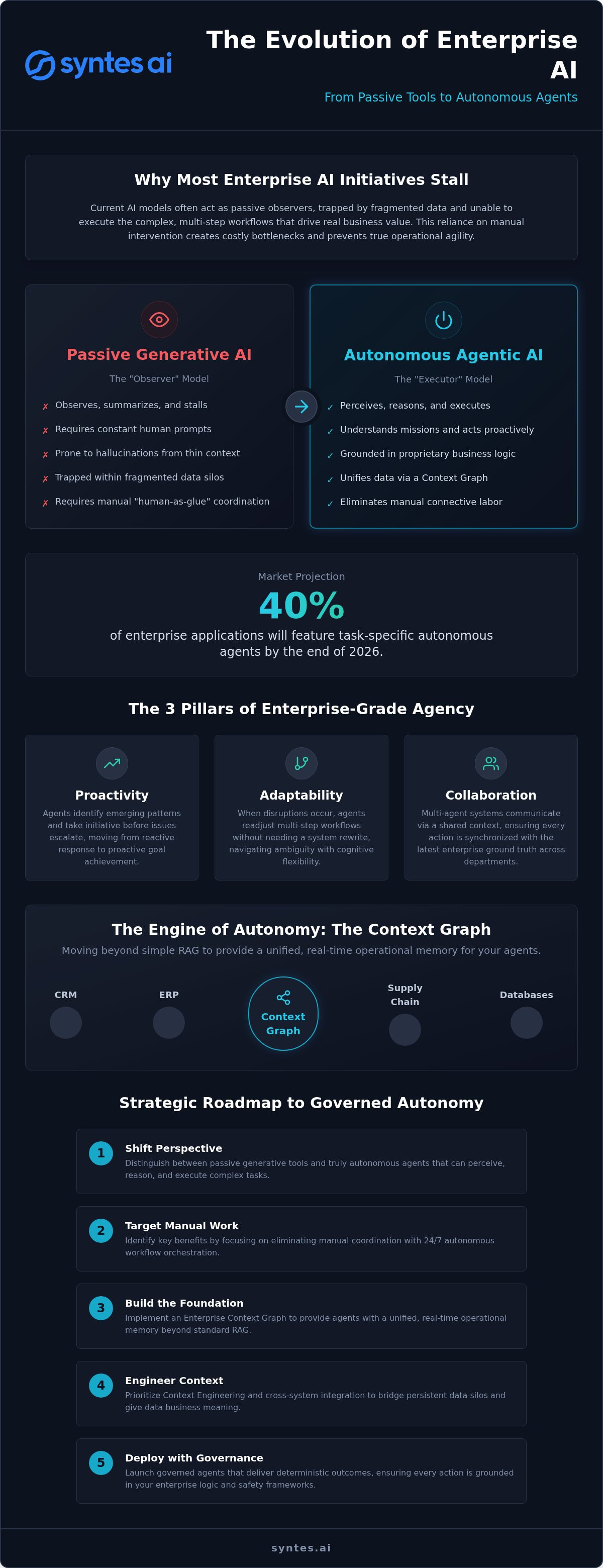
Enterprise leaders often mistake conversational interfaces for autonomous intelligence. This is a strategic error. Agentic AI is not a chatbot. It is an Intelligent Agent capable of perceiving its environment, reasoning through complex objectives, and acting within enterprise systems to achieve defined outcomes. Unlike Robotic Process Automation (RPA), which follows brittle, linear scripts, agentic systems possess the cognitive flexibility to navigate ambiguity. They don’t just follow rules. They solve problems. By the end of 2026, it’s projected that 40% of enterprise applications will feature these task-specific agents, marking a decisive shift in how organizations conceptualize labor and logic.
One of the primary benefits of agentic ai in business is the transition from reactive response to proactive goal achievement. This shift represents the true meaning of “Agency.” It moves the needle from a system that waits for a prompt to a system that understands a mission. To reach this level of reliability, organizations must move beyond simple prompt engineering toward Context Engineering. This discipline creates the structural foundation that allows an agent to understand not just the data, but the business semantics that give that data meaning.
From Chatbots to Governed Agents
Chatting is a recreational interface, not an operational one. High-stakes workflows require more than a text box; they require governed execution. Traditional Generative AI relies on passive information retrieval, which frequently leads to hallucinations when business context is thin. Agentic AI bridges this gap by grounding Large Language Models in proprietary business logic. This ensures that an agent doesn’t just summarize a supply chain delay. It initiates cross-system AI integration to reroute shipments and update inventory levels in real time. It transforms the AI from a passive advisor into an active participant in your operational value chain.
The Core Characteristics of Enterprise-Grade Agency
True agency is defined by three pillars: proactivity, adaptability, and collaboration. Proactive agents identify emerging patterns, such as a localized spike in churn, and take initiative before the issue escalates to the executive level. They are inherently adaptable. When a vendor fails or a regulation changes, they readjust multi-step workflows without requiring a complete system rewrite. Finally, multi-agent systems enable seamless collaboration across departments. These agents communicate via a shared Syntes AI Context Graph, ensuring that every action is synchronized with the latest enterprise ground truth. This is the end of the “human-as-the-glue” era of business operations.
Strategic Benefits: How Agentic AI Redefines Operational Efficiency
Efficiency in the modern enterprise is often misunderstood as the mere acceleration of individual tasks. True transformation occurs when the execution layer becomes autonomous. Currently, human employees act as the “glue” between disconnected systems, manually transferring data from an ERP to a CRM or interpreting status reports to trigger the next step in a supply chain. This manual coordination is a primary source of operational friction. One of the core benefits of agentic ai in business is the elimination of this connective labor. By utilizing the Syntes Agentic Platform, organizations can deploy multi-domain agents that orchestrate entire workflows without fatigue, operating 24/7 to ensure that no process stalls due to human unavailability.
The shift toward autonomy delivers accelerated ROI by collapsing the time between data observation and decisive action. While traditional automation requires a human to initiate a sequence, agentic systems possess the “Live Operational Memory” to recognize a need and execute the solution independently. As noted by Bain & Company on Agentic AI, these systems allow companies to reinvent workflows entirely rather than just making existing ones slightly faster. This scalability is unprecedented; an enterprise can deploy hundreds of specialized agents to handle surging operational demands without a linear increase in headcount or overhead.
Proactive Problem Resolution and Risk Mitigation
Reactive troubleshooting is a cost center. Agentic AI transforms risk management into a proactive discipline by serving as an “always-on” monitor for systemic anomalies. Whether it’s identifying a potential supply chain disruption before a shipment is missed or flagging financial discrepancies in real time, these agents take predictive action. For example, in complex logistics, an agentic system can optimize shift schedules or inventory levels dynamically as environmental conditions change. It doesn’t wait for a weekly report to highlight a shortage; it identifies the trend and initiates a restock order autonomously. If you are ready to see this level of precision in action, you can book a demo to explore our platform’s capabilities.
Empowering Human Talent with High-Level Reasoning
The goal of enterprise agency is not to replace human intelligence but to liberate it. By offloading repetitive cognitive tasks to autonomous agents, your workforce can pivot toward strategic innovation and high-level governance. This is the “Human-in-the-Loop” (HITL) model in its most sophisticated form. Agents handle the granular execution and cross-system data-gathering, while humans serve as the orchestrators who define the goals and guardrails. This transition allows your team to move from being “manual doers” to “agent orchestrators,” focusing on the creative and strategic challenges that drive long-term competitive advantage. The result is an organization that is both more lean and more intellectually capable. To help build the custom software required for this shift, you can check out HyperCode.
Standard Retrieval-Augmented Generation (RAG) is a flawed foundation for autonomous agents. It treats enterprise data as isolated snippets. While RAG functions adequately for simple information retrieval in chatbots, it collapses when an agent must reason across multi-step processes. This “fragmented knowledge” problem leads to agents that lack a coherent understanding of enterprise dependencies. To realize the full benefits of agentic ai in business, organizations must shift toward relationship-based intelligence. This requires a semantic data layer that provides agents with a definitive ground truth rather than a collection of disconnected text chunks.
The Syntes AI Context Graph serves as this critical “Live Operational Memory.” It unifies disparate data points into a structured map of organizational hierarchies, policies, and business rules. Unlike static databases, a context graph allows an agent to understand that a “customer” in the CRM is the same “debtor” in the ERP and the “subject” of a recent support ticket. This connectivity enables agents to navigate complex environments with the same nuance as a seasoned human operator. It transforms raw data into an actionable resource for autonomous execution.
Solving the Hallucination Problem in Autonomous Systems
Autonomous systems cannot afford to be creative. They must be deterministic. When an agent acts on erroneous data, the operational cost is immediate and severe. Knowledge graphs mitigate this risk by providing a structured framework that constrains the AI’s reasoning to verified facts. This architecture supports Explainable AI (XAI), offering a transparent audit trail for every decision the system makes. For a deeper dive into these technical safeguards, explore our guide on how to prevent AI hallucination. Reliability is not a luxury; it is the prerequisite for enterprise-grade agency.
Live Operational Memory vs. Static Databases
Real-time decision-making demands a continuously evolving context layer. Static databases are snapshots of the past. In contrast, a Live Operational Memory integrates structured data from ERPs and CRMs with unstructured insights from PDFs and internal policies. This unified reasoning layer is the secret to multi-agent collaboration. It allows diverse agents to share a common understanding of the environment, ensuring their actions are synchronized rather than conflicting. Operational Relationship Intelligence is what transforms a collection of individual tools into a cohesive, autonomous force capable of solving complex organizational problems.
Implementing Agentic AI: A Strategic Roadmap for Enterprise Leaders
Deploying autonomous systems requires more than a tactical software purchase. It demands a structural overhaul of how information is processed and authorized. To capture the full benefits of agentic ai in business, leaders must move beyond the pilot phase into a systematic four-phase deployment. This roadmap prioritizes data integrity and governed execution over the superficial allure of chat interfaces. It focuses on building a foundation that supports scale and reliability from day one.
Phase 1 begins with Context Engineering. You must map your enterprise context graph to define the specific business semantics that govern your operations. This creates the “ground truth” necessary for agents to reason. Phase 2 focuses on Integration. By utilizing cross-system AI integration, you bridge the disparate data silos that currently paralyze autonomous reasoning. Phase 3 introduces Agent Orchestration. Here, you define the goals, constraints, and “Human-in-the-Loop” checkpoints that ensure agents remain aligned with corporate objectives. Finally, Phase 4 addresses Governance and Auditing. You must establish the safety and security frameworks that permit autonomous action without compromising enterprise integrity.
Architecting for Secure Enterprise AI
Security is the ultimate gatekeeper for agency. Agents operating across sensitive business systems require a sophisticated permissions layer that goes beyond standard user access. Managing these controls within your enterprise AI infrastructure is non-negotiable. You don’t just need agents; you need Governed Agentic AI. This approach prevents unauthorized or risky actions by embedding compliance and security protocols directly into the agent’s reasoning path. It ensures that every autonomous step is traceable, authorized, and fully auditable.
Measuring ROI Beyond Simple Cost Savings
Measuring the strategic benefits of agentic ai in business requires a shift in perspective. Traditional ROI metrics often fail to capture the true value of autonomy. You must track “Autonomy Velocity.” This measures how quickly your system can resolve a complex, multi-step workflow without human intervention. Another critical metric is the reduction in “Decision Latency.” In large organizations, the delay between identifying a problem and executing a solution is a massive hidden cost. By automating the decision loop, you eliminate this lag. The long-term value lies in creating a reusable “Enterprise Intelligence Layer” that compounds in value as more systems are integrated into the context graph.
The Syntes Agentic Platform: Architecting Trusted Autonomous Systems
Redefine your operational baseline. Most enterprise AI tools are currently stalled in the retrieval phase, acting as sophisticated search engines rather than active participants. The Syntes Agentic Platform represents the necessary evolution of enterprise knowledge graphs, moving beyond static data representation into the realm of dynamic execution. It is the architectural answer to the limitations of standard generative models. By providing a Live Operational Memory, the platform ensures that every agentic action is grounded in the real-time truth of your business environment. This isn’t just about efficiency; it’s about shifting from passive AI experimentation to active operational intelligence.
Our platform operates on a proprietary five-stage framework designed for high-stakes enterprise environments. It’s a methodical progression from raw data to autonomous performance:
- Connect: Ingest structured and unstructured data through secure, two-way connectors.
- Understand: Map business semantics to identify entities and their complex relationships.
- Contextualize: Populate the Context Graph to create a unified reasoning layer.
- Govern: Apply enterprise-grade safety frameworks and access controls.
- Execute: Deploy agents that perform cross-system tasks with deterministic precision.
Harnessing the benefits of agentic ai in business requires more than a clever prompt. It requires a system that manages intent, authorization, and execution within a single, governed environment. It is time to stop chatting with your data and start putting it to work.
Trusted AI Execution with Governed Agents
Execution without accountability is a liability. Syntes AI provides an explainable reasoning layer for every agentic decision, ensuring that autonomous actions never occur in a “black box.” Our two-way connectors are the critical differentiator; they enable agents to not just read data from your ERP or CRM, but to perform authorized actions within them. This capability transforms the agent from a reporter into a doer. For organizations that demand enterprise-grade governance, our platform offers the transparency and control necessary to scale autonomy across sensitive, mission-critical business systems.
Building Your Live Context Graph
Success in the agentic era depends on your data’s architecture, not just the size of your model. This necessitates a shift from prompt engineering to Context Engineering as a core organizational competency. The Syntes platform unifies fragmented information from disparate silos, transforming it into a trusted intelligence layer that agents use to navigate ambiguity. We provide the tools to build a continuously evolving Context Graph that learns and adapts alongside your operations. Intelligence is only as powerful as the context it understands.
The Future of Autonomous Performance is Governed Context
The window for passive AI experimentation is closing. Organizations that rely on disconnected chatbots will be outpaced by competitors who embrace the true benefits of agentic ai in business. Leadership in this era requires a transition from superficial prompt engineering to rigorous Context Engineering. By unifying structured data from ERP and CRM systems with unstructured proprietary knowledge, you create a Live Operational Memory. This transforms AI from a passive observer into an active operational force.
The path forward is definitive. Move beyond simple automation toward a governed, deterministic architecture that prioritizes systemic integration and explainable reasoning. This isn’t just about reducing overhead; it’s about amplifying the strategic capacity of your entire enterprise.
As a leader in Context Engineering and Live Operational Memory, Syntes AI delivers the deterministic outcomes global enterprises require. Our platform ensures seamless integration across ERP, CRM, and legacy systems, providing the foundation for trusted execution. The transition to autonomous intelligence is the most significant operational evolution of the decade. It’s time to build the future your organization deserves.
Frequently Asked Questions
What is the difference between agentic AI and standard generative AI?
How does agentic AI provide measurable ROI for large businesses?
ROI is achieved by collapsing decision latency and eliminating manual connective labor between systems. One of the primary benefits of agentic ai in business is the reduction in operational overhead through the automation of complex, cross-departmental tasks. By deploying agents that operate 24/7, organizations can scale operations without a linear increase in headcount. Measurable impact is seen in Autonomy Velocity, where processes that previously took days are resolved in minutes.
Can agentic AI operate safely without constant human supervision?
Yes, provided it operates within a governed framework like the Syntes Agentic Platform. Safety is maintained through deterministic reasoning and strict access controls that limit an agent’s authority to specific systems. Instead of constant supervision, humans transition into orchestrators who define high-level goals and guardrails. This Human-in-the-Loop model ensures that agents execute tasks autonomously while remaining fully aligned with corporate policies and safety requirements. Governance is the prerequisite for trust.
What role does a knowledge graph play in preventing agentic AI hallucinations?
A knowledge graph provides a structured, semantic ground truth that constrains the AI’s reasoning to verified facts. Standard models often hallucinate when they lack specific context. By mapping the relationships between disparate data points, a knowledge graph ensures agents understand the precise meaning of enterprise information. This architecture enables explainable AI outcomes, allowing every autonomous decision to be audited against a reliable, live operational memory rather than probabilistic guesswork and fragmented data snippets.
Is agentic AI meant to replace RPA or enhance it?
Agentic AI is designed to enhance and evolve beyond the limitations of RPA. While RPA follows brittle, linear scripts that break when environments change, agentic systems possess the cognitive flexibility to adapt to ambiguity. They handle the high-level reasoning and decision-making that traditional automation cannot touch. By integrating agentic intelligence with existing RPA, businesses create a more resilient execution layer that manages both structured tasks and complex, multi-step problem solving across the organization.
What are the primary security risks when deploying AI agents in an enterprise?
The primary risks involve unauthorized system access and the potential for agents to act on unverified data. Without proper governance, autonomous agents could inadvertently expose sensitive information or execute risky financial transactions. To mitigate these risks, enterprises must implement robust AI Governance platforms that manage permissions and provide transparent audit trails. Secure deployment requires that every agentic action is authorized within a framework that prioritizes systemic integrity and access control over raw speed.
How does Context Engineering improve the performance of autonomous AI agents?
Context Engineering moves beyond simple prompt engineering by structuring the underlying data environment for agentic reasoning. It defines the business semantics and relationships that allow an agent to interpret information accurately across different systems. By providing a rich, multi-dimensional context, it ensures that agents can navigate complex hierarchies and policies. This foundational work is what allows an agent to move from generic information retrieval to precise, goal-oriented execution that respects your business logic.
What industries stand to benefit the most from agentic AI by 2026?
Logistics, financial services, and manufacturing are positioned for the most immediate gains. These sectors face high costs from manual coordination and fragmented data silos. By the end of 2026, it’s projected that 40% of enterprise applications will feature task-specific agents to manage these complexities. Companies in these industries will see the most significant benefits of agentic ai in business as they automate supply chain orchestration, fraud detection, and real-time inventory management with precision.