
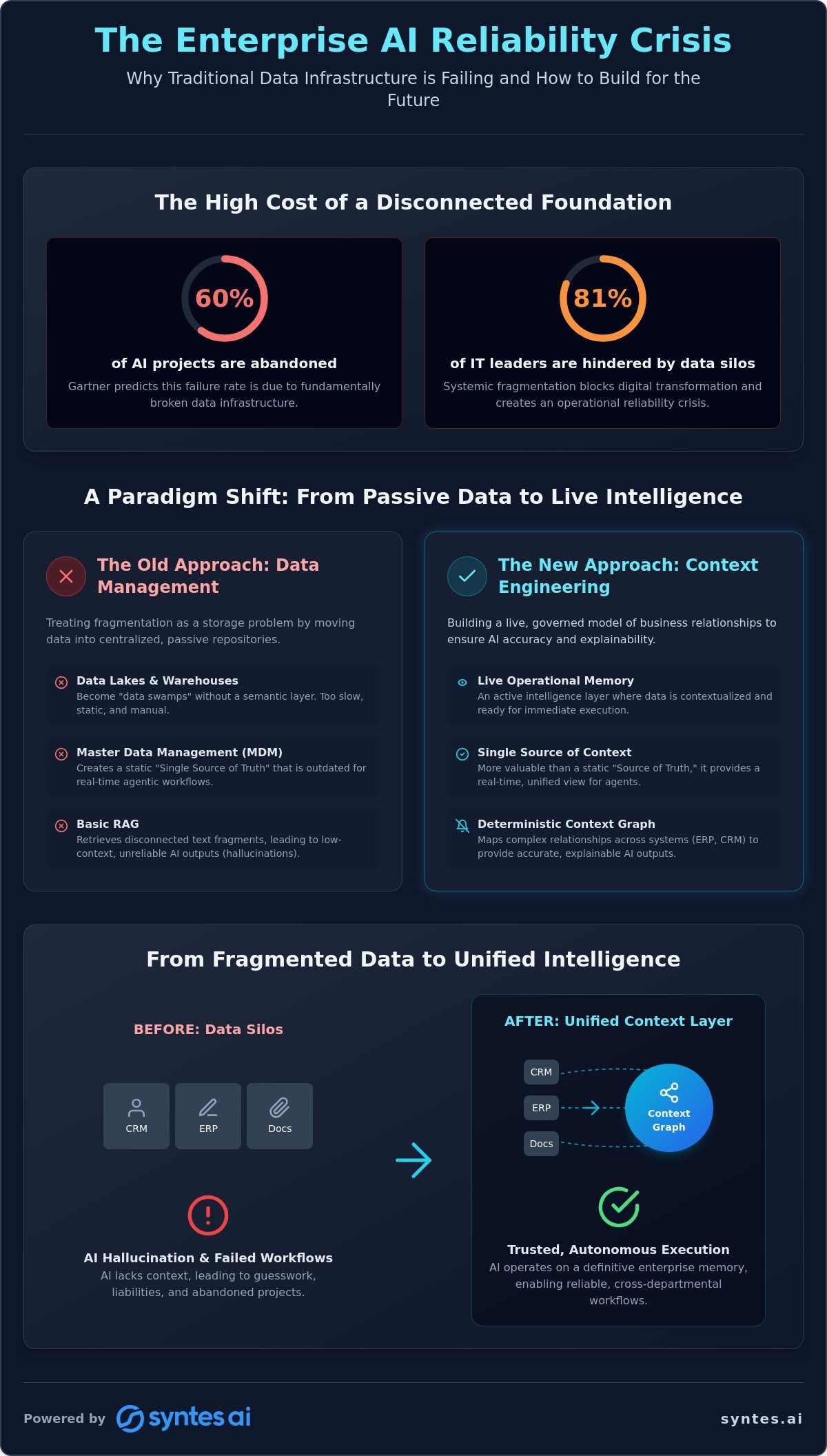
Gartner predicts that 60% of AI projects will be abandoned because the underlying data infrastructure is fundamentally broken. It’s a harsh reality for leaders who’ve spent decades building data lakes only to find their AI models hallucinating on the shores. The profound impact of data silos on AI initiatives has turned promising pilot programs into expensive, disconnected experiments. You’ve likely realized that simply moving data from one bucket to another doesn’t create intelligence; it just relocates the mess.
Traditional data unification has failed. It’s too slow, too manual, and too static for the speed of modern business logic. This article will show you why your existing stack is falling short and how to move toward a sophisticated Context Engineering framework. We’ll explore the transition from passive storage to a Live Operational Memory. You’ll discover how a deterministic context graph provides the “source of truth” necessary to execute autonomous, agentic workflows that actually scale across the enterprise.
Key Takeaways
- Stop treating fragmentation as a storage issue. Understand the severe impact of data silos on ai initiatives and why systemic fragmentation now presents a critical reliability crisis for enterprise intelligence.
- Move beyond traditional RAG. Learn how Context Engineering establishes a governed, semantic relationship model that ensures AI outputs are both accurate and explainable.
- Replace static Master Data Management with Live Operational Memory. Discover why a Single Source of Context is more operationally valuable than a traditional Single Source of Truth for agentic workflows.
- Synchronize fragmented knowledge across ERP and CRM systems. Master the transition from passive data observation to active, automated performance using continuous two-way connectors.
- Leverage the Syntes AI Context Graph. Establish a unified context layer that serves as the definitive enterprise memory for trusted, cross-departmental execution.
The Strategic Crisis of Enterprise Data Silos in the AI Era
Enterprise data silos are not merely an IT inconvenience. They represent a systemic fragmentation of institutional knowledge, where critical business logic is trapped within disconnected repositories. These information and data silos prevent a cohesive view of the enterprise, creating a landscape where departments operate on partial truths. In the era of simple predictive analytics, this was a reporting nuisance. In the era of Generative AI, it is an existential threat to operational reliability.
We are witnessing a mandatory shift in how organizations perceive their data. It is no longer enough to store information in passive repositories. High-performing enterprises are moving toward active, relationship-based intelligence layers. This transition ensures that data is not just present but is contextualized and ready for immediate execution. Without this evolution, AI remains a speculative experiment rather than a core driver of business value.
The Failure of Traditional Unification
Data lakes have reached their limit. Without a semantic layer to provide meaning, these repositories quickly devolve into “data swamps” where information is stored but never understood. Manual ETL processes cannot keep pace with high-velocity operational environments. They’re too rigid. They’re too slow. This creates Knowledge Debt: the cumulative cost of inaccessible business context that forces organizations to pay a premium for every AI interaction. Every hour your engineers spend manually mapping data is an hour lost to your competitors.
Silos as a Barrier to Agentic Intelligence
Autonomous agents represent the next frontier of enterprise efficiency, yet they cannot function in a fragmented environment. They require a unified context layer to navigate complex, cross-system tasks. An agent cannot execute a cross-departmental workflow if it cannot bridge the gap between a CRM record and an ERP invoice. Fragmented environments lead to low-context AI that fails at the point of execution. Transitioning to real-time AI performance requires moving from data-at-rest to context-in-motion, where every piece of information is part of a live, operational intelligence layer that scales across the entire enterprise.
Beyond Integration: The Shift from Data Management to Context Engineering
Centralized storage is a relic. While legacy vendors argue that a unified lakehouse is the final destination, they ignore the devastating impact of data silos on ai initiatives. Moving data is not the same as understanding it. Context Engineering is the mandatory discipline of building and governing business context to ensure AI accuracy. It represents a strategic pivot from passive data management to active operational intelligence. This approach transcends traditional Retrieval-Augmented Generation (RAG) by providing a deterministic relationship model rather than just a list of similar text fragments.
The Enterprise Knowledge Graph serves as the technical backbone of this shift. It maps complex business relationships. It bridges the gap between structured transactions in an ERP and unstructured insights in legal documents. This creates a single semantic model. It allows your AI to understand that a “Customer ID” in one system is the same “Strategic Partner” mentioned in a contract elsewhere. By unifying these disparate signals, you resolve the fragmentation that typically limits impact of data silos on AI readiness.
The Five Pillars of Context Engineering
True operational clarity requires a structured framework. Our methodology focuses on these critical phases:
- Connect and Understand: Automate the discovery of entities, relationships, and hierarchies across all disparate systems.
- Contextualize and Govern: Build a dynamic model with strict security and compliance protocols to ensure data integrity.
- Execute: Enable AI agents to reason over a trusted, live enterprise memory for immediate, informed action.
This framework ensures that your AI doesn’t just process data. It understands your business. If you’re ready to see how a unified context layer can transform your operations, you can explore our agentic platform today.
GraphRAG: The Evolution of Semantic Search
Standard vector search is insufficient for complex reasoning. It finds similar words but lacks the logic to connect them. GraphRAG is the evolution. By utilizing graph structures, AI can traverse relationships to uncover deeper insights that vector-only methods miss. This provides deterministic grounding in a live Context Graph. It is the most effective way to how to prevent ai hallucination in high-stakes environments. GraphRAG directly addresses the negative impact of data silos on ai initiatives by providing a cross-system map of institutional knowledge. When your AI relies on a relationship-aware memory, it stops guessing and starts knowing.
Breaking the Silo Cycle: Why MDM and Data Warehouses Fall Short
Why do your AI initiatives still fail despite a multi-million dollar data warehouse? Because warehouses are built for humans to query, not for machines to reason. The impact of data silos on ai initiatives remains high because traditional architectures focus on centralizing storage while ignoring the relationships between the data points. Moving data into a single bucket doesn’t make it unified; it just makes the fragmentation harder to see. Legacy systems create technical lock-in. They trap business logic in proprietary schemas. This prevents agile AI deployment and forces your team into a cycle of constant, manual data preparation.
The “Single Source of Truth” is a myth that has outlived its utility. What your enterprise actually requires is a Single Source of Context. While Master Data Management (MDM) focuses on deduplicating records, it fails to capture the dynamic interactions between those records. A record is a static fact; context is a live relationship. The risks are particularly acute in high-stakes environments where data silos and AI-driven security gaps can lead to catastrophic blind spots in threat detection and compliance. You don’t need another repository. You need an orchestration layer that understands your business logic.
Static Data vs. Living Context
Periodic batch updates are the enemy of real-time intelligence. When an enterprise relies on nightly ETL runs to populate its warehouse, it creates a latency gap that renders AI agents ineffective at the point of decision. This lag is a primary driver for the negative impact of data silos on ai initiatives, as models train on stale information that no longer reflects operational reality. Transitioning to an enterprise knowledge graph allows you to move from isolated records to relationship-based intelligence that updates in real-time. It’s the difference between reading a map and using a live GPS.
The Semantic Layer Advantage
A semantic layer decouples your business logic from physical storage limitations. It allows you to define what an “Asset” or “Customer” means once, and apply that definition across every system. This architecture enables Human-in-the-Loop systems by providing explainable AI reasoning. Instead of a “black box” output, your team receives an audit trail of how the AI reached its conclusion. Implementing a semantic data layer for enterprise ensures that your AI is grounded in deterministic truth, reducing friction and building the trust necessary for full-scale autonomous execution.
Architecting a Live Operational Memory for Agentic Intelligence
Architecting for AI requires more than a strategic vision; it requires a structural overhaul of how institutional memory is accessed and utilized. The negative impact of data silos on ai initiatives is often a direct result of architectural passivity. To move from fragmentation to agentic intelligence, organizations must transition to a proactive framework. This is not about building another repository. It is about building an orchestration layer that functions as a live enterprise brain. Success requires a methodical, four-step execution plan.
- Step 1: Inventory Fragmented Knowledge. Map the landscape. Identify where critical business logic resides across ERP systems, CRM platforms, and unstructured silos like legal contracts or technical manuals.
- Step 2: Implement Two-Way Connectors. Establish a heartbeat. Deploy continuous synchronization layers that ensure data doesn’t just flow into the context layer but remains updated in real-time as operational events occur.
- Step 3: Build the Context Graph. Connect the nodes. Use an Enterprise Knowledge Graph to discover hidden operational relationships that traditional relational databases ignore.
- Step 4: Deploy Governed AI Agents. Execute the logic. Launch autonomous agents that reason over this live context to perform cross-departmental tasks with deterministic accuracy.
If your organization is ready to bridge the gap between static storage and active execution, schedule a technical deep-dive with our team today.
Creating a Continuously Evolving Memory
A static database is a snapshot of the past. For industries like supply chain and financial services, where a 15-minute delay can cost millions, a snapshot is insufficient. You need a Live Operational Memory. This architecture integrates real-time operational events directly into the core enterprise context. It ensures that when a shipping delay occurs in your ERP, the AI agent managing customer success in your CRM is immediately aware. Building this level of responsiveness requires a modern enterprise ai infrastructure designed for high-concurrency, low-latency reasoning.
Governing the Agentic Workflow
Autonomy without oversight is a liability. To mitigate the impact of data silos on ai initiatives, governance must be baked into the context layer itself. Apply business rules and safety policies directly to the relationship model. This ensures that every decision made by an autonomous agent is auditable and explainable. When an AI can point to the specific semantic relationship it used to reach a conclusion, trust increases. Solving enterprise data silos is ultimately a journey toward total operational clarity, where every automated action is grounded in your organization’s unique business logic and compliance standards.
Syntes AI: Unifying Fragmented Knowledge into Actionable Intelligence
The era of speculative AI experimentation has reached its conclusion. Organizations can no longer afford the negative impact of data silos on ai initiatives, as fragmented knowledge continues to derail even the most ambitious automation goals. The Syntes AI Platform represents the definitive evolution in Enterprise Intelligence. It replaces the chaos of disconnected systems with a unified Context Graph. This is not just another repository. It is a live operational memory that unifies fragmented knowledge into a single, actionable intelligence layer that scales across the entire organization.
True transformation requires more than observation; it requires execution. The Syntes AI Agentic Platform empowers your organization to move from passive insights to autonomous performance. By leveraging a unified context layer, AI agents can navigate complex business logic across departments without the risk of deviation or error. This represents a fundamental shift from Black Box AI to trusted, explainable enterprise intelligence. When your AI can reason over a deterministic relationship model, it stops being a liability and starts being a strategic asset.
The Syntes AI Advantage
Why settle for prompt engineering when you can engineer the environment? Our platform provides proven cross-system integrations for both structured transactions and unstructured documents at scale. We provide deterministic grounding. This eliminates the hallucinations that plague standard RAG models by ensuring every AI response is rooted in a verified Context Graph. Syntes AI is the necessary evolution for leaders who demand certainty over probability. We bridge the gap between disparate data points to create a cohesive, real-time map of your institutional knowledge. It is the only way to neutralize the impact of data silos on ai initiatives while building a foundation for future-proof automation.
Scaling AI with Confidence
Fragmented data is the primary bottleneck to enterprise scale. A shared context layer removes this friction. It allows for the rapid deployment of new AI capabilities without the need to rebuild underlying logic for every specific use case. The future of the autonomous enterprise is powered by this shared memory. It enables a state of total operational clarity where human experts and AI agents collaborate within a single, governed framework. The transition from fragmentation to context is not optional; it is the prerequisite for survival in an AI-driven market. It’s time to stop managing silos and start engineering intelligence. Architect your Live Operational Memory with Syntes AI and secure the foundation for your agentic future.
Securing the Foundation for the Autonomous Enterprise
The transition from fragmented data to agentic context is a mandatory evolution for the modern enterprise. We’ve established that the profound impact of data silos on ai initiatives cannot be solved by simply relocating data to a central warehouse. It requires a fundamental shift toward Context Engineering. By implementing an Enterprise Knowledge Graph, organizations move beyond the limitations of static snapshots and into a state of live operational intelligence. This ensures that every automated action is grounded in deterministic truth rather than statistical guesswork.
As pioneers of the Context Engineering Framework, Syntes AI provides the technical mastery required to eliminate hallucinations and unify institutional knowledge across Manufacturing, Finance, and Retail. Our platform doesn’t just manage data; it creates a shared memory for autonomous execution. The path to a trusted, scalable AI strategy is clear. It begins with the decision to stop managing fragmentation and start engineering context. You’ve identified the systemic flaws in the current market; now it’s time to deploy the solution.
Architect your Live Operational Memory with Syntes AI and lead your organization toward total operational clarity. The future of enterprise intelligence is yours to command.
Frequently Asked Questions
How do data silos impact the accuracy of AI models?
Data silos force AI models to rely on incomplete datasets, leading to flawed inferences and high hallucination rates. The negative impact of data silos on ai initiatives is primarily seen in the erosion of trust; when models lack cross-departmental context, they generate outputs based on statistical probability rather than business reality. This fragmentation prevents the model from understanding the relationship between disparate signals, such as how a supply chain delay in an ERP system affects customer sentiment in a CRM.
What is the difference between a Data Lake and a Context Graph?
A Data Lake is a passive storage repository for raw data, whereas a Context Graph is an active, relationship-based intelligence layer. While lakes focus on the volume of data-at-rest, a Context Graph maps the semantic connections between entities in real-time. This creates a Live Operational Memory that allows AI agents to reason over current business logic instead of querying a static “data swamp” that lacks meaning and structure.
Can Context Engineering work with legacy ERP and CRM systems?
Context Engineering is specifically designed to bridge the gap between modern AI and legacy ERP or CRM systems. By implementing two-way connectors, organizations extract institutional knowledge from fragmented silos without requiring a full system replacement. This process unifies structured data from platforms like SAP or Salesforce with unstructured documents into a single, cohesive Context Graph ready for autonomous execution and real-time reasoning.
How does an Enterprise Knowledge Graph solve the data silo problem?
An Enterprise Knowledge Graph solves the data silo problem by creating a unified semantic layer that decouples business logic from physical storage. Instead of moving data into a new bucket, it maps the relationships between existing data points across the organization. This architecture provides a deterministic source of context, allowing AI to navigate complex workflows that span multiple departments with total operational clarity and zero data duplication.
What are the security implications of unifying enterprise data for AI?
Unifying data for AI requires a shift toward AI Governance where security protocols are applied directly to the context layer. Centralizing access through a Knowledge Graph actually improves security by providing a single point of auditability and fine-grained access control. This prevents unauthorized data exposure and ensures that autonomous agents operate within strict compliance boundaries, which is critical for mitigating the negative impact of data silos on ai initiatives in regulated industries.
How does Syntes AI prevent AI hallucinations in large organizations?
Syntes AI prevents hallucinations through deterministic grounding in a Live Operational Memory. Unlike standard models that guess based on training data, our platform forces the AI to verify its reasoning against the Enterprise Knowledge Graph before generating an output. This ensures that every response is grounded in real-time business facts, providing the explainability and audit trails required for high-stakes enterprise decision-making and automated execution.
What is the ROI of solving data silos with Agentic AI?
The ROI of solving silos with Agentic AI is realized through reduced operational friction and the total elimination of manual ETL processes. By automating cross-system workflows, organizations can reallocate up to 80% of the time previously spent on data preparation toward high-value strategic tasks. This leads to faster decision cycles, lower labor costs, and the ability to execute complex, real-time operations that were previously impossible in fragmented, low-context environments.
Is a semantic layer necessary if we already use RAG?
A semantic layer is essential because standard Retrieval-Augmented Generation (RAG) lacks the relationship awareness needed for complex reasoning. RAG typically relies on vector search, which finds similar words but doesn’t understand business hierarchies or logic. A semantic layer provides the deterministic framework that RAG requires to move from simple document retrieval to sophisticated, relationship-aware intelligence that actually understands the underlying business logic of your enterprise.