

Static knowledge graphs are the architectural equivalent of a data graveyard. If your system cannot navigate a billion entities with sub-second latency, it is not an intelligence layer; it is a liability. You have likely witnessed the performance degradation that occurs during deep traversals or the failure of manual ETL pipelines to keep pace with modern data velocity. Scaling enterprise knowledge graphs is no longer a theoretical exercise for R&D. It is a mandatory evolution for any organization requiring live operational memory.
We recognize the friction of fragmented context across disconnected silos and the high latency that cripples real-time AI applications. This guide will help you master the architectural strategies and governance frameworks required to transform fragmented pilots into high-performance systems. You will learn the roadmap for horizontal graph scaling, high-performance AI grounding through GraphRAG, and the methodology of Context Engineering to support autonomous AI agents. It’s time to move beyond passive observation and toward active, automated performance.
Key Takeaways
- Identify the “Connectivity Explosion” and supernode bottlenecks that transform traditional graphs into performance liabilities at scale.
- Deploy topology-aware partitioning and hybrid architectures to ensure distributed traversals remain efficient across billion-entity environments.
- Master the five pillars of Context Engineering to bridge the gap between static data repositories and high-performance, scaling enterprise knowledge graphs.
- Standardize semantic governance through RDF and SPARQL to provide a unified, governed foundation for seamless cross-system integration.
- Transition to a live operational memory that empowers autonomous AI agents to reason and act with total clarity across the enterprise ecosystem.
The Scale Paradox: Why Traditional Enterprise Knowledge Graphs Fail in Production
Most organizations treat enterprise knowledge graphs as static maps. This is a strategic error. A truly scalable graph is a dynamic, high-velocity intelligence layer. It doesn’t just store facts; it mediates action. When you reach the billion-entity threshold, the architecture of your graph determines whether your AI succeeds or stalls. Traditional systems built on legacy foundations inevitably crumble under the weight of real-time operational demands. They were designed for discovery, not for execution.
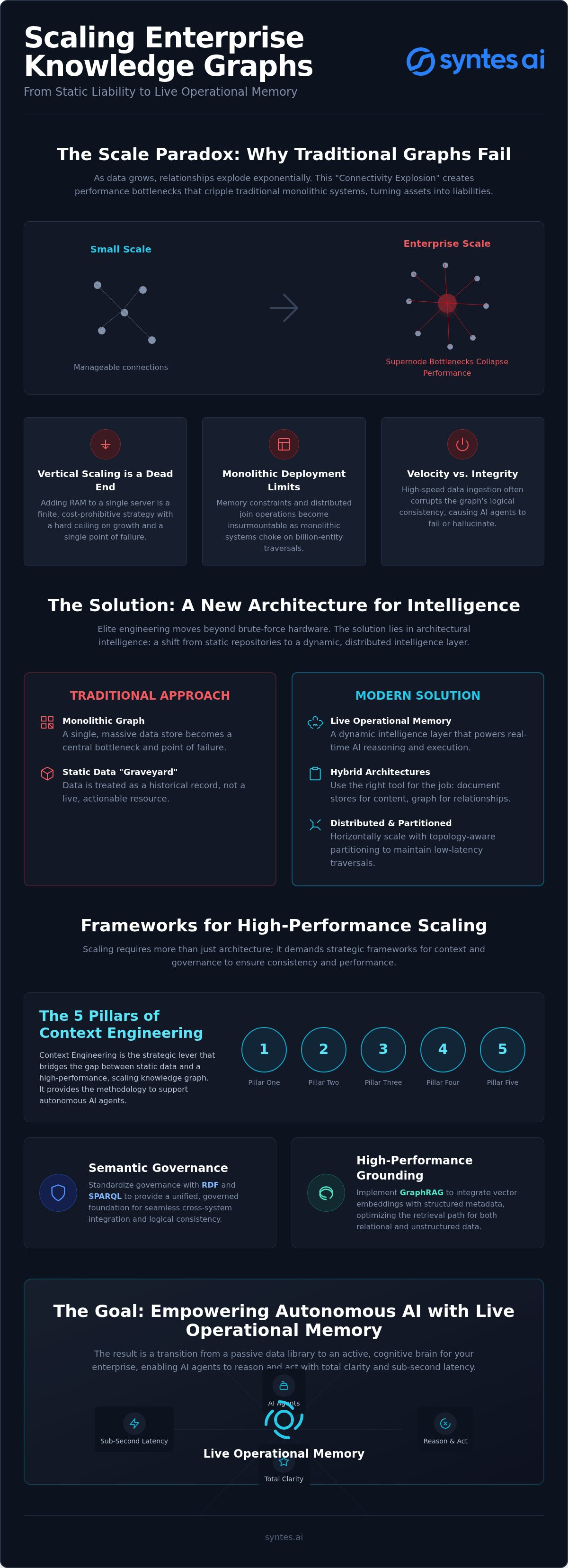
The “Connectivity Explosion” is the primary architect of this failure. As your data grows, the relationships between entities do not scale linearly; they explode. Highly connected nodes, often called supernodes, act as physical bottlenecks within the system. Standard query engines choke when attempting to traverse these hubs. Performance doesn’t just dip; it collapses. This is the Scale Paradox: the more useful your data becomes through high connectivity, the harder it is for traditional systems to retrieve it. Scaling enterprise knowledge graphs requires an architecture that anticipates these dense clusters rather than reacting to them.
Vertical scaling is a dead end. Adding RAM to a single, massive server is a finite, cost-prohibitive strategy that global enterprises cannot sustain. It creates a single point of failure and a hard ceiling on growth. True intelligence requires a transition from passive data storage to Live Operational Memory. This is the evolution from a system that records the past to one that powers real-time AI reasoning. It is the difference between a library and a brain.
The Limits of Monolithic Graph Deployments
Monolithic deployments hit the wall of distributed join operations almost immediately at scale. Memory constraints become insurmountable when every query requires loading massive subgraphs into cache. Schema-on-read approaches, while flexible in theory, struggle with the computational overhead of billion-entity traversals. General-purpose graph databases often fail because they prioritize broad compatibility over the specialized, low-latency requirements of agentic AI. They lack the precision required for deep reasoning across a distributed architecture.
Data Velocity vs. Semantic Integrity
Managing real-time ingestion without corrupting the underlying ontology is the ultimate test of a system. You cannot sacrifice semantic integrity for the sake of ingestion speed. If the graph loses its logical consistency, the AI agents relying on it will hallucinate or fail. The challenge lies in maintaining strict data governance while supporting the high-throughput requirements of modern enterprises. Balancing these two forces is essential for scaling enterprise knowledge graphs into functional, live environments. It requires a move toward governed execution where every update is validated against the enterprise context in milliseconds.
Architecting for Billions: Hybrid Models and Topology-Aware Partitioning
Hardware is a commodity. Architecture is the differentiator. While mediocre teams attempt to solve performance bottlenecks by throwing more cloud compute at the problem, elite engineering requires a move toward architectural intelligence. Scaling enterprise knowledge graphs at the billion-entity level is impossible within a monolithic framework. The physics of distributed systems dictate that as your graph grows, the cost of data movement eventually outweighs the benefits of connectivity. You must minimize the distributed “hop” costs to maintain the low-latency reasoning required for agentic AI.
Recent academic research on scaling knowledge graphs confirms that industrial-scale deployments require a shift toward heterogeneous environments. Modern GraphRAG architectures succeed by integrating vector embeddings with structured graph metadata. This isn’t just about storage; it’s about optimizing the retrieval path. By unifying these disparate data types into a single context layer, you eliminate the systemic friction that traditionally separates unstructured content from its relational meaning.
Hybrid Architectures for Enterprise Intelligence
Stop forcing every data point into a graph store. Use document stores for the heavy lifting of unstructured content and reserve the graph for high-value relationship metadata. This hybrid approach creates a Unified Context Layer that bridges the gap between raw data and actionable intelligence. To achieve sub-second reasoning, you should leverage in-memory graph accelerators. These tools bypass traditional disk I/O bottlenecks, allowing for the rapid execution of complex, multi-hop queries that would otherwise cripple a standard relational database. It’s about moving from passive storage to active, operational memory.
Partitioning Strategies: Reducing Distributed Traversal Costs
Horizontal scaling is the only path to billion-entity intelligence, but sharding introduces its own set of challenges. If your shards aren’t aligned with your business domains or entity hierarchies, you’ll trigger global locks that destroy performance. Effective scaling enterprise knowledge graphs requires a strategy that keeps related data physically close. Topology-aware partitioning is the strategic placement of related nodes on the same physical hardware to optimize query speed. By minimizing cross-shard communication, you ensure that deep traversals remain local and lightning-fast.
- Domain-Driven Sharding: Align your physical data distribution with actual business usage patterns to reduce network overhead.
- Lock-Free Concurrency: Implement optimistic concurrency control to handle high-velocity updates without stopping the world.
- Locality Optimization: Group supernodes with their immediate neighbors to prevent the “supernode bottleneck” from impacting the entire cluster.
If your current infrastructure is struggling to maintain semantic integrity at scale, it’s time to see how a live operational memory handles billion-scale workloads without the typical latency penalties of legacy systems.
Context Engineering: The Strategic Lever for Scaling Semantic Intelligence
Data engineering is a solved problem. Moving bits from point A to point B is a matter of plumbing. However, scaling enterprise knowledge graphs requires a more sophisticated discipline: Context Engineering. This is the strategic methodology of architecting meaning within a high-velocity data environment. It moves beyond the mere ingestion of entities to the active curation of operational relevance. It’s the difference between a warehouse of data and a live intelligence layer.
True semantic intelligence at scale relies on five foundational pillars:
- Connect: Establishing real-time pipelines across disparate ERP, CRM, and cloud systems.
- Understand: Extracting semantic meaning from both structured and unstructured sources.
- Contextualize: Mapping relationships to specific business processes and operational goals.
- Govern: Enforcing technical policies that ensure data fidelity and security.
- Execute: Enabling AI agents to perform autonomous actions based on the graph’s reasoning.
From Prompt Engineering to Context Engineering
Retrieval-Augmented Generation (RAG) is a temporary bridge, not a destination. While RAG provides a basic mechanism for grounding LLMs in documents, it fails when faced with complex enterprise reasoning that spans billion-entity networks. You cannot solve systemic intelligence through better prompts. You solve it by architecting a Context Graph that provides deterministic ground truth. This transition from document-retrieval to relationship-based intelligence is what separates experimental pilots from high-performance operational memory. It transforms AI from a conversational novelty into a functional executive tool.
Operational Relationship Intelligence at Scale
Hidden entities and obscured hierarchies are the norm in global enterprises. Your ERP and CRM systems are filled with disconnected data points that only gain value when contextualized within a live model. Context Engineering allows you to maintain an active, evolving model of business rules, policies, and operational events. This ensures that AI agents aren’t just guessing based on general patterns but are operating within a governed, high-fidelity context layer. It’s about building a system that understands the business as it exists in this second, not as it was recorded last quarter. Scaling enterprise knowledge graphs is ultimately a pursuit of operational clarity.
From Pilot to Production: A Framework for Scaling Graph Governance
Governance in the enterprise is often treated as a bureaucratic hurdle. This is a strategic mistake. When you are scaling enterprise knowledge graphs to billions of entities, governance must be an automated technical reality. It’s the difference between a system that performs in a controlled lab and one that survives the chaotic velocity of production. You need programmatic access points that allow for seamless cross-system integration while enforcing strict semantic standards. This isn’t about writing policies; it’s about engineering constraints.
Standardizing ontologies using RDF and SPARQL provides the necessary logical structure for global interoperability. However, you must allow for local schema flexibility to accommodate the unique requirements of different business units. Rigidity at scale leads to system breakage. Instead, automate your validation checks. Analytics processes should run continuously to maintain data integrity across the cluster. If the data serves as the ground truth for your AI, that truth must be verifiable in real-time. This requires moving beyond manual oversight to a system of automated enforcement.
The Governance Roadmap for Billion-Entity Graphs
Success at scale follows a methodical progression. Step 1 involves defining “Reasoning Boundaries” to prevent AI agents from wandering aimlessly through a billion nodes. Step 2 requires implementing automated metadata tagging and entity resolution. Manual tagging is a relic of the past that cannot survive modern data volumes. Finally, Step 3 focuses on developing a “Live” audit trail. You must possess the capability to trace every AI agent decision back to its specific data provenance. This level of transparency is non-negotiable for high-stakes enterprise operations.
Ensuring AI Model Reliability through Semantic Grounding
Large language models are inherently probabilistic and prone to error. You can prevent AI hallucination by grounding your models in a deterministic graph. This creates a logical anchor for the AI, forcing it to reason within the bounds of verified enterprise facts. Managing the trade-off between semantic inference depth and real-time performance is a constant architectural challenge. You must govern the “Execution Layer” to ensure that autonomous agents follow enterprise policies without exception. Implementing human-in-the-loop systems for high-variance actions provides the final layer of security in an otherwise automated ecosystem.
Live Operational Memory: Syntes AI’s Approach to Agentic Scaling
Passive data repositories are a relic of the past. If your graph exists simply to be queried by human analysts, you’ve failed to capture the actual value of your architecture. The Syntes AI Context Graph serves as a Live Operational Memory, providing a high-fidelity foundation for autonomous execution. Scaling enterprise knowledge graphs in this environment isn’t about building larger data lakes; it’s about engineering deeper operational relevance. We provide the substrate for agents that don’t just find information but act upon it across your entire enterprise ecosystem. This is the transition from passive observation to active, automated performance.
The strategic shift toward agentic intelligence requires a system that can reason at the speed of business. While traditional models struggle with latency during deep traversals, our architecture ensures that billion-entity networks remain responsive. We’ve moved beyond the limitations of static insights. By unifying enterprise data silos into a single, actionable operational memory, we eliminate the friction that traditionally cripples large-scale AI initiatives. You are no longer managing disconnected data points; you are managing a unified intelligence layer.
The Syntes Agentic Platform and Knowledge Graph
Our platform deploys governed agents capable of reasoning over billion-entity Context Graphs with deterministic precision. These agents don’t operate in a vacuum. They perform seamless cross-system integrations across your existing software stack, bridging the gap between ERP, CRM, and cloud environments. We’ve solved the “black box” problem of standard AI through rigorous explainability. Every action taken by an agent can be audited through explicit semantic pathways within the graph. This is the new standard for enterprise AI infrastructure, where proactive agents replace the need for manual intervention and static dashboards.
Scaling Trust: The Next Evolution of Enterprise Intelligence
Intelligence is only as smart as the context it understands. Fragmented data leads to fragmented logic, which ultimately leads to system failure at scale. Scaling enterprise knowledge graphs requires more than just technical capacity; it requires a framework for trust. By transforming fragmented data into trusted, live operational intelligence, we enable your organization to move with certainty. The future belongs to those who can unify their context and automate their execution. It is time to move past theoretical experimentation and toward total operational clarity.
The roadmap to high-performance operational memory is clear. It begins with a commitment to architectural excellence and ends with a fully autonomous enterprise. Don’t let your data remain a static liability. Build your enterprise context layer with Syntes AI and secure the future of your agentic execution.
The Mandate for Operational Intelligence
The era of static data repositories is over. Organizations that fail to transition from passive storage to a live operational memory will find themselves outpaced by competitors leveraging autonomous, context-aware systems. Mastering the art of scaling enterprise knowledge graphs requires a fundamental shift in perspective. You must prioritize topology-aware partitioning and hybrid architectures to overcome the physical limits of distributed data. You must embrace Context Engineering as the technical discipline that transforms raw entities into actionable intelligence.
True enterprise scale is not just about the volume of your data. It’s about the speed and reliability of the reasoning performed upon that data. By grounding your AI in a deterministic, billion-entity Context Graph, you eliminate hallucination and ensure every agentic action is backed by explainable AI reasoning. The governed Syntes Agentic Platform provides the execution layer necessary to move from fragmented pilots to high-performance operational reality. It’s time to stop observing and start executing.
The future of your enterprise depends on the clarity of its context. Take the first step toward a unified, agentic intelligence layer today.
Frequently Asked Questions
What is the primary bottleneck when scaling an enterprise knowledge graph?
The primary bottleneck is the “Connectivity Explosion” where supernodes cripple standard query performance during deep traversals. As relationships grow non-linearly, distributed join operations hit a physical memory wall. Traditional vertical scaling fails to address the underlying computational complexity of billion-scale networks. You must move toward topology-aware partitioning to keep related data physically proximate and minimize network latency across the cluster.
How does a Context Graph differ from a traditional graph database at scale?
A Context Graph serves as a live operational memory designed for agentic execution, whereas traditional graph databases focus on static storage and human-led discovery. Traditional systems prioritize broad compatibility and discovery. A Context Graph prioritizes real-time relevance and deterministic grounding for AI agents. It bridges the gap between raw data and automated performance by providing a unified layer for reasoning.
Can GraphRAG effectively handle billion-entity datasets for AI grounding?
GraphRAG can effectively handle billion-entity datasets provided the architecture utilizes a hybrid graph-vector approach. This integration allows AI models to retrieve structured relationship metadata alongside unstructured content. Scaling enterprise knowledge graphs with GraphRAG ensures that AI grounding remains accurate and contextually aware even at massive volumes. It transforms probabilistic LLM outputs into deterministic enterprise intelligence that is verifiable and precise.
How do you handle schema evolution in a large-scale production graph?
Schema evolution is managed through a combination of RDF standards and local schema flexibility. You must establish a core ontology using SPARQL while allowing individual business units to extend models for specific use cases. Automated validation checks are essential to ensure that updates don’t corrupt the global semantic integrity. This programmatic approach prevents the rigidity that typically leads to system failure in high-velocity production environments.
What is the role of Context Engineering in scaling enterprise AI?
Context Engineering is the technical discipline of architecting meaning to enable autonomous AI execution at scale. It moves beyond standard data engineering by focusing on the five pillars: connect, understand, contextualize, govern, and execute. This methodology ensures that scaling enterprise knowledge graphs results in a functional intelligence layer rather than a fragmented data graveyard. It is the strategic lever required for operational clarity.
How does horizontal partitioning affect query latency in knowledge graphs?
Horizontal partitioning typically increases query latency due to the overhead of cross-shard network hops. You can mitigate this through topology-aware partitioning, which places related nodes on the same physical hardware. Without this strategic placement, distributed traversals trigger global locks that destroy sub-second performance. Effective sharding must be aligned with business domains or entity hierarchies to maintain the high-velocity reasoning required for agentic AI.
Why are autonomous AI agents dependent on a scaled knowledge graph?
Autonomous AI agents require a scaled knowledge graph to define reasoning boundaries and ensure deterministic truth. Without a live operational memory, agents rely on probabilistic patterns that lead to hallucinations and policy violations. A scaled graph provides the high-fidelity context needed for agents to perform complex reasoning and actions across disparate systems. It serves as the essential “brain” for governed agentic automation.
What are the security implications of scaling a live operational memory?
Scaling a live operational memory introduces critical requirements for data provenance and governed execution layers. You must implement a live audit trail to track AI agent decisions back to their specific source entities within the graph. Security at this scale isn’t just about access control; it’s about ensuring semantic integrity and policy compliance. Governed execution layers prevent autonomous agents from acting outside of established enterprise boundaries.