
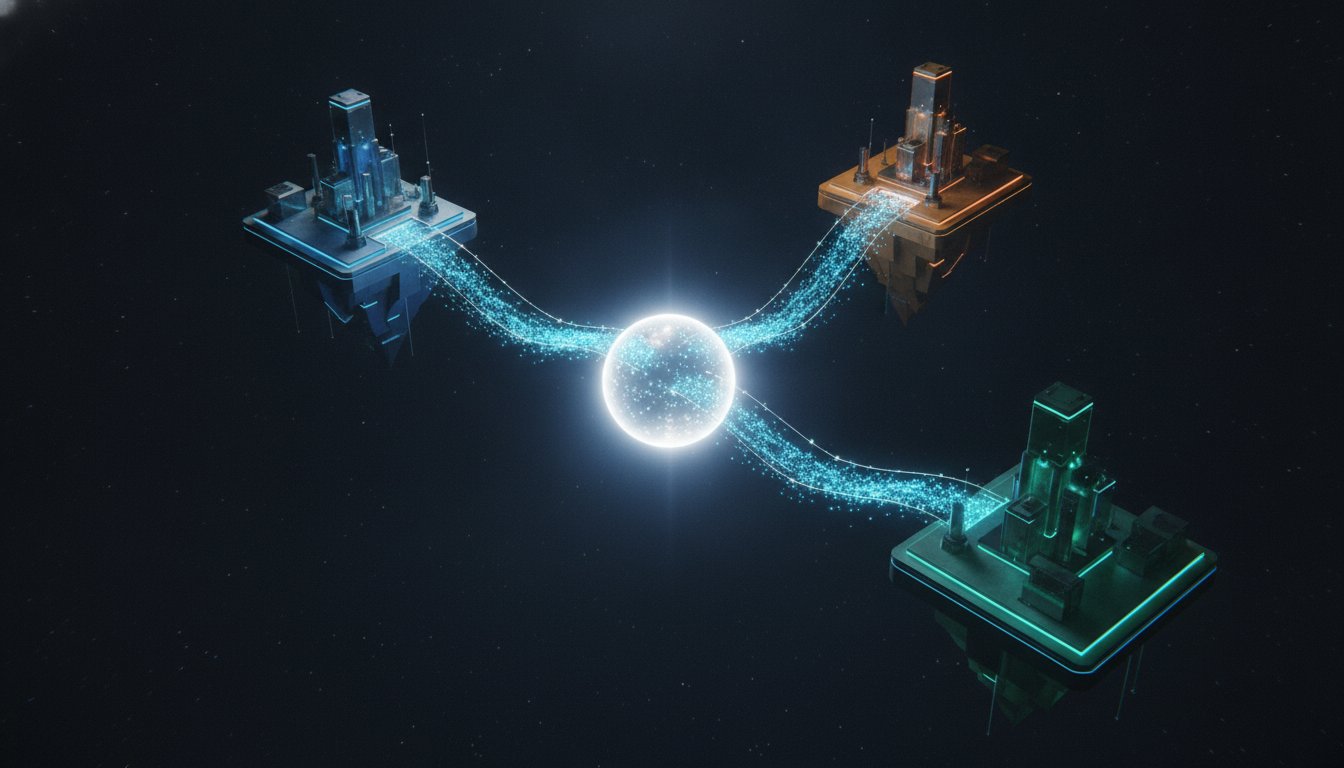
Your multi-cloud strategy is likely failing your AI. While you were promised agility, the reality in 2026 is a fragmented architectural landscape where data egress fees and latency have turned your enterprise knowledge into a series of disconnected islands. Cloud bills now frequently exceed forecasts by 40 percent because teams are still fighting the same challenges with multi-cloud data integration that plagued the last decade. It’s no longer just a networking problem; it’s a semantic crisis.
You recognize the technical debt of maintaining inconsistent security protocols across AWS, Azure, and Google Cloud while your AI agents continue to hallucinate. This article provides the definitive blueprint to master these architectural hurdles. You’ll learn how to move beyond brittle ETL pipelines toward the Syntes AI Context Graph. We’ll detail how to eliminate data silos, enforce consistent governance, and finally achieve the operational efficiency of trusted, hallucination-free AI reasoning through a unified context layer.
Key Takeaways
- Recognize why multi-cloud data fragmentation is a semantic crisis that undermines enterprise intelligence and breaks the single source of truth.
- Address the five critical challenges with multi-cloud data integration, specifically overcoming semantic inconsistency and relationship fragmentation across provider boundaries.
- Transition from fragile RAG architectures to Context Engineering to support the complex reasoning requirements of 2026’s agentic AI platforms.
- Architect a unified context layer using two-way connectors and entity discovery to bridge the gap between disparate cloud silos.
- Deploy the Syntes AI Context Graph to establish a live operational memory that ensures governed, trusted, and hallucination-free AI execution.
The Multi-Cloud Paradox: Why Integration is the Final Frontier for Enterprise AI
By 2026, the architectural debate has shifted. We’ve moved past the era of mere storage redundancy into the age of systemic intelligence. Enterprises now face a stark choice: achieve multi-cloud reasoning or succumb to operational stagnation. Most organizations have inadvertently built a fragmented maze where critical knowledge is trapped within provider-specific silos. This fragmentation directly undermines the “single source of truth,” creating an intelligence debt that is far more costly than any egress fee or storage bill. While storage is cheap, the inability to connect disparate signals is expensive.
Traditional ETL pipelines are no longer a viable solution. They’re a bottleneck. Batch processing cannot keep pace with the real-time requirements of agentic AI. When an automated agent needs to make a millisecond decision based on cross-cloud telemetry, waiting for a nightly load is a failure state. These challenges with multi-cloud data integration aren’t just technical hurdles; they’re existential threats to automated performance. To survive, enterprises must move from passive data management to active execution.
The Shift from Data Management to Context Engineering
The industry is moving beyond the passive collection of information. We are entering the era of Context Engineering. This discipline isn’t about moving rows and columns; it’s about building a live, proprietary framework that gives Large Language Models (LLMs) the “why” behind the “what.” Without this deep business context, even the most advanced models fail. They hallucinate because they lack the specific operational memory of your enterprise. To build trusted AI, you must transition from static data lakes to a semantic data layer for enterprise. This layer acts as the connective tissue, ensuring that every AI agent understands the relationships between your products, customers, and global supply chains in real time.
The Intelligence Gap in Heterogeneous Architectures
Modern multicloud environments suffer from a fundamental intelligence gap. AWS, Azure, and GCP each offer powerful data services, but they are designed to keep you within their own ecosystem. This friction creates “Data Gravity,” where the sheer volume of information makes traditional centralization nearly impossible and prohibitively expensive. You cannot simply move all your data to one place. The solution is not movement, but connectivity. You need a unified context layer that spans cloud boundaries without requiring massive data relocation. This layer must resolve the challenges with multi-cloud data integration by providing a consistent semantic map that follows the logic of your business, not the limitations of your cloud provider’s API.
5 Critical Challenges with Multi-Cloud Data Integration
Integrating disparate cloud ecosystems isn’t a mere logistical exercise; it’s a battle for semantic clarity. Most enterprises treat multi-cloud as a collection of storage silos, but this approach is fatal for agentic AI. You face five critical challenges with multi-cloud data integration that legacy middleware simply cannot solve. These hurdles represent the difference between a high-performing autonomous system and a fragmented, expensive liability.
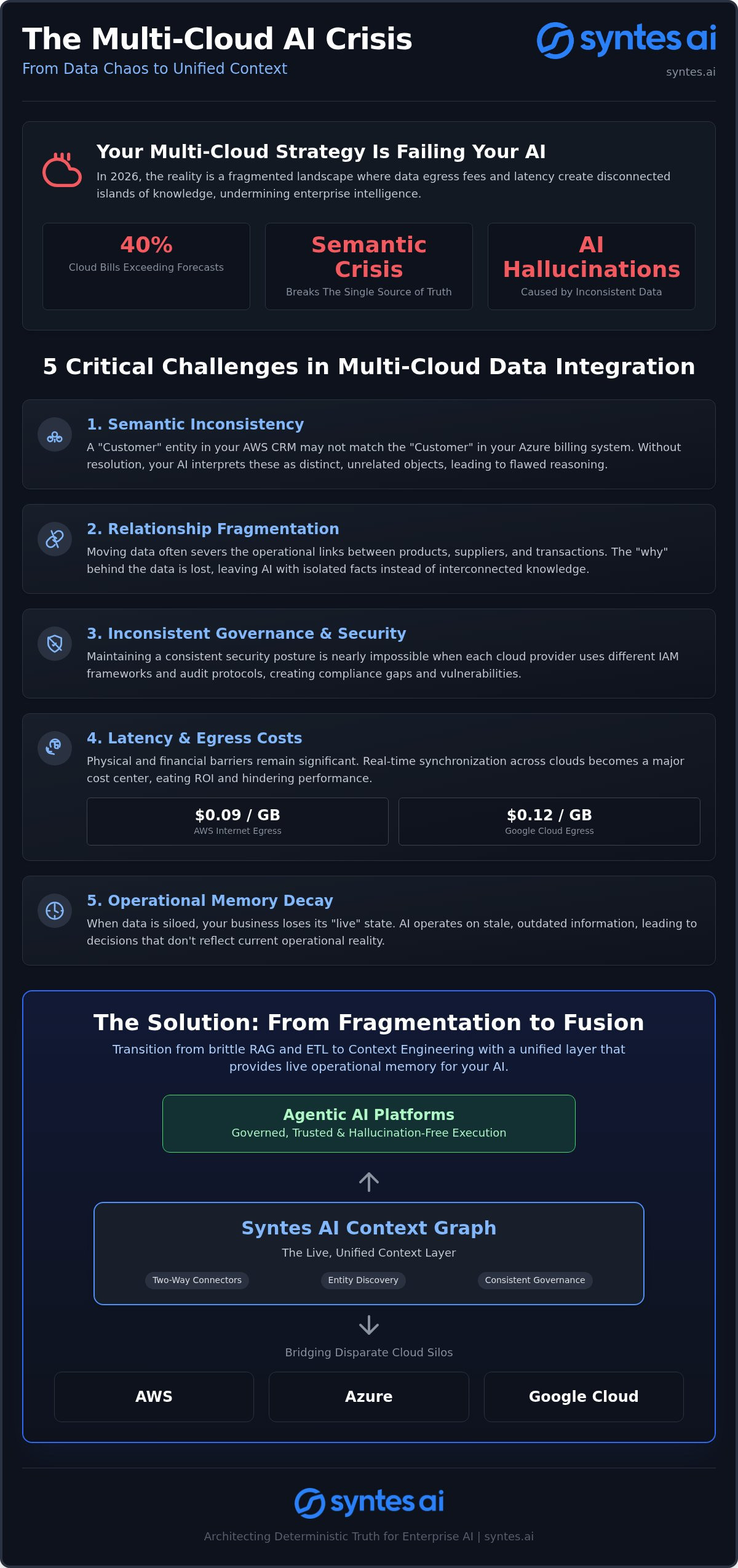
- Semantic Inconsistency: A “Customer” defined in your AWS CRM may not match the “Customer” entity in your Azure billing system. Without resolution, your AI interprets these as distinct, unrelated objects.
- Relationship Fragmentation: Moving data often severs the operational links between products, suppliers, and transactions. You lose the “why” behind the data.
- Governance and Security: Maintaining a consistent secure enterprise AI posture is nearly impossible when each provider uses different IAM frameworks and audit protocols.
- Latency and Egress: Physical and financial barriers remain significant. With AWS charging $0.09 per GB and Google Cloud reaching $0.12 per GB for internet egress, real-time synchronization becomes a cost center that eats your ROI.
- Operational Memory Decay: When data is siloed, your business loses its “live” state. Your AI operates on stale information, leading to decisions that don’t reflect current reality.
Semantic Drift and Data Integrity
Master data management fails in decentralized environments because of semantic drift. Semantic drift is the divergence of data meaning over time across different systems. As your schemas evolve independently on different clouds, the underlying logic begins to clash. This inconsistency is the primary driver of AI hallucinations. When an LLM receives conflicting definitions of a core business entity, it fills the gaps with probabilistic guesses. To prevent this, you must establish a stable ground truth that exists independently of the underlying cloud provider’s schema.
The Governance Nightmare of Cross-Cloud Agents
Managing permissions for AI agents that operate across multiple clouds is an immense technical challenge. Each agent requires an audit trail that satisfies global regulations, such as the EU NIS2 Directive, which mandates incident reporting within as little as 24 hours. You don’t just need to track what the agent did; you need to prove why it had the authority to access data on Azure and execute a command on GCP. AI Governance is the only way to maintain trusted execution in these heterogeneous architectures. If your current integration strategy lacks this unified oversight, you’re inviting systemic risk. To see how we resolve these complexities, you should book a demo and explore our unified governance framework.
Beyond RAG: Why Traditional Integration Fails Agentic AI
First-wave RAG has reached its limit. While retrieval-augmented generation provided a temporary bridge for simple query-response pairs, it collapses under the weight of complex, multi-step enterprise workflows. In 2026, the architectural focus has shifted from finding documents to executing actions. This transition highlights the inherent challenges with multi-cloud data integration; you cannot reason across systems if your AI only sees isolated fragments of text. Disconnected documents prevent your agents from performing high-stakes operational tasks because they lack a unified view of the business logic.
The failure of traditional integration in the AI era is a failure of depth. Most integration tools focus on moving data from point A to point B. They ignore the semantic relationships that give that data meaning. When your knowledge is scattered across different clouds, your AI is forced to work with a low-resolution map. It might find the right document, but it won’t understand how that document relates to a live transaction or a supply chain disruption. You need a transition from simple retrieval to sophisticated reasoning.
Vector Search vs. Operational Relationship Intelligence
Vector databases excel at finding semantic similarity, but they are blind to operational logic. They find related words, not related business entities. This is a critical distinction. Isolated facts are not enough for enterprise-grade AI reasoning. For example, a procurement agent needs to know that a specific contract on AWS relates to a supplier’s risk profile stored in GCP and a current inventory shortage on Azure. This requires Operational Relationship Intelligence. By moving toward a Syntes AI Context Graph, you provide your models with a structured map of reality. It’s the difference between guessing based on proximity and knowing based on architecture.
The Need for Live Operational Memory
Static databases are a liability for agentic ai platforms. If your context layer is based on a snapshot from six hours ago, your agents are making decisions in the past. We define Live Operational Memory as a continuously evolving model of your business that reflects current reality. Every transaction, status change, and telemetry ping across your multi-cloud environment must update the global context layer immediately. Without this real-time evolution, your AI agents will inevitably act on stale information, leading to operational errors and systemic distrust. You don’t need a archive; you need a living memory that spans your entire cloud footprint.
Architecting a Unified Context Layer: The Strategic Response
Solving the challenges with multi-cloud data integration requires a fundamental architectural pivot. You don’t need another migration project; you need a unified context layer. This is a strategic response that treats data as a live asset rather than a static record. The architecture follows a rigorous five-step progression designed for the high-stakes environment of 2026. It’s about building a system that understands your business as well as your best employees do.
First, you must connect structured and unstructured data using high-fidelity, two-way connectors. These are not simple pipes; they are intelligent bridges. Second, you must discover entities and hierarchies across all cloud silos to resolve identity conflicts in real time. Third, you build a dynamic enterprise knowledge graph that serves as your unified model of truth. Fourth, implement a governed context engineering framework to ensure every model input is verified and compliant. Finally, enable your AI agents to execute complex, multi-step actions based on trusted relationship intelligence. This isn’t just integration; it’s the creation of a systemic brain.
Implementing the Context Engineering Framework
Operational clarity is achieved through the Five Pillars: Connect, Understand, Contextualize, Govern, and Execute. This framework is the only way to bridge the gap between the general intelligence of LLMs and the proprietary nuances of your enterprise. It’s about moving beyond simple data access to systemic comprehension. Contextualization transforms raw data into a live operational graph by mapping the intricate dependencies between seemingly unrelated data points. This transformation allows the system to recognize that a delay in a GCP-hosted logistics service directly impacts a sales contract residing on Azure. Without this layer, your AI is operating in the dark.
Unifying Structured and Unstructured Data
Modern enterprise logic is buried in both structured ERP tables and unstructured technical manuals. You must integrate these disparate sources into a single, navigable map. We utilize GraphRAG to facilitate advanced retrieval and reasoning, allowing AI agents to traverse the business logic like a seasoned consultant. This process creates a “Context Graph” that mirrors the complexity of your global operations. By integrating ERP, CRM, and cloud-native databases with your internal policies, you eliminate the fragmentation that historically crippled multi-cloud strategies. Your agents don’t just find data; they understand how that data dictates the next best action across your entire cloud footprint.
The Syntes AI Solution: Transforming Multi-Cloud Chaos into Live Operational Memory
The Syntes AI Enterprise AI Platform is not just another integration tool; it is the definitive 2026 guide to enterprise ai infrastructure. We have identified the systemic flaws in traditional middleware and replaced them with a platform designed for autonomous execution. While legacy architectures struggle with the persistent challenges with multi-cloud data integration, Syntes AI provides a resolution through the Syntes AI Context Graph. This is the end of fragmented knowledge. By mapping every data point to its true business meaning, we eliminate the silos that have historically crippled multi-cloud strategies.
Trusted AI execution requires more than just access; it requires explainability. We move beyond “black box” results to deliver auditable, relationship-based intelligence. Your decision-makers need to know exactly why an agent took a specific action. The Syntes AI Context Graph provides this transparency. It ensures that every reasoning step is grounded in your proprietary business logic, transforming multi-cloud chaos into a coherent, actionable reality. You gain total operational clarity across every cloud provider in your stack.
Live Operational Context for the Modern Enterprise
Syntes AI creates a continuously evolving memory for your organization. We call this Live Operational Memory. It represents a fundamental shift from passive observation to active, automated performance. Consider a global manufacturing supply chain. In a traditional setup, telemetry from a factory in Asia (AWS) might take hours to reconcile with inventory levels in Europe (Azure). Syntes AI unifies these signals instantly. The platform understands the relationship between a machine failure and a potential shipping delay, allowing governed agents to reroute resources before the disruption occurs. You are no longer just watching your data; you are executing on it in real time.
Governed Agentic AI at Scale
Deploying AI agents that reason accurately across cross-system integrations is the final frontier of the modern enterprise. We achieve this through the Syntes Agentic Platform, where safety and security are built into the architecture. The Syntes Governance framework ensures that every agent operates within strict compliance boundaries, satisfying the rigorous demands of the 2026 regulatory environment. This is not experimental AI; this is operational intelligence at scale. You can now deploy autonomous agents that interact with your entire multi-cloud stack with total confidence. The transition from fragmented data to unified intelligence is no longer a strategic goal; it is a current capability.
Discover how Syntes AI builds the live context graph for your enterprise.
Securing Operational Sovereignty in a Multi-Cloud World
The era of passive data accumulation has reached its definitive end. To maintain leadership in 2026, your organization must resolve the systemic challenges with multi-cloud data integration by transitioning from fragmented silos to a unified context layer. This is not merely a networking upgrade. It is a strategic pivot toward relationship-based intelligence that empowers your AI to reason across provider boundaries with absolute precision. You must move from managing records to engineering context.
Syntes AI provides the technical mastery required for this evolution. By facilitating deep cross-system integration of structured and unstructured data across your entire footprint, we establish a Live Operational Memory that serves as the heartbeat of your enterprise. Our Governed Agentic AI framework ensures that every automated action is transparent, compliant, and grounded in your proprietary business logic. The complexity of your heterogeneous architecture shouldn’t be a liability; it should be your greatest competitive advantage.
You possess the tools to transform multi-cloud chaos into a state of total operational clarity. Take the next step toward a future of trusted, autonomous intelligence.
Frequently Asked Questions
What are the primary technical challenges with multi-cloud data integration?
The primary technical challenges with multi-cloud data integration include semantic inconsistency, relationship fragmentation, and the high cost of data egress. In 2026, moving data between AWS, Azure, and Google Cloud often results in “data gravity” issues and significant latency. These hurdles prevent a unified source of truth. Syntes AI resolves this by establishing a unified context layer that connects disparate signals without requiring massive, expensive data relocation across cloud boundaries.
How does multi-cloud data fragmentation lead to AI hallucinations?
Fragmentation causes AI hallucinations by providing large language models with conflicting or incomplete metadata. When an AI agent encounters different definitions for a single entity, such as a “Customer,” across various cloud silos, it lacks a stable ground truth. To resolve this ambiguity, the model relies on probabilistic guesses rather than deterministic facts. This results in “black box” outcomes that lack the explainability required for high-stakes enterprise decision-making.
What is the difference between a traditional data warehouse and a Context Graph?
Traditional data warehouses are designed for historical reporting and store data in static, structured tables. In contrast, the Syntes AI Context Graph is a live operational model that maps relationships between structured and unstructured data in real time. While warehouses focus on “what happened,” the Context Graph provides the “why” and “how.” It creates a continuously evolving memory that allows AI agents to understand complex business logic across heterogeneous architectures.
How does Context Engineering improve AI agent reliability in multi-cloud environments?
Context Engineering improves reliability by building a proprietary framework that anchors AI reasoning in specific business reality. By following the Five Pillars—Connect, Understand, Contextualize, Govern, and Execute—organizations move beyond simple prompt engineering. This discipline ensures that AI agents have access to the exact rules, policies, and real-time events needed to perform multi-step tasks safely. It bridges the gap between general model knowledge and the proprietary data stored in your specific systems.
Can I integrate legacy ERP systems with modern cloud-native AI platforms?
Yes, you can bridge the gap between legacy systems and modern AI through intelligent two-way connectors. These tools integrate on-premise ERP data with cloud-native databases to build a unified context layer. This approach allows organizations to leverage critical historical data without performing a full-scale migration. By connecting legacy logic to the Syntes AI Context Graph, you ensure that your AI agents understand the full history and current state of your operations.
What is Operational Relationship Intelligence and why does it matter for AI?
Operational Relationship Intelligence is the comprehension of how different business entities, such as suppliers, transactions, and inventory, interact within a system. AI needs this intelligence to reason through complex workflows rather than just retrieving isolated documents. Without understanding these dependencies, an agent cannot predict how a delay in one cloud service impacts a contract in another. It is the foundation for moving from passive observation to active, automated performance.
How does Syntes AI manage data governance across multiple cloud providers?
Syntes AI manages governance by applying a centralized framework of security, permissions, and business rules across every connected cloud provider. This ensures a consistent security posture regardless of whether the data resides on AWS, Azure, or GCP. The platform provides explainable reasoning and a clear audit trail for every action taken by an AI agent. This centralized oversight is essential for meeting 2026 regulatory requirements like the EU NIS2 Directive.
Why is RAG insufficient for complex enterprise data integration?
RAG is insufficient because it treats information as isolated text chunks for retrieval rather than a living model of the business. It fails to capture the deep, multi-step reasoning required to solve the most pressing challenges with multi-cloud data integration. While RAG finds similar documents, it cannot understand the real-time operational state or the complex hierarchies of an enterprise. You need a system that offers Live Operational Memory to achieve trusted, hallucination-free execution.