

Your graph database is not your intelligence layer. It’s a filing cabinet. Many organizations are currently building their 2026 AI strategy on a fundamental architectural misunderstanding that treats data storage as equivalent to operational reasoning. The debate over knowledge graph vs graph database isn’t just a technical nuance; it’s a strategic fork in the road for any leader serious about agentic AI. Choosing the wrong path leads directly to persistent data silos and AI hallucinations that no amount of prompt engineering can fix.
You’ve likely realized that providing LLMs with more data hasn’t solved the lack of business context. This guide explores why the distinction between graph storage and semantic intelligence is the critical factor in building trusted, autonomous systems. We’ll provide a clear framework for choosing the right architecture to achieve deterministic context. You’ll discover how a live operational memory replaces passive storage to eliminate technical debt and finally move your enterprise from experimental RAG to sophisticated, agentic performance.
Key Takeaways
- Distinguish between a knowledge graph vs graph database to ensure your 2026 architecture supports active reasoning rather than just passive storage.
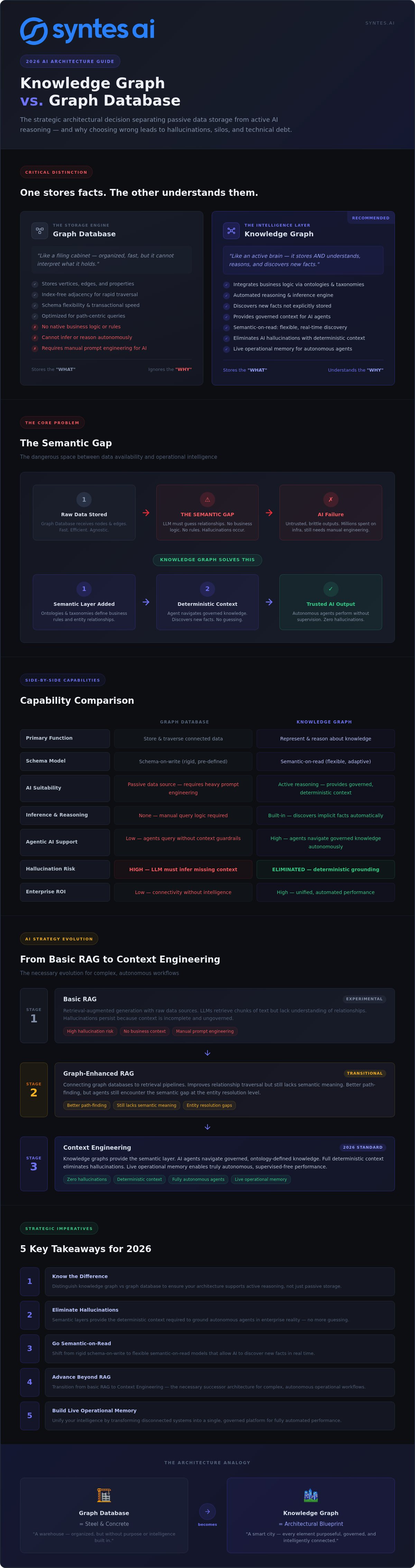
- Eliminate hallucinations by identifying how semantic layers provide the deterministic context required to ground autonomous agents in enterprise reality.
- Shift your architecture from rigid schema-on-write systems to flexible semantic-on-read models that allow AI to discover new facts in real time.
- Advance your AI strategy by transitioning from basic RAG to Context Engineering, the necessary successor for complex operational workflows.
- Unify your intelligence by building a live operational memory that transforms disconnected systems into a single, governed platform for automated performance.
The Semantic Gap: Why a Graph Database is No Longer Enough
Data storage is a solved problem. In 2026, the strategic challenge isn’t how to house a billion nodes; it’s how to orchestrate their meaning. Most enterprises currently face a “hallucination ceiling” where their AI agents fail to reach ground truth. This failure stems from a fundamental reliance on disconnected data silos that lack inherent business logic. When an LLM retrieves data from a raw storage engine, it’s often forced to guess the relationships between entities. This is the semantic gap. It’s the space between data availability and operational intelligence.
The hidden cost of treating a storage engine as a complete solution is technical debt. Organizations spend millions on high-performance infrastructure only to find their AI still requires manual prompt engineering to stay on track. Without a layer of semantic reasoning, your AI remains untrusted and brittle. The debate regarding knowledge graph vs graph database is essentially a choice between a passive filing cabinet and an active brain. One stores facts; the other understands them.
The Infrastructure Fallacy
High-performance storage doesn’t equal business understanding. This is the infrastructure fallacy that plagues modern IT departments. Managing nodes and edges is a mathematical exercise; managing enterprise meaning is a strategic one. A graph database is an excellent engine for storing connected data, but it remains agnostic to the rules of your industry. It doesn’t know that a “customer” in your CRM must be the same entity as the “policyholder” in your claims system unless you manually code that logic into every query. This is why IT-led graph initiatives frequently fail to deliver measurable ROI. They provide the connectivity but lack the intelligence to exploit it. They offer speed without direction.
The Rise of Agentic Requirements
Autonomous AI agents are the new primary consumers of enterprise data. They don’t query databases the way humans do. They navigate knowledge to execute workflows. These agents require more than just raw access; they need governed context and deterministic reasoning. The transition from human-queried databases to agent-navigated knowledge is non-negotiable for 2026 operations. This shift is why leading organizations are prioritizing enterprise knowledge graphs over traditional storage solutions. These systems act as a live operational memory, providing the guardrails and logic that allow agents to perform without supervision. When evaluating knowledge graph vs graph database, the question isn’t about storage capacity. It’s about whether your architecture can support the complex, automated performance that modern business demands.
Defining the Core: Graph Database vs. Knowledge Graph
Architecture requires both materials and meaning. A graph database provides the steel and concrete; it’s the physical structure that holds data in place. A knowledge graph is the architectural blueprint. It defines the purpose of every room and the logic of every hallway. Understanding the distinction in knowledge graph vs graph database is the difference between owning a warehouse and operating a smart city. One is a technical tool for engineers; the other is a strategic asset for the entire enterprise. Without the blueprint, your building is just a pile of expensive materials.
What is a Graph Database? (The Storage Engine)
It’s a high-speed engine designed for one primary task: storing and traversing connected data points. Its core focus lies in vertices, edges, and properties. By utilizing index-free adjacency, it allows for rapid relationship traversal without the overhead of traditional relational joins. It’s optimized for path-centric queries. If you need to know which customers bought which products in a three-step chain, the graph database excels. It offers schema flexibility and transactional speed, but it remains a passive recipient of data. It stores the “what” but ignores the “why.” It’s a foundational component, yet it lacks the native intelligence to govern itself.
What is a Knowledge Graph? (The Intelligence Layer)
This is where semantics enter the architecture. A knowledge graph integrates business logic through ontologies and taxonomies. It doesn’t just store a link between a “User” and a “Device”; it understands the rules governing that relationship. This enables automated reasoning and inference. The system can “discover” new facts that weren’t explicitly entered into the database. For example, if a knowledge graph knows that “Product A” is a component of “System B” and “System B” is currently offline, it can infer the status of “Product A” without a direct sensor reading. By transforming raw, fragmented inputs into a semantic data layer for enterprise intelligence, it creates a unified source of truth. It’s an active system that powers explainable AI.
Choosing the right path depends on your ultimate goal. If you’re building for 2026, storage alone is a liability. You need an architecture that understands your business logic as well as your engineers do. You can explore how this intelligence layer functions within a live environment to see the strategic advantage of shifting from storage to reasoning.
Technical Architecture: Storage Engine vs. Semantic Reasoning
Architecture determines operational agility. A graph database typically relies on a schema-on-write approach, requiring data to be strictly structured before it is ingested. This creates a persistent bottleneck for large-scale enterprises. In contrast, a knowledge graph operates on a semantic-on-read principle. It allows you to layer meaning over disparate data sets without requiring destructive or time-consuming transformations. This technical distinction in the knowledge graph vs graph database debate is critical for achieving true integration depth. It is the mechanism that connects structured ERP tables with thousands of unstructured contracts and technical manuals. The result is deterministic grounding. AI agents no longer guess; they verify against a verified model of reality.
Logic and Reasoning Capabilities
Reasoning is the engine of discovery. While a database traverses paths you have already defined, a knowledge graph uses inference to uncover facts that were never explicitly stated. It applies business rules to validate AI outputs in real time. Keyword search is a relic of the past; semantic relationship discovery is the 2026 standard. This architecture provides a clear, mathematical audit trail for every decision. It achieves explainable AI by mapping the exact reasoning paths the system took to reach its conclusion. You gain total transparency where competitors see only a black box. This capability transforms raw data into a reliable foundation for automated decision-making.
Governance and Security at the Edge
Governance must be baked into the data layer, not bolted on as an afterthought. Enterprises cannot risk AI agents accessing sensitive financial records or violating strict compliance protocols. A knowledge graph applies enterprise-grade permissions directly within the graph structure itself. It ensures that AI agents operate within strictly governed business boundaries at all times. This is the only path to scaling autonomous systems safely across a global organization. Truly solving enterprise data silos requires more than just a central repository. It requires a governed semantic layer that manages access, security, and meaning simultaneously. Without this layer, your agents are liabilities rather than strategic assets. They lack the guardrails necessary for high-stakes execution.
From RAG to Context Engineering: The Evolution of AI Grounding
Standard Retrieval-Augmented Generation (RAG) is reaching its limit. It relies on vector similarity, which is essentially a high-stakes guessing game based on probabilistic proximity. For enterprise AI to move beyond experimental pilots, it must transition to Context Engineering. This discipline treats context as a structured, governed asset rather than a loose collection of text snippets. In the knowledge graph vs graph database comparison, the knowledge graph serves as the bedrock for this shift. It provides the multi-hop reasoning capabilities that standard databases lack, allowing AI to follow complex logic across dozens of related entities. Prompt engineering is a band-aid; Context Engineering is the cure. It involves the systematic design of the information environment in which an AI operates.
The Hallucination Problem
Hallucinations aren’t a bug of the LLM; they’re a symptom of poor grounding. When data remains trapped in disconnected silos, the model is forced to fill the gaps with probabilistic noise. You can effectively prevent AI hallucination by replacing these best guesses with exact-match context derived from a semantic layer. This creates a deterministic ground truth. It ensures that every response generated by your agentic systems is anchored in verified enterprise reality. Precision is mandatory. By using GraphRAG, enterprises can retrieve not just a document, but the entire web of relationships surrounding a query. This eliminates the “hallucination ceiling” that currently prevents AI from managing high-stakes business logic.
Live Operational Context
Static data is dead data. In 2026, agentic workflows require real-time integration to be effective. A standard database might store a customer’s history, but it cannot capture the live operational event happening this second. This is where the distinction in knowledge graph vs graph database becomes most apparent. A live operational memory connects current events to static knowledge instantly. It provides the fluid context necessary for agents to make autonomous decisions. Static databases cannot support the dynamic requirements of modern automation. They offer a snapshot of the past while a knowledge graph provides a pulse of the present. Without this real-time awareness, your AI is operating on yesterday’s information. It’s a relic in a fast-paced market.
Beyond Storage: Building a Live Operational Memory with Syntes AI
Storage is a commodity; intelligence is a competitive advantage. While the technical industry remains entangled in the knowledge graph vs graph database debate, strategic leaders have already moved toward execution. The Syntes AI Context Graph is not a static repository of historical records. It is a living, breathing model of your enterprise. We unify customers, products, and complex business rules into a single intelligence layer that serves as the foundation for all automated performance. This isn’t just about connecting data points. It’s about creating a system that understands the real-world implications of those connections in real time.
Passive storage engines are historical archives. They tell you what happened yesterday. A Live Operational Memory tells you what is happening now and what must happen next. This is the definitive shift required for 2026 operations. Syntes AI enables this by maintaining a pulse on live operational events, ensuring that your agentic platform is always synchronized with the current state of the business. You aren’t just building a database; you’re architecting an enterprise brain capable of autonomous reasoning.
The Syntes Context Engineering Framework
Our framework follows a methodical path to operational clarity. First, we Connect. We integrate structured ERP data and unstructured documents across your entire stack, eliminating the silos that traditionally starve AI of truth. Second, we Understand. The platform automatically discovers hierarchies and business semantics that manual modeling often misses. This automated discovery ensures your graph evolves as fast as your business does. Finally, we Govern. We apply granular security and compliance protocols to every AI action. This ensures your agents never step outside their designated boundaries, providing a level of safety that consumer-grade tools cannot match.
Execution and Agentic Intelligence
Execution is the ultimate metric of success. The Syntes Agentic Platform allows you to deploy governed agents that reason over trusted, deterministic context. These agents don’t rely on probabilistic guesses. They navigate the Syntes AI Context Graph to find exact answers and execute complex workflows with precision. This transforms fragmented, siloed information into a Live Operational Memory that powers the entire organization. Syntes AI is the definitive choice for next-generation intelligence because we value informed action over theoretical experimentation. We provide the sophisticated tools required to move beyond the “hallucination ceiling” of standard RAG. We offer a clear roadmap to enterprise ai infrastructure excellence that is grounded in systemic integration and operational mastery. The choice between a simple database and a full knowledge graph solution is clear: one holds your data, while the other drives your future.
The Architecture of Deterministic Enterprise Intelligence
The strategic imperative for 2026 is clear. You cannot build agentic AI on top of a passive storage layer. While a graph database provides the necessary connectivity, it lacks the semantic reasoning required to eliminate hallucinations. The distinction in knowledge graph vs graph database is the difference between data availability and operational truth. By adopting a Deterministic Context Engineering Framework, your organization can finally move beyond the limits of standard RAG and build systems that reason with absolute certainty.
Syntes AI provides the necessary evolution for the global enterprise. Our Live Operational Memory technology ensures that your agents are grounded in the real-time reality of your business logic. With Enterprise-grade Agentic Governance, you possess the power to scale autonomous workflows without compromising security or compliance. Stop managing disconnected nodes. Start orchestrating systemic intelligence.
The path to operational clarity is open. It’s time to build the foundation for a truly autonomous enterprise that values informed action over experimental guesswork.
Frequently Asked Questions
Is a knowledge graph just a more expensive graph database?
No. A graph database is a storage engine, while a knowledge graph is an intelligence layer. A database focuses on the physical storage of nodes and edges for transactional speed. A knowledge graph adds a layer of semantics, rules, and business logic that allows for automated reasoning. It’s a strategic asset designed to provide the deterministic grounding required for autonomous enterprise operations rather than simple data persistence.
Can I build a knowledge graph using my existing relational database?
You can map relational data to a graph structure, but relational databases struggle with the multi-hop relationship traversal required for real-time reasoning. To achieve a true knowledge graph vs graph database architecture, you need a system optimized for index-free adjacency. Syntes AI uses a hybrid graph approach to bridge these worlds, ensuring that performance doesn’t degrade as the complexity of your enterprise relationships scales across different systems.
How does a knowledge graph reduce AI hallucinations in LLMs?
It provides deterministic context. Instead of relying on the probabilistic guesses of an LLM, the system retrieves facts from a verified semantic model. This grounding ensures the AI operates within a ground truth framework. By using a Context Graph, enterprises replace vector similarity searches with exact relationship matching. This forces the model to reason based on verified business rules rather than general training data, which effectively eliminates noise.
What is the role of ontologies in a modern knowledge graph?
Ontologies serve as the logical blueprint of the enterprise. They define the entities, properties, and relationships that govern how data is interpreted by the system. Without an ontology, a graph is just a collection of connected points. In a modern architecture, ontologies enable automated reasoning. They allow the system to infer new facts and ensure that AI agents understand the specific business meaning behind every data point they encounter.
Do I need a graph database to implement GraphRAG?
GraphRAG requires a graph-native structure to perform efficient multi-hop retrieval. While you can run these processes on various storage types, a graph database provides the necessary performance layer for traversing deep relationships. However, the knowledge graph provides the semantic depth. Implementing GraphRAG without a semantic layer often results in the same context fragmentation found in standard RAG. You need the logic, not just the storage, to make it effective.
What is the difference between a data fabric and a knowledge graph?
A data fabric is an architectural approach to data management that focuses on discovery and access across a distributed landscape. A knowledge graph is a specific technology that models that data through semantics and relationships. While a data fabric provides the connectivity, the knowledge graph provides the understanding. It transforms raw access into a Live Operational Memory that AI agents can use for complex reasoning and autonomous workflow execution.
How long does it take to deploy an enterprise knowledge graph?
Deployment times vary based on data complexity and integration depth. Modern platforms like the Syntes Agentic Platform use two-way connectors to accelerate the process. Initial connectivity and context discovery can often occur within weeks. However, building a comprehensive Live Operational Memory is an iterative process. Most enterprises start with a high-value pilot, such as supply chain or customer context, before scaling the architecture across the entire enterprise stack.
Why is governance more critical in a knowledge graph than a standard database?
Knowledge graphs power autonomous agents that make decisions on behalf of the business. In a standard database, a human typically interprets the results. In a graph-based agentic system, the AI takes action. Governance ensures these actions occur within strictly defined boundaries. It applies security, permissions, and compliance rules directly to the relationships. This prevents agents from accessing sensitive data or violating operational protocols during high-stakes execution.