
The era of the experimental chatbot is dead. If your autonomous agents are still hallucinating or stalling at the edge of fragmented ERP and CRM silos, you don’t have a model problem; you have a foundational memory problem. High-level enterprise decision-makers recognize that raw data is useless without the connective tissue of logic. You need more than a search engine for your documents. You need a way to orchestrate knowledge graph data integration that turns passive records into a live, evolving model of your entire business.
You’re likely tired of the ‘black box’ uncertainty that plagues current AI implementations. It’s time to demand explainable reasoning and trusted execution. This guide will show you how to architect a deterministic Context Graph that powers agentic AI with precision. We will examine the transition from simple retrieval to a state of total operational clarity where your agents navigate cross-system integrations with the same insight as your best strategic experts.
Key Takeaways
- Identify why traditional RAG and disconnected data silos fail to provide the logical grounding required for autonomous reasoning.
- Architect a robust strategy for knowledge graph data integration that unifies structured ERP data with unstructured enterprise policies.
- Transition from static, frozen knowledge bases to Live Operational Memory to ensure your agents act on real-time business reality.
- Apply the 5-Pillar Framework for Context Engineering to map complex business semantics and hidden organizational relationships.
- Leverage the Syntes AI Platform to bridge the gap between general AI knowledge and your proprietary operational intelligence.
Why Traditional Data Integration Fails the Agentic Enterprise
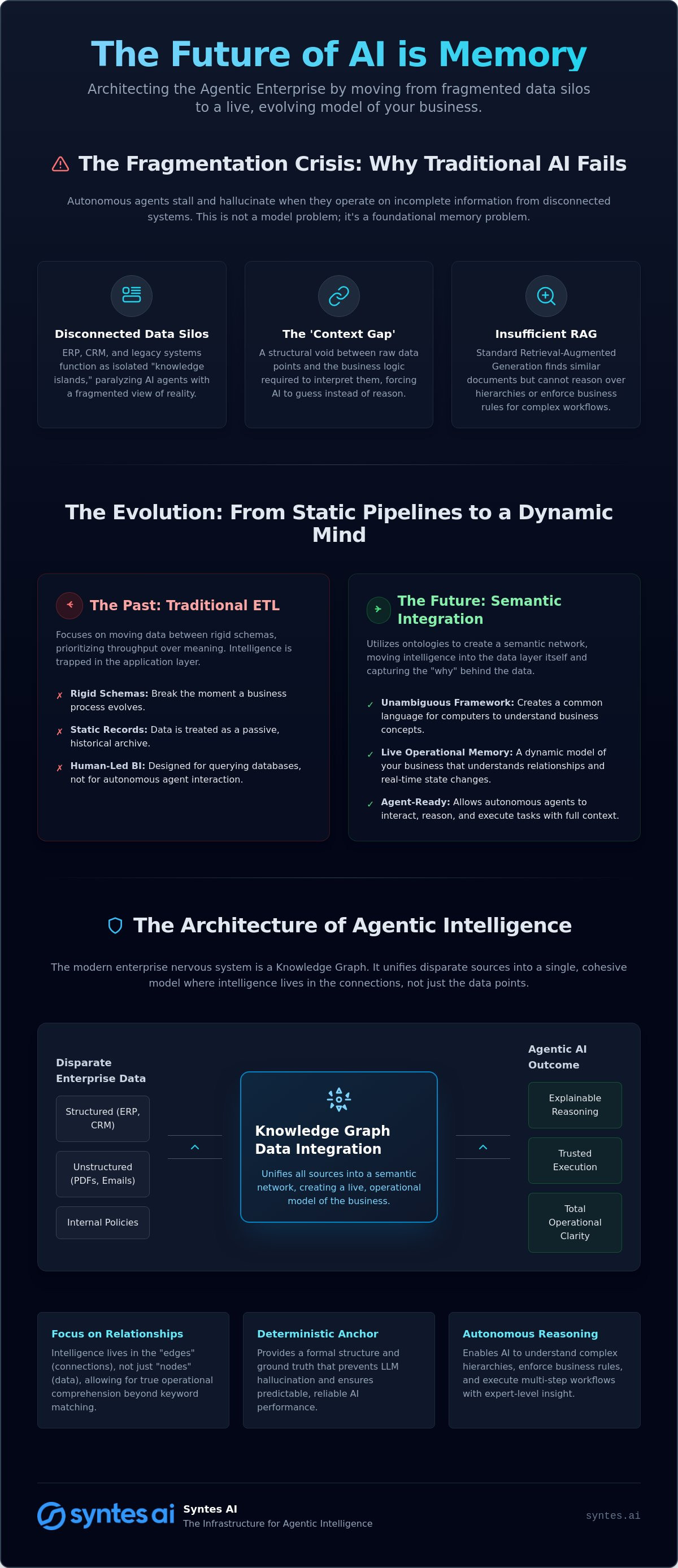
Legacy data integration is a liability in the age of autonomy. For decades, enterprises invested billions in data warehouses and lakes designed for human-led business intelligence. These systems were built to store records, not to facilitate reasoning. When you deploy an autonomous agent into this environment, it encounters the ‘Context Gap.’ This is the structural void between raw data points and the business logic required to interpret them. Large Language Models (LLMs) are probabilistic engines; they excel at predicting the next word but fail at navigating disconnected silos without a deterministic anchor.
To bridge this gap, leaders are shifting toward knowledge graph data integration. This is not a simple exercise in moving bytes from point A to point B. It is the sophisticated process of unifying disparate sources into a semantic network that captures the “why” behind the data. A Knowledge graph provides the formal structure needed for an AI to understand that a ‘Customer ID’ in your CRM and a ‘Contract Signatory’ in your legal database represent the same real-world entity. Without this semantic layer, your AI is merely guessing.
Standard Retrieval-Augmented Generation (RAG) is proving insufficient for complex operations. While vector retrieval can find documents that look similar to a query, it cannot reason over hierarchies or enforce business rules. It lacks the model-aware analytical processes required to execute a multi-step workflow. We are moving beyond passive storage. The goal is an active, evolving architecture that transforms fragmented enterprise history into a live, operational asset.
The Fragmentation Crisis in Enterprise Data
ERP, CRM, and legacy systems function as isolated knowledge islands. These islands paralyze AI agents by forcing them to operate with incomplete information. When an agent lacks a unified ground truth, the result is hallucination. This isn’t just a technical glitch; it’s a strategic failure that erodes trust in AI results. Most standard data pipelines fail because they prioritize throughput over meaning, leaving agents to struggle with ambiguous references and conflicting data versions across the stack.
Semantic Data Integration vs. Traditional ETL
Traditional ETL (Extract, Transform, Load) focuses on rigid schemas that break the moment a business process evolves. Semantic integration utilizes ontologies to create an unambiguous framework for computers. It moves the intelligence from the application layer down into the data layer itself. This transition allows the organization to move from static data records to Live Operational Memory. Instead of querying a database, your agents interact with a dynamic model of your business that understands relationships, permissions, and real-time state changes.
The Architecture of Knowledge Graph Data Integration in 2026
The enterprise architecture of 2026 has moved beyond the “dump and search” mentality of the early 2020s. Today, knowledge graph data integration serves as the vital nervous system for agentic AI. It is no longer sufficient to store data in isolation. Modern architecture must prioritize the relationship between disparate entities to allow for autonomous reasoning. This need for semantic structure also applies to external content, where Content Marketing SG assists brands in optimizing their visibility for modern search environments. We are seeing a transition toward hybrid graph databases that manage multi-dimensional enterprise relationships in real time. This is the only way to ensure that an agent understands the implications of a supply chain delay on a specific customer contract.
Intelligence lives in the connections. While traditional databases focus on the “node” or the data point, agentic AI requires relationship-based intelligence found in the “edge.” By mapping the specific predicates that connect a vendor to a purchase order, the system moves beyond simple keyword matching toward true operational comprehension. This sophisticated knowledge graph construction process ensures that every piece of data is contextualized within the broader business logic. It transforms a static record into an active participant in a reasoning chain.
Unifying Structured and Unstructured Sources
The primary challenge remains the reconciliation of rigid SQL tables with the fluid nature of PDFs, emails, and internal policies. Effective integration requires mapping relational tables to graph triples where business rules are treated as first-class entities. This creates a unified layer where a structured invoice and an unstructured email thread exist in the same semantic space. Organizations must master unifying structured and unstructured data to prevent the fragmentation that leads to AI failure. When policies are extracted as nodes rather than just text, agents can finally enforce compliance autonomously.
GraphRAG and Semantic Grounding
GraphRAG represents the next evolution of retrieval-augmented generation. By providing a structured map of the organization, graph structures offer the missing context that prevents LLMs from straying into hallucination. GraphRAG is the bridge between retrieval and reasoning. Implementing two-way connectors ensures that as your ERP updates, your agent’s understanding of the world remains synchronized. This level of semantic grounding is what separates a generic chatbot from a high-performance autonomous agent. To see how these architectures operate in a live environment, you can book a demo of the Syntes AI Context Graph.
Static Knowledge Bases vs. Live Operational Memory
Static knowledge is an oxymoron in a high-velocity enterprise. In an environment where market conditions, inventory levels, and customer sentiments shift by the minute, a repository that relies on periodic updates is a liability. When an autonomous agent makes a strategic decision based on data that is even a few hours old, it risks executing a maneuver that no longer aligns with reality. We are witnessing the death of the frozen data lake. The new standard is Live Operational Memory. This is a continuously evolving model of the organization that reflects the current state of every entity and relationship within the enterprise stack.
To achieve this, knowledge graph data integration must transition from a batch process to an event-driven architecture. By tracking changes in entities and their associations over time, the system develops what we call Operational Relationship Intelligence. This allows an AI agent to understand not just what a contract says, but how a recent amendment affects every downstream delivery and payment obligation. A live graph prevents agents from acting on stale or out-of-context information. It ensures that every automated action is grounded in the absolute current state of the business.
The Evolution of Enterprise Memory
Enterprise memory is undergoing a radical transformation. We have moved from the era of periodic batch updates to real-time, event-driven graph integration. This shift is critical for maintaining Live Operational Context, the essential ingredient for AI model reliability. When data flows seamlessly from the source to the graph, the AI’s reasoning engine remains tethered to the truth. You can explore the strategic necessity of this transition in our guide on solving enterprise data silos. Reliability isn’t a feature; it’s a prerequisite for agentic intelligence.
Determinism and Trust in AI Reasoning
Trust is the ultimate currency in enterprise AI. A live graph is the only way to achieve explainable AI outcomes that satisfy the scrutiny of high-level stakeholders. While probabilistic vector search provides a “best guess” based on similarity, deterministic graph retrieval offers a verifiable fact based on explicit, modeled relationships. You can eliminate the ‘black box’ by auditing the graph’s reasoning path. This transparency allows you to see exactly why an agent reached a specific conclusion. It provides a level of accountability that simple RAG architectures can never match. By prioritizing deterministic retrieval over probabilistic search, you secure a foundation for governed, high-stakes execution.
The 5-Pillar Framework for Context Engineering
Context Engineering is the rigorous methodology that transforms raw infrastructure into a reasoning engine. It isn’t a suggestion; it’s a requirement for any enterprise that values precision over probability. To move from static data to agentic execution, organizations must adopt a structured framework that ensures knowledge graph data integration serves as the active logic layer of the business. This process moves beyond simple storage to create a deterministic environment where agents don’t just find information; they understand it.
The framework is built upon five foundational pillars designed to lead an organization from fragmentation to total operational clarity:
- Connect: Integrate disparate enterprise data across the entire software stack, from legacy mainframes to modern SaaS.
- Understand: Discover hierarchies, business semantics, and the hidden relationships that define your unique operations.
- Contextualize: Build the live Context Graph as a dynamic, real-time model of the enterprise.
- Govern: Apply security, permissions, and business rules directly to the knowledge layer to ensure compliance.
- Execute: Enable AI agents to perform governed actions over a trusted, semantic context.
Connecting and Understanding the Data Mesh
Connecting the data mesh requires a radical departure from traditional ETL logic. You aren’t merely moving tables; you’re mapping the entire enterprise data catalog to a unified semantic layer. This involves the automated discovery of entities such as customers, products, and projects, along with the intricate hierarchies that govern their interactions. By integrating business policies as executable logic within the graph, you provide the AI with a rulebook for reality. It’s a shift from passive observation to active, automated performance where every node reflects a verifiable business truth.
Governance and Execution for Agentic AI
Execution without governance is a recipe for systemic failure. In an agentic environment, you must implement Human-in-the-Loop systems for high-stakes decisions while maintaining a deterministic reasoning path for autonomous tasks. This is the essence of AI governance. You can learn how to prevent AI hallucination by grounding every agent action in this semantic truth. When your context is trusted, execution becomes seamless and explainable. To see how this framework secures your AI strategy, book a demo of the Syntes Agentic Platform today.
Syntes AI: The Infrastructure for Agentic Intelligence
Syntes AI is the architectural answer to the enterprise intelligence crisis. While consumer-grade chatbots rely on probabilistic guesses, the Syntes AI Enterprise AI Platform provides a deterministic anchor for high-stakes decision-making. We don’t just provide a tool; we provide the foundational infrastructure required to bridge the gap between general LLM knowledge and your proprietary, sensitive data. By industrializing knowledge graph data integration, Syntes AI ensures that your proprietary business logic remains the primary driver of AI behavior. It’s time to move beyond the experimental phase and deploy technical, authoritative intelligence that understands the messy reality of your operations.
The Syntes Agentic Platform is designed for scale. It allows you to deploy governed AI agents that operate with the insight of a seasoned consultant and the precision of a system architect. These agents don’t stall when they encounter a disconnected silo. They navigate your entire software stack using the Syntes AI Context Graph as their primary map. This is the transition from passive observation to active, automated performance. We enable your organization to execute complex workflows with a level of trust that simple RAG architectures can’t sustain.
The Syntes AI Context Graph Advantage
Operational Relationship Intelligence is the core differentiator for leaders in retail, finance, and manufacturing. In these high-velocity sectors, the ability to see the hidden connections between inventory levels, market volatility, and contractual obligations is the difference between agility and obsolescence. Syntes AI creates a unified context layer that facilitates seamless cross-system automation. You can explore the strategic depth of this approach in our executive guide to enterprise knowledge graphs. We transform your data from a stagnant lake into a live, operational asset.
Building the Future with Context Engineering
Context Engineering is the next strategic evolution for the modern CIO. It represents a shift away from ungrounded, risky AI initiatives toward a governed and scalable intelligence strategy. By prioritizing knowledge graph data integration, you mitigate the risks of hallucination and ensure that your AI initiatives are rooted in verifiable truth. This is how you build a future where autonomous agents are trusted to handle critical business logic without constant human intervention. The path to total operational clarity is clear. Transform your fragmented data into trusted intelligence and lead your organization into the era of agentic excellence.
Mastering the Transition to Agentic Operational Intelligence
The transition from passive data storage to active, model-aware intelligence is no longer optional. Enterprises that rely on fragmented silos or probabilistic guesses will fail to keep pace with the speed of autonomous business operations. We’ve examined how knowledge graph data integration serves as the indispensable foundation for this shift. It moves your organization beyond the limitations of simple RAG toward a state of total operational clarity. By adopting Live Operational Memory, you ensure that every agentic action is grounded in real-time truth and governed by explicit business logic.
Reliability is the only metric that matters in the agentic enterprise. You need a system that offers deterministic, explainable AI reasoning to secure the trust of high-level stakeholders. The Syntes AI Context Graph provides this live operational context, transforming messy data into a strategic asset for governed execution. Don’t let your AI strategy stall at the edge of a disconnected silo.
Architect your enterprise's Live Operational Memory with Syntes AI and reclaim control over your operational intelligence. The future belongs to those who turn context into a competitive advantage.
Frequently Asked Questions
What is knowledge graph data integration?
Knowledge graph data integration is the strategic process of unifying disparate enterprise sources into a semantic network of entities and relationships. It moves beyond simple data ingestion by mapping business logic and context directly into the data architecture. This creates a deterministic framework where AI agents can reason over connected information rather than isolated silos. By prioritizing meaning over raw storage, you build a foundation for trusted, autonomous enterprise intelligence.
How does a knowledge graph differ from a traditional data warehouse?
Traditional data warehouses store records in rigid, two-dimensional tables designed for historical reporting and human analysis. Knowledge graphs differ by modeling data as a multi-dimensional network of interconnected entities and predicates. This shift allows for real-time relationship traversal and complex semantic reasoning. While warehouses act as passive repositories for the past, knowledge graphs function as active, machine-readable memory for the immediate execution of autonomous tasks.
Can knowledge graphs integrate unstructured data like PDFs and emails?
Modern knowledge graph data integration excels at extracting entities and explicit relationships from unstructured sources like PDFs and internal emails. For enterprises capturing spoken insights, a Free Notes App provides a way to convert voice to text for ingestion. The system uses sophisticated ontologies to transform static text into first-class graph nodes. This ensures that a specific clause in a legal document and a transaction record in an ERP system are linked within the same logical framework. It effectively eliminates the knowledge islands that typically paralyze enterprise AI.
What is the role of GraphRAG in data integration?
GraphRAG serves as the critical bridge between data retrieval and logical reasoning for Large Language Models. It uses the structured relationships within a knowledge graph to provide the specific context that standard vector search lacks. By providing a map of the organization, it allows the AI to understand how different entities relate to one another. This architectural layer ensures that AI outputs are grounded in the explicit, verifiable logic of your enterprise.
How does a live operational memory prevent AI hallucinations?
Live operational memory prevents hallucinations by providing a deterministic ground truth that constrains the probabilistic nature of LLMs. It anchors AI agents to a real-time, evolving model of the business rather than a static training set. When an agent verifies a fact through an explicit graph relationship, it eliminates the need for guesswork. This transparency creates an explainable reasoning path that satisfies the scrutiny of high-level enterprise decision-makers.
Is knowledge graph integration compatible with existing ERP and CRM systems?
Integration is fully compatible with existing ERP and CRM systems through the use of semantic connectors and live virtualization layers. You don’t need to replace your legacy stack to achieve intelligence. Instead, you layer a knowledge graph over your existing software to unify data across the entire organization. This approach allows for seamless cross-system automation without the excessive costs or operational risks associated with a total infrastructure overhaul.
How long does it typically take to implement an enterprise knowledge graph?
Implementation timelines depend on the complexity of your data environment and the specific scope of your initial use cases. While some industry professionals report that initial operational layers can be established in a matter of months, the process is typically phased to ensure maximum utility. Success requires a focus on clear ontology definition and the use of automated discovery tools. This methodical progression moves the organization toward a state of total operational clarity.
What industries benefit most from semantic data integration?
Industries with high data complexity and rigorous compliance standards, such as finance, healthcare, and retail, benefit most from semantic integration. These sectors manage intricate relationships between customers, supply chains, and regulatory requirements. Semantic data integration provides the clarity needed to automate these complex workflows while maintaining a verifiable audit trail. It allows these organizations to move from passive observation to active, automated performance across their entire global operations.