
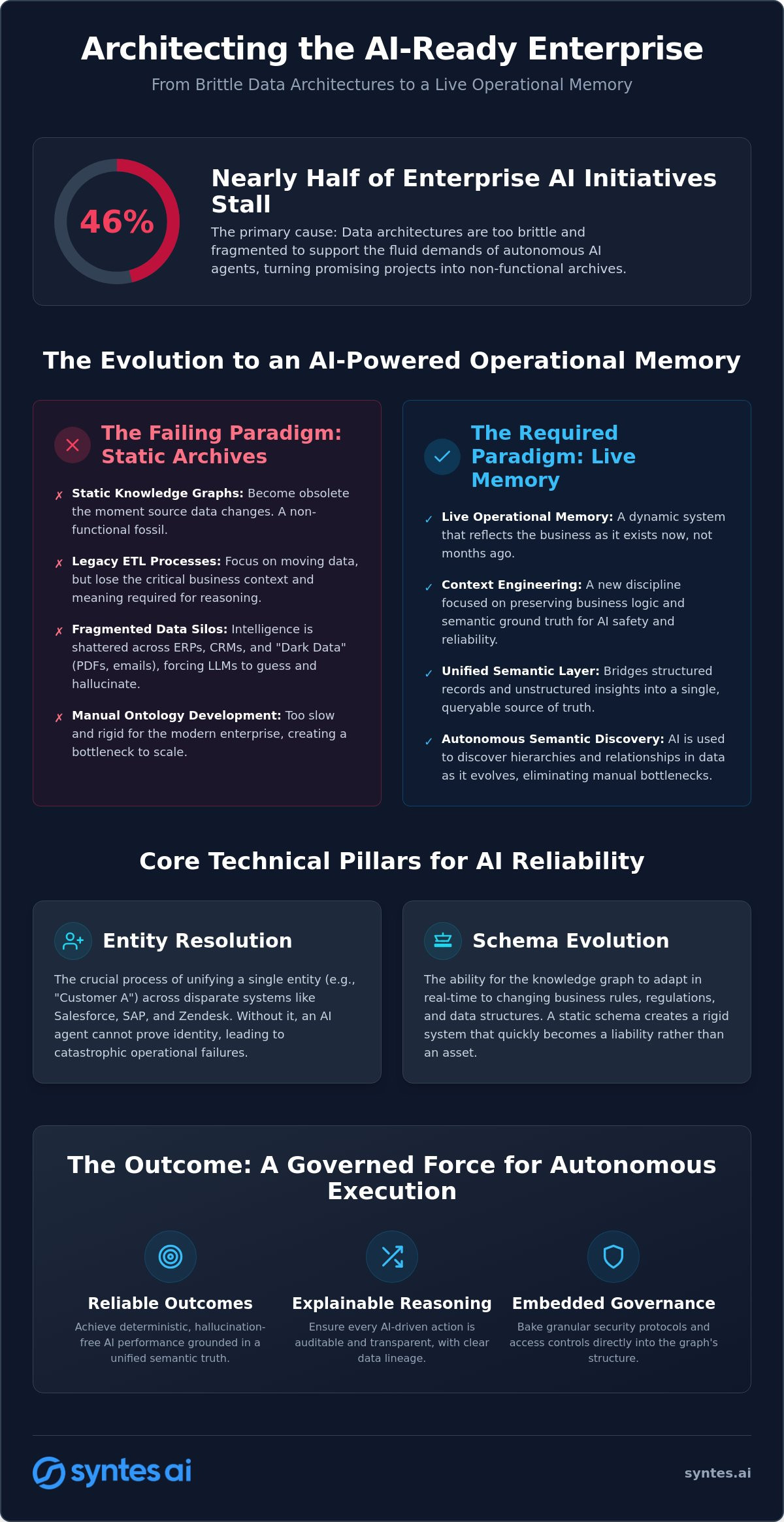
Why do nearly 46% of enterprise AI initiatives stall before they ever reach production? The reality is that most data architectures are too brittle to support the fluid demands of agentic reasoning. You’ve likely experienced the frustration of fragmented data trapped within legacy ERP and CRM systems, where traditional knowledge graph construction challenges turn promising projects into static, non-functional archives. It’s time to stop building passive maps and start architecting a live operational memory.
We understand that the high failure rate of these projects stems from an inability to maintain real-time context. This article provides a clear roadmap for building a scalable knowledge graph that integrates both structured and unstructured data seamlessly. We’ll preview the technical evolution from simple retrieval to sophisticated Context Engineering, ensuring your autonomous agents deliver reliable, hallucination-free outcomes. Discover how to transform your data from a disconnected liability into an active, governed force for execution.
Key Takeaways
- Identify why traditional approaches fail by addressing specific knowledge graph construction challenges like data fragmentation and the inherent obsolescence of static architectures.
- Master the technical requirements for entity resolution and schema evolution to maintain a unified, real-time view of business entities across disparate enterprise systems.
- Move beyond the limitations of standard RAG by implementing Context Engineering to provide the semantic ground truth necessary for deterministic AI outcomes.
- Establish a robust governance framework that ensures AI agent reliability through explainable reasoning and granular security protocols embedded directly within the graph structure.
- Architect a live operational memory that transforms passive data into an active, governed environment capable of driving autonomous enterprise execution.
What Are Knowledge Graph Construction Challenges in the Modern Enterprise?
Data is noise. Context is signal. Most organizations treat the process of building a graph as a one-time migration project. They are wrong. Traditional knowledge graph construction challenges often stem from a fundamental misunderstanding of what these systems actually do. While the academic definition of what a knowledge graph is focuses on the representation of entities and their relationships, the enterprise reality requires an execution layer that remains accurate under the pressure of real-time operations.
Static graphs are non-functional. They become obsolete the moment the first record in your CRM updates or a supply chain disruption occurs. In 2026, the industrial-scale unification of data requires more than a search index; it requires a live operational memory that balances the inherent tension between massive scalability and absolute accuracy. Overcoming these knowledge graph construction challenges requires a shift from passive storage to active reasoning. If your graph cannot handle schema evolution or real-time ingestion, it isn’t an asset. It’s a fossil.
The Fragmentation of Enterprise Intelligence
Enterprise intelligence is currently shattered across legacy ERPs, CRM platforms, and unstructured document stores. This “Dark Data”, consisting of millions of PDFs, emails, and call logs, represents the majority of corporate knowledge, yet it remains invisible to autonomous agents. Disconnected data silos are no longer just an IT inconvenience; they are a strategic liability. When context is fragmented, LLMs are forced to guess. This leads directly to the “Hallucination Problem” where AI generates plausible but factually incorrect outputs. Reliable agentic AI cannot exist in a vacuum of disconnected facts. It requires a unified semantic ground truth that bridges the gap between structured records and unstructured insights.
The Evolution from Data Integration to Context Engineering
Standard ETL processes are built for business intelligence dashboards, not for agentic reasoning. They fail because they focus on moving data rather than preserving the nuance of business logic. Extract, Transform, Load is a legacy mindset that prioritizes movement over meaning. The construction of a modern graph must move beyond simple extraction toward deep contextualization and automated understanding. We must prioritize “Understand” and “Contextualize” as core pillars of the build process. Context Engineering is the discipline of maintaining business context for AI safety.
Core Technical Bottlenecks: Entity Resolution and Schema Evolution
Identity is a moving target. In the context of knowledge graph construction challenges, the most pervasive nightmare is Entity Resolution. Unifying “Customer A” across a Salesforce CRM, an SAP ERP, and Zendesk support tickets requires more than simple string matching. It demands a sophisticated understanding of lineage and overlap. If your AI agent cannot definitively prove that the person requesting a refund is the same entity that signed a master service agreement, the system fails. This lack of identity clarity is a primary driver of the technical challenges in knowledge graph construction that stall high-level automation.
Rigid schemas are equally dangerous. Enterprise business rules and data structures change daily. A graph built on a static ontology is a liability because it cannot adapt to new regulatory requirements or shifting market logic. We must move toward Operational Relationship Intelligence. This means moving beyond simple “Node A connects to Node B” structures. We need to capture complex business logic, such as temporal validity and conditional permissions. Integrating real-time operational events into a semantic framework ensures that your graph reflects the business as it exists now, not as it was documented six months ago.
Solving the Semantic Mapping Crisis
Manual ontology development is too slow for the modern enterprise. It’s a bottleneck that prevents scale. We must use AI to discover hierarchies and business semantics autonomously, allowing the system to learn the relationships between data points as they evolve. Two-way connectors are essential here. They maintain live data integrity by ensuring that any change in the source system is immediately reflected in the graph. This creates a closed loop of accuracy. To see how these systems function in a live environment, you can explore our architectural approach to real-time integration.
Unifying Structured and Unstructured Data
Deterministic truth requires bridging the gap between SQL databases and PDF repositories. Most knowledge graph construction challenges arise when trying to extract structured insights from digital assets like contracts and policies. You cannot have a reliable AI agent if it can read the invoice data but cannot interpret the legal clauses in the accompanying PDF. We must bridge this gap to ensure that the AI operates on a single version of the truth, regardless of the original data format. This unification is the only way to achieve the precision required for autonomous execution.
Beyond RAG: Why Context Engineering is the Next Evolution
Standard Retrieval-Augmented Generation (RAG) is reaching its expiration date. By 2026, enterprise leaders have realized that simple vector similarity is no longer enough for high-stakes automation. Proximity isn’t logic. If an AI agent retrieves a document because it’s “close” in a vector space but fails to understand the hierarchical relationship between a parent company and its subsidiary, it will fail. This is where knowledge graph construction challenges become most visible. We’re moving beyond simple retrieval toward complex, structured reasoning.
Reasoning requires a semantic ground truth. Without it, even the most advanced models fall victim to the “hallucination trap.” Learning How to Prevent AI Hallucination involves architecting a deterministic logic layer where facts are verified against a governed structure. This isn’t just about GraphRAG; it’s about building a Live Operational Memory that evolves as the business moves. We must implement robust pipelines to construct and continuously update these structures to ensure the AI’s “brain” never falls out of sync with reality.
The Failure of Prompt Engineering
Prompt engineering is a temporary fix for a foundational problem. It’s ephemeral and fragile. A prompt is a whisper; persistent enterprise memory is a permanent record. You can’t prompt your way out of a lack of context. Context Engineering represents the shift from manual prompt tuning to a systematic discipline of maintaining persistent, high-fidelity business intelligence. This framework ensures AI accuracy by design, not by coincidence. It transforms the AI from a tool that guesses into a system that knows.
Architecting a Live Operational Context
The Syntes AI Context Graph serves as a dynamic model of the business. It is not a static repository. By Solving Enterprise Data Silos, we enable cross-system reasoning that was previously impossible. This architecture relies on Operational Relationship Intelligence to drive decisions. When agents can see the real-time state of every interconnected system, from supply chains to customer success, they stop being chatbots and start being operators. This is the difference between passive observation and active execution. It’s the only way to overcome the most persistent knowledge graph construction challenges in the modern enterprise.
Governing the Execution: Security and AI Agent Reliability
Governance isn’t an afterthought. It’s the architecture. When shifting from passive search to active execution, the most significant knowledge graph construction challenges transform from data ingestion issues into trust and security bottlenecks. Opaque “Black Box” AI is a non-starter in regulated environments. If an agent executes a complex workflow, you must know exactly why it took that path. Explainable reasoning is non-negotiable. Transparency is the cost of entry for enterprise-grade autonomous systems.
Permissions must be granular. You can’t grant an AI agent blanket access to the entire graph. Security protocols must be embedded within the graph structure itself, ensuring that the agent’s reach is limited by the same compliance rules that govern human employees. A Semantic Data Layer for Enterprise provides the essential audit trail for every query and action. It records the provenance of facts and the logic behind decisions, satisfying the high-risk obligations mandated by the EU AI Act set to take effect in August 2026. This layer ensures that every automated action is traceable to a specific, governed data point.
The Governance Pillar of Knowledge Construction
We must apply business rules directly to the graph nodes and edges. This ensures that AI agents operate within governed boundaries by design rather than by accident. Human-in-the-Loop systems act as a final validation layer for high-stakes decisions, but the graph provides the pre-filtered, safe environment for those decisions to occur. Live Operational Memory serves as the real-time auditor. It flags deviations from established policy before they result in operational failure, turning knowledge graph construction challenges into a framework for continuous compliance.
Trusted AI Execution for Agentic Systems
Passive insights are a relic of the dashboard era. Modern Agentic AI Platforms leverage the graph for multi-step reasoning, moving beyond simple task completion to autonomous problem-solving. This requires a foundation of explainable intelligence where every step is traceable and justified by semantic relationships. Building this trust is the only way to move AI out of the sandbox and into the core of enterprise operations. It’s about moving from “what happened” to “what should we do next.” To see how we secure these autonomous workflows and maintain total operational clarity, book a demo of the Syntes Agentic Platform.
The Syntes AI Approach: Transforming Challenges into Operational Intelligence
Static repositories are liabilities. Traditional data strategies fail because they stop at ingestion, leaving information to rot in disconnected silos. Syntes AI provides the Enterprise AI Platform required to move from data hoarding to operational execution. We address the most persistent knowledge graph construction challenges by treating the graph as a living, breathing nervous system rather than a digital filing cabinet. Our approach replaces fragile prompt tuning with a rigorous Context Engineering Framework designed for the complexities of the global enterprise.
The Syntes framework is built on five strategic pillars that transform raw data into a reasoning layer. First, we Connect through deep Cross-System Integrations. We then Understand by extracting semantic meaning from both structured and unstructured sources. Next, we Contextualize that data into a live Context Graph. We Govern the system through strict AI Governance protocols to ensure safety. Finally, we Execute, powering AI Workflow Automation that drives real business value. This methodology ensures that your AI agents aren’t just guessing; they’re operating from a position of absolute certainty.
By moving from fragmented silos to a live Context Graph, organizations can finally overcome the knowledge graph construction challenges that have historically stalled AI adoption. One global logistics firm transitioned from manual data reconciliation to a Syntes-powered live graph, allowing their agents to reason across shipping manifests, legal contracts, and real-time sensor data simultaneously. This isn’t just a technical upgrade. It’s a strategic evolution into agentic intelligence.
Implementing the Syntes AI Context Graph
We leverage two-way connectors to ensure your graph remains in sync with your source systems in real-time. This creates a continuously evolving Enterprise Memory that grows as your business grows. By unifying customers, products, and complex business rules into a single reasoning layer, we eliminate the latency that kills AI reliability. Your agents don’t work with yesterday’s data; they work with the current state of your entire operation. It’s a deterministic foundation for a world that never stops moving.
Unleashing the Syntes Agentic Platform
Scaling AI initiatives requires more than just a clever model. It requires enterprise-grade infrastructure that can manage multi-step reasoning across billions of data points. The Syntes Agentic Platform allows you to deploy governed agents that reason over trusted context, ensuring every action is justified and every decision is traceable. We provide the tools to transition from passive observation to active, automated performance at scale. Don’t let your AI be limited by the boundaries of your data silos. Explore the Syntes AI Enterprise AI Platform and start architecting your live operational memory today.
Architecting the Future of Agentic Intelligence
The era of passive data storage is over. Enterprises that continue to treat data as a static library will find themselves sidelined by the rapid evolution of autonomous agents. You’re already seeing the limits of legacy systems that fail to provide real-time relevance. We’ve established that overcoming knowledge graph construction challenges requires a fundamental shift from simple retrieval to deep, governed Context Engineering. By architecting a live operational memory, you move beyond the fragility of vector search toward a deterministic reasoning layer that drives actual business results.
Governance, security, and real-time integration are the three pillars of a reliable agentic strategy. Syntes AI provides the framework to unify your fragmented silos into a single, executable Context Graph. Trusted by global enterprises, our platform delivers an explainable and governed AI reasoning framework that turns operational complexity into a competitive advantage. The transition from observation to automated performance is no longer a theoretical goal; it’s a strategic necessity.
Architect your enterprise memory with the Syntes AI Platform and secure your position as a leader in the next evolution of autonomous intelligence. The tools for total operational clarity are within your reach.
Frequently Asked Questions
What are the biggest knowledge graph construction challenges for large enterprises?
The most significant knowledge graph construction challenges involve bridging the gap between legacy ERP systems and unstructured document repositories. High failure rates often stem from a lack of real-time synchronization. Enterprises struggle to maintain a dynamic nervous system when their data sources are architected as static, disconnected libraries. Without a live operational memory, the graph becomes a fossilized record rather than a tool for agentic execution.
How does Context Engineering differ from traditional data engineering?
Traditional data engineering focuses on the physical movement of bits through ETL pipelines. It prioritizes storage and retrieval. Context Engineering is a strategic discipline that prioritizes the preservation of business logic and semantic relationships. It ensures that data isn’t just moved, but understood by AI agents. This approach transitions the enterprise from passive data observation to active, automated performance by embedding governing rules directly into the data structure.
Can a knowledge graph help prevent AI hallucinations in enterprise applications?
Knowledge graphs provide a deterministic ground truth that constrains AI outputs within governed boundaries. Standard LLMs often hallucinate because they rely on probabilistic patterns rather than verified facts. By grounding an agent in a semantic graph, you force the model to justify its reasoning against structured enterprise data. This architectural constraint ensures that AI outcomes are reliable, traceable, and free from the fabrications common in ungrounded generative systems.
Why is entity resolution so difficult in knowledge graph construction?
Entity resolution is difficult because identical business entities often exist under different identifiers across CRM, ERP, and support platforms. A customer in Salesforce might not share a primary key with their record in an SAP instance. Resolving these duplicates requires sophisticated semantic matching that accounts for temporal changes and overlapping attributes. If this process fails, the graph’s integrity collapses, leading to fragmented insights and unreliable AI agent performance across the enterprise.
What is the difference between a static knowledge graph and a live Context Graph?
A static knowledge graph is a snapshot of information that begins to decay the moment it’s built. It lacks the connectivity to reflect real-time business changes. In contrast, a live Context Graph functions as an operational memory. It utilizes two-way connectors to ingest events as they happen. This ensures that AI agents are reasoning over the current state of the business, not a historical record that no longer reflects reality.
How do AI agents use knowledge graphs to execute business processes?
AI agents use the graph as a roadmap for multi-step reasoning and cross-system execution. Instead of simply retrieving a document, an agent traverses the graph to understand the relationships between products, customers, and compliance rules. This semantic map allows the agent to identify the correct sequence of actions for complex workflows. It transforms the AI from a simple chatbot into an autonomous operator capable of performing governed business processes.
Is a vector database enough for enterprise AI, or do I need a knowledge graph?
A vector database is insufficient for complex enterprise logic because it only measures similarity, not relationships. While vector search is excellent for finding related items, it cannot reason about hierarchies or conditional business rules. You need a knowledge graph to provide the semantic structure that vector databases lack. Combining both through GraphRAG enables the AI to understand the logic behind the data, ensuring outcomes that are both relevant and logically sound.
What industries benefit most from enterprise knowledge graph implementation?
Regulated industries with high data complexity benefit most from these implementations. Finance, pharmaceuticals, and global logistics require the absolute precision and explainability that only a semantic graph can provide. These sectors face unique knowledge graph construction challenges due to strict compliance mandates like the EU AI Act. For these organizations, a governed graph isn’t just a technical advantage; it’s a requirement for maintaining operational integrity and regulatory transparency.