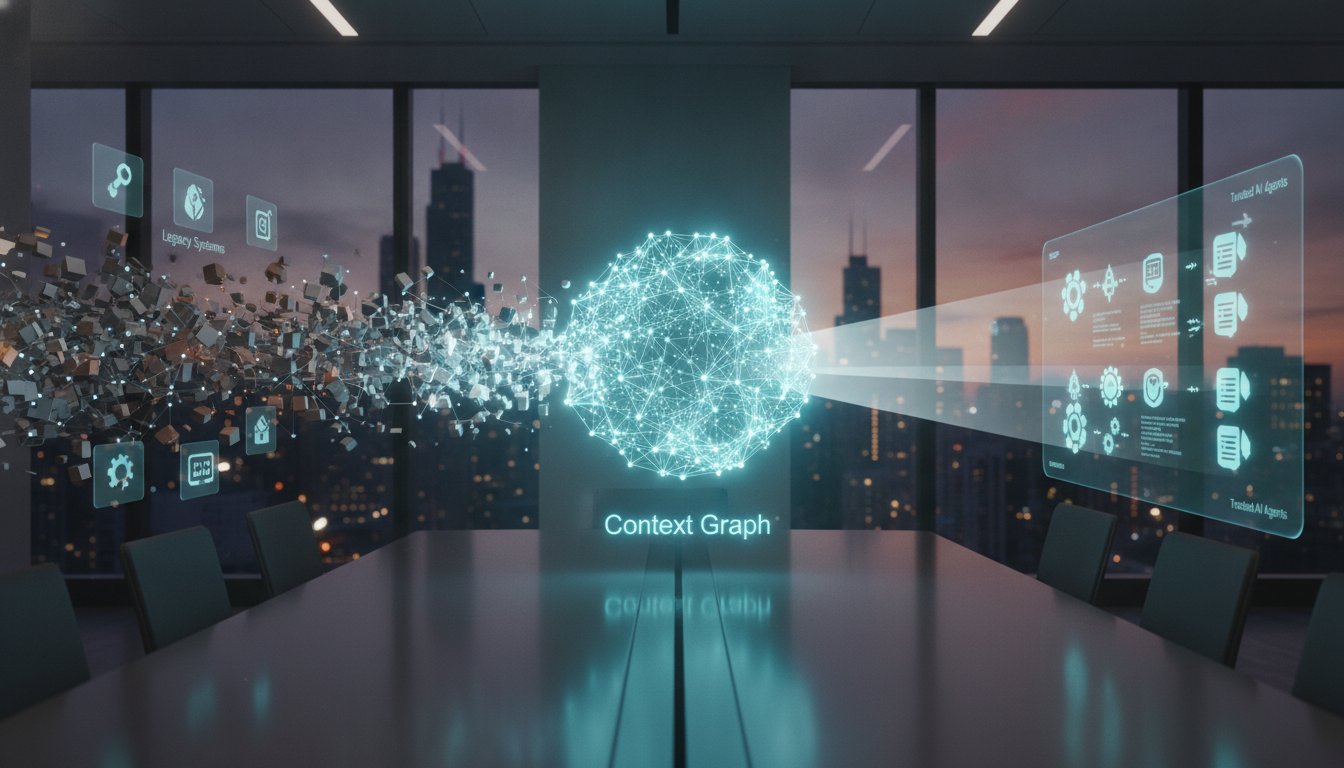
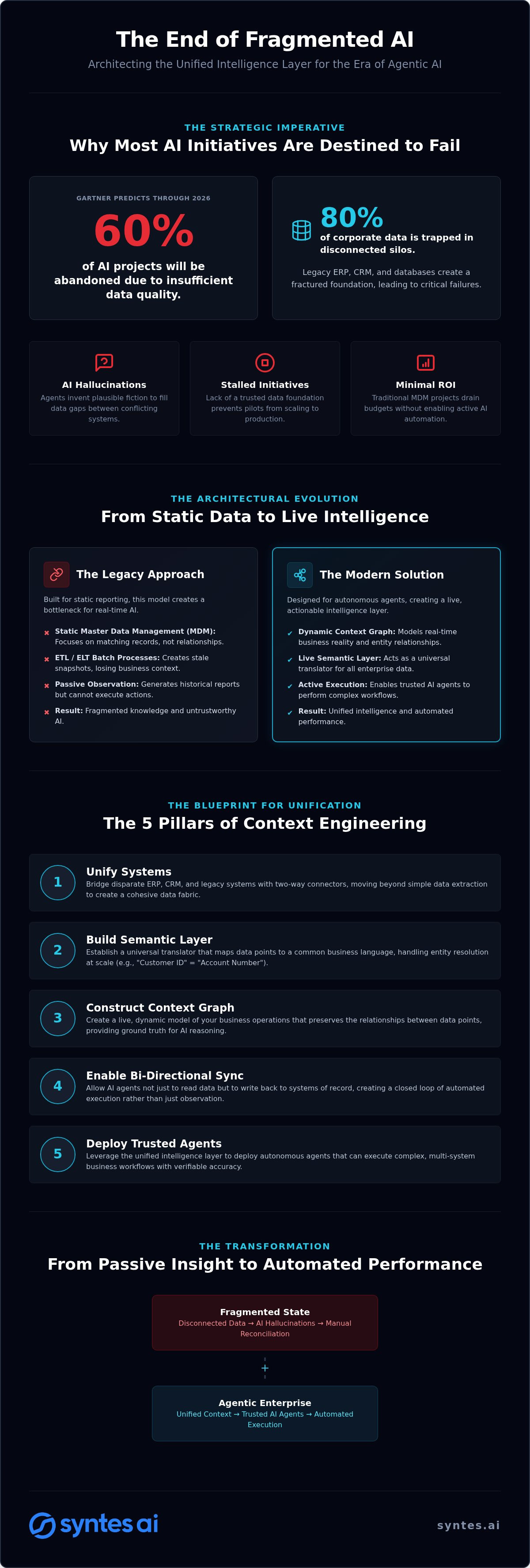
Gartner predicts that through 2026, 60% of AI projects will be abandoned due to insufficient data quality. It’s a staggering failure rate for an era defined by the promise of autonomous intelligence. Most organizations are still wrestling with 80% of their corporate data trapped in disconnected silos across legacy ERP and CRM systems. You likely feel the friction. Your AI initiatives are stalled by hallucinations and a lack of grounding. Traditional MDM projects continue to drain budgets with minimal ROI. It’s a systemic flaw that demands a strategic evolution.
It’s time to move beyond matching records. This guide details the shift toward a live operational context layer. We’ll explore advanced enterprise data unification strategies that replace static databases with a dynamic Context Graph. You’ll discover a blueprint for building a unified intelligence layer that allows trusted AI agents to execute complex business processes without manual reconciliation. We’re moving from passive observation to active, automated performance. The era of fragmented knowledge is over. The era of agentic intelligence has arrived, exemplified by specialized applications like SetSmart that automate customer engagement and appointment setting across messaging channels.
Key Takeaways
- Understand why legacy data silos are the primary catalyst for AI hallucinations and why architecting a context layer is mandatory for autonomous agents in 2026.
- Evaluate modern enterprise data unification strategies that transition from traditional ETL processes to sophisticated semantic layers and live operational memory.
- Contrast the inherent limitations of static Master Data Management (MDM) with the dynamic capabilities of a Context Graph for real-time AI reasoning and execution.
- Master the five pillars of the Syntes Context Engineering Framework to successfully bridge disparate ERP, CRM, and legacy systems into a single source of truth.
- Discover how to deploy trusted AI agents that execute complex business workflows by leveraging a unified intelligence layer powered by the Syntes Agentic Platform.
The Strategic Imperative for Enterprise Data Unification in 2026
Data unification was once a back-office cleaning exercise. In 2026, it’s the architectural prerequisite for survival. For the AI-first enterprise, effective enterprise data unification strategies are no longer optional; they are the foundation of the modern autonomous enterprise. Unification now means creating a live semantic layer that translates raw data into business context. Without this layer, your AI is effectively blind. It’s guessing. It’s hallucinating. It’s failing to deliver the ROI you were promised. True unification provides the ground truth necessary for agentic reasoning.
Legacy silos are the primary cause of AI hallucinations. Large Language Models are powerful reasoning engines, but they lack the proprietary context of your specific business. When an agent queries a siloed ERP and receives data that conflicts with your CRM, it fills the gaps with plausible fiction. This is why most pilot projects fail. They don’t fail because the AI is weak. They fail because the data foundation is fractured and inconsistent. We’re witnessing a shift from passive business intelligence, which merely reports the past, to active operational intelligence, which drives the present.
The Hidden Cost of Fragmented Enterprise Context
Disconnected data creates a trust gap that no amount of prompt engineering can bridge. Organizations lose millions in operational friction when AI agents cannot verify facts across systems. This lack of a single source of truth prevents the transition to autonomous execution. If you don’t trust the data, you can’t trust the agent to process an invoice or update a supply chain. This systemic problem is why many leaders are Solving Enterprise Data Silos by shifting toward agentic intelligence architectures that prioritize real-time relevance and systemic integration.
Why Connectivity Alone is Not Unification
Connectivity is a pipe. Unification is the meaning of what flows through it. Simple API integrations or data dumps into vector databases don’t constitute a strategy. You need a structured context layer. Modern enterprise data unification strategies focus on Context Engineering, the strategic discipline of defining how data points relate to business logic in real-time. Connectivity gets you into the room; context gives you the power to act. By architecting context rather than just connectivity, enterprises move beyond passive observation into a state of total operational clarity and automated performance.
Core Strategies for Unifying Disparate Enterprise Data
Traditional ETL and ELT processes are artifacts of a pre-AI era. They were designed for static reporting. They weren’t built for the high-velocity demands of autonomous agents. In 2026, effective enterprise data unification strategies must prioritize immediacy and semantic depth. Instead of moving data into a central lake where it loses its original context, modern architectures utilize a Context Graph. This live operational model preserves the relationships between data points across ERPs and CRMs. It ensures that AI reasoning is grounded in the actual state of the business, not a stale snapshot from a midnight batch run.
Two-way connectors are essential for this transition. They don’t just pull data; they maintain a bi-directional synchronization that allows AI agents to write back to the systems of record. This creates a loop of execution rather than just observation. This approach unifies structured SQL data with unstructured assets like PDFs and documentation into a single, cohesive model. The result is a system that understands that a line item in an invoice is directly tied to a specific clause in a vendor contract. It bridges the gap between what’s recorded in a database and what’s written in a document.
Building the Semantic Data Layer
The semantic layer acts as the universal translator between your fragmented systems and the AI reasoning engine. It’s the infrastructure that handles entity resolution and relationship discovery at scale. Mapping disparate data points to a common business language ensures that “Customer ID” in one system and “Account Number” in another are recognized as the same entity. This layer provides the logic that LLMs need to navigate complex schemas without getting lost in technical debt. For a deeper look at this architecture, see The Semantic Data Layer.
From RAG to GraphRAG: Advanced Retrieval Strategies
Standard Retrieval-Augmented Generation (RAG) relies on vector search. This often fails to capture the intricate web of business relationships. It finds similar words but misses the underlying logic. GraphRAG solves this by providing the necessary reasoning paths for LLMs. It maps how entities interact across your entire organization. This allows an agent to understand why a shipment delay in Asia impacts a specific customer’s contract in Europe. This relationship-based intelligence transforms a simple chatbot into a reliable operational partner. If you’re ready to see how this works within your infrastructure, you can book a demo to explore our Context Graph capabilities.
Evaluating Unification Frameworks: MDM vs. Context Graphs
Traditional Master Data Management (MDM) was architected for a world of human-centric reporting. It prioritizes the “Golden Record,” a sanitized, static version of reality. For agentic AI, this approach is insufficient. Modern enterprise data unification strategies must account for the high-velocity nature of live operations. Relational schemas are too rigid. They require months of mapping before a single query can be run. Often, the system is obsolete by the time it reaches production. In contrast, graph-based unification allows for rapid entity resolution without the need for an inflexible, pre-defined structure. It focuses on the relationships that drive business value.
The speed-to-value of a graph-based model far outpaces traditional relational databases. Instead of forcing data into a fixed box, a Context Graph maps the enterprise as it actually exists. It treats every system update as a live event rather than a batch entry. This living model evolves in real-time, ensuring that your AI agents aren’t making decisions based on yesterday’s data. It replaces the “Golden Record” with a dynamic operational context. This is the difference between a static map and a live GPS system. One shows you where things were; the other tells you where to go right now.
Why MDM Falls Short for Agentic AI
MDM suffers from inherent latency. The governance workflows required to validate and merge records often take days or weeks. By the time the data is “clean,” the business reality has shifted. Rigid schemas can’t handle the complexity of modern business logic where relationships are just as important as attributes. A Context Graph acts as an agile, AI-ready alternative. It doesn’t just store data; it maps the shifting dependencies between systems. This eliminates the trust gap that stops AI pilot projects in their tracks. If your data is static, your AI is stagnant.
The Advantage of Live Operational Memory
Static databases are graveyards of information. Live Operational Memory is a continuously evolving enterprise model. It integrates real-time event streams, such as a sensor alert or a CRM update, directly into the reasoning layer. This transforms data unification from a background task into a live stream of intelligence. It allows AI agents to act on what’s happening in this exact moment. For a strategic deep dive into this architectural shift, consult The Executive Guide to Enterprise Knowledge Graphs. This is the necessary evolution from passive data storage to active, automated performance.
Implementing a Modern Data Unification Strategy
Execution is the graveyard of theoretical ambition. Many enterprise data unification strategies fail because they lack a repeatable, engineered process. Syntes addresses this systemic weakness through the Context Engineering Framework. It’s a methodical progression from raw connectivity to autonomous execution. This framework isn’t a suggestion; it’s a requirement for organizations that intend to lead in 2026. It replaces guesswork with technical precision.
The process begins with four foundational steps. Step 1: Connect. You must bridge disparate sources without disrupting current operations, including ERPs, CRMs, cloud environments, and legacy systems. Step 2: Understand. Automated discovery identifies entities and hierarchies, finding the hidden relationships that manual mapping misses. Step 3: Contextualize. Data is woven into a dynamic enterprise model that reflects your specific business logic. Step 4: Govern. You apply enterprise-grade security and business rules to ensure every output is compliant and accurate.
Overcoming Integration Friction
Legacy systems often act as strategic anchors. Massive refactoring is a non-starter for most global enterprises. AI middleware bridges the gap between old tech stacks and modern AI requirements. It allows for seamless data flow without the need to rip and replace core infrastructure. This approach ensures immediate utility while maintaining long-term architectural integrity. For specific deployment tips on modernizing your stack, see our guide on Enterprise AI Infrastructure.
Establishing Governance for Autonomous Agents
Unification isn’t just about data quality; it’s about governing AI actions. As agents begin to execute business processes, you need frameworks that manage their decisions. Effective enterprise data unification strategies must include the governance of AI behavior. Human-in-the-loop systems remain critical for high-stakes operations to ensure that while the AI is autonomous, it isn’t rogue. To learn more about building these trust frameworks, read How to Prevent AI Hallucination.
Syntes AI: Orchestrating Unified Intelligence via the Context Graph
The Syntes AI Platform is the definitive resolution for enterprises trapped in the cycle of data fragmentation. It’s the bridge between raw information and autonomous performance. Most enterprise data unification strategies stop at the point of ingestion. They leave the heavy lifting of reasoning to the LLM. Syntes flips this model. We provide the Syntes Agentic Platform, a system where unification is merely the first step toward systemic execution. The Context Graph acts as the brain of this operation. It enables explainable AI reasoning. It ensures every action taken by an agent is traceable back to a specific business rule or data point. This is how you build trust in a machine-led world.
Enterprise leaders need a path from fragmentation to intelligence. It’s not enough to have a data lake; you need a live operational model. The Syntes Enterprise AI Platform provides the infrastructure to move from passive data storage to active, automated performance. It replaces static records with a dynamic map of your entire business logic. This isn’t just about cleaning data. It’s about architecting a system that can think, reason, and act with the same precision as your best human operators. The transition is inevitable. The only question is how quickly your organization will adapt.
Transforming Data into Actionable Context
Unified context allows AI agents to perform cross-system tasks autonomously. When an agent understands that a logistics delay in a legacy ERP impacts a high-priority contract in the CRM, it can trigger automated mitigation workflows. This is the power of Operational Relationship Intelligence. It provides decision-makers with a view of the enterprise that is both granular and systemic. You’re no longer looking at isolated facts; you’re seeing the web of dependencies that drive your revenue. We invite you to see this in action. Experience how we bridge the gap between data and execution by scheduling a demonstration of our platform.
The Future of Enterprise Intelligence
The 2026 enterprise will be defined by its context layer. Organizations that continue to rely on fragmented silos will find themselves unable to compete with the speed of autonomous agents. Syntes AI is on a mission to eliminate fragmented knowledge. We’re building the foundation for a future where every piece of data is a catalyst for action. The era of passive observation is over. The era of agentic intelligence has arrived. It’s time to stop managing data and start orchestrating intelligence.
Architecting the Future of Enterprise Intelligence
The architecture of 2026 demands more than just connected systems. It requires a live, intelligent memory that understands the nuances of your business logic. We’ve seen how legacy silos act as anchors, dragging down AI ROI and fueling hallucinations. By implementing advanced enterprise data unification strategies, you replace these fragmented relics with a dynamic Context Graph. This isn’t just about data quality; it’s about engineering the deterministic ground truth that allows agents to execute processes with total certainty.
Syntes AI provides the definitive roadmap to AI maturity through our Context Engineering Framework. We’ve helped global enterprises bridge the gap between sophisticated LLMs and the messy reality of proprietary data. The result is a system that doesn’t just predict text, but performs work. It’s time to stop experimenting with isolated pilots and start orchestrating unified intelligence across your entire operational stack.
The path to operational clarity is clear. We’re ready to help you build the foundation for a truly autonomous future.
Frequently Asked Questions
What is the difference between data integration and data unification?
Integration is the technical pipe that moves data between systems via APIs or ETL processes. Unification is the semantic layer that defines what that data actually means. While integration provides connectivity, unification resolves disparate records into a single, cohesive entity. It’s the difference between having multiple disconnected databases and possessing a unified intelligence layer that understands your entire business logic.
How does a Context Graph improve AI accuracy compared to standard RAG?
Standard RAG relies on vector similarity, which often misses the structural logic of an enterprise. It finds related words but lacks understanding. A Context Graph maps the actual relationships between entities, providing a deterministic reasoning path for the LLM. This structural grounding eliminates hallucinations by ensuring the AI understands how a shipment delay in one system impacts a contract in another.
Can we unify data from legacy ERP systems without a total system overhaul?
Why is MDM insufficient for powering agentic AI platforms?
MDM focuses on static “Golden Records,” which are too rigid for the real-time needs of autonomous agents. It lacks the relationship-based depth required for complex reasoning. Agentic platforms need Live Operational Memory, not a deduplicated database from a midnight batch run. MDM provides a snapshot of the past; agentic AI requires a live model of the present to execute business processes effectively.
What are the first steps in an enterprise data unification strategy?
The first step is identifying high-value data silos and the core business logic they contain. You then initiate the “Connect” phase of the Context Engineering Framework. Successful enterprise data unification strategies begin by establishing secure, bi-directional flows between your ERP, CRM, and unstructured document stores. This creates the initial foundation for a dynamic enterprise model that scales with your AI maturity.
How does Syntes AI handle data governance and security during unification?
Syntes AI embeds governance directly into the architecture of the Context Graph. We utilize enterprise-grade security protocols and specific business rules to ensure AI agents operate within strict boundaries. This includes human-in-the-loop triggers for high-stakes decisions and granular access controls. Governance is not a separate layer; it’s a fundamental component of the unified intelligence we provide to ensure trusted, compliant execution.
Is a knowledge graph the same as a data fabric?
A data fabric is an architectural approach to data management, while a knowledge graph is the specific technology that makes it intelligent. The graph provides the semantic relationships and reasoning capabilities that turn a passive data fabric into an active intelligence layer. While the fabric connects the data, the graph understands it, enabling the transition from passive observation to active, automated performance.
How long does it typically take to implement a unified context layer?
A pilot context layer can be deployed in weeks. Unlike traditional MDM projects that take years, modern enterprise data unification strategies focus on incremental value. You start with a high-impact use case and expand the graph as your operational needs evolve. This methodical progression ensures immediate ROI while building the long-term infrastructure required for total operational clarity and autonomous enterprise intelligence.