

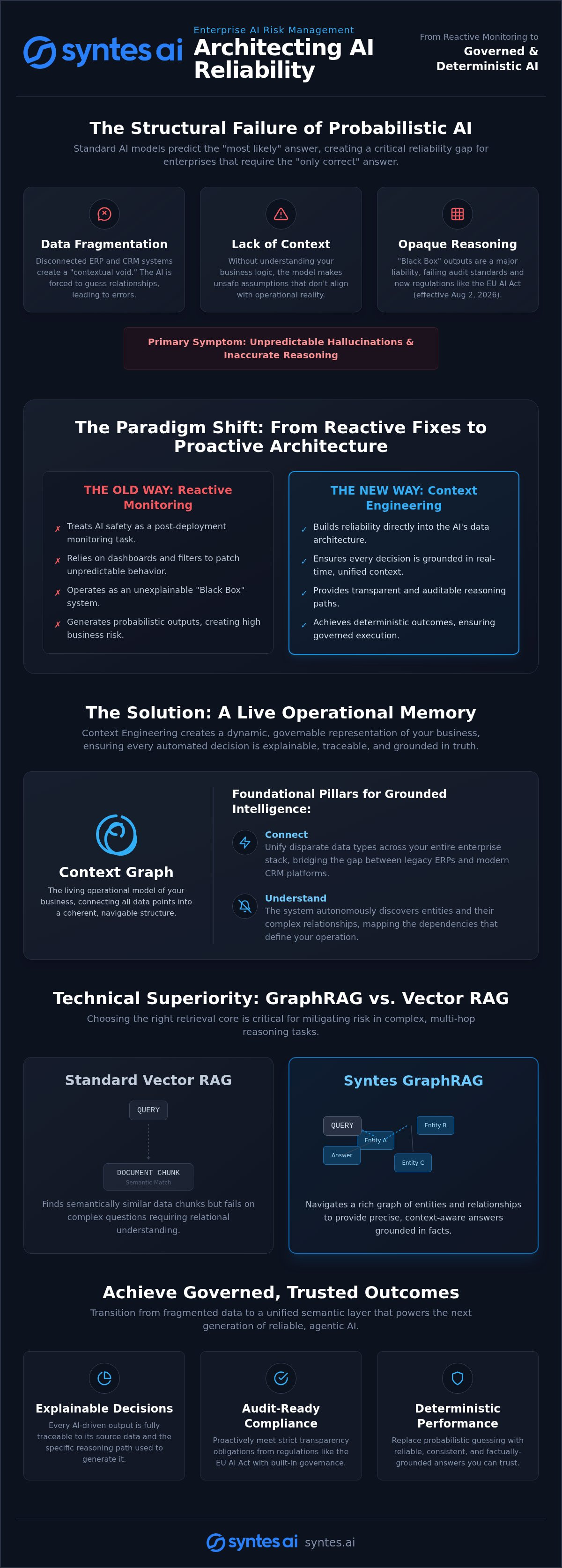
Stop treating AI safety as a post-deployment monitoring task. It is a structural engineering failure. With the EU AI Act transparency obligations now in full effect as of August 2, 2026, the era of the “black box” is officially over. Effective enterprise ai risk management isn’t found in a reactive dashboard or a post-hoc filter. It’s built into the very architecture of your data through rigorous Context Engineering.
You’ve likely experienced the frustration of unpredictable hallucinations in production and reasoning paths that fail to meet basic audit standards. It’s a direct result of fragmented data silos feeding an engine that doesn’t truly understand your business logic. We’ll show you how to replace this volatility with a deterministic framework that ensures governed AI execution. This article explores the transition to a Live Operational Memory, providing a scalable roadmap for architecting reliable, explainable, and agentic AI systems.
Key Takeaways
- Identify the structural flaws in probabilistic models that prevent AI from achieving the deterministic truth required for high-stakes business environments.
- Transition from reactive monitoring to a proactive enterprise ai risk management strategy by architecting reliability directly into your systems with Context Engineering.
- Evaluate the technical superiority of GraphRAG over standard Vector RAG for complex, multi-hop reasoning tasks that demand precise data relationships.
- Execute a scalable roadmap to unify fragmented data silos into a single, governed semantic layer that supports the next generation of agentic AI.
- Leverage the Syntes AI Platform to create a Live Operational Memory, ensuring every automated decision is explainable, traceable, and grounded in real-time context.
Why Probabilistic Models Fail Enterprise AI Risk Management Standards
Enterprise ai risk management is not a passive monitoring task; it is a structural discipline. It is the rigorous process of ensuring that every AI-driven output is consistent, accurate, and compliant with global standards. Most current approaches fail because they rely on probabilistic models to solve deterministic problems. A model that predicts the “most likely” next word is fundamentally at odds with an enterprise that requires the “only correct” answer. This conflict between statistical probability and deterministic truth creates a reliability gap that cannot be patched with simple filters or guardrails. It must be addressed at the architectural level.
The reliability gap rests on three structural pillars: fragmentation, lack of context, and opaque reasoning. When data is scattered, the model lacks a unified source of truth. When context is missing, the model makes assumptions. When reasoning is opaque, the system becomes a liability rather than an asset. True reliability is not a post-deployment feature. It is a fundamental property that must be built into the context layer of your AI environment.
The Hallucination Problem: A Symptom of Data Fragmentation
Hallucinations are not random glitches. They are the model’s desperate attempt to bridge the gaps in fragmented enterprise knowledge. Disconnected ERP and CRM systems create a “contextual void” where the AI is forced to guess relationships between entities that have never been mapped. To solve this, you must focus on how to prevent ai hallucination by grounding every query in a unified, cross-system data layer. Without this grounding, your AI is merely a sophisticated guessing machine operating in a vacuum of its own making. Grounded intelligence requires a live operational memory that connects every siloed data point into a coherent, navigable structure.
The Executive Requirement for Explainable AI (XAI)
The “black box” approach to AI is a relic of the past. As of August 2, 2026, the EU AI Act has mandated strict transparency obligations that make unexplainable AI outputs a legal and financial risk. Leaders can no longer accept a “trust me” response from their technology. High-stakes decisions require structured reasoning over established business logic, not just probabilistic next-token generation. By adhering to foundational AI safety principles, organizations can move toward explainability that satisfies both internal auditors and external regulators. This transparency is the only foundation for executive trust; it transforms AI from a risky experiment into a governed tool for enterprise ai risk management. When the reasoning path is visible, the risk is manageable.
Context Engineering: The Structural Core of AI Reliability
Context Engineering is the discipline of building and governing enterprise context to ensure AI accuracy at scale. It represents a fundamental shift in how we approach machine intelligence. Simple RAG and prompt engineering are superficial fixes; they provide a snippet of data but lack the structural understanding of how that data relates to the broader business logic. To achieve true enterprise ai risk management, organizations must move toward “Operational Relationship Intelligence.” This is the capacity of a reasoning engine to understand not just facts, but the interconnected dependencies that define your operation. Without this structural foundation, AI remains a liability.
The Syntes AI Context Graph serves as the “Living Operational Model” of the business. It is a dynamic architecture that mirrors your actual environment in real-time. While many high-level frameworks, such as the NIST AI Risk Management Framework, focus on organizational policy and administrative mapping, Syntes provides the technical data architecture to enforce these policies autonomously. It moves governance from a document in a drawer to a line of code in the execution layer.
The Five Pillars of the Syntes Context Engineering Framework
Reliability isn’t an accident. It’s the result of a methodical framework designed to eliminate ambiguity. The first three pillars of our approach create the foundation for grounded intelligence:
- Connect: We unify disparate data types across your entire enterprise stack, bridging the gap between legacy ERPs and modern CRM platforms.
- Understand: The system autonomously discovers entities, relationships, and hierarchies, transforming raw data into a structured map of your business.
- Contextualize: This process culminates in a dynamic enterprise knowledge graph that acts as a live, real-time model of your operational reality.
This architecture ensures that the AI never operates in a vacuum. It has a comprehensive map of the truth, allowing it to navigate complex queries with precision rather than probability.
Govern and Execute: Mitigating Risk at the Point of Action
How do you ensure an AI agent follows your rules? You embed them in the context. By integrating business rules and compliance standards directly into the Context Graph, we move risk mitigation to the point of action. This creates “Governed Agentic AI.” These are agents that don’t just suggest; they execute within enterprise-grade constraints. It transforms AI from a passive chatbot into an active, reliable operator that understands its boundaries. If you’re ready to see how this structural approach can secure your operations, you should explore our Context Engineering platform. This framework is the definitive solution for enterprise ai risk management, ensuring that every automated step is traceable, compliant, and grounded in fact.
GraphRAG vs. Vector RAG: Choosing the Core for Risk Mitigation
Standard Vector RAG is a gamble. It relies on semantic similarity, a mathematical proxy for relevance that frequently fails in high-stakes environments. While vector databases excel at finding “similar” text, they are fundamentally incapable of understanding the structured relationships that define your business logic. For effective enterprise ai risk management, your retrieval architecture must move beyond proximity and toward precision. This is where GraphRAG becomes the gold standard. It provides the structural integrity needed to prevent contextual drift, ensuring that your AI doesn’t just find related data, but navigates the actual hierarchy of your organization.
Choosing the right core architecture is the prerequisite for building a robust semantic data layer for enterprise integrity. Without a Knowledge Graph, your AI is forced to operate on “vibes” rather than facts. This architectural choice determines whether your AI system is a compliant asset or a liability that ignores critical business constraints during execution.
Why Vector Similarity is Not Semantic Understanding
The fatal flaw of Vector RAG is the “Top-K” retrieval problem. In this model, the system retrieves the top few snippets of data that look mathematically similar to the query. However, relevance in an enterprise setting is rarely about similarity; it’s about connection. If the critical business logic is buried in a document that doesn’t share keywords with the prompt, the model ignores it. This creates a “contextual void” that leads directly to hallucinations. In contrast, Knowledge Graphs preserve the meaning and hierarchy of entities. Consider a financial service use case: connecting a specific transaction to a customer’s history and a current regulatory policy requires following a logical chain, not just finding similar words. Vector RAG fails these multi-hop reasoning tasks because it cannot “jump” between related nodes of information.
The Reliability Advantage of Graph-Based Grounding
GraphRAG provides a verifiable, auditable path from query to output. Every response generated by the system is grounded in the Context Graph, allowing you to trace exactly which entities and relationships were used to reach a conclusion. This transparency is essential for aligning with the NIST AI Risk Management Framework, which demands that AI systems be both explainable and resilient. By utilizing a “Unified Context Layer,” you create a single source of truth that all agents must follow. This strict grounding eliminates the possibility of the model “wandering” into speculative territory. It transforms enterprise ai risk management from a monitoring task into a deterministic certainty. When your AI is grounded in a Knowledge Graph, it doesn’t guess. It knows.
Governing the Machine: A Roadmap for Reliable Agentic AI
Strategic excellence in enterprise ai risk management requires a transition from theory to a rigorous operational roadmap. You cannot govern what you cannot map. The path to reliable agentic intelligence is built on five non-negotiable stages. First, audit data fragmentation. You must identify high-risk “context silos” where critical business logic is currently lost to the model. Second, implement a semantic layer to unify structured and unstructured data assets into a single, navigable truth. Third, deploy agentic ai platforms that are strictly grounded in your Knowledge Graph. Fourth, establish Human-in-the-Loop (HITL) checkpoints for high-stakes actions to ensure human oversight remains where it matters most. Finally, continuously evolve your “Live Operational Memory” to reflect real-time business changes, ensuring your AI never operates on stale information.
Security and Governance in Agentic Orchestration
From Chatbots to Reliable Operational Agents
The market is moving beyond passive chatbots toward active enterprise ai infrastructure execution. Modern agents use the Context Graph to navigate complex cross-system integrations safely. They don’t just find information; they act on it. Reliability in 2026 is the ability to execute governed actions without human supervision. This level of autonomy is only possible when the agent possesses a deep, structured understanding of the operational environment. It’s the difference between a tool that tells you there’s a problem and a partner that fixes it. By grounding agents in a Knowledge Graph, we eliminate the guesswork that leads to operational failure.
Syntes AI: The Enterprise Intelligence Layer for Trusted Outcomes
Syntes AI delivers the definitive architecture for organizations that refuse to gamble on probabilistic outcomes. We resolve the reliability crisis at its source. By replacing fragmented data with a unified intelligence layer, we move beyond the reactive “First-Wave AI” of conversational chatbots. We’re entering the era of “Second-Wave AI,” where enterprise ai risk management is synonymous with governed execution. The Syntes AI Context Graph functions as the essential Enterprise Memory, providing the grounded truth necessary for autonomous agents to perform with total certainty. It transforms your fragmented data into a strategic asset, ensuring that every automated decision is traceable and defensible.
Live Operational Memory: The Reliability Engine
Reliability is a product of real-time awareness. The Syntes platform operates on a continuous risk-mitigation loop: Connect, Understand, and Contextualize. This cycle ensures that your AI is never operating on stale or disconnected information. We utilize sophisticated two-way connectors to maintain data integrity across your entire ecosystem; as your business changes, your AI’s understanding evolves alongside it. This isn’t just a pilot-scale solution. Our architecture is designed for national, large-scale enterprise deployments where the cost of a single hallucination is measured in millions. It provides the systemic integration required to move from passive observation to active, automated performance without compromising safety.
Beyond RAG: The Future of Trusted Enterprise Intelligence
AI is only as intelligent as the context it understands. Standard RAG is a temporary patch; it cannot provide the deep relationship mapping required for complex business logic. The long-term ROI of a governed context layer far outweighs the cost of fragmented, disconnected AI tools that create new security silos. By centralizing your operational intelligence, you create a scalable foundation for all future automation. It’s time to stop experimenting with theoretical models and start architecting for operational clarity. Syntes AI is the partner that understands the messy realities of large-scale operations and possesses the sophisticated tools to bring order to them. This is the definitive evolution of enterprise ai risk management.
Architecting the Future of Governed Intelligence
The transition from probabilistic guesswork to deterministic reliability is no longer optional. It’s a strategic mandate for the modern leader. You’ve seen how the Syntes Context Engineering Framework replaces fragmented silos with a unified, navigable truth. By prioritizing an enterprise-grade GraphRAG implementation, you eliminate the structural poverty of standard retrieval methods. This isn’t just about accuracy; it’s about building a system that satisfies the most rigorous audit standards.
The era of the “black box” has ended. It’s time to build the intelligence layer your enterprise can finally trust.
Frequently Asked Questions
What is enterprise AI risk management in 2026?
Enterprise ai risk management is the technical discipline of architecting deterministic truth within machine intelligence. It has evolved from passive monitoring to an active structural requirement. As of August 2, 2026, it primarily focuses on meeting the transparency obligations of the EU AI Act. Organizations must now prove their AI outputs are grounded in verifiable business logic rather than probabilistic guessing.
How does a Knowledge Graph improve AI model reliability?
A Knowledge Graph replaces mathematical proximity with logical certainty. It maps the complex relationships between your entities, hierarchies, and business rules. This structure allows the AI to navigate your data with precision. It eliminates the “contextual void” where hallucinations occur. By providing a clear map of the truth, it ensures the model understands the “why” behind every connection.
What is the difference between AI governance and Context Engineering?
Governance is the policy; Context Engineering is the execution. AI governance defines the rules, ethics, and compliance standards your organization must follow. Context Engineering is the technical discipline that embeds these rules directly into the data layer. It transforms abstract policies into a functional architecture that governs AI behavior at the point of every single execution.
Can AI hallucinations be completely eliminated in enterprise settings?
Yes. Hallucinations are symptoms of fragmented data and poor grounding. When you utilize a Knowledge Graph to provide a “Live Operational Memory,” you restrict the model to verified facts. The AI no longer needs to bridge gaps in its knowledge with statistical probability. Strict grounding ensures that if the answer isn’t in the context, the model won’t invent one.
How does GraphRAG mitigate risk better than standard RAG?
Standard RAG relies on semantic similarity, which often retrieves irrelevant data that “looks” like the query. GraphRAG utilizes structured relationships to perform multi-hop reasoning. It follows logical chains across your enterprise systems. This prevents contextual drift and ensures that the retrieved information is logically connected to the specific business problem you’re trying to solve.
What is ‘Live Operational Memory’ and why does it matter for risk?
Live Operational Memory is a real-time, synchronized model of your entire enterprise ecosystem. Risk increases exponentially when AI operates on stale or disconnected data. This architecture ensures that every decision is based on the current state of your business. It maintains data integrity across cross-system integrations, providing a single, reliable source of truth for all automated agents.
How do you ensure security in autonomous agentic AI workflows?
Security is enforced through granular permissions within the Context Graph. You don’t just give an agent access to a database; you define exactly which entities and actions it’s permitted to touch. This structural boundary prevents unauthorized operations. Additionally, every agentic action generates an explainable reasoning path. This creates a transparent audit trail that satisfies both security teams and regulatory bodies.
What is the ROI of investing in reliable AI infrastructure?
The ROI is found in the elimination of the “hallucination tax” and the avoidance of regulatory penalties. Reliable enterprise ai risk management prevents the massive costs associated with human-led error correction and failed deployments. By 2026, non-compliance with transparency standards can result in fines up to 3% of worldwide annual turnover. Investing in a governed context layer is a prerequisite for scaling automation without increasing liability.