

By 2026, 30% of generative AI projects will be abandoned due to systemic data failures. This is not a software issue; it is a structural collapse. Enterprise leaders currently find themselves caught in a false dichotomy regarding data mesh vs data fabric, debating whether to prioritize automated connectivity or decentralized ownership. While both frameworks attempt to dismantle fragmented silos, neither alone provides the deterministic truth required for agentic intelligence to operate without the risk of hallucinations.
You have likely felt the friction of governance bottlenecks or watched RAG-based AI pilots stall because they lack deep operational context. You understand that scaling AI requires more than simple data access; it requires a live, relational model of your business logic. This article provides a definitive decision framework to help you navigate the strategic divide between these architectures. We examine how to synthesize automated metadata with domain-driven ownership to build a unified context layer. You will discover how to transition from passive data storage to a governed execution engine that fuels trusted enterprise AI.
Key Takeaways
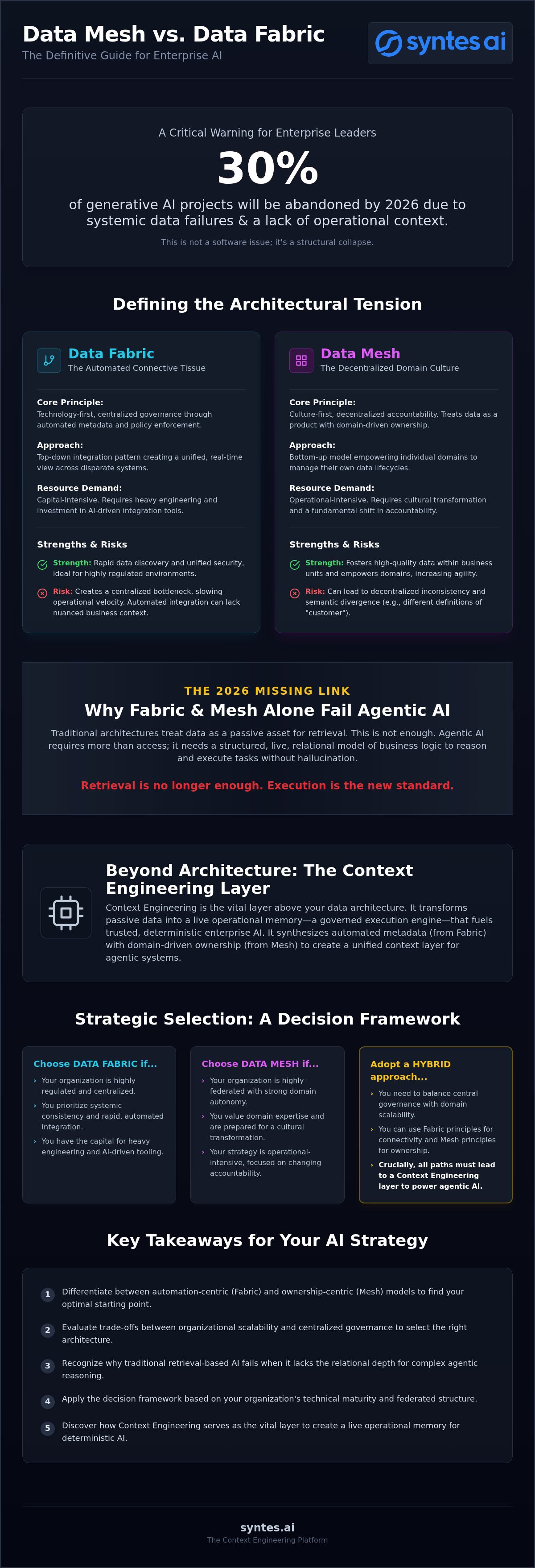
- Differentiate between automation-centric and ownership-centric models to determine the optimal starting point for your operational intelligence strategy.
- Evaluate the strategic trade-offs of data mesh vs data fabric to select an architecture that balances organizational scalability with centralized governance.
- Identify why traditional retrieval-based AI pilots fail when they lack the relational depth required for complex agentic reasoning and execution.
- Apply a definitive decision framework based on your organization’s technical maturity and federated structure to choose between fabric, mesh, or hybrid approaches.
- Discover how Context Engineering serves as the vital layer above your data architecture to create a live operational memory for deterministic AI.
Data Mesh vs. Data Fabric: Defining the Architectural Tension
The conflict surrounding data mesh vs data fabric has evolved. It’s no longer a simple discussion of storage architecture or cloud migration. In 2026, the priority has shifted toward operational intelligence. Enterprise leaders now face a high-stakes race to enable autonomous agents to reason accurately within volatile business environments. Traditional architectures often fail because they treat data as a passive asset. They ignore the fact that for an agent to execute, it needs more than access; it needs context. Architecture must now serve the reasoning requirements of agentic systems.
Data Fabric: The Automated Connective Tissue
Data Fabric functions as the automated connective tissue of the enterprise. It utilizes active metadata to discover, integrate, and orchestrate information across disparate hybrid clouds. This approach focuses on centralized governance. It employs automated policy enforcement to ensure compliance without manual intervention. By integrating an AI Data Platform with sophisticated Knowledge Graphs and data catalogs, the fabric creates a unified, real-time view of the organization. It’s a technology-first strategy. It prioritizes systemic consistency and rapid integration over individual domain autonomy.
Data Mesh: The Decentralized Domain Culture
A Data Mesh represents a fundamental shift toward decentralized accountability. It rejects the centralized bottleneck. Instead, it adopts domain-driven design, shifting ownership to the people closest to the data. This model treats data as a product. It applies product management principles to ensure that information is discoverable, addressable, and trustworthy. A federated governance model balances this local autonomy with organizational standards. It’s a culture-first strategy. It empowers domains to manage their own lifecycles while maintaining a baseline of global interoperability.
The tension between these paradigms is where strategy is forged. The fabric automates the ‘how’ of connectivity. The mesh organizes the ‘who’ of ownership. Both rely on rich metadata to bridge the gap between siloed systems and actionable intelligence. However, as AI agents become the primary consumers of enterprise data, the architecture must evolve. Retrieval is no longer enough. Agents require a structured understanding of business logic and operational relationships to function without the risk of hallucinations. The choice you make today determines the reliability of your AI tomorrow.
Technical Automation vs. Organizational Ownership
Architecture is a choice between control and agility. It’s the fundamental friction at the heart of the data mesh vs data fabric debate. While one prioritizes the machine, the other prioritizes the human. This tension dictates how quickly an enterprise can move from raw information to actionable intelligence. In 2026, the cost of a wrong choice isn’t just technical debt; it’s the total failure of your AI strategy.
Fabric utilizes a top-down integration pattern. It imposes a unified metadata layer across the enterprise to ensure that security and access remain consistent. While this accelerates discovery, it often creates a centralized bottleneck. The core data team becomes a clearinghouse for every request, slowing down operational velocity. Conversely, Data Mesh adopts a bottom-up approach. It empowers individual domains to manage their own data as a product. This fosters high quality within business units but risks decentralized inconsistency. Without a unified semantic layer, “customer lifetime value” might mean something entirely different in marketing than it does in finance.
Resource requirements also diverge sharply. Fabric demands heavy engineering and investment in sophisticated AI-driven integration tools. It’s a capital-intensive path. Mesh demands cultural transformation and a shift in accountability. It’s an operational-intensive path. Most organizations find that they can’t simply buy their way into a mesh; they must evolve into it. Choosing between data mesh vs data fabric requires an honest assessment of whether your organization values centralized policy enforcement or federated domain standards more highly.
Centralized Automation (Fabric) Strengths and Risks
Fabric excels in highly regulated environments. It provides rapid discovery and unified security across disparate systems. However, it suffers from the “Black Box” problem. Automated integration often lacks the nuanced business context required for high-stakes decision-making. If the machine doesn’t understand the “why” behind the data, the resulting insights remain superficial and prone to misinterpretation by autonomous systems.
Distributed Domain Ownership (Mesh) Strengths and Risks
Mesh is ideal for large, diverse conglomerates with distinct business models. It ensures that those closest to the data are responsible for its integrity. The primary risk is the creation of “Semantic Silos.” When domains operate in isolation, they inevitably develop conflicting definitions for the same entities. This fragmentation prevents the cross-domain reasoning necessary for advanced AI agents to execute complex workflows.
Bridging this gap requires more than just picking a side. It requires a strategy that balances technical automation with human accountability to ensure semantic integrity. If you’re struggling to reconcile these two paradigms, you can book a demo to explore how a unified context layer resolves these architectural conflicts. The goal is to move beyond the binary choice and toward a system that provides both speed and deterministic truth.
The 2026 Missing Link: Why Mesh and Fabric Alone Fail Agentic AI
The current debate over data mesh vs data fabric ignores a critical reality: both architectures were designed for humans and dashboards, not for autonomous agents. Most enterprises are currently hitting the “RAG Wall.” They’ve realized that simply retrieving documents through vector search is insufficient for complex agentic reasoning. Agents don’t just need data access; they need a Live Operational Memory. Without this, even the most sophisticated mesh domains remain isolated, leading to catastrophic reasoning failures when agents attempt to execute cross-functional tasks.
Fragmentation is the primary enemy of intelligence. When data ownership is siloed, AI agents lose the connective business logic required to navigate complex workflows. This leads to AI hallucinations that are often untraceable and impossible to debug. Context Engineering is the only way forward. It’s the necessary architectural layer that sits above your data foundation to synthesize disparate information into a coherent world model. It transforms passive data into active intelligence.
Moving Beyond Data Products to Context Graphs
The “Data as a Product” philosophy was a major step forward for organizational accountability. It’s insufficient for agents. An agent doesn’t just need a “product”; it needs to understand the intricate relationships between that product and every other entity in the enterprise. You must transition from passive catalogs to active enterprise knowledge graphs. This shift enables Operational Relationship Intelligence. It provides the structural context that allows an agent to move from observation to execution with total certainty. It’s the difference between a list of facts and a map of operations.
Architecting for Deterministic Truth
Trust is non-negotiable in the enterprise. A unified context layer prevents AI hallucination by providing rigorous semantic grounding. It ensures that every reasoning path an agent takes is anchored in verified business logic. By governing the reasoning path across distributed mesh domains, you create a system that is both safe and auditable. You don’t just want an AI that is fast. You want an AI that is correct. Semantic grounding is the only way to achieve deterministic truth in a world dominated by probabilistic models. It provides the guardrails necessary for autonomous execution in high-stakes environments.
Strategic Selection: When to Choose Fabric, Mesh, or a Hybrid
Choosing between data mesh vs data fabric isn’t a theological debate. It’s a cold-blooded assessment of your operational reality. The decision determines whether your AI strategy accelerates or collapses under its own weight. To select the correct architecture, you must evaluate four critical pillars of your enterprise environment: organizational structure, technical maturity, deployment urgency, and data diversity.
Organizational structure is the primary filter. If your enterprise is a monolith with a strong central IT department, Fabric provides the efficiency you need. If you’re a global conglomerate with autonomous business units, Mesh is the only way to handle the inherent complexity. Technical maturity also dictates your path. Automation requires high-quality metadata. If your metadata is currently fragmented or poor, Fabric’s automated connectivity will merely automate chaos. In such cases, the domain-level accountability of a Mesh is required to clean the well at the source.
Urgency and data diversity further complicate the choice. Agentic AI demands immediate, high-fidelity context. Fabric connects systems fast, but Mesh governs the nuance of business logic deeply. With the explosion of unstructured data in 2026, you can’t rely on manual tagging alone. You need the automated discovery of a Fabric to find the data, paired with the domain expertise of a Mesh to explain what that data actually means for a reasoning agent.
The Case for a Hybrid Foundation
Rigidly adhering to one philosophy is a strategic error. Most successful enterprises in 2026 utilize a hybrid foundation. They employ Fabric for the “Connect and Understand” phases, using active metadata to map their digital estate. They then apply Mesh principles for the “Govern and Execute” phases, ensuring that local domains own the truth of their data products. The bridge between these two is a semantic data layer. This layer ensures that while ownership is distributed, the meaning remains unified and accessible to autonomous systems.
Implementation Roadmap for 2026
Execution requires a methodical approach. First, audit your current enterprise AI infrastructure to identify where silos are choking your pilots. Second, pinpoint the “Context Gaps” where agents lose the thread of business logic. Finally, deploy a Context Graph. This isn’t just another repository; it’s a system that unifies disparate domain outputs into a single, live operational memory. It provides the deterministic foundation that probabilistic AI models lack.
Beyond Architecture: Context Engineering with Syntes AI
The Syntes AI Context Graph creates a Live Operational Memory. This is not a static repository. It is a dynamic model that evolves with every transaction and relationship across your enterprise. By following the five pillars of Context Engineering; Connect, Understand, Contextualize, Govern, and Execute; Syntes AI ensures that your data is not just available, but meaningful. This framework provides the deterministic grounding necessary for agentic AI platforms to operate with absolute precision in high-stakes environments.
From Passive Data to Governed Execution
Syntes AI bridges the dangerous gap between the general knowledge of an LLM and your proprietary business logic. Most AI failures occur because the model lacks the “tribal knowledge” embedded in your operational systems. Our platform utilizes Two-way Connectors to maintain a live, continuously evolving model of your operations. These connectors don’t just pull data. They push context back into the reasoning engine. This ensures that every action taken by an AI agent is governed by your specific safety and compliance protocols. You don’t just deploy agents; you control their reasoning path.
Why Syntes AI is the Logical Conclusion of the Mesh/Fabric Debate
Syntes AI does not require you to rip and replace your existing investments. It makes that architecture actionable. Whether you have invested in a centralized fabric or a decentralized mesh, you still face the challenge of semantic fragmentation. Syntes AI unifies these disparate outputs into a single Live Operational Memory. It provides the “reasoning substrate” that allows agents to understand cross-domain relationships without manual intervention. It is the definitive solution for the data mesh vs data fabric dilemma.
The choice is no longer about storage philosophy. The choice is between passive observation and active execution. As business logic becomes increasingly automated, the quality of your context determines the success of your enterprise. You must secure your AI future by moving beyond simple data management. Explore how Context Engineering transforms your fragmented estate into a foundation for trusted, autonomous intelligence.
Securing the Reasoning Layer of the Modern Enterprise
Architecture is no longer a passive container for data. It is the foundation of agentic reasoning. You’ve navigated the strategic tension of data mesh vs data fabric and identified why traditional silos fail the rigorous requirements of autonomous execution. Redefining enterprise intelligence through Context Engineering is the only way to move beyond the limitations of standard retrieval models. It’s the difference between a system that merely remembers and a system that truly understands.
By establishing a Live Operational Memory, you provide the structural truth necessary for agents to act with certainty. The path forward requires a shift from managing repositories to governing reasoning paths. You must ensure that every autonomous decision is anchored in a deep understanding of your business logic and operational relationships. This isn’t a theoretical experiment; it’s a necessary evolution for survival in an AI-first economy. High-stakes operations demand deterministic grounding, not probabilistic guesswork.
Transition from fragmented observation to active operational intelligence today. Governed execution for autonomous agents is no longer a future goal; it’s a current requirement for trusted scale. Your organization’s future depends on the clarity and reliability of its context. Take the lead in architecting a foundation that doesn’t just store data but executes with intelligence.
Frequently Asked Questions
What is the main difference between data mesh and data fabric?
The main difference between data mesh vs data fabric lies in the locus of control and integration philosophy. Data fabric is a technology-centric architecture that uses active metadata to automate data integration from the top down. It prioritizes centralized connectivity. Data mesh is an organizational model that decentralizes ownership to specific business domains from the bottom up. It prioritizes domain-driven accountability and treats data as a product.
Can you implement a data mesh using data fabric technology?
You can certainly implement a data mesh using data fabric technology. In 2026, many enterprises use a fabric as the “self-serve data platform” required for a functional mesh. The fabric provides the automated tools for discovery and access across hybrid clouds. The mesh provides the cultural framework for domain ownership. This synergy allows you to automate technical plumbing while maintaining clear accountability for data quality at the source.
Which architecture is better for preventing AI hallucinations?
Neither architecture is inherently sufficient for preventing AI hallucinations on its own. Hallucinations are a symptom of architectural context gaps. While the data mesh vs data fabric debate focuses on access and ownership, preventing hallucinations requires a unified context layer. This layer provides the semantic grounding and deterministic truth that probabilistic models lack. It ensures that agentic systems remain anchored in verified business logic rather than statistical guesswork.
How does a knowledge graph fit into a data fabric architecture?
A knowledge graph functions as the cognitive engine of a data fabric. It maps the complex relationships between metadata, business entities, and disparate data sources. By providing a structured, relational view of the enterprise, the knowledge graph allows the fabric to automate integration and policy enforcement. It transforms passive data catalogs into active intelligence. This enables the system to understand not just where data is, but what it actually means.
Is data mesh or data fabric more expensive to implement?
Implementation costs depend on your existing technical debt and organizational maturity. Data fabric typically requires higher upfront investment in sophisticated AI-driven integration tools and centralized infrastructure. It’s a capital-intensive technical shift. Data mesh often demands higher long-term costs associated with cultural transformation, domain-level staffing, and decentralized governance. It’s an operational-intensive cultural shift. The most efficient choice is the one that aligns with your current power structure.
What is Context Engineering and how does it relate to data architecture?
Context Engineering is the architectural discipline of synthesizing fragmented data into a live operational memory for AI agents. It sits above your data foundation, whether you use a mesh or a fabric. This layer unifies disparate domain outputs into a coherent world model. It ensures that agents understand the intricate relationships and business logic required for execution. It’s the transition from providing raw information to providing actionable, governed intelligence.
Does agentic AI require a specific data architecture to function safely?
Agentic AI demands an architecture that provides live operational memory and deterministic grounding to function safely. It doesn’t require a specific brand of architecture, but it does require relationship-based intelligence. Traditional systems often fail because they treat data as a passive asset. For an agent to execute autonomously, the underlying data layer must support real-time relevance and governed reasoning. Without this foundation, agents remain prone to errors and lack auditability.