
Your AI agents are failing because they’re starving for context. While most enterprises obsess over model parameters, the real bottleneck remains the fragmented architecture of legacy ERP and CRM systems that keep your business logic trapped. Without sophisticated data harmonization techniques, your autonomous intelligence is grounded in nothing but noise. It’s a systemic flaw that turns promising pilots into expensive, hallucinating liabilities.
You’ve likely felt the friction of trying to scale AI beyond simple chatbots. It’s a common struggle. High failure rates in RAG-based systems are almost always a data grounding problem. Gartner estimates the average annual cost of poor data quality at $12.9 million, a figure that becomes catastrophic when applied to automated decision-making. You need a deterministic foundation for AI reasoning, not just another layer of messy integrations. This article provides the blueprint to transform fragmented silos into a unified, live operational context layer. We’ll examine the roadmap for building an Enterprise Knowledge Graph that moves your organization from passive observation to active, automated performance.
Key Takeaways
- Identify why fragmented data silos cripple agentic reasoning and how standardizing disparate schemas is the foundational step toward enterprise operational intelligence.
- Master sophisticated data harmonization techniques like schema mapping and value normalization to ensure deterministic accuracy across legacy ERP and CRM platforms.
- Understand why traditional Master Data Management (MDM) fails in the AI era and how Enterprise Knowledge Graphs provide the dynamic context layer required for autonomous agents.
- Execute a strategic roadmap to bridge structured and unstructured data sources, creating a live operational memory that reduces friction and scales AI initiatives.
- Leverage the Syntes AI Context Graph to move beyond simple RAG, achieving explainable reasoning and trusted execution through the Context Engineering framework.
Beyond Batch Processing: Why Data Harmonization is the Critical Bottleneck for Enterprise AI
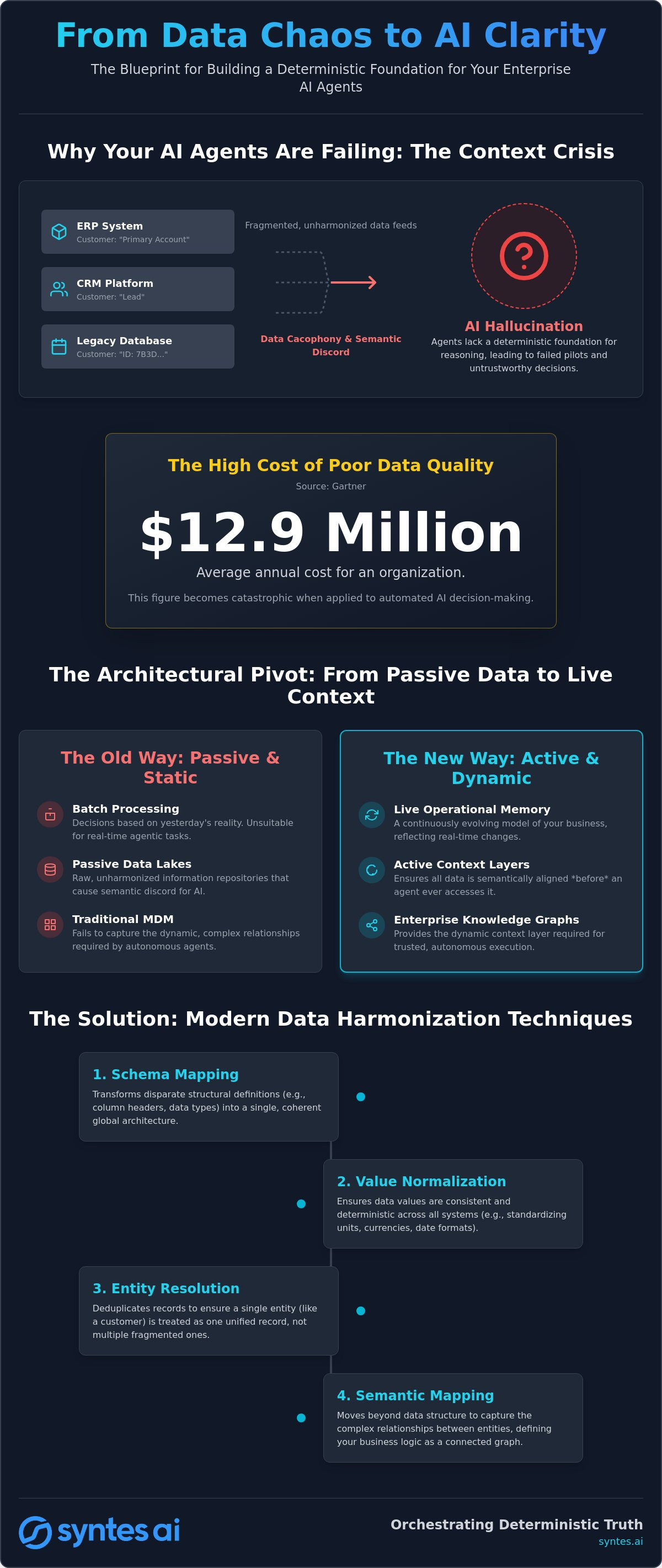
Data harmonization is the rigorous process of standardizing disparate data fields, formats, and dimensions into a unified schema. It represents the bridge between raw information and executable intelligence. Traditional data integration focuses on moving data from point A to point B; harmonization focuses on making it meaningful once it arrives. Without this structural alignment, your enterprise operates in a state of “Data Cacophony.” Your ERP records a customer as a “Primary Account,” while your CRM labels them a “Lead,” and your legacy database uses an obscure hexadecimal ID. Logic requires alignment. Silos kill reasoning.
Static data harmonization techniques are no longer sufficient for the 2026 Agentic Era. Modern AI agents don’t just need clean tables; they require a live operational context. If your strategy relies on monthly batch updates, your agents are making decisions based on yesterday’s reality. This is why Context Engineering has emerged as the necessary successor to traditional data cleanup. It’s the strategic engineering of business context required for deterministic AI execution.
The Cost of Fragmented Enterprise Knowledge
Why do enterprise AI initiatives fail? The answer lies in the data grounding layer. High hallucination rates and model distrust are direct consequences of semantic discord. Gartner estimates the average annual cost of poor data quality for an organization is an estimated $12.9 million. This figure becomes catastrophic when applied to automated decision-making. When a Large Language Model (LLM) retrieves information via Retrieval-Augmented Generation (RAG) from unharmonized sources, it encounters conflicting facts. The result is a total breakdown in logic. Organizations must pivot from maintaining “passive data lakes” to building “active context layers.” This shift ensures that every piece of data is semantically aligned before an agent ever touches it.
From Data Cleaning to Live Operational Memory
Batch processing is a relic of the reporting era. In an autonomous enterprise, you need Live Operational Memory. This is a continuously evolving model of your business that reflects real-time changes across every system. It’s the difference between looking at a static map and having a live GPS. To understand how this transition from static data to agentic intelligence occurs, consult our Executive Guide to Enterprise Knowledge Graphs. Mastering data harmonization techniques is the first step toward this state of total operational clarity. It moves the enterprise from passive observation to active, automated performance.
Modern Data Harmonization Techniques: From Schema Mapping to Semantic Unification
Execution requires precision. To build a deterministic foundation for AI, you must first master the structural alignment of your data. Schema mapping serves as the bedrock of this effort, transforming disparate structural definitions into a coherent, global architecture. It is not merely a task of matching column headers; it is the rigorous enforcement of logic across conflicting systems. Complementing this is value normalization. This technique ensures that units, dates, and currencies remain deterministic across every touchpoint. Without a General-Purpose Data Harmonization Framework to govern these transformations, your AI agents will inevitably stumble over basic mathematical and temporal contradictions.
Entity resolution, or deduplication, represents the next critical layer of data harmonization techniques. In a typical enterprise, a single customer might exist across five different platforms with five different identifiers. You cannot achieve operational intelligence if your system treats a single entity as multiple fragmented records. Semantic mapping then bridges the gap between these resolved entities by capturing the complex relationships that define your business. It moves beyond “what” an object is to “how” it interacts with the rest of the enterprise ecosystem.
Unifying Structured and Unstructured Data
The true challenge lies in the dark data trapped in PDF contracts, emails, and technical manuals. Modern harmonization workflows utilize Natural Language Processing (NLP) to extract entities from these unstructured sources and link them directly to ERP transactions. This creates a unified thread of truth. Maintaining strict data lineage during this transformation is non-negotiable. You must be able to trace every piece of AI reasoning back to its specific source record to ensure auditability and trust. If you are ready to see this level of integration in action, you can explore our context engineering platform to witness how these disparate threads weave into a single operational fabric.
Graph-Based Harmonization: The Power of Relationships
Relational databases are inherently rigid. They struggle to represent the multi-dimensional business logic and deep hierarchies that drive modern global enterprises. This is why sophisticated organizations are pivoting toward graph-based data harmonization techniques. Using graph structures allows you to represent dependencies and parent-child relationships natively. It facilitates our “Understand” pillar, which focuses on discovering entities and business semantics automatically. Instead of forcing data into flat tables, you build a model that mirrors the messy, interconnected reality of your operations. This architectural shift is what enables AI agents to navigate your business with the same nuance as a seasoned executive.
The Architectural Pivot: Why Knowledge Graphs Outperform Traditional MDM
Traditional Master Data Management (MDM) is a legacy solution for a legacy problem. It was engineered to create a “Golden Record” for static reporting, a goal that is fundamentally mismatched with the requirements of autonomous AI. Agentic systems don’t just need a single source of truth; they need a single source of context. While MDM focuses on cleaning flat tables, Enterprise Knowledge Graphs (EKG) utilize advanced data harmonization techniques to map the intricate web of dependencies that define your business operations. This is the difference between a filing cabinet and a dynamic nervous system.
The rigidity of MDM is its fatal flaw in the Agentic Era. Every time a business rule changes or a new system is integrated, MDM schemas often require extensive manual reconfiguration. EKGs provide a fluid alternative. Graph schemas are inherently flexible, allowing you to adapt to new business logic without the downtime associated with relational restructuring. Managing this transition requires Context Engineering, the strategic framework that moves your enterprise from passive data storage to an active, reasoning-ready architecture.
MDM vs. Context Graph: A Strategic Comparison
To understand the necessity of this pivot, you must evaluate the technical gap between traditional methods and modern context graphs. MDM creates a static snapshot; a Context Graph provides a live operational model. The following comparison highlights why “Golden Records” are too fragile for high-stakes AI reasoning.
| Feature | Traditional MDM | Enterprise Knowledge Graph |
|---|---|---|
| Latency | High (Batch Processing) | Real-time (Live Updates) |
| Schema Flexibility | Rigid / Fragile | Dynamic / Fluid |
| Relationship Depth | Shallow (Flat Tables) | Deep (Multi-dimensional) |
| AI Readiness | Low (Passive Data) | High (Agentic Context) |
Rigid records provide no insight into how entities interact across silos. By adopting a Semantic Data Layer, you move beyond simple record matching. You begin architecting a foundation where the relationships between data points are as valuable as the data points themselves.
Overcoming the Limitations of Federated Queries
Federated queries are often proposed as a shortcut to data integration, but they are a performance bottleneck for real-time AI. Relying on slow, cross-system joins across legacy infrastructure causes unacceptable latency. AI agents cannot wait for a federated query to time out while trying to execute a critical workflow. You need a Unified Context Layer that sits above your existing software stack, providing immediate access to harmonized intelligence. This is achieved through the “Connect” pillar of our framework. Two-way connectors ensure a continuous, live data flow, transforming fragmented information into Live Operational Memory. This architectural shift eliminates the friction of legacy joins and empowers your agents with the speed required for deterministic execution.
Executing the Harmonization Strategy: Building a Live Operational Context Layer
Strategy without execution is merely a hallucination. To move beyond theoretical pilots, you must implement a rigorous roadmap that transforms fragmented silos into a high-fidelity context layer. This is not a one-time ETL task; it’s the continuous engineering of truth. Deploying modern data harmonization techniques requires a methodical approach that prioritizes relationship depth over simple record matching. Your goal is to create a deterministic environment where AI agents don’t just guess; they know.
- Step 1: Audit and Map. Identify existing data silos and pinpoint where cross-system logic breaks down. You must map the critical relationships that define your business processes, not just the fields in a database.
- Step 2: Semantic Integration. Bridge the gap between structured ERP data and unstructured sources like PDF contracts or technical manuals. Use semantic mapping to ensure every entity is linked to its operational context.
- Step 3: Establish Live Operational Memory. Deploy a Context Graph to serve as the unified brain of the enterprise. This layer must provide real-time updates, ensuring agents act on current reality rather than stale batch data.
- Step 4: Bake in Governance. Implement security and compliance at the node level. Harmonized data is useless if it bypasses the permissions and regulatory rules that protect your enterprise.
- Step 5: Power Autonomous Execution. Feed this deterministic truth into your agentic AI platform. With a high-fidelity context layer, agents can perform complex workflows with minimal human intervention and maximum reliability.
The Role of AI Governance in Harmonization
Security cannot be an afterthought in the Agentic Era. When you unify data from disparate systems, you create a powerful central intelligence that must be strictly governed. AI Governance ensures that permissions and business rules are enforced at the semantic level. This means an agent only accesses the information it’s authorized to see, based on the context of its specific task. Without these guardrails, your harmonization efforts increase your attack surface. To understand how to manage this risk while scaling, read our guide on Solving Enterprise Data Silos. It’s the only way to ensure your data harmonization techniques result in a secure, compliant foundation for growth.
Measuring the ROI of Data Harmonization
How do you quantify the value of a unified context layer? The metrics must reflect operational reality. Organizations implementing Master Data Management see an average 20% improvement in data accuracy and a 15% gain in efficiency according to Gartner benchmarks. For agentic AI, the KPIs are even more dramatic. You should track the reduction in AI hallucination rates, the speed of new agent deployment, and the total decrease in manual data engineering hours. To further improve your operational bottom line, Knowi helps you explore SaaS Subscription Fees and optimize your analytics infrastructure. Ultimately, ROI in this space is defined as the sum of your operational relationship intelligence. It’s the ability of your systems to understand, reason, and execute based on the complex web of connections that drive your business forward.
Syntes AI: Orchestrating Deterministic Truth via the Enterprise Context Graph
Syntes AI represents the necessary evolution beyond the limitations of traditional RAG and MDM. It marks the end of the experimental phase of enterprise AI. While others struggle with fragmented knowledge, the Syntes AI Context Graph creates a unified operational memory that powers every decision. It’s the ultimate destination for your data harmonization techniques, turning static records into an active, reasoning-ready architecture. Execution requires certainty. Syntes AI provides it.
Our “Execute” pillar is where the engineering pays off. By providing a high-fidelity context layer, we enable AI agents to perform complex reasoning over trusted, real-time data. This isn’t about simple retrieval; it’s about deterministic execution. The Syntes Agentic Platform serves as the central command for this intelligence, ensuring that every automated workflow is grounded in the messy, interconnected reality of your global operations. Just as The Songai by Songai Media creates a harmonious musical gift from personal memories, our platform moves your enterprise from passive observation to a state of total operational clarity, resolving the data cacophony that paralyzes legacy systems.
From Context Engineering to Trusted Execution
Proprietary data is the only moat that remains in the 2026 landscape. Syntes AI bridges the gap between the general knowledge of Large Language Models and the specific, high-register logic of your business. Our “Live” model evolves with every transaction, event, and system update. It ensures your agents aren’t hallucinating on stale data. To see how this fits into the broader technological shift, consult our 2026 Guide to Enterprise AI Infrastructure. It’s the blueprint for architecting for agentic intelligence and moving beyond the constraints of traditional data silos.
Deploying Governed AI Agents with Syntes
Automation requires trust. The Syntes platform manages complex business automation via a shared context layer that enforces your rules and permissions at the node level. Our “Govern” pillar is essential for enterprise-grade AI safety, providing the guardrails required for high-stakes decision-making. We prioritize human-in-the-loop systems for critical workflows, ensuring that systemic integration doesn’t come at the cost of oversight. It’s a partner, not a black box. This approach values clarity and efficiency over theoretical experimentation. You’ve mastered the data harmonization techniques required to build the foundation. Now, it’s time to execute.
Explore the Syntes AI Agentic Platform
Architecting the Future of Autonomous Intelligence
The window for experimental AI is closing. Enterprises that continue to rely on fragmented data silos and static “Golden Records” will remain trapped in a cycle of high hallucination rates and perpetual pilot purgatory. True operational intelligence requires a fundamental architectural pivot. By mastering sophisticated data harmonization techniques, you transition from passive observation to active, automated performance. You build a system that doesn’t just store information but understands the complex web of relationships that drive your business logic. This is the difference between a filing cabinet and a live, reasoning nervous system.
The Syntes AI Context Graph provides the deterministic foundation necessary for this evolution. It delivers explainable AI reasoning and is trusted by global enterprises to secure their most critical workflows. By reducing AI hallucinations by over 90%, our platform ensures your agents act with the precision of a seasoned strategist. The messy reality of large-scale operations demands order. It’s time to engineer the context your intelligence deserves and move toward a state of total operational clarity.
Your journey toward deterministic enterprise intelligence starts with a single, strategically sound step. Take it today.
Frequently Asked Questions
What is the difference between data integration and data harmonization?
Data integration focuses on the technical connectivity and physical movement of data between systems. It solves the problem of transport. Data harmonization ensures semantic alignment across disparate fields, formats, and dimensions. It solves the problem of meaning. Integration moves the bytes; harmonization provides the logic required for automated reasoning.
How does data harmonization prevent AI hallucinations in enterprise models?
Hallucinations occur when models encounter contradictory or ungrounded data during retrieval. By implementing rigorous data harmonization techniques, you establish a deterministic truth layer that eliminates ambiguity. Standardizing dimensions and resolving entity conflicts ensures that the model retrieves a single, verified context rather than forcing it to guess between conflicting records.
What are the most common data harmonization techniques used in 2026?
The standard baseline in 2026 includes schema mapping and value normalization to ensure units and currencies remain deterministic. Advanced enterprises utilize entity resolution to deduplicate identities across fragmented ERP and CRM systems. Semantic mapping represents the most sophisticated tier, capturing the multi-dimensional relationships between structured transactions and unstructured documentation.
Can data harmonization be automated using AI?
Automation is now a critical component of the harmonization workflow. Large Language Models and Natural Language Processing identify mapping patterns and extract business logic from legacy codebases at scale. While these tools accelerate the discovery phase, human-in-the-loop governance remains essential to verify high-stakes semantic relationships and ensure compliance with enterprise safety standards.
Why is a Knowledge Graph better for data harmonization than a Data Warehouse?
Data Warehouses are designed for static, historical reporting using rigid, flat tables that struggle with complex business logic. Knowledge Graphs create a dynamic, interconnected model of the business. This graph structure allows for the deep relationship traversal required for real-time agentic reasoning, providing a more fluid foundation for evolving business rules.
How does data harmonization impact the performance of Agentic AI platforms?
Harmonization acts as a primary performance multiplier for autonomous agents. It reduces operational friction by providing a pre-aligned context layer, which eliminates the need for slow, real-time joins across legacy infrastructure. High-fidelity data harmonization techniques ensure that agents execute workflows with the speed and precision required for high-stakes enterprise automation.
What is the role of semantic mapping in data harmonization?
Semantic mapping defines the logical relationships between entities within your data architecture. It moves beyond simply identifying “what” an object is to explain “how” it interacts with the broader enterprise ecosystem. This mapping creates the essential business context that allows AI agents to navigate hierarchies and dependencies with human-level nuance.
How much time does it typically take to implement an enterprise data harmonization strategy?
Initial context layers for specific, high-value workflows can often be deployed within weeks. A comprehensive, enterprise-wide strategy is an iterative strategic shift rather than a one-time project. The total timeline depends on the complexity of your legacy silos and the maturity of your existing data governance frameworks.