
Is your database a tool for strategic growth or merely a tomb for disconnected data? In 2026, maintaining a passive record system is a choice that invites operational decay. Most enterprise leaders recognize that fragmented silos and the persistent threat of AI hallucinations undermine their technological investments. We agree that a basic chatbot is an insufficient response to the messy realities of global operations. You need a system that doesn’t just suggest text but executes workflows with absolute certainty.
This article shows you how to move beyond superficial tools to achieve a deep, sovereign crm and ai integration. You’ll learn to architect a live, governed context layer that transforms static records into a functioning operational memory. We provide a definitive roadmap for deploying autonomous agents that handle routine business processes safely. By the end of this guide, you’ll understand how to bridge the gap between general AI knowledge and your proprietary data to drive true autonomous execution.
Key Takeaways
- Shift from passive lead scoring to autonomous execution by evolving your architecture from predictive models to agentic AI.
- Eliminate the operational risks of “AI Silos” by unifying fragmented data sources into a single, high-fidelity context layer.
- Secure a competitive advantage through a strategic crm and ai integration that converts static customer records into a live operational memory.
- Prevent AI hallucinations and ensure governed execution by anchoring your agents in deterministic truth and semantic grounding.
- Architect a sovereign enterprise where a Context Graph enables agents to orchestrate complex workflows with total cross-system visibility.
The Evolution of CRM and AI Integration: From Predictive to Agentic
The era of the CRM as a digital filing cabinet is dead. Historically, Customer Relationship Management (CRM) systems served as passive ledgers, storing static contact details and interaction histories for human review. True crm and ai integration in 2026 has moved beyond this administrative burden. It is the fusion of high-fidelity customer data with autonomous reasoning engines. While first-wave AI focused on predictive lead scoring, the current shift is toward agentic execution. You don’t need a system that merely predicts a churn risk; you need a system that identifies the risk and autonomously initiates a retention workflow.
Modern enterprises are abandoning flat data structures in favor of an enterprise knowledge graph to power their operations. This shift transforms the CRM from a siloed database into an active organ of the business. In the Agentic Enterprise, the CRM provides the foundational truth that allows AI agents to reason, plan, and act with sovereign precision. It is no longer about managing records. It’s about orchestrating intelligence.
The Shift from Passive Records to Live Operational Memory
Static CRM fields are insufficient for high-velocity AI reasoning. They represent snapshots of the past, not the reality of the present. To achieve effective crm and ai integration, organizations must implement Live Operational Memory. This architecture provides real-time context that standard Retrieval-Augmented Generation (RAG) cannot match. While basic RAG pulls isolated text snippets, GraphRAG maps the complex relationships between every email, invoice, and supply chain update. This allows your sales agents to operate with a deep, relational understanding of every account, ensuring that every interaction is grounded in the current operational state of the business.
Agentic Workflows: The New Standard for CRM Automation
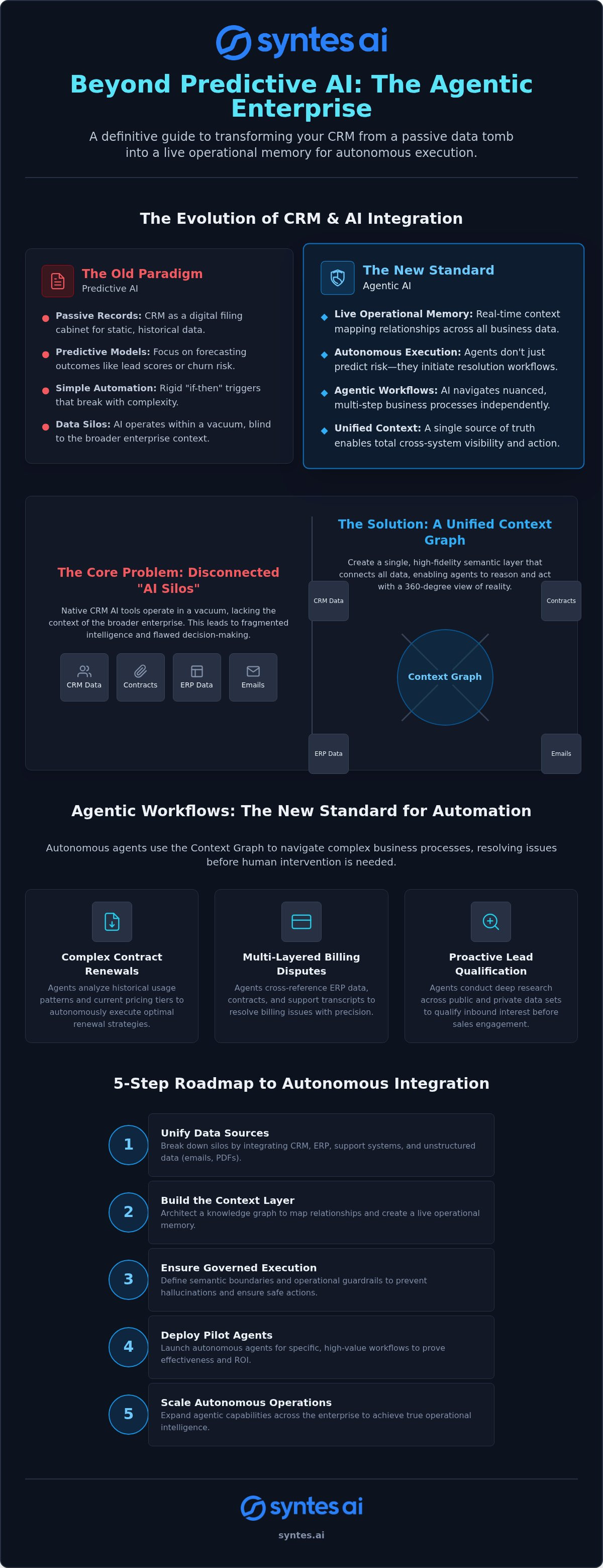
Automation used to mean simple, rigid “if-then” triggers that frequently broke under the pressure of real-world complexity. That paradigm has been replaced by agentic workflows. These agents use CRM data to autonomously navigate nuanced business processes. 2026 is the year of the autonomous CRM sub-agent, capable of handling:
- Executing complex contract renewals based on historical usage patterns and current pricing tiers.
- Resolving multi-layered billing disputes by cross-referencing ERP data with customer support transcripts.
- Proactively qualifying inbound interest by conducting deep research across public and private data sets.
This level of performance requires sophisticated Context Engineering. You must define the semantic boundaries and operational guardrails that allow an agent to interact with customer records safely. When agents are properly grounded, they don’t just alert your team to a problem; they resolve it before a human even needs to step in.
Why Cross-System Integration is the Core of CRM Intelligence
Native AI features in traditional CRM platforms are fundamentally limited. They operate within a vacuum. Relying solely on these built-in tools creates dangerous “AI Silos” that lack the context of the broader enterprise. This is where most crm and ai integration initiatives fail. They ignore the reality that solving enterprise data silos is the mandatory prerequisite for any agentic strategy. Without a cross-system architecture, your AI is merely a fast reader of a narrow book. It cannot reason across the business because it cannot see the business.
Industry leaders recognize that AI-powered CRM systems must bridge the gap between front-office interactions and back-office operations. The Syntes AI Context Graph provides this bridge. It normalizes disparate business rules into a single, high-fidelity semantic layer. This allows the system to transition from basic data storage to operational intelligence. It ensures that every agentic action is grounded in a 360-degree view of your technical and commercial reality.
Connecting Structured and Unstructured Customer Data
Most customer intelligence is trapped in unstructured formats. PDF contracts, lengthy email threads, and meeting transcripts often contain the critical “why” behind a customer’s behavior. A robust crm and ai integration must ingest these sources and map them to structured records in real time. We utilize two-way connectors to maintain a live data flow, uncovering hidden relationships between disparate entities. This is Operational Relationship Intelligence. It identifies risks, such as a pending contract breach mentioned in a legal thread, that a human analyst might miss until it’s too late. It turns buried text into actionable signals.
CRM Meets ERP: The Unified Context Layer
There is a persistent “Semantic Gap” between sales and supply chain. If your AI agent closes a high-value deal in the CRM but cannot see the inventory levels or shipping delays in the ERP, it creates a customer experience disaster. A unified context layer ensures that AI has the “ground truth” before executing any transaction. It synchronizes cross-departmental logic so that agents act with total visibility. The agent knows what is in the warehouse before it promises a delivery date to a client. This deterministic truth is what separates a reliable enterprise agent from a hallucinating chatbot. If you want to see how this unified intelligence functions in real time, you can schedule a platform walkthrough.
Solving the Hallucination Problem in CRM Environments
Trust is the primary casualty of a failed AI deployment. For executive decision-makers, the greatest risk isn’t that AI will be slow; it’s that it will be confidently wrong. A customer-facing agent hallucinating a 50% discount or misquoting a contract term isn’t just a technical glitch. It’s a liability. This fear often stalls crm and ai integration projects before they reach production. To move forward, you must abandon the idea that better prompting will solve the problem. You need a deterministic architecture.
We solve this by focusing on how to prevent ai hallucination through semantic grounding. While standard “Black Box” LLMs rely on probabilistic guesses, a governed context graph enforces factual boundaries. It ensures the AI only reasons over the data you have verified. This transition from guessing to knowing is the hallmark of a mature enterprise AI strategy. It replaces uncertainty with an explainable, auditable system of truth.
Context Engineering vs. Prompt Engineering
Prompts are flimsy instructions. They are easily bypassed and lack the depth required for complex crm and ai integration. Context Engineering is the superior discipline. It follows a rigorous framework: Connect, Understand, Contextualize, Govern, and Execute. By building a governed Context Graph, you create a permanent guardrail for your agents. You are not just asking the AI to behave; you are restricting its reasoning to a verified semantic environment. This framework ensures that every response is anchored in your specific business logic, rather than the probabilistic noise of a public model.
Explainable Reasoning: Auditing AI CRM Actions
Accountability requires transparency. Every autonomous action taken by an agent must produce a clear, auditable reasoning path. If an agent adjusts a sales forecast or modifies a lead score, it must back-reference the specific data points from the CRM, ERP, and email archives that informed that conclusion. This is explainable AI. For high-stakes CRM actions, such as altering contract terms or approving high-value refunds, we integrate Human-in-the-Loop (HITL) systems. This ensures that while agents handle the routine, your human experts retain sovereignty over critical strategic pivots. Governance is the engine of scalable execution.
A 5-Step Roadmap for Implementing AI and CRM Integration
Architecting an agentic enterprise requires more than a simple software update. It demands a rigorous, phased approach to ensure your crm and ai integration is both functional and secure. You aren’t just connecting two tools; you’re building a cognitive layer that sits above your entire stack. Success follows a defined progression from raw connectivity to autonomous execution. Implementation isn’t a suggestion; it’s a survival requirement for the 2026 enterprise.
- Phase 1: Connect. Integrate disparate data sources into a unified, real-time stream to feed the reasoning engine.
- Phase 2: Understand. Map entities and semantic relationships to define what “customer” and “product” mean across every siloed system.
- Phase 3: Contextualize. Build a live Context Graph to serve as the permanent, high-fidelity intelligence core of your operations.
- Phase 4: Govern. Apply security, granular permissions, and hard business rules to every AI access point and agentic trigger.
- Phase 5: Execute. Deploy agentic AI to perform governed business processes with sovereign precision and minimal human intervention.
Auditing Your Current Enterprise Data Mesh
Your CRM is likely filled with “Dark Data”: meeting notes, email attachments, and dormant records that your current systems ignore. Effective crm and ai integration starts by identifying these hidden assets and evaluating your API infrastructure for two-way synchronization. You must map the hierarchy of business semantics to ensure your agents understand the relationship between a lead, a supplier, and a contract. This involves moving beyond simple field mapping to a deep semantic understanding of how your business actually functions. If your data mesh is fragmented, your AI’s reasoning will be equally broken. Audit your connectivity before you attempt to automate.
Selecting the Right AI Orchestration Platform
Consumer chatbots are toys; enterprise agents are tools. When selecting a platform, prioritize those that offer a live operational memory over those that simply wrap a Large Language Model in a basic interface. You need an orchestration layer that supports custom agentic workflows and complex “Build vs. Buy” decisions. Look for a platform that treats governance as a first-class citizen. It’s not enough for an agent to be fast; it must be explainable. The Syntes Agentic Platform provides the necessary architecture to turn these conceptual phases into a high-performance reality.
The Syntes AI Advantage: Turning CRM Data into Operational Intelligence
Standard approaches to crm and ai integration often collapse under the weight of enterprise complexity. Most vendors offer simple wrappers around Large Language Models, leaving you with a system that possesses general knowledge but lacks specific business context. Syntes AI operates on a different plane. We move beyond basic Retrieval-Augmented Generation (RAG) to provide trusted, deterministic execution. By utilizing the Syntes Context Graph, we create a Live Operational Model of your business that serves as the bridge between general LLM intelligence and your proprietary data assets.
We don’t just archive data; we mobilize it. Our platform enables governed agents to reason across your CRM, ERP, and internal documentation simultaneously. This cross-system visibility ensures that every action is grounded in the current reality of your supply chain, financial state, and customer history. It is a sovereign engine for operational clarity.
Agentic AI for Operational Efficiency
Real-world efficiency requires agents that act, not just suggest. The Syntes Agentic Platform allows you to deploy specialized agents for high-value use cases:
- Autonomous Lead Qualification: Agents conduct deep research and qualify inbound interest without human oversight.
- Automated Contract Negotiation: Systems analyze historical terms and current business rules to draft and negotiate renewals.
- Proactive Churn Prevention: AI identifies subtle relationship decay by monitoring cross-system signals and initiates retention protocols.
This architecture reduces the friction between data insight and business action. You can scale your AI initiatives without accumulating the technical debt associated with brittle, point-to-point integrations. We provide the infrastructure to turn your crm and ai integration into a self-optimizing system of execution.
Next Steps: From CRM Records to Enterprise Intelligence
The 2026 landscape demands a shift from record-keeping to relationship-based intelligence. Maintaining a static database is a liability in a market defined by agentic speed. You must evolve. Transitioning your organization toward Context Engineering is the first step in securing your operational future. We invite you to explore the Syntes Agentic Platform to see how a unified context layer can redefine your CRM needs. Start a pilot program today to map your semantic relationships and build your first governed agentic workflows. Operational intelligence is no longer optional. It’s the only path forward.
Sovereignty in the Age of Agentic Execution
The transition to an agentic model is the definitive strategic shift of 2026. You’ve seen that static databases are no longer sufficient to power high-stakes autonomous decision-making. A robust crm and ai integration requires a live, governed context layer that bridges the gap between raw data and systemic action. By implementing Context Engineering, your organization can eliminate the risk of hallucinations and ensure every agentic workflow is grounded in deterministic truth.
Syntes AI remains the pioneer of this architectural evolution. Trusted by global enterprises for explainable AI, our platform provides the Live Operational Memory required for governed AI agents and safe operational execution. You possess the roadmap. Now, you must choose between maintaining a legacy of disconnected silos or architecting a future of systemic intelligence and sovereign performance.
The tools for total operational clarity are within your reach. Build the enterprise that executes with certainty.
Frequently Asked Questions
What is the difference between an AI CRM and standard CRM software?
Standard CRM software is a passive ledger designed for manual record-keeping and human-led analysis. An AI CRM, specifically when powered by modern crm and ai integration, acts as an active reasoning engine. While legacy systems require employees to hunt for data, AI-driven platforms autonomously identify patterns, predict outcomes, and execute workflows. In 2026, the distinction is the shift from a database that records history to a platform that orchestrates future business actions.
How does an enterprise knowledge graph improve CRM performance?
An Enterprise Knowledge Graph unifies siloed data by mapping complex relationships between entities like customers, products, and supply chain updates. Traditional CRMs use flat tables that miss the nuance of real-world operations. By providing a relational layer, the graph enables deeper reasoning and faster data retrieval. This architecture allows AI to understand the “why” behind customer behaviors, ensuring every department operates from a single source of truth rather than fragmented records.
Can AI agents in a CRM safely execute business processes?
Safety is achieved through a governed framework and the use of deterministic guardrails. AI agents can safely execute processes by using Context Engineering, which restricts their reasoning to verified enterprise data. Unlike consumer-grade bots, enterprise agents utilize Human-in-the-Loop triggers for high-stakes decisions like contract modifications. This ensures that while routine tasks are automated, strategic control remains with your experts. Governance isn’t a limitation; it’s the foundation for scaling autonomous execution safely.
What is Context Engineering and why is it better than prompt engineering?
Context Engineering is a disciplined architectural framework, while prompt engineering is merely a set of linguistic instructions. Prompts are fragile and easily bypassed by model updates or adversarial inputs. Context Engineering involves building a governed Context Graph that anchors AI reasoning in structured business logic. It provides the model with the necessary ground truth to perform accurately. It’s the difference between asking an AI to be smart and providing the systemic intelligence it needs to be correct.
How do I prevent AI hallucinations in my customer-facing CRM tools?
Hallucinations are prevented through semantic grounding and the implementation of GraphRAG. You must move away from “Black Box” LLMs that guess answers based on probability. By anchoring your crm and ai integration in a verified knowledge graph, the AI only speaks from your proprietary data. If the information isn’t in the graph, the agent doesn’t invent it. This deterministic approach ensures that every customer interaction is factually accurate, auditable, and compliant with business rules.
What is a Context Graph and how does it connect to my CRM?
A Context Graph is a live operational model that unifies structured CRM records with unstructured data like email threads and PDF contracts. It connects to your CRM via two-way APIs, serving as a real-time intelligence layer. Instead of seeing a customer as a single row in a database, the graph sees them as a node in a network of interactions. This connectivity provides the Live Operational Memory required for agents to act with total situational awareness.
How do I measure the ROI of CRM and AI integration?
ROI is measured by the reduction in operational cycle times and the increase in autonomous task completion rates. Track specific metrics like the percentage of leads qualified without human intervention and the reduction in support ticket resolution times. A 2023 Nucleus Research analysis found the average ROI for CRM is $3.10 for every dollar spent. Adding agentic AI compounds this through labor cost reduction and the elimination of errors caused by fragmented data.
Is it better to use native CRM AI or a cross-system AI platform?
Native AI is often limited to a single vendor’s ecosystem, creating dangerous AI Silos that lack broader context. A cross-system platform is superior because it reasons across your CRM, ERP, and internal documentation. Most enterprise processes don’t live in one tool. A cross-system architecture ensures your AI has the visibility to close a sale while checking inventory levels or shipping status. It provides a unified context layer that native tools fundamentally lack.