
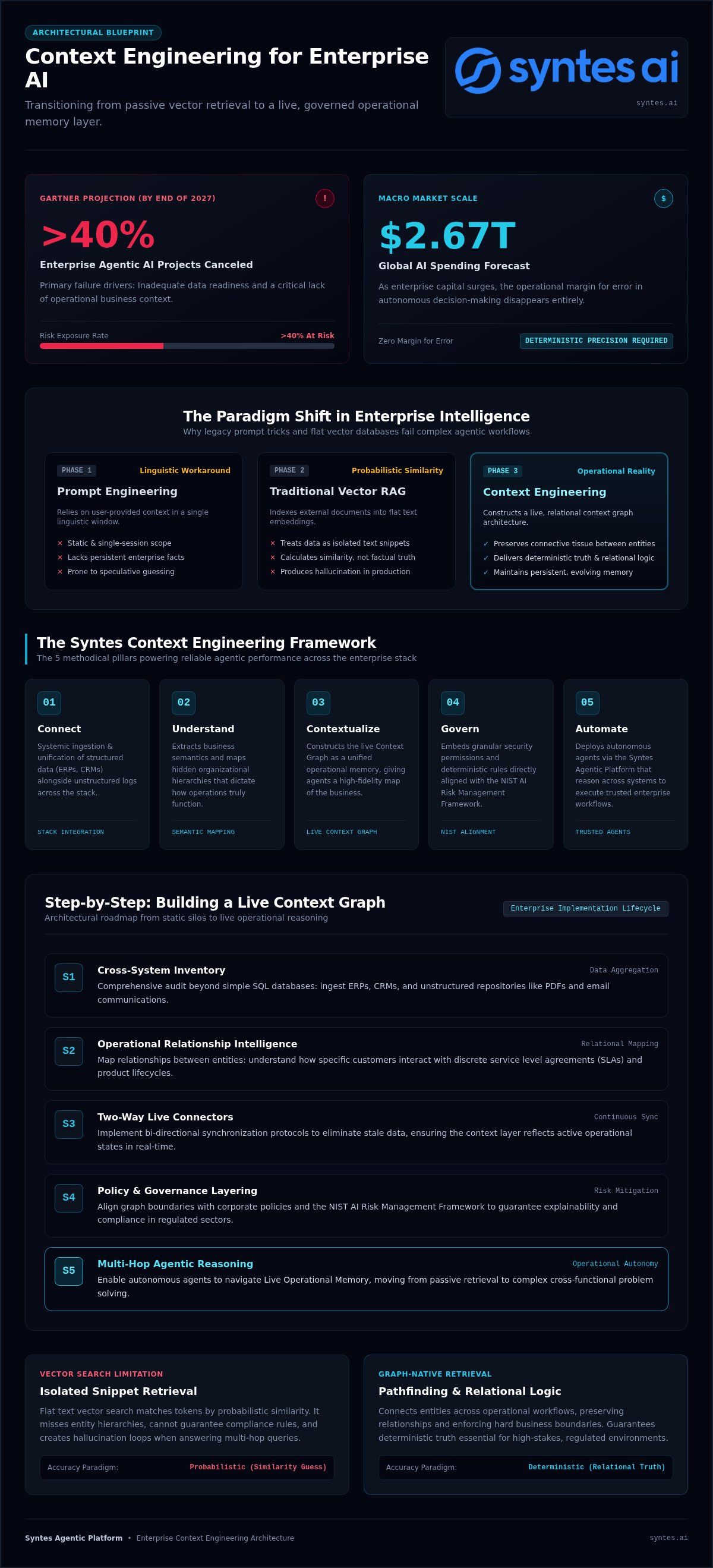
By the end of 2027, Gartner forecasts that over 40% of enterprise agentic AI projects will be canceled due to inadequate data readiness and a lack of business context. It’s a sobering reality for leaders who expected generative models to solve operational silos overnight. You’ve likely felt this friction already. Models hallucinate. They miss critical connections between entities. They can’t explain why they made a specific decision to your stakeholders. This gap exists because foundation models don’t fail because of their size; they fail because they lack a sophisticated architecture for context engineering for enterprise ai.
You need a system that doesn’t just retrieve data but actually understands it. This guide provides the definitive framework for mastering the transition from passive data retrieval to a live, governed context layer. We’ll examine the shift from static vector RAG to dynamic context graphs that preserve business logic and enforce security. You’ll learn how to build a reliable grounding framework that powers autonomous agents capable of reasoning across your entire enterprise. It’s time to move from theoretical experimentation to total operational clarity.
Key Takeaways
- Master the systematic discipline of context engineering for enterprise ai to transform fragmented data silos into a unified, live operational memory.
- Discover a five-pillar framework to connect cross-system data and map the complex operational relationships that traditional foundation models overlook.
- Identify why standard vector RAG leads to reasoning failures and how graph-native retrieval provides the pathfinding accuracy required for regulated environments.
- Learn to embed granular security permissions and deterministic business rules directly into your context layer to ensure safe, explainable agentic execution.
- Transition from passive information retrieval to automated performance by deploying trusted agents through the Syntes Agentic Platform.
What is Context Engineering for Enterprise AI?
Context Engineering for Enterprise AI is the rigorous discipline of architecting, governing, and maintaining the live operational memory required for AI systems to function with absolute precision. It is not a cosmetic layer. It is the fundamental infrastructure that ensures an AI agent understands the specific nuances of your business rules, customer hierarchies, and real-time supply chain status. While prompt engineering attempts to guide a model through linguistic trickery, context engineering provides the model with a structured, verifiable reality.
Prompt engineering is static; it relies on the user to provide enough information in a single window. Context engineering is dynamic. It builds a persistent, evolving environment where the AI is already grounded in the facts of the enterprise before the first word is ever typed. This distinction is critical in 2026. As global AI spending reaches $2.67 trillion, the margin for error in automated decision-making has effectively disappeared. Context is the fuel for enterprise-grade agentic AI. Without it, your agents are merely sophisticated guessing machines.
The Evolution from RAG to Context Engineering
First-wave Retrieval-Augmented Generation (RAG) served its purpose by connecting Large Language Models (LLMs) to external documents. However, it fails in complex environments because it treats data as isolated snippets. Vector search identifies similarity, not truth. Context engineering moves beyond simple retrieval toward deep operational understanding. It transforms flat text into knowledge graph architectures that preserve the connective tissue between entities. This creates a “deterministic truth” for LLMs. It eliminates the guesswork that leads to hallucinations in production by replacing probabilistic retrieval with relational logic.
The Five Pillars of the Context Engineering Framework
The Syntes Context Engineering Framework organizes this discipline into a methodical progression. The first three pillars establish the foundation for a shared context layer:
- Connect: This involves the systemic ingestion and unification of structured data from ERPs and CRMs alongside unstructured operational logs across the entire stack.
- Understand: The system extracts business semantics and identifies the hidden hierarchies that define how your organization actually functions.
- Contextualize: This is the construction of the live Context Graph. It serves as the unified operational memory, ensuring every agent operates with the same high-fidelity map of the business.
This shared context layer is the new enterprise infrastructure. It allows for cross-functional reasoning that was previously impossible when data was trapped in silos. It moves the organization from passive observation to active, automated performance.
How to Build a Live Context Graph: A Step-by-Step Framework
Building a live context graph is not a one-time data migration. It is an architectural commitment to continuous operational intelligence. Most enterprises fail because they treat data as a static repository rather than a living system. To achieve true context engineering for enterprise ai, you must follow a methodical framework that prioritizes relationships over raw volume.
Step 1 requires a comprehensive inventory of cross-system data. You must look beyond simple SQL databases to include ERPs, CRMs, and the vast sea of unstructured PDFs and emails. Step 2 involves mapping these entities through Operational Relationship Intelligence. This isn’t just about identifying a customer; it’s about understanding how that customer interacts with specific SLAs and product lifecycles. Step 3 implements two-way connectors. These ensure real-time synchronization so your AI never reasons over stale information.
Step 4 layers business rules and governance over the graph. By aligning your architecture with the NIST AI Risk Management Framework, you ensure that AI decisions remain within the bounds of corporate policy. Finally, Step 5 enables your AI agents to reason over this Live Operational Memory, moving from simple retrieval to complex, multi-hop problem solving.
Connecting the Disconnected: Structured vs. Unstructured Data
Bridging the gap between rigid SQL tables and fluid PDF policies is the primary hurdle. Legacy systems often hide the most valuable context in buried logs or undocumented workflows. Two-way connectors maintain a live data flow, ensuring that as your business changes, your AI’s understanding changes with it. If you’re struggling to unify these disparate sources, you might consider how to accelerate your integration strategy through automated discovery.
From Data Points to Relationships: The Power of Graph Technology
Traditional relational databases crumble under the weight of multi-hop enterprise queries. Hybrid graph databases are superior because they treat the relationship as a first-class citizen. You’re modeling your business as a network of interconnected events rather than a series of disconnected rows. A Context Graph is a live operational model of the business. This shift allows you to resolve entity ambiguity and track real-time relevance across the entire global stack, providing the semantic structure necessary for the successful discipline of context engineering for enterprise ai.
Moving Beyond RAG: Why Traditional Retrieval Isn’t Enough in 2026
First-generation Retrieval-Augmented Generation (RAG) has reached its architectural limit. In the early days of generative adoption, simply connecting a model to a vector database felt like a breakthrough. In 2026, it’s a legacy approach that introduces unacceptable risks. Vector search operates on a “black box” principle of mathematical similarity. It identifies passages that look like the answer but lacks the structural logic to verify if they are actually true within your business context. This probabilistic guessing is the primary engine of enterprise hallucinations.
Traditional retrieval treats your data as a static library. Context engineering for enterprise ai treats it as a live operational memory. The difference is profound. Similarity is not truth. While a vector database might find a document about “shipping policies,” it cannot navigate the multi-hop relationships required to understand how a specific weather event in the Pacific impacts a high-priority customer’s SLA in Europe. Relationship-based intelligence allows the system to understand “why” things happen, moving beyond keyword matching toward genuine pathfinding and reasoning.
The Hallucination Problem: Architecting Deterministic Truth
The stakes for accuracy have never been higher. A Stanford HAI study on RAG limitations demonstrates that even sophisticated models fail significantly when queries require precise relational logic. To solve this, Syntes AI prevents hallucinations by replacing probabilistic retrieval with semantic grounding. By anchoring every AI response in a structured enterprise knowledge graph, we move from “best-guess” outputs to deterministic reasoning. The model no longer predicts the next likely word; it retrieves the verified operational fact.
Reasoning Over Relationships, Not Just Facts
Enterprise intelligence requires more than finding a file. It requires understanding a policy. Context engineering allows agents to navigate complex supply chains or intricate financial rules by tracing the connections between disparate data points. Consider a manufacturing agent tasked with optimizing production schedules. It doesn’t just look at inventory levels. It simultaneously reasons over real-time shipping delays, fluctuating energy costs, and historical weather patterns. This multi-dimensional reasoning is only possible when the AI understands the connective tissue between entities. It’s the shift from simple data retrieval to comprehensive context engineering for enterprise ai, ensuring that your agents act as informed experts rather than automated search bars.
Governing Agentic AI: Safety and Accuracy in Execution
Deploying autonomous agents without a governed context layer is an invitation to systemic failure. As enterprises move from informational chatbots to agentic workflows that execute write actions in core systems, the risk profile shifts from “embarrassing hallucination” to “catastrophic operational error.” Context engineering for enterprise ai provides the necessary guardrails. It ensures that an agent doesn’t just know the facts, but also understands the boundaries of its authority. Success in 2026 requires more than just performance; it requires compliance with the direct regulatory enforcement of the EU AI Act.
Security isn’t a bolt-on feature. It’s a fundamental component of the architecture. By embedding granular access controls and business rules directly into the Context Graph, you create a self-governing environment. Every action an agent considers is first validated against the live operational memory of what is permitted. This approach replaces the “black box” model with a transparent execution engine. Human-in-the-loop (HITL) systems further reinforce this by providing checkpoints for high-stakes decisions, ensuring that automated efficiency never bypasses human oversight.
The Governance Framework for Enterprise Agents
Effective governance requires applying permissions across the semantic data layer. Such a structure ensures that an AI agent reasoning over sensitive financial data only accesses information relevant to its specific role. Enforcing compliance through live operational guardrails prevents unauthorized transactions before they occur. Governance must be an engineering priority from day one. To maintain control, your framework should include:
- Deterministic Policy Enforcement: Business rules that restrict agent actions based on real-time operational state.
- Granular Access Control: Permissions mapped directly to the entities within the context graph.
- Action Verification: Mandatory HITL checkpoints for transactions exceeding defined risk thresholds.
Architecting this way is the difference between a fragile pilot project and a resilient, production-ready system that can withstand rigorous market surveillance.
Explainable AI: Building Trust with Stakeholders
Why did the agent choose that specific supplier? In a standard LLM deployment, you can’t answer. Context Engineering provides a clear audit trail of AI reasoning by tracing every decision back to its source in the relational graph. It bridges the gap between probabilistic LLM intuition and deterministic enterprise logic. Syntes AI enables explainable AI through its Context Graph architecture by providing a deterministic map of the relationships and rules that guided an agent’s specific decision. This transparency is vital for regulated industries where accountability is non-negotiable and “I don’t know” is an unacceptable answer to a stakeholder.
Deploying Your Context Engineering Strategy with Syntes AI
The Syntes Agentic Platform serves as the definitive execution engine for organizations ready to move beyond static retrieval. It is the bridge between raw data and autonomous action. Implementing a rigorous approach to context engineering for enterprise ai requires more than just a vector database; it demands a system that can reason across the entire organizational stack. You must transition from simply solving data silos to deploying agents that possess the intelligence to act. Stop experimenting with isolated pilots. Start executing with a unified context layer.
The Syntes AI Context Graph as Enterprise Memory
The Syntes AI Context Graph functions as a continuously evolving operational memory for the organization. It doesn’t just store data points. It understands the connective tissue between your ERP, CRM, and custom business systems. This is where Operational Relationship Intelligence provides a decisive competitive edge in 2026. By mapping how a specific delay in a manufacturing node affects a downstream financial commitment, the platform enables agents to perform multi-hop reasoning. Traditional systems cannot replicate this depth. Integrating these disparate systems into a single Context Graph ensures that your AI agents operate with a high-fidelity map of the business, rather than a fragmented view of disconnected records.
Future-Proofing with Enterprise AI Infrastructure
Long-term scalability depends on evaluating your enterprise AI infrastructure against the demands of agentic intelligence. The next evolution of the market is not generative; it is agentic. Generative models answer questions. Agentic systems solve problems. This shift requires a platform capable of governing these actions with absolute precision. By adopting context engineering for enterprise ai, you move from passive observation to active, automated performance.
The roadmap to operational clarity begins with a commitment to context. Stop settling for probabilistic guesses and start building on a foundation of deterministic truth. Your journey toward a live, governed context layer starts with a platform built specifically for enterprise trust and systemic integration. It is time to deploy AI that doesn’t just talk, but actually works.
Mastering Operational Clarity in the Agentic Era
The transition from probabilistic retrieval to deterministic reasoning is the defining strategic challenge for the 2026 enterprise. You’ve seen why traditional RAG fails to capture the intricate relationship topologies that drive your business logic. Mastering context engineering for enterprise ai is the only path to deploying agents that stakeholders actually trust. It requires a fundamental shift. You must move from managing static data silos to architecting a live, governed context layer that evolves in real-time alongside your operations.
Syntes AI is already redefining enterprise intelligence for leaders across the financial services and manufacturing sectors. Our platform provides the Live Operational Memory necessary to bridge the gap between LLM intuition and rigorous business rules. The era of autonomous business isn’t coming; it’s here. Secure your competitive advantage by grounding your AI in a verifiable reality. It’s time to replace black-box uncertainty with systemic integration and execution.
Take the first step toward total operational clarity and build the future of your enterprise on a foundation of trusted intelligence.
Frequently Asked Questions
What is the difference between RAG and Context Engineering?
Retrieval-Augmented Generation (RAG) is a mechanism for finding isolated text snippets based on similarity. Context Engineering is a comprehensive discipline that builds a live, governed environment. While RAG retrieves data, Context Engineering understands business relationships and rules. It moves from probabilistic guessing to deterministic grounding. This architectural evolution ensures AI agents operate with total operational clarity by providing a structured reality instead of disconnected document fragments.
How does a Context Graph improve AI accuracy?
A Context Graph improves accuracy by preserving the connective tissue between disparate data points. Unlike flat vector databases, it maps complex hierarchies and operational relationships. This allows AI to perform multi-hop reasoning, such as identifying how a supply chain delay impacts a specific customer SLA. By providing this relational logic, the graph eliminates the guesswork that leads to reasoning failures in high-stakes enterprise environments.
Can Context Engineering work with our existing ERP and CRM systems?
Yes, it’s designed specifically to unify fragmented data across legacy and modern stacks. Syntes AI uses two-way connectors to ingest structured data from ERPs and CRMs alongside unstructured operational logs. This creates a shared context layer that bridges the gap between disconnected silos. It transforms your existing data into a live operational memory without requiring a full rip and replace of your current infrastructure.
Why is explainable AI important for enterprise governance?
Explainability is the foundation of trust in regulated industries. Enterprise leaders must be able to audit the reasoning behind every AI-driven action to ensure compliance with internal policies and global standards. Context Engineering provides a clear audit trail by tracing decisions back to specific entities and rules within the graph. This transparency prevents black box outcomes and allows for human-in-the-loop verification of autonomous agents. For organizations seeking strategic advisory to move toward verifiable, transparent systems, learn more about AITHENTIC to discover their AI transformation consulting services.
What industries benefit most from Context Engineering?
Highly regulated and operationally complex sectors gain the most immediate value. Manufacturing, financial services, healthcare, and construction rely on intricate dependencies that standard generative models often miss. These industries require the precision of context engineering for enterprise ai to manage supply chains and enforce financial rules. Any organization where an incorrect automated decision carries significant financial or legal risk needs this level of architectural rigor.
How does Syntes AI prevent AI hallucinations?
Syntes AI prevents hallucinations by replacing probabilistic word prediction with semantic grounding in a verifiable reality. Every response is anchored in the Syntes AI Context Graph, which serves as the ground truth for the model. Instead of guessing the next likely token, the agent retrieves and reasons over confirmed operational facts. This deterministic approach ensures that AI outputs are consistently accurate and aligned with current business rules.
Is Context Engineering a replacement for data engineering?
It is an evolution and a partner to data engineering, not a replacement. While data engineering focuses on the movement and storage of raw information, Context Engineering focuses on the semantic meaning and operational relationships of that data. It sits atop your data pipeline to transform raw inputs into an actionable intelligence layer. It ensures that the data you’ve engineered is actually ready for autonomous reasoning.
What is Live Operational Memory in the context of AI?
Live Operational Memory is a continuously evolving model of the organization that tracks real-time events, business rules, and permissions. It differs from static databases by maintaining a dynamic state of the enterprise. This memory allows AI agents to understand the current operational context, such as inventory levels or energy costs, as they change. It provides the persistent environment needed for context engineering for enterprise ai to succeed at scale.