
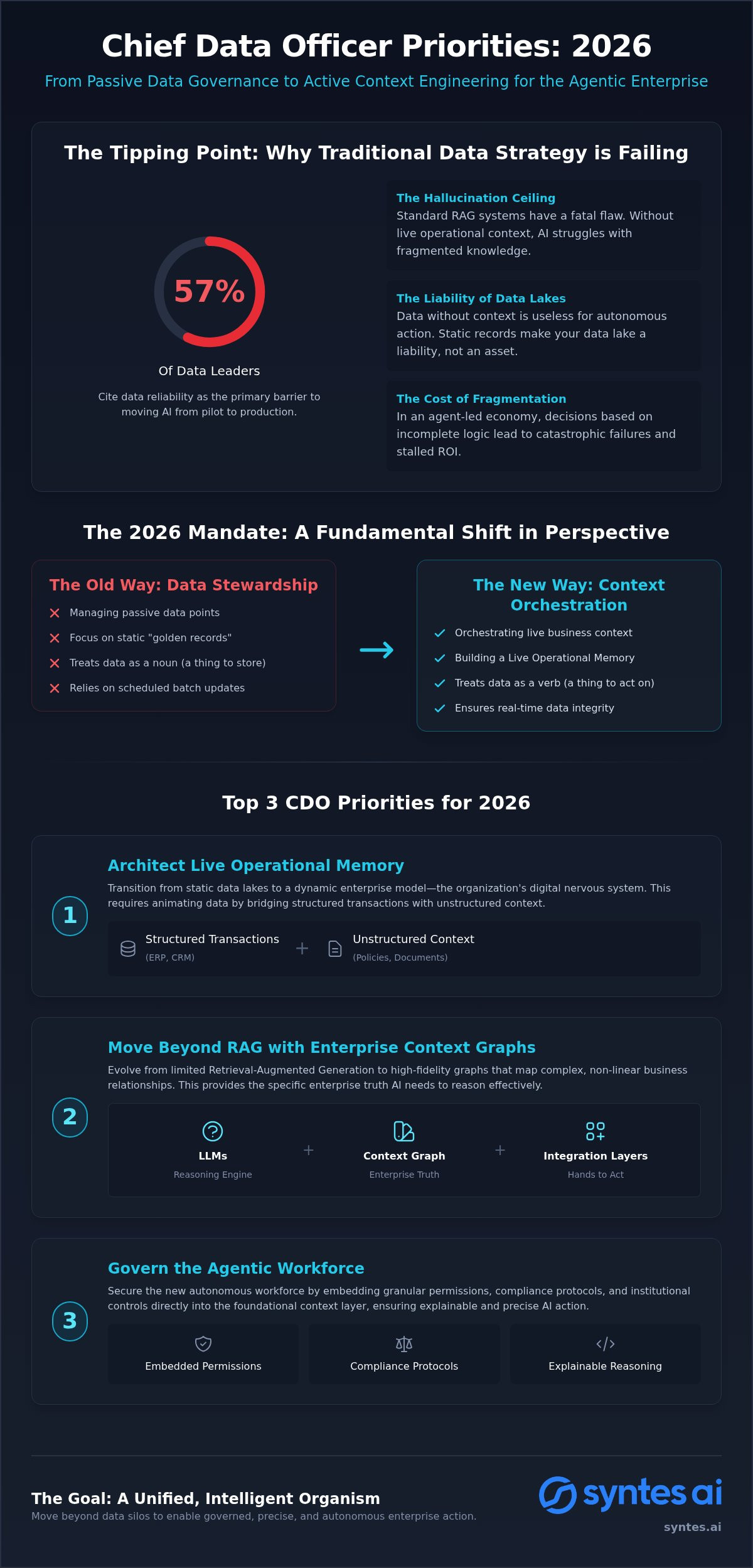
Your data lake isn’t an asset. It’s a liability. By 2026, the hallucination ceiling of standard RAG systems has exposed a fatal flaw in traditional architecture: data without live operational context is effectively useless for autonomous action. You’ve likely spent years governing static records, yet your AI still struggles with fragmented enterprise knowledge across legacy systems. It’s a frustrating reality when 57% of data leaders still cite data reliability as the primary barrier to moving AI projects from pilot to production.
We understand the intense pressure to prove ROI while navigating the complexities of the EU AI Act and the latest OWASP risks for agentic applications. This guide defines the critical chief data officer priorities 2026, offering a strategic roadmap to move beyond passive data governance. You’ll learn how to architect an Enterprise Knowledge Graph that serves as a Live Operational Memory for your organization. We’ll preview the transition from simple data stewardship to sophisticated Context Engineering. This shift ensures your agentic AI operates with explainable reasoning and governed precision, transforming your enterprise from a collection of silos into a unified, intelligent organism.
Key Takeaways
- Transition from managing passive data points to orchestrating live business context to enable autonomous enterprise execution and institutional control.
- Construct a Live Operational Memory that integrates structured transactions with unstructured policies into a continuously evolving enterprise model.
- Define chief data officer priorities 2026 by evolving beyond limited RAG systems toward high-fidelity Enterprise Context Graphs for explainable AI reasoning.
- Secure the agentic workforce by embedding granular permissions and compliance protocols directly into the foundational context layer.
- Deploy a five-pillar Context Engineering framework to convert fragmented legacy systems into a unified source of operational intelligence.
From Data Stewardship to Context Orchestration: The 2026 Shift
The era of passive data stewardship is over. In 2026, the mandate for the Chief Data Officer (CDO) has evolved from merely protecting data points to orchestrating live business context. Traditional Master Data Management (MDM) focuses on “golden records,” but it fails because it lacks the relational nuance required for autonomous systems. Agentic AI doesn’t just need to know who a customer is; it needs to understand the historical friction, the current contract obligations, and the unwritten business rules that govern the relationship. Why is MDM failing the agentic enterprise? Because it treats data as a noun when agents need it to be a verb.
This brings us to the core of chief data officer priorities 2026: enabling autonomous execution without surrendering institutional control. We’ve reached a tipping point where 57% of data leaders view data reliability as the primary barrier to production-ready AI. Context Engineering is the discipline of building and governing business context for AI accuracy. It’s no longer about how much data you store, but how effectively you can contextualize it for machine reasoning.
The Rise of the Agentic Enterprise
Chatbots were the toys of 2024. Today, autonomous agents are the workers. These systems don’t just summarize information; they execute complex workflows across disparate legacy systems. Research indicates that 47% of organizations have already embraced agentic AI as of early 2026. However, the cost of fragmented knowledge is catastrophic in an agent-led economy. When an agent lacks the “Live Operational Memory” of the enterprise, it makes decisions based on incomplete logic. This leads to the “hallucination ceiling” that stalls ROI. Moving from passive data lakes to active execution environments is the only way to sustain momentum.
Why Context is the New Oil
Large Language Models (LLMs) are smart but blind to your specific business logic. General AI knowledge has become a commodity, while your proprietary operational logic is the true competitive advantage. Bridging the gap requires Operational Relationship Intelligence, a framework that maps how data points interact in real-time. Without this, AI remains a black box that cannot be trusted with high-stakes decisions.
- LLMs provide the reasoning engine.
- Context Graphs provide the specific enterprise truth.
- Integration layers provide the hands to act.
The strategic value lies in how you connect these three elements. By focusing on chief data officer priorities 2026, leaders can ensure that their AI isn’t just reciting data, but understanding the business context required for precise, governed action.
Priority 1: Architecting Live Operational Memory
Static repositories are a relic of the pre-agentic era. In the current landscape, one of the top chief data officer priorities 2026 is the shift from archival storage to Live Operational Memory. This isn’t a data lake. It’s a continuously evolving enterprise model that functions as the digital nervous system of your organization. To achieve this, you must bridge the gap between structured transactions found in ERP and CRM systems and the unstructured context trapped in business policies, legal documents, and communication logs. It isn’t enough to store data; you must animate it.
Maintaining this memory requires sophisticated two-way connectors that ensure real-time data integrity. If an agent acts on information that is even minutes old, the risk of operational failure or compliance breach spikes. This is why a modern enterprise-wide data strategy must prioritize live synchronization over the scheduled batch updates of the past. By Solving Enterprise Data Silos, you provide autonomous agents with the comprehensive, up-to-the-second context needed to reason accurately and execute safely.
Building the Live Context Graph
The technical foundation of live memory is the Context Graph. This unified layer integrates customers, products, and operational events into a single, navigable architecture. Moving from traditional relational databases to hybrid graph structures allows for the representation of complex, non-linear relationships that SQL simply cannot handle. Scalability is non-negotiable. Your architecture must support millions of real-time relationships without latency. It’s the difference between an AI that merely “knows” a customer and an AI that understands a customer’s intent based on their last three interactions across four different platforms.
Operationalizing Relationship Intelligence
Contextual intelligence allows for the discovery of hidden hierarchies and semantic dependencies that remain invisible in flat files. When an enterprise achieves this level of clarity, AI agents move from reactive tools to proactive partners. They begin to anticipate business needs before a human even initiates a query. For example, transitioning from batch processing to live context allows a supply chain agent to reroute shipments the moment a port delay is logged, rather than waiting for a nightly report. Architecting this level of responsiveness is a cornerstone of chief data officer priorities 2026. If your current stack feels like a collection of disconnected islands, you should explore how the Syntes Agentic Platform builds live operational context.
Priority 2: Moving Beyond RAG with Enterprise Context Graphs
First-wave Retrieval-Augmented Generation (RAG) was a necessary bridge, but it isn’t the destination. In 2026, the technical limitations of vector-only retrieval have become undeniable: similarity isn’t the same as truth. Standard RAG systems often retrieve “relevant” chunks that are logically contradictory, leading to sophisticated but incorrect outcomes. For any leader focused on chief data officer priorities 2026, the evolution toward Enterprise Context Graphs is now a strategic requirement. We’re moving from simple retrieval to deterministic semantic grounding.
The solution lies in GraphRAG. This architecture combines the intuitive search capabilities of vector embeddings with the rigid, logical relationships of a Knowledge Graph. By mapping data as a series of interconnected nodes and edges, you provide the AI with a roadmap of facts rather than a pile of text. This transition is critical for How to Prevent AI Hallucination. It ensures that when an agent reasons, it follows a path of verified enterprise logic rather than a statistical guess.
Vector Search vs. Semantic Context Graphs
Vector databases are essentially “black boxes.” They calculate mathematical proximity between concepts but lack an understanding of the actual hierarchy or business rules. If an agent asks for a discount policy, a vector search might return three different versions of the policy because they’re semantically similar. A Semantic Context Graph, however, identifies which policy is currently active, which department it applies to, and what the legal constraints are. This provides an explainable reasoning path. You can audit exactly why an AI made a specific decision, which is essential as the EU AI Act begins enforcement in August 2026, requiring rigorous documentation for high-risk systems.
Implementing Deterministic AI Truth
True intelligence requires constraints. By using business rules and internal policies as hard constraints within your Context Graph, you create a “Live Operational Memory” that functions as a deterministic ground truth. The AI doesn’t just “read” your documents; it understands the logic within them. This semantic grounding changes the stakes for enterprise AI adoption. When stakeholders see that the system is bound by the same rules as human employees, trust increases. It transforms AI from a risky experiment into a reliable operational asset that follows your specific enterprise logic with absolute fidelity. Stop guessing with vectors and start architecting with context.
Priority 3: Governing the Agentic Workforce
Governance is no longer a defensive checklist. It’s an operational requirement for the autonomous enterprise. As autonomous agents begin to replace simple chatbots, the focus of chief data officer priorities 2026 must shift from human-centric oversight to agent-centric data governance. You aren’t just managing who can see a spreadsheet anymore; you’re managing what an agent can execute across your entire stack. With only 12% of enterprises having mature AI governance processes in place as of May 2026, the gap between capability and control is a systemic risk. Alarmingly, 76% of data leaders state that their company’s AI governance doesn’t completely keep pace with employee use of the technology. Closing this gap is the only way to avoid operational instability.
Embedding security, permissions, and compliance directly into the Context Graph ensures that governance is not an afterthought. It becomes the foundation of the execution layer. This approach moves beyond static policy documents toward live, enforced constraints. By integrating Human-in-the-Loop (HITL) systems, you maintain institutional control over high-stakes decisions while allowing agents to handle high-volume operational tasks. This balanced architecture is the hallmark of sophisticated Agentic AI Platforms. You don’t just hope for compliance; you architect it into the system’s memory.
Governed Agentic AI Frameworks
Managing the ‘Agentic Lifecycle’ requires a rigorous framework that covers deployment, monitoring, and retirement. You must define granular permissions for autonomous agents that govern their behavior across cross-system integrations. If an agent has access to financial systems and customer data, its reasoning must be auditable. Every action should be traceable back to specific enterprise data points to satisfy the 2026 OWASP Top 10 for Agentic Applications. This level of auditability prevents the emergent behaviors that lead to cascading system failures. Without these guardrails, agents become black boxes that introduce unmanaged risk into your production environment.
Explainable AI (XAI) as a Strategic Asset
Trust is built on transparency, not probability. Moving beyond probabilistic guesses to auditable logical steps is the only way to satisfy executive stakeholders and increasingly strict regulators. Explainable reasoning is the ability to trace every AI action to a specific business rule. This capability transforms XAI from a technical feature into a strategic asset. When your AI can show its work, you eliminate the anxiety that often stalls enterprise-wide adoption. You move from a state of uncertainty to a state of total operational clarity, ensuring that every automated decision is both defensible and correct.
The 2026 Roadmap: Executing with Syntes AI
Execution is the only metric that matters in the agentic enterprise. To transform chief data officer priorities 2026 from a strategic vision into an operational reality, you need a framework that moves beyond fragmented data lakes. Syntes AI delivers this through a rigorous five-pillar Context Engineering framework. This methodology is designed to turn silent enterprise data into a unified, intelligent organism capable of autonomous action. It moves your organization beyond the limitations of fragile, no-code AI applications toward sophisticated agentic workflows that drive measurable bottom-line results.
- Connect: Establish deep cross-system integrations to eliminate data silos.
- Understand: Process structured transactions and unstructured assets into semantic meaning.
- Contextualize: Map these insights into a Live Operational Context Graph.
- Govern: Enforce AI governance and permissions directly at the context layer.
- Execute: Power autonomous agents that act with deterministic precision and institutional control.
Ready to architect your enterprise context? Book a demo with Syntes AI today
The Syntes Agentic Platform Advantage
The Syntes Agentic Platform eliminates the friction of fragmented enterprise knowledge by unifying structured and unstructured data into a single operational layer. This isn’t a consumer-grade chatbot environment. It’s a technical ecosystem built for global enterprise scale. It allows you to deploy governed agents that operate across your entire software stack, following the exact business rules you’ve architected into your Context Graph. By providing a “Live Operational Memory,” the platform ensures that your AI agents reason with the same up-to-the-second accuracy as your best human operators.
Next Steps for the 2026 CDO
Your immediate priority is assessing your organization’s “Context Maturity.” With 86% of companies increasing their investment in data management this year, the competition for operational intelligence is accelerating. You must identify high-value agentic use cases where Live Operational Memory can deliver immediate ROI. Whether it’s automating complex supply chain decisions or managing real-time compliance, the focus should be on moving from passive observation to active performance. Architecting this foundation now is the only way to satisfy the intense pressure to prove AI’s business value while maintaining total operational clarity.
Mastering the Architecture of Autonomy
The transition from passive data management to active context orchestration is no longer a choice; it’s the baseline for survival in an agentic economy. Context is the new execution layer. By architecting a Live Operational Memory, you move beyond the unreliable outputs of standard RAG systems and provide your AI with a deterministic ground truth. This shift ensures that your autonomous agents act with the precision and institutional control required for high-stakes enterprise performance.
Addressing chief data officer priorities 2026 requires a fundamental pivot toward Context Engineering. You must embed governance and explainability directly into your data layer to satisfy both regulatory demands and executive expectations. With Live Operational Context Graph technology and enterprise-grade governance, you can finally bridge the gap between fragmented legacy systems and unified operational intelligence. The era of the black box is over.
The future belongs to those who treat context as their most valuable asset. Your organization possesses the potential to move from fragmented data to absolute operational clarity. Begin your journey toward a truly intelligent, governed enterprise today.
Frequently Asked Questions
What are the top CDO priorities for 2026?
The primary chief data officer priorities 2026 focus on transitioning from passive data stewardship to architecting Live Operational Memory. This involves moving beyond document-based retrieval toward governed context graphs that enable autonomous agentic AI. CDOs must prioritize the implementation of Context Engineering frameworks to ensure AI outcomes are both reliable and explainable. Proving business value through automated, cross-system execution remains a critical mandate as organizations move from pilot projects to full-scale production environments.
How does Context Engineering differ from standard Data Governance?
Standard Data Governance typically focuses on defensive postures like data quality, privacy, and policy compliance on paper. Context Engineering is an active, architectural discipline that builds and maintains the specific business context required for AI systems to reason accurately. While governance sets the rules, Context Engineering provides the execution layer by mapping relationships between structured and unstructured data. It transforms static records into a unified context layer that powers trusted enterprise intelligence.
Why is a Knowledge Graph essential for Agentic AI?
A Knowledge Graph is essential because autonomous agents require more than just raw data; they need to understand the relationships between entities like customers, products, and policies. Large Language Models provide the reasoning engine, but the Knowledge Graph provides the specific enterprise truth. It allows agents to navigate complex hierarchies and semantic dependencies in real-time. Without this relational intelligence, agentic systems lack the necessary grounding to perform sophisticated tasks across disparate legacy systems.
How can CDOs prevent AI hallucinations in enterprise environments?
Preventing hallucinations requires moving from probabilistic guesses to deterministic semantic grounding. CDOs achieve this by architecting an Enterprise Knowledge Graph that serves as the AI’s ground truth. By using business rules and internal policies as hard constraints within a Context Graph, organizations ensure AI reasoning follows verified logic. This architectural shift provides a Live Operational Memory that replaces statistical proximity with factual relationships, effectively eliminating the hallucination ceiling found in standard RAG systems.
What is the role of Live Operational Memory in AI strategy?
Live Operational Memory serves as a continuously evolving model of the business that connects data from various systems in real-time. It functions as the digital nervous system for the enterprise, integrating structured transactions with unstructured context. This allows AI agents to act with an up-to-date understanding of the organization’s current state. By prioritizing this as one of the chief data officer priorities 2026, leaders ensure their AI strategy is grounded in real-time operational relevance and proprietary business logic.
How do I govern autonomous AI agents across legacy systems?
Governing autonomous agents requires embedding security, permissions, and compliance directly into the execution layer. Rather than relying on static policy documents, CDOs must utilize a Context Graph to enforce granular constraints on agent behavior. This framework includes Human-in-the-Loop systems for high-stakes decisions and rigorous audit trails for every automated action. Effective governance ensures that agents operate within institutional guardrails while maintaining the ability to execute complex workflows across disparate and fragmented software stacks.
What is GraphRAG and why does it matter for 2026?
GraphRAG is the evolution of Retrieval-Augmented Generation that combines vector search with structured graph relationships. It matters in 2026 because first-wave RAG often fails at complex reasoning due to its reliance on semantic similarity rather than logical truth. By mapping data as interconnected nodes and edges, GraphRAG provides AI agents with explainable reasoning paths. This technology allows the enterprise to scale AI initiatives without the operational risks associated with black-box retrieval methods found in traditional vector databases.
How do I measure the ROI of an Enterprise AI Platform?
Measuring ROI involves tracking the transition from manual batch processing to automated, context-aware execution. Success is defined by the reduction in AI hallucinations, the speed of cross-system workflow completion, and the accuracy of autonomous decision-making. CDOs should focus on high-value use cases where Live Operational Memory directly improves operational efficiency. By providing a foundation for trusted enterprise intelligence, the Syntes Agentic Platform enables organizations to capture measurable value that static data lakes simply cannot deliver.