
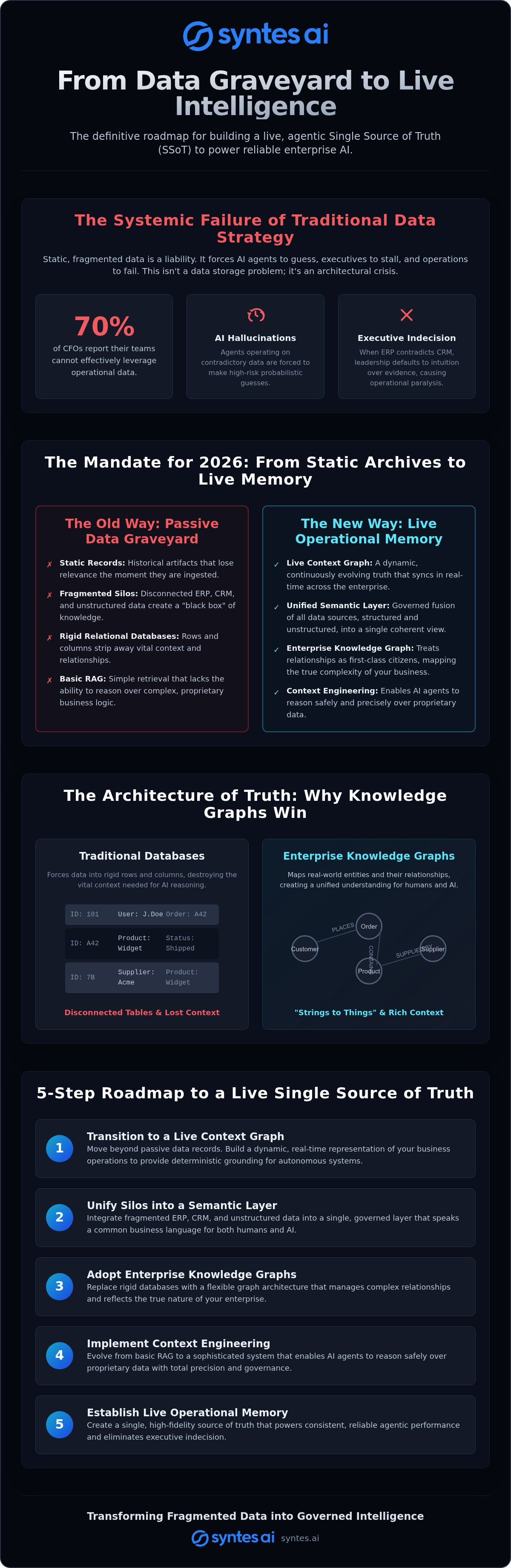
Your current data strategy is likely a graveyard of static records that your AI agents cannot navigate. You’ve invested millions in building a single source of truth for data only to watch your agents hallucinate and your executives stall over conflicting reports. It’s a systemic failure of architecture. When 70% of CFOs acknowledge that their teams cannot effectively leverage operational data, the issue isn’t a lack of information; it’s a lack of governed, real-time context. You don’t need more data storage. You need operational intelligence.
We recognize the friction caused by fragmented legacy systems and the indecision it breeds at the highest levels of leadership. This guide serves as the definitive roadmap to transcend these limitations. You’ll learn to build a live, agentic single source of truth that provides the deterministic grounding required for reliable enterprise AI. We’ll examine the transition from passive data lakes to active Context Graphs, ensuring your organization operates from a unified, high-fidelity memory that drives immediate, automated action.
Key Takeaways
- Transition from passive records to a live Context Graph to provide the deterministic grounding necessary for autonomous systems.
- Master the strategic roadmap for building a single source of truth for data by unifying fragmented ERP and CRM silos into a governed semantic layer.
- Discover why an Enterprise Knowledge Graph outperforms traditional databases in managing the complex relationships required for modern operational intelligence.
- Implement Context Engineering to replace basic RAG, enabling AI agents to reason safely over proprietary data with total precision.
- Establish a live operational memory that eliminates executive indecision and powers consistent, reliable agentic performance.
What is a Single Source of Truth (SSoT) in the Era of Agentic AI?
Traditional data management is failing. It’s too slow. It’s too rigid. A Single source of truth (SSoT) is no longer just a centralized repository for human reporting; it’s a governed, deterministic foundation that ensures every person and AI agent operates from the same evidentiary base. In 2026, the mandate for building a single source of truth for data has shifted. We’ve moved beyond “Data as a Record” to “Data as a Context.” For autonomous systems to function, they don’t just need to know what happened; they need to understand the relationships and business logic surrounding that event.
This shift is the only viable path for the prevention of AI hallucinations. When an AI agent reasons over fragmented or contradictory information, it’s forced to fill the gaps with probabilistic guesses. That’s a recipe for operational disaster. By architecting a deterministic truth, you replace those guesses with governed execution. You provide the AI with a boundary it cannot cross, ensuring that every output is grounded in your proprietary, verified reality. Without this foundation, enterprise AI remains a high-risk experiment rather than a strategic asset.
The Cost of Fragmented Enterprise Knowledge
Disconnected systems breed operational paralysis. When your ERP contradicts your CRM, executive decision-making defaults to intuition rather than evidence. These departmental silos are the primary barrier to AI reliability. They create a “Black Box” where data goes in, but clarity never comes out. Fragmented data leads to ungrounded AI decisions that expose the enterprise to significant risk. An agent operating on stale sales figures or conflicting inventory logs isn’t just inefficient; it’s a liability. You can’t automate what you haven’t unified.
From Static Archives to Live Operational Memory
Most data warehouses are graveyards. They house historical artifacts that lose relevance the moment they’re ingested. Building a single source of truth for data requires a transition to Live Operational Memory. This isn’t a passive archive. It’s a dynamic, continuously evolving truth that synchronizes in real-time across the entire architecture. True operational clarity demands that your SSoT stays as fast as your business. It requires a system that doesn’t just store facts but actively reconciles them, providing a live context layer that powers both human strategy and machine execution simultaneously.
The Architecture of Truth: Knowledge Graphs vs. Traditional Databases
Relational databases are rigid. They excel at transactional logging but buckle under the weight of modern interconnectedness. When you are building a single source of truth for data, you aren’t just looking for a storage bin; you’re looking for a map. Traditional SQL structures force data into rows and columns, stripping away the vital context that defines enterprise operations. This is the primary reason why many organizations fail to achieve a true single source of data truth. They are attempting to solve a multi-dimensional relationship problem with a two-dimensional tool, resulting in data silos that remain impenetrable to AI agents and human analysts alike.
The solution is an Enterprise Knowledge Graph. Unlike relational models, graph technology treats relationships as first-class citizens. It maps entities, attributes, and business rules into a unified layer that reflects the messy reality of global business. We call this the transition from “strings” to “things.” Instead of merely matching text strings across disparate tables, the architecture identifies real-world entities, such as specific customers, unique products, and global suppliers, and understands exactly how they interact in real-time. This isn’t just a database change; it’s a fundamental shift in how building a single source of truth for data is executed for the agentic era.
Unifying Structured and Unstructured Data
Most enterprise knowledge is trapped in unstructured formats. PDFs, emails, and internal policies contain the logic that governs transactions, yet they rarely touch the database. A semantic data layer bridges this gap. It creates a cohesive understanding across disparate sources, allowing transactional data from an ERP to be interpreted through the lens of a legal contract or a service-level agreement. This semantic alignment is what transforms raw information into actionable intelligence, ensuring your AI agents don’t just see numbers, but understand the rules that govern them.
Operational Relationship Intelligence
Why does the relationship between data points matter? Because context is everything. Mapping the hidden connections between a specific supplier’s delay and a customer’s churn risk requires more than a join query; it requires reasoning. Graph-based structures enable AI agents to traverse these connections, identifying risks and opportunities that a flat database would miss. This intelligence is the bedrock of autonomous execution. If you’re ready to see how this architecture functions in practice, you can explore our platform capabilities.
Context Engineering: The Strategic Evolution of Data Management
Context Engineering is the next evolution of systems architecture. It is the rigorous discipline of building and governing the business context required for AI to act with precision. While the previous decade focused on data collection, the current era demands data comprehension. Building a single source of truth for data in 2026 requires more than just technical integration; it requires semantic alignment. Solving enterprise data silos is ultimately about creating a shared language that both humans and autonomous agents can interpret without ambiguity. Without this alignment, your data remains a collection of disconnected facts rather than a functional intelligence asset.
Standard Retrieval-Augmented Generation (RAG) is no longer sufficient. It’s a probabilistic band-aid for a deterministic problem. Relying on simple vector searches often results in AI agents retrieving irrelevant snippets that lead to confident but incorrect conclusions. Context Engineering replaces this guesswork with a high-fidelity operational memory. As Graph Databases Go Mainstream, the focus has shifted from simple storage to the active engineering of relationships. This process ensures that when an agent queries the system, it doesn’t just find a record; it understands the entire web of business logic surrounding that record.
MDM vs. Context Engineering
Master Data Management (MDM) was built for a slower world. It focuses on the “Golden Record,” a static, cleansed version of a data point used primarily for reporting. Context Engineering focuses on the “Governed Context.” This is a live, multi-dimensional view that enables AI agents to perform complex, multi-step reasoning. We’re moving from passive data catalogs to active, operational context graphs. This shift allows your architecture to move beyond observation and into the territory of governed execution.
The Core Pillars of Context Engineering
Building a single source of truth for data through Context Engineering rests on three functional pillars:
- Connect: Integrating structured and unstructured data via two-way connectors to ensure no knowledge is left in a silo.
- Understand: Automatically discovering entities and hierarchies to map how your business actually functions.
- Govern: Applying rigorous security, permissions, and business rules to the truth, ensuring that AI agents only act on verified, authorized information.
This framework is not a one-time project. It’s a continuous loop. Human-in-the-loop systems remain critical for refining this truth, providing the high-level oversight that ensures the context graph evolves alongside the business. It’s about moving from a state of data chaos to a state of total operational clarity.
A 5-Step Roadmap to Building a Live Single Source of Truth
Most digital transformation initiatives fail because they treat integration as the destination. It’s a fatal strategic error. In the agentic era, integration is merely the prerequisite. building a single source of truth for data requires a disciplined transition from static records to a live, operational memory that your AI agents can navigate with total certainty. This isn’t a project for the IT department alone; it’s a strategic mandate for the entire enterprise. You must move beyond the “clean data” obsession of the past decade and focus on “governed execution” for the next one.
- Step 1: Audit and Connect. Map your fragmented landscape. Establish two-way connectivity between your ERP, CRM, and various operational databases to eliminate departmental blind spots.
- Step 2: Define the Semantic Layer. Use a Knowledge Graph to translate raw data into real-world entities. Define the relationships that govern how your business actually functions.
- Step 3: Implement Context Engineering. Move beyond basic RAG. Unify your internal rules, policies, and transactional logic into a cohesive context layer that AI can reason over.
- Step 4: Secure the Truth. Apply enterprise-grade governance. Security isn’t a hurdle; it’s the engine that allows your agents to act with speed and authority.
- Step 5: Deploy Governed AI Agents. Activate your Live Operational Memory. Deploy agents that execute complex workflows based on the unified context you’ve engineered.
Identifying Critical Data Systems
Don’t boil the ocean. Prioritize high-impact systems like your global ERP and customer platforms for initial integration. You must also map your unstructured assets; contracts, SOPs, and internal emails provide the essential business context that transactional data lacks. Determine which streams require real-time synchronization and which can tolerate batch processing. True operational clarity depends on knowing which data points move the needle and ensuring they are the first to be unified when building a single source of truth for data.
Governance and AI Safety
Governance is the primary enabler of AI performance. You must ensure AI agents only access data they’re permitted to see, using rigorous permissioning structures. Build explainable reasoning paths so every decision an agent makes can be audited and justified. Maintain the integrity of your truth through continuous automated monitoring. When governance is baked into the architecture, you eliminate the risk of ungrounded decisions and move toward a state of total operational intelligence.
Syntes AI: Transforming Fragmented Data into Governed Intelligence
The era of experimental AI has ended. High-parameter models are functionally inert without high-fidelity grounding. Syntes AI provides the definitive solution by building a single source of truth for data through a live Context Graph. This is not a passive data lake; it is an active, governed environment where autonomous agents reason with the same precision as your most senior analysts. We provide the enterprise AI infrastructure required to turn fragmented records into operational intelligence that scales.
The Syntes AI Context Graph Advantage
Our platform creates a continuously evolving model of your business. It maps the real-world state of your operations in real-time. Through deep cross-system integrations, we eliminate silos without the catastrophic cost of replacing your legacy ERP or CRM software. You gain a Live Operational Memory that serves as the unified context layer for the entire organization. This architecture enables the transition from simple automation to sophisticated, agentic workflows that respect your proprietary business logic and existing security protocols.
Getting Started with Context Engineering
Implementation is immediate. By leveraging Syntes AI’s no-code AI apps, your teams can begin building a single source of truth for data that delivers measurable ROI in weeks. In retail, this translates to hyper-accurate inventory forecasting and demand sensing. In finance, it enables real-time risk mitigation across disparate portfolios. In manufacturing, it’s the seamless coordination of complex, multi-tiered logistics. For sales teams, this intelligence ensures strategy is applied to every deal; check out CloseStrong to see how to implement company strategies effectively. Operational relationship intelligence is the primary competitive advantage of 2026.
The path to operational clarity is through a unified context layer. Stop managing data and start engineering intelligence. Book a demo of the Syntes AI Platform to unify your enterprise context and activate your agentic workforce today.
The Mandate for Operational Clarity
The pursuit of enterprise intelligence ends where fragmentation begins. We’ve established that building a single source of truth for data in the agentic era is no longer a passive exercise in storage; it’s an active engineering of context. By moving from rigid relational databases to a dynamic Knowledge Graph, you establish the deterministic foundation required for autonomous systems to function with absolute precision. This is the necessary transition from passive observation to high-fidelity execution. Departments that cling to silos will remain paralyzed by indecision, while those that unify their operational memory will lead the market.
Syntes AI provides the Live Operational Memory necessary to ground your AI agents in proprietary reality. Our platform ensures governed Agentic AI execution, replacing probabilistic guesswork with trusted, explainable reasoning that stands up to executive audit. You now possess the strategic roadmap to bridge the gap between legacy systems and autonomous performance. The future belongs to organizations that treat context as their most valuable architectural asset. It’s time to stop managing records and start governing intelligence.
The era of data chaos is over. We’re ready to help you build your operational truth.
Frequently Asked Questions
What is the difference between a Data Warehouse and a Single Source of Truth?
A data warehouse is a historical archive used for retrospective reporting. A Single Source of Truth is a live operational foundation. Warehouses capture what happened in the past; building a single source of truth for data creates a real-time context layer that dictates current action. It ensures every system and AI agent operates from the same evidentiary base at the exact moment of execution.
How does a Single Source of Truth prevent AI hallucinations?
An SSoT provides deterministic grounding that replaces probabilistic guesswork. Hallucinations occur when AI agents fill information gaps with statistical predictions. By providing a unified, verified source of proprietary truth, you eliminate those gaps entirely. The agent no longer needs to guess. It simply retrieves and reasons over your specific business logic and verified facts to deliver accurate outputs.
Can we build an SSoT without replacing our existing ERP or CRM systems?
You can build a unified truth layer without costly rip and replace cycles. Modern platforms use cross-system integrations to pull data from legacy ERP and CRM systems into a centralized Context Graph. This approach preserves your existing infrastructure investments while eliminating the silos that prevent a holistic business view. It is an evolution of connectivity, not a total system replacement.
What is the role of a Knowledge Graph in building a Single Source of Truth?
A Knowledge Graph maps the complex relationships between entities that flat databases inevitably miss. It translates raw data into real-world concepts like customers, products, and contracts, then defines how they interact. This relational intelligence is the bedrock of building a single source of truth for data that AI agents can actually understand, navigate, and use for complex reasoning.
How long does it typically take to implement an enterprise-wide SSoT?
Initial results often manifest within weeks through targeted, high-impact integrations. While a full enterprise-wide rollout is a continuous evolution, the deployment of specific agentic workflows typically requires three to six months. Speed depends on the complexity of your legacy environment and the clarity of your semantic layer definitions. We focus on rapid, measurable ROI through iterative implementation.
How do you handle unstructured data, like PDFs and emails, in an SSoT?
We ingest unstructured data by converting it into semantic entities within the Context Graph. Traditional systems ignore the logic trapped in PDFs and emails. We extract that context and link it directly to transactional records. This ensures your source of truth includes the rules and intent behind the numbers, providing a complete operational picture for both humans and machines.
What is Context Engineering and why is it necessary for SSoT?
Context Engineering is the discipline of governing the business logic that surrounds raw data. It is necessary because AI requires more than just isolated facts. It needs the rules, permissions, and relationships that give those facts meaning. Without this engineering, your SSoT is merely a pile of data rather than a functional intelligence layer capable of powering autonomous execution.
How does Syntes AI ensure data security and governance in a unified truth layer?
Syntes AI applies enterprise-grade governance directly to the Context Graph layer. We ensure that AI agents only access data they are explicitly permitted to see through rigorous permissioning and immutable audit trails. Security is not an afterthought in our architecture. It is the primary engine that enables safe, autonomous performance across the entire enterprise architecture.