
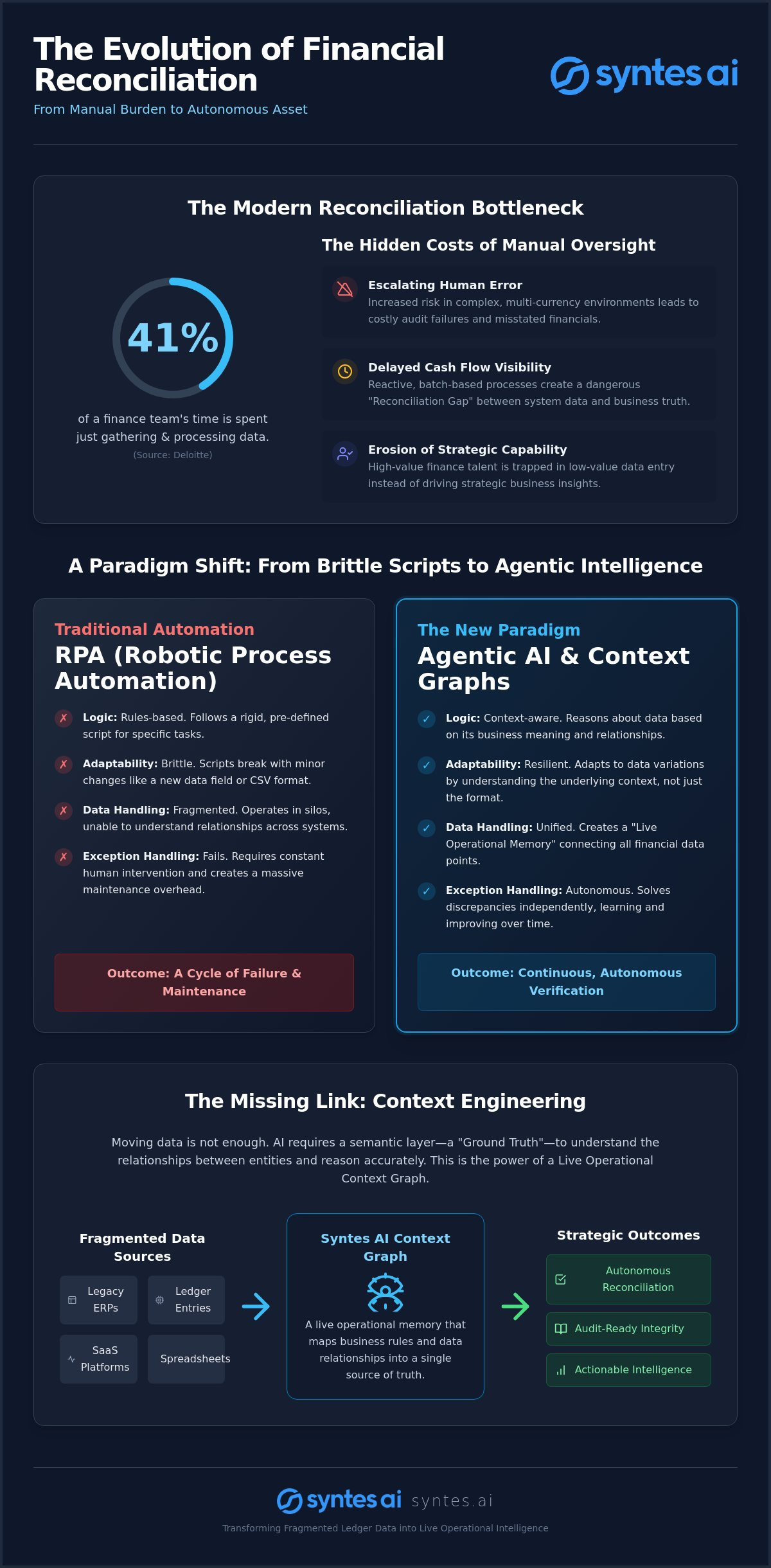
Why does financial reconciliation still feel like a 20th-century manual labor project despite the millions spent on enterprise automation? For most organizations, the promise of automating financial reconciliation has collapsed under the weight of brittle RPA scripts and fragmented data silos spanning legacy ERPs and modern SaaS platforms. You’ve been told that more rules will solve the problem. They won’t. Rules are rigid; financial reality is fluid. Deloitte research shows that finance teams still spend an average of 41% of their time gathering and processing data. This isn’t just an efficiency leak; it’s a systemic failure of context.
You’re likely exhausted by the high cost of manual exception handling and “black-box” AI models that fail the simplest audit. It’s time to move beyond static logic. This article demonstrates how Enterprise Knowledge Graphs and Agentic AI are transforming reconciliation from a manual burden into a strategic, autonomous asset. We’ll examine the transition from passive observation to active, automated performance. You’ll discover how a Live Operational Context Graph provides the necessary grounding for audit-ready financial agents that don’t just match data, but master it with total operational clarity.
Key Takeaways
- Redefine financial integrity by transitioning from periodic manual checks to a continuous, autonomous verification process that spans your entire enterprise stack.
- Master the discipline of Context Engineering to provide AI agents with the Live Operational Memory required to reason through complex financial data accurately.
- Evaluate the strategic shift from brittle RPA scripts to agentic intelligence, enabling systems to solve exceptions autonomously rather than failing at data variations.
- Learn the technical requirements for automating financial reconciliation, including how to map business rules and disparate data sources into a unified Context Graph.
- Deploy governed reconciliation agents that transform fragmented ledger entries into actionable, real-time operational intelligence for the modern finance department.
The Strategic Imperative for Automating Financial Reconciliation in the Modern Enterprise
Traditional financial reconciliation is a relic. It represents a reactive, backwards-looking activity that tethers the finance department to the past. Modern enterprises require more. True automating financial reconciliation is a continuous, autonomous process of verifying data integrity across the entire enterprise stack. It isn’t a month-end ritual; it’s a real-time operational necessity. When reconciliation remains manual, it stops being a process and becomes a systemic bottleneck. Global organizations can’t afford to wait for batch processing to identify discrepancies that occurred weeks ago. This delay creates the “Reconciliation Gap,” a dangerous void between system-specific data and the actual business truth. Closing this gap requires a shift from passive observation to active, automated performance.
The Hidden Cost of Manual Exception Handling
What is the true price of manual oversight? It is the erosion of strategic capability. Manual exception handling is a silent killer of enterprise productivity. High-value finance talent shouldn’t spend hours on low-value data entry or chasing down rounding errors. Deloitte research indicates finance teams spend 41% of their time gathering and processing data. This misallocation of resources is staggering. In complex, multi-currency environments, the risk of human error escalates exponentially. One misplaced decimal in a multi-entity consolidation doesn’t just create an audit risk; it obscures real-time cash flow visibility. You can’t steer a ship if your instruments are two weeks behind the current.
Why First-Generation Automation (RPA) is Falling Short
Why does RPA fail at scale? Because it lacks the cognitive flexibility to handle data entropy. First-generation automation is brittle. These rules-based scripts break the moment a bank changes its CSV schema or an ERP update alters a data field. Managing thousands of disconnected bots creates a maintenance overhead that rivals the manual work it was supposed to replace. To move beyond simple task automation, leaders must focus on solving enterprise data silos. Rules-based logic cannot reason. It cannot adapt. It simply stops. The transition to agentic intelligence is the only path to automating financial reconciliation without constant human intervention, achieving total operational clarity in an increasingly volatile financial landscape.
Context Engineering: The Missing Link in Financial Data Integrity
Context Engineering is not just a technical buzzword. It is the rigorous discipline of building and governing the business context required for AI to reason accurately within your specific ecosystem. Most organizations mistake data integration for intelligence. They are wrong. Moving data from point A to point B provides connectivity, not understanding. Understanding requires a semantic data layer for enterprise that maps the intricate relationships between entities. This layer creates the “Ground Truth” for financial agents. Without it, automating financial reconciliation remains a fragmented effort of disconnected spreadsheets and brittle scripts that fail at the first sign of data variation.
Large Language Models (LLMs) are impressive but inherently dangerous when deployed in isolation. They are probabilistic engines operating in a strictly deterministic world. They don’t possess memory; they possess patterns. For an AI to perform reconciliation at an enterprise level, it requires a grounded “Live Operational Memory.” It must recognize that a specific ledger entry isn’t just a floating integer. It is a value tethered to a contract, a physical shipment, and a specific tax jurisdiction. Context Engineering provides the cognitive scaffolding that allows AI to move from guessing to knowing.
The Syntes AI Context Graph as Financial Memory
The Syntes AI Context Graph serves as the architectural remedy for data fragmentation. It maps the web of relationships between invoices, bank events, and shipping manifests in real-time. Traditional rules-based systems identify a discrepancy and stop. They require a human to investigate the “why.” A Knowledge Graph identifies the discrepancy and already understands the cause. It recognizes that a $50 variance isn’t an error but a regional shipping surcharge defined in a 2025 vendor contract. This level of insight transforms automating financial reconciliation from simple matching into active problem-solving. To see this architecture in action, you can explore our platform capabilities during a live walkthrough.
Eliminating Hallucinations in Financial Reporting
Probabilistic AI has no place in financial reporting. A 95% accuracy rate is a 5% failure rate that invites regulatory disaster and audit failure. By preventing AI hallucination through graph-grounding, we ensure that every reconciliation action is rooted in verifiable fact. The agent doesn’t speculate. It verifies. Contextual Grounding is the process of anchoring AI reasoning in verified enterprise relationships. This deterministic approach ensures that every automated decision is transparent, traceable, and entirely audit-ready, providing the operational clarity that modern CFOs demand.
From RPA to Agentic Intelligence: A Comparative Framework
The legacy approach to automating financial reconciliation has reached its logical limit. Robotic Process Automation (RPA) was built for a static world. It relies on “If-This-Then-That” logic. This works until a vendor changes an invoice format or a bank updates its API. Then, the bot breaks. Machine Learning (ML) improved the match rate but introduced a transparency crisis. Auditors don’t want “99% confident” guesses from a black box; they want deterministic truth. Agentic AI represents the necessary evolution. Unlike static bots, agentic ai platforms use the Context Graph to navigate system changes autonomously. They don’t just follow a path. They reason through the goal.
Defining the Agentic Advantage in Finance
Agents aren’t restricted to single systems. They execute multi-step, cross-system workflows that bridge the gap between your ERP, bank portals, and CRM. While RPA struggles with unstructured data, agents process PDF contracts and email threads to find the missing context behind a variance. A static bot is a prisoner of its script. A dynamic agent is a student of the evolving Context Graph. It learns why a specific exception occurs and resolves it without human intervention. For high-variance exceptions that require professional judgment, the agent prepares the evidence and presents a clear recommendation to the human-in-the-loop. It doesn’t replace the accountant; it liberates them.
The ROI of Autonomous Reconciliation
The financial impact of this shift is measurable. Faster cash application directly reduces Days Sales Outstanding (DSO). It moves the organization toward the “Continuous Close,” where financial truth is available daily rather than just at month-end. Gartner projects that embedded AI in cloud ERPs will accelerate the financial close by 30% by 2028. This isn’t just a finance win. It is a proof of concept for enterprise ai infrastructure that scales across the entire organization. By automating financial reconciliation through an agentic lens, you build a foundation of operational intelligence that pays dividends long after the books are closed.
Architecting the Close: Deploying Governed Reconciliation Agents
Deployment is not a singular event; it is a phased architectural transformation. Moving from manual oversight to automating financial reconciliation requires a roadmap that prioritizes connectivity, context, and control. Most enterprises fail here because they attempt to automate before they integrate. They layer scripts over silos. This only compounds technical debt. To build a resilient closing process, you must first establish a bidirectional flow of information between your ERP, CRM, bank portals, and logistics systems. This connectivity ensures that your agents possess a 360-degree view of every transaction, from the initial contract signature to the final bank clearance.
Cross-System Integration: Bridging the Silos
Silos are the enemy of accuracy. Effective reconciliation demands two-way connectors that can ingest both structured data from legacy mainframes and unstructured data from modern cloud APIs. You cannot reconcile what you cannot see. By leveraging enterprise knowledge graphs, organizations create a unified data fabric. This fabric allows the system to recognize that a logistics delay in a warehouse directly impacts a revenue recognition event in the general ledger. It transforms fragmented data points into a coherent operational narrative.
Once the data is unified, the next critical step is building the Syntes Context Graph. This is where you map your specific business rules and entity relationships. It is the brain of the operation. You define the governance and security protocols that dictate exactly how and when an agent can act. Agents shouldn’t operate in a vacuum. They must monitor real-time operational events and perform automated matching only when the context is 100% verified. This ensures that automating financial reconciliation remains a controlled, deterministic process rather than a series of unguided guesses.
Governance and Auditability in Agentic Systems
Auditors despise “black boxes.” If an AI identifies a discrepancy but cannot explain its logic, it is useless for financial reporting. We solve this through Governed Execution. This framework ensures agents operate within strict compliance boundaries. Every action taken by an agent is backed by an “Explainable Reasoning” log. This log provides a step-by-step audit trail, detailing the exact data points and relationships the agent used to reach its conclusion. It provides the transparency required for regulatory scrutiny. For high-value exceptions or complex variances, the system automatically triggers a Human-in-the-Loop workflow. This allows your senior finance talent to perform final verification based on the evidence the agent has already gathered. To see how this governed architecture can streamline your operations, book a demo with our technical team today.
Syntes AI: Transforming Fragmented Ledger Data into Live Operational Intelligence
Syntes AI is the architectural resolution to the chaos of fragmented ledger data. It provides the foundational infrastructure for the next generation of finance operations. The Syntes Agentic Platform does not simply follow a script; it orchestrates complex, cross-system reconciliations with a level of precision that legacy systems cannot match. By automating financial reconciliation through this platform, organizations transform a static accounting requirement into a dynamic intelligence stream. This is the shift from passive recording to active operational mastery. You’re no longer just closing the books; you’re illuminating the entire enterprise.
Beyond RAG: Why Syntes AI is the Future of Finance
Standard Retrieval-Augmented Generation (RAG) solutions are inadequate for the deterministic requirements of global finance. They retrieve documents but fail to understand the systemic logic of a complex enterprise. The Syntes Context Engineering framework goes deeper. It builds a continuously evolving operational model that maps the actual, multi-dimensional relationships between your business entities. Unlike static databases that grow stale, this model lives alongside your operations. It ensures that every outcome is explainable, governed, and entirely deterministic. We don’t deal in probabilistic guesses. We deliver Trusted AI that stands up to the most rigorous regulatory and audit scrutiny by providing a clear, logical path for every automated decision.
Live Operational Memory turns reconciliation from a backward-looking task into a forward-looking intelligence asset. Traditional processes are post-mortems. They tell you what went wrong after the damage is done. Syntes AI changes the timeline. It provides a real-time view of financial integrity, allowing the system to identify and resolve discrepancies as they occur. This turns the reconciliation process into a strategic engine that informs cash flow forecasting and risk management with total operational clarity. It’s the difference between reacting to the past and engineering the future.
Ready to Automate Your Financial Core?
The window for incremental improvement is closing. High-level decision-makers must evaluate their current automation maturity against the capabilities of agentic systems. Automating financial reconciliation is the first step toward a fully autonomous finance function. Building sophisticated, no-code AI apps on the Syntes platform allows your team to deploy custom reconciliation logic without the need for extensive engineering resources. It empowers the finance department to own its technology. It’s time to move beyond the limitations of rules-based logic and brittle scripts. Discover how Syntes AI can orchestrate your financial reconciliation and lead your organization toward a state of true Enterprise Intelligence.
Mastering the Future of Financial Integrity
The era of manual, reactive finance is over. You’ve seen how Context Engineering bridges the Reconciliation Gap by transforming fragmented data into a unified Context Graph. By moving from rigid RPA to agentic intelligence, your organization can finally achieve a continuous close that adapts to system changes without human intervention. This isn’t just an efficiency play. It is a strategic evolution toward total operational clarity. Automating financial reconciliation is the foundational step in turning your ledger data into a forward-looking intelligence asset.
The Syntes Agentic Platform provides the necessary Live Operational Memory to ensure 100% Ground Truth across your legacy mainframes and modern cloud stacks. It delivers enterprise-grade governance through explainable reasoning logs, ensuring every automated action remains entirely audit-ready. Don’t let your finance operations be held hostage by brittle scripts and data silos. It’s time to lead with certainty and precision. Scale your AI initiatives with the Syntes Agentic Platform. The path to autonomous financial intelligence is clear. We invite you to build it with us.
Frequently Asked Questions
What is the difference between RPA and Agentic AI for reconciliation?
RPA is a brittle solution for a fluid world because it relies on rigid “if-then” scripts that break when data formats change. Agentic AI uses the Syntes Agentic Platform to reason through goals autonomously. While RPA requires constant manual maintenance for every new edge case, agentic systems use the Context Graph to navigate system variations without human intervention. It’s the shift from simple task automation to true operational intelligence.
How does a Knowledge Graph improve the accuracy of financial matching?
A Knowledge Graph improves accuracy by mapping multi-dimensional relationships between disparate data points like invoices, bank events, and shipping manifests. Traditional matching is limited to surface-level identifiers like transaction IDs. By providing Live Operational Memory, the graph allows the system to understand the context behind a variance, such as a regional tax adjustment, which significantly reduces false positives when automating financial reconciliation.
Can Syntes AI integrate with legacy ERP systems like SAP or Oracle?
The Syntes Agentic Platform is designed for seamless cross-system integrations across legacy ERPs and modern cloud environments. We utilize two-way connectors to ingest data from mainframes like SAP or Oracle alongside modern SaaS APIs. To learn more about optimizing these data architectures for SAP and Microsoft, specialized consultancy is often beneficial. This creates a unified data fabric that ensures your automated agents have a 360-degree view of the financial stack regardless of where the data originates or how old the system is.
How does the platform ensure auditability for automated financial actions?
Auditability is built into the core of the platform through explainable reasoning logs and strict governance frameworks. Every decision made by an agent is documented with a step-by-step logic trail that references specific entity relationships in the Knowledge Graph. This deterministic approach eliminates the “black box” problem. It provides the transparency and traceability required to satisfy both internal controls and external regulatory scrutiny during the close.
What is ‘Context Engineering’ and why does it matter for the CFO?
Context Engineering is the discipline of anchoring AI reasoning in verified enterprise relationships to ensure 100% ground truth. CFOs don’t need patterns; they need truth. This matters because it eliminates the risk of probabilistic errors in financial reporting. It moves the department beyond simple automating financial reconciliation toward a state of total operational clarity where financial data becomes a strategic asset for real-time decision-making.
How long does it take to deploy an agentic reconciliation workflow?
Deployment timelines vary based on the complexity of your data environment, but most organizations see operational workflows live within weeks. Because the Syntes platform features no-code AI app building, your finance team can deploy custom reconciliation logic without a heavy engineering lift. This speed to value is a critical advantage over legacy automation projects that often take months or years to realize any significant ROI.
Does Syntes AI handle unstructured data like scanned invoices or email receipts?
Yes, the Syntes Agentic Platform natively handles unstructured data such as scanned invoices, PDF contracts, and email receipts. Unlike traditional systems that only process structured CSV or SQL data, our agents use multi-modal processing to extract and contextualize information from various formats. This capability allows the system to bridge the gap between physical documentation and digital ledger entries automatically and with high precision.
How do you prevent AI hallucinations in financial reporting?
We prevent AI hallucinations by utilizing graph-grounding and deterministic logic rather than relying on pure probabilistic models. The AI doesn’t guess; it verifies its reasoning against the Knowledge Graph. By anchoring the agent’s decision-making process in your organization’s Live Operational Memory, we ensure that every output is rooted in verified business facts. This maintains the absolute integrity required for a secure and compliant financial Close.