
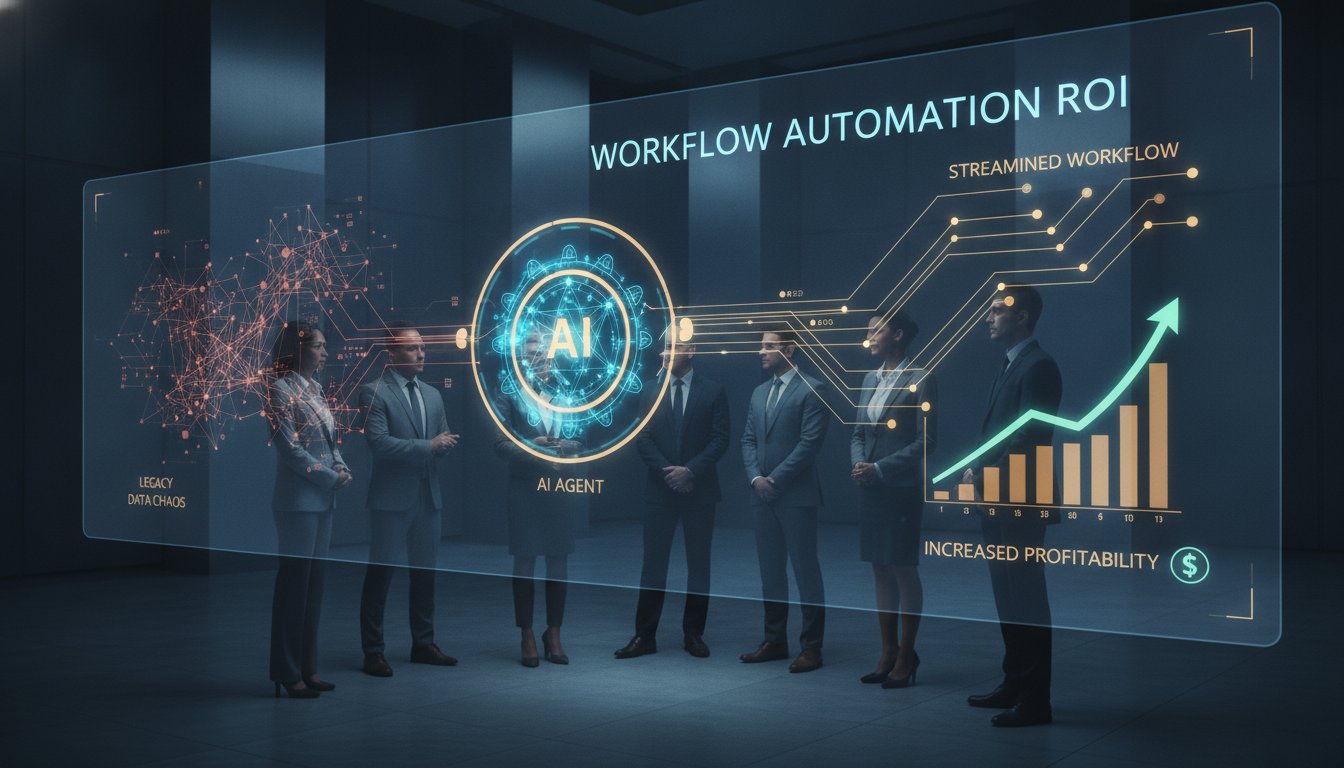
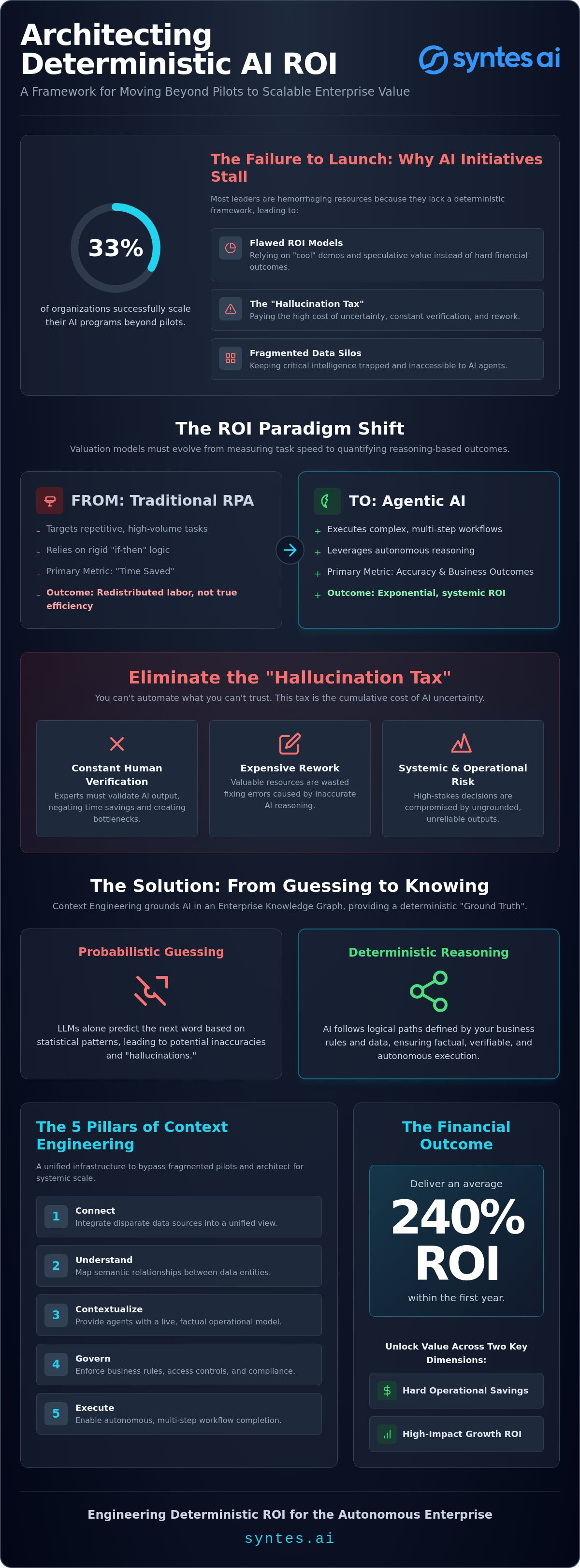
Only 33% of organizations have successfully scaled their AI programs beyond the pilot phase. This failure to launch occurs because most leaders lack a deterministic framework to measure ai workflow automation roi. They’re hemorrhaging resources on the “hallucination tax” and fragmented data silos that keep intelligence trapped in a vacuum. You recognize that “cool” experimental demos don’t satisfy a board of directors. You need hard financial outcomes and systemic integration.
We’ll provide the definitive framework required to calculate and maximize the financial return of enterprise-grade agentic intelligence. You’ll learn how to move past speculative pilots toward a system designed to deliver a 240% average ROI within the first year. We’ll analyze the necessary infrastructure for scalable automation and the precise strategy to eliminate operational inaccuracy. It’s time to stop observing the AI revolution and start architecting its performance. This is the roadmap to total operational clarity.
Executive Summary
- Redefine your valuation models. Transitioning from basic RPA to Agentic AI requires a fundamental shift from measuring simple task speed to quantifying reasoning-based ai workflow automation roi.
- Eliminate the hallucination tax. Grounding your agents in an Enterprise Knowledge Graph provides the deterministic “ground truth” necessary for autonomous execution without constant human verification.
- Analyze the four dimensions of value. Distinguish between hard operational savings and the high-impact growth ROI of capturing market opportunities that were previously inaccessible due to data fragmentation.
- Architect for systemic scale. Bypass the limitations of fragmented pilots by adopting a unified infrastructure centered on the five pillars of Context Engineering: Connect, Understand, Contextualize, Govern, and Execute.
Beyond Task Speed: Why Enterprise AI Workflow Automation ROI Requires a New Framework
For decades, Business Process Automation (BPA) focused on the mechanical. It targeted repetitive, high-volume tasks with rigid, “if-then” logic. Today, that paradigm is obsolete. We’ve moved beyond the limitations of Robotic Process Automation (RPA) into the era of agentic intelligence. This transition shifts the fundamental ai workflow automation roi calculation from simple task completion to autonomous reasoning. It’s no longer about how fast a bot can move data; it’s about how accurately an agent can interpret it.
Traditional metrics often rely on “time saved” as the primary value driver. This is a deceptive indicator. If an AI system generates output in seconds but demands hours of expert verification to ensure accuracy, you haven’t gained efficiency. You’ve merely redistributed labor. First-wave AI deployments often suffered from this fragmentation. They created impressive demos but failed at scale because they lacked the infrastructure to guarantee performance. In 2026, the mandate is clear. Enterprises must shift from passive observation to active, automated performance that requires zero-trust verification.
The Death of the “Chatbot” ROI Model
Consumer-grade interfaces don’t belong in the enterprise stack. They’re conversational toys. True financial returns come from agentic ai platforms that execute complex, multi-step workflows across disparate systems. We’re witnessing a shift from AI that suggests to AI that performs. This isn’t about having a better search bar. It’s about engineering an autonomous workforce that interacts with your proprietary data in real time. When agents can execute transactions and resolve logic gaps independently, the ai workflow automation roi moves from incremental to exponential.
Defining the “Hallucination Tax”
What is the real cost of uncertainty? Inaccurate reasoning destroys the business case for automation. We call this the “hallucination tax.” It’s the cumulative cost of human-in-the-loop verification, rework, and the systemic risk associated with ungrounded outputs. High-stakes enterprise environments require deterministic truth. Without a framework that connects AI to a live operational memory, your ROI remains a theoretical exercise. You can’t automate what you can’t trust. Eliminating this tax is the first step toward reclaiming the lost value of your AI investments.
The Context Gap: How Knowledge Graphs Eliminate the Hallucination Tax
Large Language Models (LLMs) are inherently probabilistic engines. They predict the next token based on statistical patterns rather than a factual understanding of your business logic. This fundamental limitation is the root cause of the hallucination tax. To achieve a sustainable ai workflow automation roi, enterprises must bridge the gap between general model intelligence and proprietary, real-time data. The solution is the implementation of a Context Graph. This isn’t a static database; it’s a live operational model that provides the definitive “ground truth” for AI agents. By grounding intelligence in facts, you transform AI from a suggestive assistant into an executive force.
Deterministic Reasoning vs. Probabilistic Guessing
Knowledge Graphs provide the structural integrity that LLMs lack by mapping semantic relationships between entities. Instead of guessing, the AI follows a logical path defined by your specific business rules and data hierarchies. This reduces error rates in complex decision-making processes. While prompt engineering attempts to guide a model’s behavior through better phrasing, Context Engineering builds a foundation for it to understand. Context Engineering is the definitive architectural shift that moves beyond the limitations of static RAG to provide agentic systems with a multi-dimensional, factual understanding of enterprise operations in 2026.
Unifying Disparate Data for Reliable Execution
The primary barrier to automation is often the data itself. Utilizing enterprise knowledge graphs is the only viable path for solving enterprise data silos that currently paralyze AI utility. These graphs act as a central nervous system, connecting structured ERP data with unstructured document intelligence. This connectivity directly impacts your ai workflow automation roi by eliminating the need for manual data reconciliation. Two-way connectors ensure that this operational memory stays “live,” updating the graph as transactions occur across your stack.
When your AI agents possess a live operational memory, they stop being observers and start being performers. You’re no longer asking an AI to find information; you’re enabling it to know it. This transition from static retrieval to dynamic understanding is what separates a failed pilot project from a systemic enterprise success. If you’re ready to see how this architecture functions in a live environment, you can examine our platform's integration capabilities. The era of probabilistic guessing is over. The era of deterministic execution has arrived.
Measuring the 4 Dimensions of Agentic Automation Value
Measuring value is not a headcount exercise. It’s a multidimensional analysis of how agentic intelligence reconfigures the very cost structure of your organization. To accurately quantify ai workflow automation roi, leaders must look beyond the immediate horizon of labor replacement. We categorize the impact into four distinct dimensions of value. Each dimension serves a specific strategic purpose. Together, they form a comprehensive framework for justifying enterprise-scale investment.
- Dimension 1: Direct Operational Savings (The “Hard” ROI) focuses on the immediate reduction of cost-per-transaction and the elimination of manual rework.
- Dimension 2: Opportunity Capture (The “Growth” ROI) measures the revenue generated by executing at speeds and volumes that were previously impossible for human teams.
- Dimension 3: Risk Mitigation and Governance (The “Insurance” ROI) quantifies the avoidance of regulatory fines, data breaches, and operational errors through deterministic execution.
- Dimension 4: Compounding Knowledge Value (The “Strategic” ROI) captures the long-term utility of a live operational memory that becomes more valuable as it integrates more data points.
Hard ROI: Beyond FTE Reduction
Hard savings are the easiest to defend but the most frequently underestimated. Research indicates that process automation can deliver an average ROI of 240% within the first year. This isn’t just about reducing staff. It’s about achieving a 30-70% reduction in cost-per-transaction while maintaining 24/7 autonomous execution. When agents operate across systems without fatigue, cycle times drop by an average of 40%. For example, automating communication through nexdial.com allows businesses to scale outreach without increasing overhead. The financial impact of this speed is undeniable. You’re not just doing things faster; you’re doing them with a level of precision that eliminates the expensive cycle of error and correction.
| ROI Driver | Consumer-Grade RAG | Syntes Agentic Platform |
|---|---|---|
| Transaction Cost | High (Manual Verification Required) | Low (Autonomous Execution) |
| Scale Potential | Limited (Pilot Purgatory) | Enterprise-Wide (Systemic) |
| Time-to-Value | Slow (Context Building per Prompt) | Immediate (Live Operational Memory) |
Soft ROI: The Strategic Advantage of Enterprise Intelligence
The most profound impact of agentic intelligence is often found in decision velocity. Implementing a semantic data layer creates a foundation for “Explainable AI.” This is critical in regulated industries where “black box” decisions are a liability. By moving from reactive IT support to a proactive operational memory, your ai workflow automation roi includes the value of executive clarity. You’re no longer waiting for quarterly reports to identify bottlenecks. The system identifies them in real time and, in many cases, resolves them before they reach a human dashboard. This shift from observation to performance is the ultimate strategic advantage.
Architecting for Scale: Moving from Fragmented Pilots to Systemic ROI
Pilot Purgatory is the final destination for 67% of AI initiatives. It is the inevitable result of fragmented thinking and a lack of unified enterprise ai infrastructure. Most organizations start with isolated use cases that solve a single problem but create three new data silos. This approach fails to deliver a compounding ai workflow automation roi because it lacks a scalable foundation. Systemic value requires a shift from “cool” experiments to a robust architecture that treats intelligence as a shared utility across the entire enterprise.
To move beyond these limitations, we utilize the Syntes Context Engineering Framework. This methodology is built on five critical pillars designed to move data from passive storage to active execution:
- Connect: Establish real-time links between disparate data sources and systems.
- Understand: Map the semantic relationships within your data to create meaning.
- Contextualize: Apply business logic and situational awareness to every interaction.
- Govern: Implement deterministic controls to ensure security and compliance.
- Execute: Empower agents to perform multi-step actions across your technical stack.
This framework builds a Live Operational Memory. Unlike static databases, this memory grows more valuable with every integrated system. It creates a flywheel effect where each new automation project benefits from the context established by the last.
The Governance-ROI Paradox
Governance is not a bottleneck. It is a prerequisite for scale. Many leaders fear that strict oversight will slow down innovation, but the opposite is true. Without a framework for preventing ai hallucination, your agents are too risky to deploy in high-stakes environments. We implement GraphRAG to ensure auditable AI reasoning, allowing you to trace every decision back to a factual source. For high-value exceptions, Human-in-the-Loop systems provide a safety net that maintains trust without sacrificing the speed of autonomous execution. This deterministic approach is the only way to safeguard your ai workflow automation roi against the costs of unpredictable model behavior.
Cross-System Integration as an ROI Multiplier
The true power of agentic intelligence is realized when agents operate across your CRM, ERP, and legacy stacks. Read-only AI provides insights, but read-write agentic systems provide outcomes. When an agent can identify a supply chain bottleneck in your ERP and automatically update customer records in your CRM, the value is immediate and measurable. You are no longer managing a collection of tools. You are overseeing a unified enterprise intelligence layer that scales across departments. If you are ready to transition from fragmented pilots to a systemic ROI model, schedule a strategic architecture review with our team today.
The Syntes Agentic Platform: Engineering Deterministic ROI
Speculative experimentation has reached its limit. Industrial-grade execution requires more than just a large language model; it requires a foundational architecture built for precision. The Syntes Agentic Platform is that foundation. It resolves the systemic flaws of first-wave generative AI by transforming fragmented data into trusted operational intelligence. While general-purpose models guess, our platform calculates. This architectural shift is the only way to secure a definitive ai workflow automation roi in a market that no longer tolerates unreliable pilots. We don’t just bridge the gap between data and action. We eliminate it.
At the core of this evolution is the Context Graph. It serves as a continuously evolving memory for the modern enterprise, ensuring that every agent operates with total situational awareness. Unlike document-based retrieval systems that lose nuance, the Context Graph maintains the semantic integrity of your entire operational landscape. This allows governed AI agents to execute complex business rules with explainable reasoning. You can audit every decision. You can verify every outcome. This level of transparency is mandatory for organizations moving toward a state of total operational clarity.
From Passive Data to Active Intelligence
We turn “black box” AI into an auditable business asset. By utilizing our platform, you move away from the unpredictability of probabilistic models toward a deterministic execution engine. Our no-code AI apps allow for rapid deployment, enabling teams to realize ai workflow automation roi in weeks rather than quarters. The Syntes Context Graph acts as the central nervous system of enterprise automation, coordinating activities across disparate systems with surgical precision. It’s a shift from observing data to performing with it, a principle that Nodal Marketing applies to maximize digital performance through advanced data science.
Future-Proofing Your AI Investment
The economy of 2027-2030 will be defined by agentic performance, not just information retrieval. Relying on document-based retrieval is a tactical error in a relationship-based world. We champion Operational Relationship Intelligence, a model that understands the intricate connections between your customers, products, and processes. This approach ensures your AI infrastructure is not just current but resilient. It prepares your organization for a future where autonomous agents handle the bulk of operational complexity. If you’re ready to move beyond the limitations of first-wave AI, Experience the Syntes Agentic Platform and architect your deterministic future today.
Transcending Pilot Purgatory: The Era of Deterministic Execution
The transition from passive observation to active, automated performance is no longer a strategic option; it is an operational necessity. You’ve seen that sustainable ai workflow automation roi isn’t found in isolated task speed, but in the systemic unification of knowledge through Context Engineering. By bridging the context gap with a Live Operational Memory, you eliminate the hallucination tax and transform AI from a suggestive assistant into an executive workforce. This is the definitive shift from probabilistic guessing to deterministic results.
The path forward requires more than just better prompts. It demands enterprise-grade AI Governance and an infrastructure built for scale. As a pioneer in Context Engineering, we provide the tools to turn fragmented data into auditable business outcomes. It’s time to stop experimenting and start performing. Your journey toward total operational clarity begins with a single, definitive architectural shift. We’re ready to help you engineer that transition.
Architect Your Deterministic ROI with Syntes AI
Frequently Asked Questions
How do you calculate ROI for AI workflow automation in 2026?
ROI is calculated by aggregating direct operational savings, revenue from opportunity capture, and the value of risk mitigation, then subtracting the total cost of ownership (TCO). This TCO must include infrastructure, data preparation, and ongoing governance. To master your ai workflow automation roi, you must move beyond simple labor replacement and quantify the value of achieving 24/7 autonomous execution with zero error rates.
What is the “Hallucination Tax” and how does it affect AI ROI?
The “Hallucination Tax” represents the hidden operational costs of verifying, correcting, and auditing unreliable AI outputs. It’s the primary drain on ai workflow automation roi because it forces high-cost human experts to act as babysitters for probabilistic models. Eliminating this tax requires a deterministic architecture that grounds every agentic action in a verified Context Graph, ensuring that intelligence remains factually accurate.
Why do most enterprise AI pilots fail to reach full ROI?
Most pilots fail because they’re architected as isolated experiments rather than systemic infrastructure. Only 33% of organizations successfully scale AI beyond the pilot stage because they lack the unified data layer needed to support organization-wide intelligence. Without a live operational memory, these projects become fragmented silos that cannot deliver the compounding financial value required to justify long-term enterprise investment.
How does a Knowledge Graph improve the business case for AI agents?
A Knowledge Graph transforms the business case by providing a definitive “ground truth” that enables autonomous reasoning. It bridges the gap between general model knowledge and your proprietary business logic. By mapping semantic relationships, it ensures that AI agents understand the specific context of your operations. This is the only way to achieve reliable, high-stakes automation that meets enterprise standards.
Can Agentic AI work with our existing legacy ERP systems?
Yes, agentic intelligence is specifically designed to bridge the gap between modern AI and legacy ERP systems through cross-system integrations. Unlike simple chatbots, our platform uses two-way connectors to read from and write to legacy stacks. This allows agents to execute complex, multi-step workflows that synchronize data across your entire enterprise environment without requiring a complete system overhaul or expensive data migration.
What is the difference between RAG and Context Engineering for ROI?
RAG is a static retrieval method that provides a model with relevant documents, while Context Engineering creates a dynamic, live operational memory. Context Engineering is the evolution necessary for 2026 because it moves beyond simple text matching to provide a multi-dimensional understanding of business entities. This shift is critical for ROI because it enables deterministic execution rather than probabilistic guessing, reducing the cost of manual oversight.
How long does it take to see a return on investment with Syntes AI?
While typical payback periods for AI automation investments average 6 to 9 months, our platform is designed for more rapid deployment through no-code AI apps. Many organizations report significant returns within the first year by targeting high-impact, easily measurable workflows first. The key to fast ROI is starting with a deterministic framework that avoids the lengthy verification cycles associated with ungrounded, first-wave AI models.
Is AI workflow automation safe for highly regulated industries like finance or healthcare?
AI workflow automation is safe for regulated industries when it’s built on a foundation of “Explainable AI” and deterministic governance. By utilizing GraphRAG and strict operational controls, enterprises can audit every decision an agent makes. This level of transparency ensures compliance with finance and healthcare regulations while allowing for the speed and efficiency of autonomous performance. You maintain total control over the execution logic.






Unlock the Power of Agentic AI
Automate, optimize, and scale with autonomous AI agents built on your industry and company-specific knowledge graph.
