
Your current automation architecture is likely a house of cards built on brittle scripts and unpredictable chat models. While the promise of ai agent workflow automation is immense, most enterprises remain trapped in a cycle of probabilistic hallucinations and constant manual oversight. You recognize that RPA cannot handle the dynamic complexity of modern business logic, yet you cannot risk autonomous agents interacting blindly with your legacy ERPs or critical data silos. It is time to stop experimenting and start executing.
This guide provides the blueprint for moving beyond the chat interface to achieve deterministic enterprise action. You’ll learn how to architect reliable, cross-system workflows using the Syntes Agentic Platform and a robust Enterprise Knowledge Graph to ensure every agentic decision is grounded in a single source of truth. We will examine the transition from rule-based bots to a scalable silicon workforce that delivers high-volume performance with zero-trust security. We are moving from passive observation to active, automated intelligence that actually works. The transition is not just possible; it is a strategic necessity for the modern enterprise.
Key Takeaways
- Stop relying on brittle scripts. Learn how ai agent workflow automation replaces static RPA with dynamic, goal-oriented systems that perceive and reason.
- Ground your agents in reality. Discover why an Enterprise Knowledge Graph is the essential memory required to move from probabilistic chat to deterministic execution.
- Evaluate your stack effectively. We’ll analyze the strategic difference between thin orchestration tools and comprehensive agentic platforms designed for scale.
- Eliminate the risk of hallucination. Learn to implement Deterministic Execution Layers that ensure your autonomous agents act only on verified, high-integrity data.
- Bridge the execution gap. See how the Syntes Agentic Platform integrates cross-system data to turn passive insights into active, enterprise-wide performance.
Beyond RPA: Defining AI Agent Workflow Automation in 2026
The era of rigid, linear automation is dead. For a decade, Business process automation (BPA) relied on the “if-this-then-that” logic of Robotic Process Automation (RPA). It was effective for predictable, high-volume tasks, yet it shattered the moment it encountered a variable it hadn’t been programmed to see. By 2026, the market has pivoted. We’ve moved into the age of ai agent workflow automation, where systems no longer just follow instructions; they perceive, reason, and act within complex enterprise environments.
The Evolution from Scripted to Autonomous
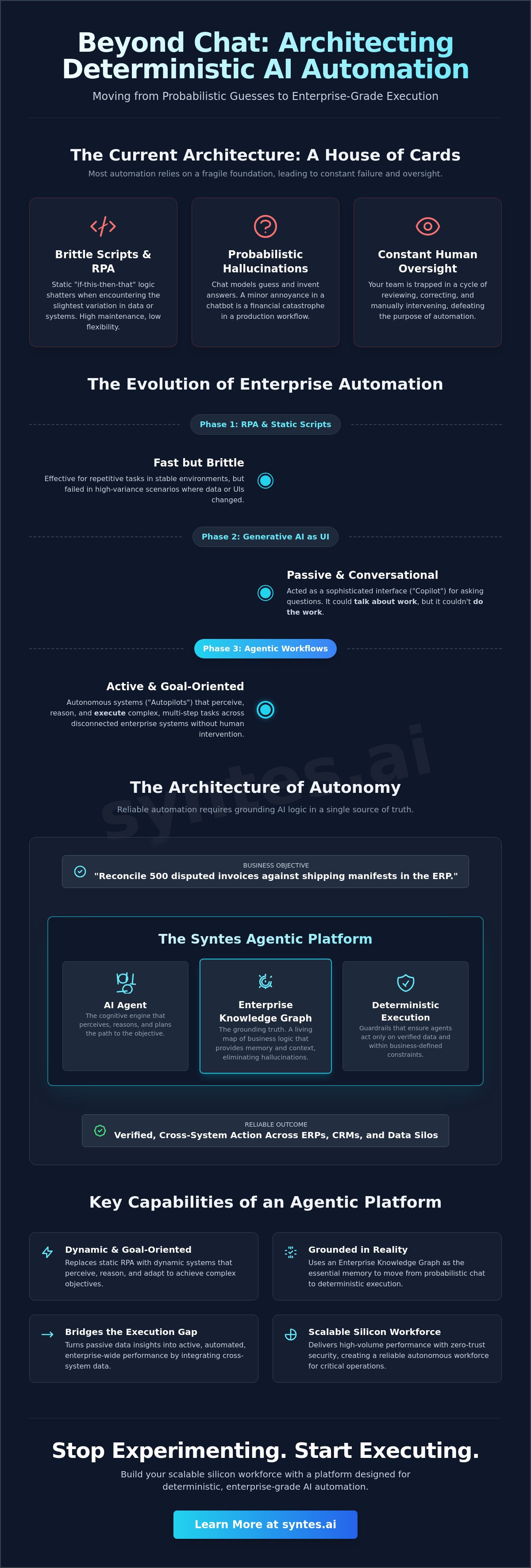
Enterprise automation has matured through three distinct phases. Phase 1 was defined by RPA and static scripts. These tools were fast but brittle, failing in high-variance environments where data formats changed or systems updated. Phase 2 introduced Generative AI as a conversational layer. It acted as a sophisticated UI for data, allowing users to ask questions, but it remained passive. It could talk about work, but it couldn’t do the work. We’ve now entered Phase 3: Agentic Workflows. These systems possess the agency to execute multi-step processes across disconnected silos without constant human hand-holding.
Why Enterprise Context Changes the Automation Stakes
The stakes of automation shift dramatically when you move from a chat window to a production environment. A hallucinated response in a consumer chatbot is a minor annoyance. A hallucinated business action in a procurement workflow is a financial catastrophe. Consumer-grade AI tools lack the guardrails to handle these risks, often failing when solving enterprise data silos becomes the primary obstacle. High-level execution requires more than just a large language model; it requires a platform that bridges the gap between raw reasoning and legacy system execution. Without a deterministic foundation, autonomy is simply a liability. You need a system that treats enterprise context as a prerequisite for action, ensuring that every autonomous step is grounded in verified operational truth.
The Architecture of Autonomy: Why Logic Needs Ground Truth
Logic is a liability without truth. If your automation strategy relies solely on a Large Language Model (LLM) to “figure it out,” you aren’t building a system; you’re gambling with your operations. For ai agent workflow automation to achieve enterprise-grade reliability, the agent’s reasoning must be tethered to a deterministic ground truth. Reasoning without memory is merely a sophisticated guess. In the high-stakes environment of global commerce, a “guess” leads to broken supply chains and corrupted financial records. You don’t need more AI; you need better grounding.
The solution lies in the enterprise knowledge graph. This isn’t just another database. It is a living map of your business logic, entities, and relationships. While an LLM provides the cognitive engine, the Knowledge Graph provides the rails. It transforms probabilistic AI outputs into deterministic business actions by ensuring the agent understands the context of every data point it touches. The Semantic Layer acts as the definitive interface, translating the enterprise’s complex data reality into a language the agent can act upon with absolute certainty.
The Deterministic Foundation: Knowledge Graphs
A knowledge graph does not just store data points; it maps relationships. It understands that “Customer A” is linked to “Invoice 502,” which is currently flagged for a “Shipping Delay.” By providing this structured World Model, you eliminate the ambiguity that triggers hallucinations. Semantic grounding ensures AI agents operate within business-defined constraints, effectively acting as an automated compliance officer for every step of the workflow. If you’re looking to stabilize your autonomous architecture, the Syntes Agentic Platform provides the necessary integration for this semantic foundation.
Grounding LLMs in Reality
Standard Retrieval-Augmented Generation (RAG) is insufficient for complex workflows. It retrieves fragments but lacks the connective tissue required for multi-step reasoning. To move forward, enterprises must adopt Graph-RAG. This approach allows agents to understand the deep business logic embedded in the semantic data layer for enterprise. Static databases are dead weight for agents that must cross-reference real-time ERP and CRM data. Your agents need to know not just what the data is, but what it means in the context of a live, moving operation. Operational intelligence is the result of connectivity and context working in unison.
Strategic Evaluation: Orchestration Tools vs. Agentic Platforms
Orchestration is not execution. While thin orchestration layers like Zapier or n8n have long served as the connective tissue for simple API triggers, they lack the cognitive depth required for ai agent workflow automation at scale. These tools operate on a linear “if-this-then-that” logic. They are reactive by design. An enterprise-grade agentic platform, such as Syntes AI, functions differently. It is proactive. It moves from trigger-based automation to goal-based behavior, where the system is given an objective rather than a script. This distinction is the difference between a tool that follows orders and a platform that solves problems.
The “build vs. buy” dilemma has shifted. In previous cycles, enterprises might have attempted to stitch together disparate tools to create a custom solution. In 2026, the complexity of enterprise ai infrastructure makes this approach a strategic liability. You don’t just need a workflow builder; you need a comprehensive environment that handles security, governance, and auditability by default. A “thick” agentic platform provides the necessary infrastructure to manage long-running, autonomous processes that simple orchestration nodes cannot sustain. It ensures that your automation isn’t just a series of disconnected tasks, but a unified system of operational intelligence.
Cross-System AI Integration: The Real Bottleneck
Agents fail when they encounter “walled garden” software or legacy on-premise systems that don’t speak modern API languages. Most tools only allow agents to read data. This is insufficient. True ai agent workflow automation requires deep, bi-directional integration that empowers agents to write back to the system of record. Syntes AI enables agents to navigate these disparate stacks without requiring custom code for every individual node. This capability removes the technical friction that typically stalls autonomous initiatives, allowing for seamless execution across ERPs, CRMs, and custom legacy databases alike.
Managing Agentic Identity and Governance
Accountability is the cornerstone of enterprise execution. When an agent takes an action, there must be a clear digital identity associated with that decision. You cannot have “ghost” agents acting within your systems. Governance frameworks must shift from rigid rules to flexible guardrails that allow for autonomy while ensuring compliance. The “Black Box” problem in automation is solved through comprehensive audit logs that record not just the outcome, but the reasoning path the agent took. This level of transparency is non-negotiable for high-stakes enterprise environments where every autonomous action must be defensible and reversible.
Implementation at Scale: Overcoming the Execution Gap
The primary barrier to enterprise-wide ai agent workflow automation is not a lack of ambition; it is a lack of trust. Decision-makers often resist full-scale deployment because they view AI as fundamentally unpredictable. This skepticism is justified if you are relying on raw LLM outputs. To move from experimentation to execution, you must implement Deterministic Execution Layers. These layers act as a firewall between the agent’s probabilistic reasoning and your production environment. They ensure that every action is validated against hard business rules before a single byte of data is changed.
Reliability is engineered, not inherited. You can learn how to prevent ai hallucination by utilizing your Knowledge Graph as a real-time verification engine. Instead of letting an agent guess a customer’s credit limit, the system forces a lookup against the semantic truth. If the data doesn’t align, the execution halts. This process is further strengthened by a strategic Human-in-the-Loop (HITL) model. Oversight shouldn’t be a manual bottleneck. It should be a high-level exception handling mechanism where humans validate only the most complex edge cases, allowing the agentic swarm to handle high-volume, high-ROI tasks like supply chain orchestration and complex claims processing without friction.
Architecting for Reliability and Truth
Scaling requires a closed verification loop. The agent proposes an action, the Knowledge Graph validates that action against corporate policy, and only then does execution occur. When an agent encounters an unknown variable, it must be programmed to escalate rather than improvise. This systemic restraint is what separates professional tools from toys. We are witnessing a definitive shift from probabilistic reasoning to deterministic business execution where the margin for error is effectively engineered to zero. If you are ready to bridge this gap, you should explore the Syntes Agentic Platform to see these guardrails in action.
Scaling Beyond the Pilot Phase
Success in a sandbox does not guarantee success in production. As you move from a single research agent to a multi-agent swarm, you will encounter “Agent Conflict.” This occurs when two autonomous systems have overlapping goals or competing resource requirements. Managing this requires a centralized orchestration layer that prioritizes objectives based on real-time business value. Furthermore, your performance monitoring must evolve. Stop measuring “Task Speed” and start measuring “Goal Completion.” In an autonomous enterprise, the only metric that matters is whether the system successfully resolved the business objective without human intervention.
The Syntes Agentic Platform: Unifying Data and Action
The Syntes Agentic Platform is the definitive bridge between fragmented enterprise data silos and autonomous execution. While most solutions focus on the superficial “chat” interface, we prioritize the underlying architecture of performance. True ai agent workflow automation requires more than a large language model; it requires a unified execution layer that understands the deep business logic of your organization. By integrating our Enterprise Knowledge Graph directly into the agentic framework, we ensure that every action is grounded in verified, real-time context. This is the transition from passive observation to active operational intelligence.
Connectivity is the prerequisite for autonomy. Our platform provides the cross-system capability necessary to execute complex workflows across SAP, Salesforce, and custom legacy databases seamlessly. We don’t just read data. We empower agents to orchestrate multi-step processes that write back to the system of record with absolute precision. This eliminates the manual hand-offs that traditionally slow down high-volume operations. You aren’t just automating tasks; you are deploying a silicon workforce capable of navigating the most complex enterprise stacks with certainty.
Why Syntes AI is the Strategic Choice for 2026
The market has moved past experimental pilots. In 2026, the strategic priority is avoiding “automation debt,” which is the accumulation of brittle, low-code scripts that break under the slightest system change. Syntes AI provides a pre-integrated semantic foundation that scales without the need for constant maintenance. Our architecture is built with enterprise-grade security and zero-trust governance at its core. This ensures that autonomous execution never compromises systemic integrity. We provide the stability required for long-term operational success in a volatile global market.
Next Steps for the Agentic Enterprise
The journey toward total operational clarity begins with a strategic assessment of your current data mesh. You must evaluate your readiness for autonomous execution by identifying the silos that currently prevent your agents from accessing a single source of truth. The roadmap from data unification to autonomous workflow execution is methodical and purposeful. It requires a partner who understands the messy realities of global operations and possesses the sophisticated tools to bring order to them. To begin this transition, request a briefing on the Syntes Agentic Platform today.
The Mandate for Autonomous Execution
The transition from rigid scripts to goal-oriented autonomy is no longer a theoretical exercise. It is a competitive imperative. You’ve seen how ai agent workflow automation demands more than just a reasoning engine; it requires a deterministic foundation that anchors every autonomous action in enterprise truth. By unifying your data mesh through a Knowledge Graph and implementing cross-system connectivity, you move beyond the limitations of brittle RPA into a state of total operational clarity.
Scale your operational intelligence with the Syntes Agentic Platform and leverage a deterministic execution framework designed for the high-stakes reality of the global enterprise. With our enterprise-grade Knowledge Graph integration and robust cross-system legacy connectivity, you can finally bridge the execution gap. The future of the autonomous enterprise is here. Build it with certainty.
Frequently Asked Questions
What is the difference between AI agent workflow automation and RPA?
RPA is a digital mimic that executes predefined, linear scripts; ai agent workflow automation is a cognitive system that pursues objectives. While RPA fails when a UI element shifts or a data format changes, agents perceive the environment and adjust their path dynamically. We are moving from rigid “if-this-then-that” scripts to goal-based execution that handles high-variance business logic.
How do AI agents handle data silos in large enterprises?
Agents dissolve silos by utilizing an Enterprise Knowledge Graph to create a unified semantic map of the organization. This architecture allows autonomous systems to cross-reference data from legacy ERPs and modern CRMs simultaneously without requiring a massive data migration. Instead of moving data into a single lake, you provide the agent with the “operational intelligence” to navigate the existing landscape.
Can AI agents really be trusted to take autonomous actions in an ERP?
Trust is established through deterministic execution layers that act as a firewall for your system of record. An agent should never write to an ERP based on a probabilistic guess. By enforcing policy-based validation, you ensure that every autonomous step is verified against hard business rules before any data is committed, effectively eliminating the risk of unvetted system changes.
What role does a Knowledge Graph play in AI agent automation?
The Knowledge Graph serves as the agent’s deterministic memory and world model. It defines the relationships between entities, such as customers, invoices, and shipping manifests, providing the context necessary for reasoning. Without this grounding, an agent is merely a reasoning engine without a map; it will inevitably fail when navigating complex, multi-system environments.
How do you prevent AI hallucinations in automated workflows?
You prevent hallucinations by implementing semantic grounding as a mandatory prerequisite for action. Before an agent executes a workflow step, the system forces a lookup against the Enterprise Knowledge Graph to verify the factual basis of its plan. If the agent’s reasoning path contradicts the established truth, the action is halted or escalated for human review immediately.
Is it better to build or buy an agentic AI platform?
Enterprises should buy the agentic platform to secure the underlying infrastructure and then build specialized agents for their unique business logic. Developing core connectivity, security, and governance layers in-house creates massive technical debt. A platform like Syntes AI provides the mature execution layer, allowing your internal teams to focus on domain-specific automation rather than plumbing.
How do you measure the ROI of agentic workflow automation?
ROI is measured by the reduction in manual oversight and the acceleration of complex deployment cycles. Businesses using agentic AI for development report up to 70% faster cycles on complex projects. You must shift your focus from simple task speed to total goal completion rates and the resulting gains in systemic operational efficiency.
What are the security requirements for deploying autonomous agents?
Security requires a zero-trust framework and a distinct digital identity for every autonomous agent. You must maintain immutable audit logs that record the reasoning path behind every decision to ensure accountability. This transparency ensures that autonomous actions are defensible, reversible, and compliant with global regulations, such as the transparency obligations under the EU AI Act.