

Why are your enterprise agents still waiting for permission to be useful? Most organizations have spent the last year building sophisticated search engines disguised as assistants, yet these systems remain paralyzed when tasked with real-world execution. The hard truth is that basic chatbots cannot drive revenue or optimize supply chains. To achieve true agentic ai for enterprise automation, you must move beyond the limitations of passive retrieval and address the systemic flaws of data silos and ungoverned hallucinations.
You recognize the frustration of AI that sounds confident but lacks the context to act reliably. It’s a common bottleneck that prevents innovation from reaching production. This article provides the definitive blueprint for architecting an autonomous organization grounded in a live Enterprise Knowledge Graph. You’ll discover how to transform fragmented data into a unified Context Graph that powers trusted, explainable execution. We’ll break down the critical shift from passive RAG to active agentic workflows; ensuring your AI moves from observation to measurable operational autonomy by 2026.
Key Takeaways
- Identify the strategic drivers that make 2026 the definitive year for transitioning from experimental AI pilots to total operational autonomy.
- Recognize why vector-only RAG fails in complex environments and how an Enterprise Knowledge Graph serves as the essential “Live Operational Memory.”
- Master the shift from rigid RPA workflows to dynamic reasoning by deploying agentic ai for enterprise automation that orchestrates across disparate systems.
- Adopt the Context Engineering Framework to replace fragile prompt engineering with a governed, five-step process for reliable AI execution.
- Build a foundation for trusted automation by leveraging a Context Graph to bridge the gap between large language models and proprietary business data.
Defining Agentic AI for the Modern Enterprise
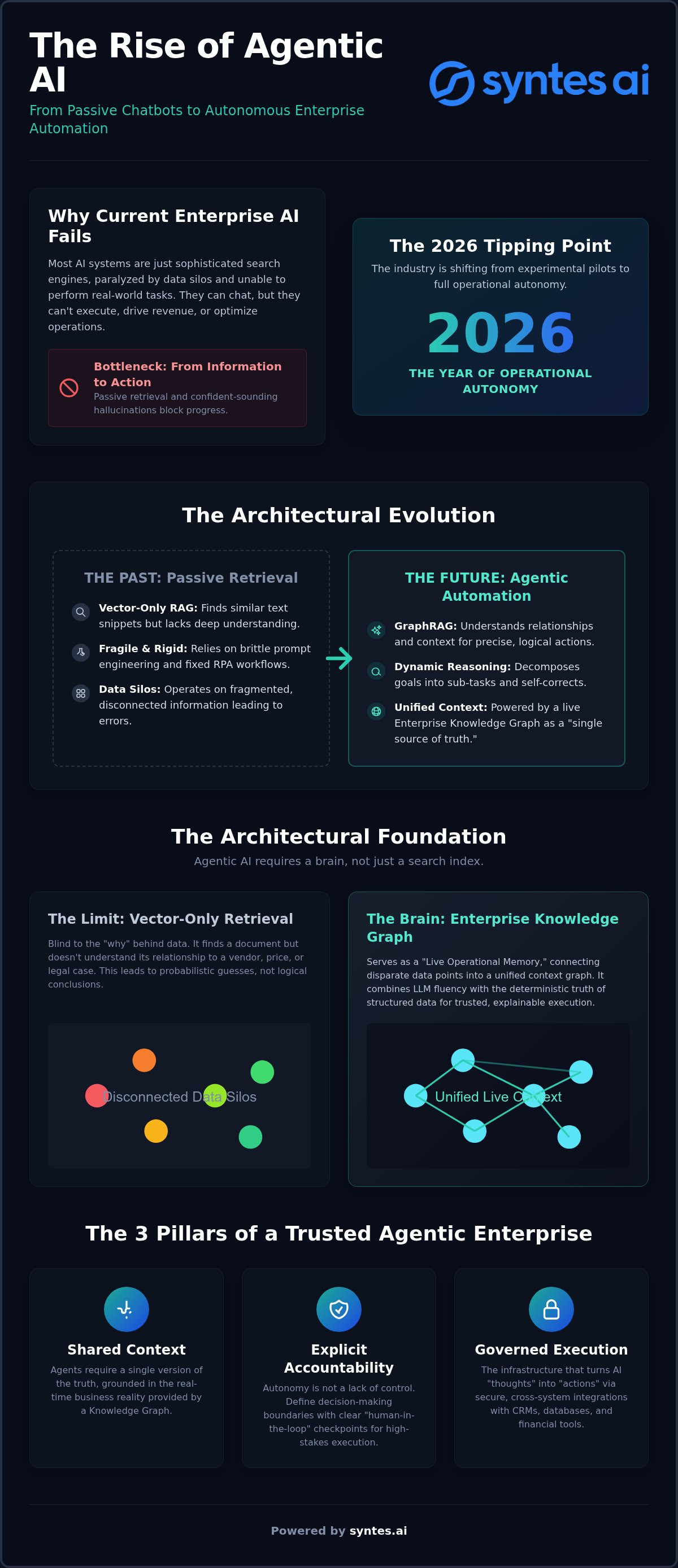
The fascination with generative chatbots has reached its expiration date. While the first wave of enterprise AI focused on summarizing text and generating emails, the second wave demands execution. By 2026, the industry will pivot from experimental pilots to full operational autonomy. This shift isn’t merely a software upgrade; it’s a fundamental architectural re-engineering. CIOs are now prioritizing agentic frameworks over simple LLMs because the trillion-dollar opportunity lies in action, not just conversation.
Enterprise-grade agents distinguish themselves through three core capabilities: reasoning, tool-use, and self-correction. Unlike a standard model that predicts the next word, an agent predicts the next step. It evaluates its own output, identifies logical gaps, and iterates until the objective is met. Achieving agentic ai for enterprise automation requires a departure from the fragile, prompt-based architectures of the past. It demands a system that understands the gravity of business logic and the necessity of precision.
Beyond Chatbots: The Shift to Autonomous Reasoning
Conversational AI is passive. It waits for a prompt and provides a response based on probabilistic patterns. In contrast, task-oriented agentic systems are proactive. They possess the ability to decompose a high-level business goal into a sequence of actionable sub-tasks. If an agent is told to “optimize the Q3 supply chain,” it doesn’t just write a report. It queries the ERP, analyzes vendor performance, and prepares purchase orders for approval. Agentic AI is a system capable of perceiving, reasoning, and acting independently within governed guardrails.
The Three Pillars of the Agentic Enterprise
To move from theory to production, an autonomous organization must rest on three non-negotiable pillars. These pillars ensure that agentic ai for enterprise automation remains a strategic asset rather than a liability.
- Shared Context: Agents cannot operate in a vacuum. They require a single version of the truth, often provided by an Enterprise Knowledge Graph, to ensure every action is grounded in real-time business reality.
- Explicit Accountability: Autonomy does not mean a lack of control. Organizations must define the exact boundaries of an agent’s decision-making authority, establishing clear “human-in-the-loop” checkpoints for high-stakes execution.
- Governed Execution: This is the infrastructure that turns AI “thoughts” into “actions.” It involves secure cross-system integrations that allow agents to interact with CRMs, databases, and financial tools without compromising security protocols.
Without these pillars, agents remain toys. With them, they become the primary drivers of operational intelligence, capable of managing complex workflows with minimal human intervention.
The Architectural Foundation: Why Knowledge Graphs are the ‘Brain’ of Agentic AI
Vector-only retrieval augmented generation (RAG) is reaching its limit. While it excels at finding similar text snippets, it fails to understand the hierarchical and relational complexities of a global business. Scalable agentic ai for enterprise automation requires more than a simple search engine; it requires a brain. An enterprise knowledge graph serves as this essential cognitive foundation, providing the Live Operational Memory that agents need to act with certainty.
Without a graph, agents are blind to the “why” behind your data. They might find a contract, but they won’t understand its relationship to a specific vendor, a fluctuating price index, or a pending litigation. GraphRAG bridges this gap. It combines the linguistic fluency of LLMs with the deterministic, structured truth of a graph. This ensures that every autonomous action is based on logic, not just probability. It is the difference between an AI that guesses and an AI that knows.
From Static Data to Live Operational Context
Data silos are the enemy of autonomy. When an agent relies on fragmented information, it makes fragmented decisions. A live semantic data layer for enterprise unifies these disparate sources in real-time. It connects structured ERP records with unstructured policy documents, creating a single, coherent environment for reasoning. This connectivity is vital for real-time relevance. If your inventory levels shift in the ERP, your procurement agent must know instantly. It shouldn’t wait for a periodic re-indexing. By maintaining a live context graph, you ensure your agents are always operating on the most current version of reality.
Solving the Hallucination Problem via Semantic Grounding
Hallucinations are not a quirk of AI; they are a symptom of missing context. Knowledge graphs provide a ground truth that LLMs cannot ignore. By forcing agents to validate their reasoning against established business rules, you eliminate the guesswork that plagues standard deployments. We call this “Operational Relationship Intelligence.” It’s the ability for a system to understand how different entities across your business interact. This intelligence allows agentic ai for enterprise automation to perform with high reliability.
This grounding enables agents to perform several critical functions:
- Enforce Compliance: Check actions against regulatory graphs before execution.
- Detect Anomalies: Identify deviations from historical relationship patterns in real-time.
- Optimize Workflows: Understand the downstream impact of a single decision across the entire supply chain.
Building this foundation is the first step toward a resilient autonomous strategy. To see how these systems integrate with your existing architecture, you can explore our agentic platform solutions to learn more about semantic grounding.
Agentic AI vs. Traditional Automation: A Strategic Comparison
Legacy automation is a prison of its own making. For a decade, Robotic Process Automation (RPA) promised to liberate the enterprise from mundane tasks, yet it created a new form of technical debt: brittle scripts that break at the slightest change in a user interface or data schema. While RPA is about “doing,” agentic ai for enterprise automation is about “deciding and doing.” This shift from rigid, if-this-then-that logic to dynamic reasoning allows organizations to automate processes that were previously considered too complex or variable for machines to handle.
The strategic value of agents lies in their ability to manage ambiguity. When a traditional bot encounters an unexpected data format, it fails. When an agent encounters the same obstacle, it reasons through the discrepancy, identifies a solution, and self-corrects. This resilience transforms the cost-to-value ratio of automation. While the initial complexity of an agentic framework is higher, the long-term ROI is significantly greater because maintenance costs plummet as the system adapts to environmental changes rather than requiring manual reprogramming.
RPA vs. Agentic Workflows: Deterministic vs. Probabilistic
RPA is deterministic. It requires a perfect map of every possible turn in a workflow. You should keep RPA for high-volume, low-variability tasks like batch payroll processing where the rules never change. However, you must deploy agents for multi-step processes with shifting variables, such as dynamic supply chain re-routing, personalized customer resolution, or an AI booking platform for entertainment industry. The most sophisticated organizations are adopting a “Hybrid Automation” model. In this setup, agents act as the orchestrators, managing a fleet of RPA bots to execute legacy system tasks while the agent handles the high-level decision-making and exception management.
From Retrieval to Action: The New AI Maturity Model
Understanding where your organization sits on the AI maturity curve is vital for resource allocation. Most enterprises are currently stuck in the first two stages, failing to realize the full potential of agentic ai for enterprise automation.
- Level 1: Chatbots (Information Retrieval). These systems provide answers based on pre-defined scripts or basic LLM patterns. They are conversational but cannot influence business systems.
- Level 2: RAG (Contextualized Retrieval). These systems use vector databases to find relevant documents, providing more accurate answers. They are informed but remain passive observers.
- Level 3: Agentic (Autonomous Execution). These systems move beyond retrieval to orchestration. They possess the authority to query databases, trigger API calls, and complete end-to-end business processes across disparate platforms without constant human intervention.
The transition to Level 3 is not just a technical upgrade; it is a strategic mandate for any organization aiming for total operational clarity by 2026.
Implementing Agentic Workflows: The Context Engineering Framework
Prompt engineering is a dead end. It relies on the hope that a large language model will behave predictably when fed a string of clever adjectives, a hope that inevitably collapses in the face of enterprise complexity. As we move toward 2026, the foundational discipline for agentic ai for enterprise automation is Context Engineering. This is the architectural successor to prompting. It’s a methodical process of building the semantic environment where agents can reason with deterministic accuracy rather than probabilistic guesswork.
To architect a system that actually works, you must follow a rigorous four step implementation path. First, you Connect by unifying disparate data sources into a single stream. Second, you Understand by discovering the entities and business semantics that define your operations. Third, you Govern by applying security and compliance rails to every autonomous action. Finally, you Execute by deploying agents that reason over this trusted, unified context. This framework ensures that your agents aren’t just guessing; they’re calculating based on reality.
Mastering the Five Pillars of Context Engineering
Successful execution requires more than just a list of steps. It requires a commitment to solving enterprise data silos before you even think about deployment. Reliable agentic ai for enterprise automation is impossible without a Context Graph that serves as the enterprise’s central nervous system. This graph provides the relational depth necessary for agents to understand the downstream consequences of their actions. Even in an autonomous environment, human-in-the-loop (HITL) checkpoints remain essential for high-stakes execution. They provide the final layer of strategic oversight for decisions that impact revenue or regulatory standing.
Security and Governance for Autonomous Systems
Autonomy without governance is a liability. You must manage agent permissions with the same rigor you apply to human employees. If an agent has the authority to execute a financial transaction, its reasoning path must be fully auditable and transparent. How to prevent AI hallucination is no longer a mystery; it’s a matter of architecting deterministic truth through governed memory. By forcing agents to validate every step against business rules, you ensure compliance with evolving AI regulations. This creates a permanent, explainable record of why every action was taken, providing the operational clarity that stakeholders demand.
Syntes AI: Orchestrating the Agentic Enterprise
Most enterprises possess the raw ingredients for autonomy but lack the specialized engine required to ignite it. The Syntes Agentic Platform bridges the critical gap between general-purpose large language models and the proprietary, high-stakes data that defines your competitive advantage. It functions as the orchestration layer, ensuring that agentic ai for enterprise automation isn’t just a theoretical experiment but a hardened operational reality. By grounding every model interaction in the Syntes Context Graph, we provide the deterministic truth necessary for agents to act on your behalf without constant human oversight.
This platform isn’t restricted to a single silo. It enables seamless cross-system integrations across your entire stack, including ERP, CRM, and bespoke cloud applications. This connectivity allows agents to move fluidly between systems, executing complex workflows that require data from multiple sources. Choosing the right enterprise ai infrastructure is the most consequential decision a CIO will make this decade. Syntes provides the foundation for that future, offering a scalable environment where intelligence is both trusted and governed.
The Syntes Advantage: Live Operational Memory
Static databases are insufficient for the speed of modern business. Syntes replaces these rigid structures with Live Operational Memory, a continuously evolving model of your enterprise. This technology enables “Explainable AI,” allowing human operators to audit the exact reasoning path an agent took before reaching a decision. It builds trust through transparency. Additionally, the platform accelerates time-to-value by offering no-code development tools. Business leaders can now deploy sophisticated agentic ai for enterprise automation without the traditional bottlenecks of custom software engineering.
Getting Started with Agentic Automation
Ready to build your agentic future? Book a demo with Syntes AI today.
Architecting the Autonomous Future
The era of experimental AI pilots is closing. By 2026, the distinction between market leaders and laggards will be defined by their ability to deploy agentic ai for enterprise automation that actually executes. Success requires moving beyond fragile prompt engineering to a robust Context Engineering framework grounded in deterministic truth. You’ve seen how an Enterprise Knowledge Graph provides the essential Live Operational Memory needed to transform fragmented data into actionable intelligence.
Syntes delivers the infrastructure for this evolution. Our Governed Agentic AI framework ensures that autonomy never comes at the cost of security or compliance. With enterprise-grade Explainable AI, every autonomous action is transparent, auditable, and perfectly aligned with your internal business logic. It’s time to stop observing and start orchestrating. You have the tools to bridge the gap between static data and active performance. Build a foundation that turns systemic complexity into total operational clarity.
The transition to a fully autonomous organization is a strategic mandate that begins with the right architectural choices. Your journey toward trusted, scalable automation starts today.
Frequently Asked Questions
What is the difference between agentic AI and traditional AI chatbots?
Traditional chatbots are passive information retrieval tools that rely on probabilistic patterns to generate text. In contrast, agentic AI is a proactive execution system. It doesn’t just answer questions; it decomposes complex business objectives into actionable sub-tasks. These agents use specialized tools and cross-system integrations to complete end-to-end workflows independently, moving beyond conversation toward total operational performance.
How does a knowledge graph prevent AI hallucinations in enterprise automation?
Knowledge graphs provide a deterministic ground truth that forces AI to validate its reasoning against factual business relationships. Standard LLMs often hallucinate because they lack a structural understanding of your specific data. By grounding agentic ai for enterprise automation in a live Context Graph, you ensure every decision is based on verified logic rather than statistical guesswork. This architectural layer makes hallucinations mathematically improbable within governed environments.
Can agentic AI agents really be trusted to perform financial or legal tasks?
Trust is an architectural requirement, not a secondary consideration. Agents can perform high-stakes tasks when they are contained within a governed AI framework that enforces strict permissioning. By utilizing explainable reasoning paths, humans can audit exactly why an agent took a specific action. For financial or legal execution, organizations typically implement human-in-the-loop checkpoints to provide strategic oversight for final approvals.
What is Context Engineering and why is it replacing prompt engineering?
Prompt engineering is a fragile, trial-and-error approach that fails to scale in complex environments. Context Engineering is the methodical discipline of architecting a unified data environment for AI. It focuses on building a Live Operational Memory that provides agents with the semantic depth they need to reason accurately. It’s replacing prompting because it offers a deterministic foundation for reliable, enterprise-grade execution.
How do I integrate agentic AI with my existing ERP and CRM systems?
Integration is achieved through a semantic data layer that unifies fragmented silos into a single Context Graph. This layer connects to your ERP and CRM via secure APIs, translating disparate data schemas into a common language the agent understands. This allows the system to perceive real-time changes across your entire stack, ensuring that autonomous actions are always based on the most current business reality.
What are the security risks of deploying autonomous AI agents at scale?
The primary risks involve unauthorized system access and the potential for unintended autonomous actions. Scalable security requires granular permissions that define exactly what an agent can and cannot do. You must implement comprehensive audit trails and a robust AI governance strategy. These controls ensure that every decision is traceable and that the agent’s authority is always bounded by established corporate safety protocols.
Does agentic AI replace RPA or work alongside it?
Agentic AI doesn’t necessarily replace RPA; it evolves it. RPA is ideal for rigid, high-volume tasks with zero variability. However, agentic ai for enterprise automation handles the complex reasoning and exception management that breaks traditional bots. A hybrid model is often the most effective approach. In this setup, agents orchestrate legacy RPA bots to execute repetitive tasks while managing the higher-level decision-making processes.
How do I measure the ROI of an agentic AI platform?
ROI is measured by the degree of operational autonomy achieved and the reduction in system maintenance costs. Unlike RPA, which requires frequent manual updates when interfaces change, agentic systems self-correct and adapt to environmental shifts. You should track the decrease in human intervention for multi-step processes and the acceleration of cycle times for complex workflows. These metrics provide a clear picture of systemic efficiency gains.