
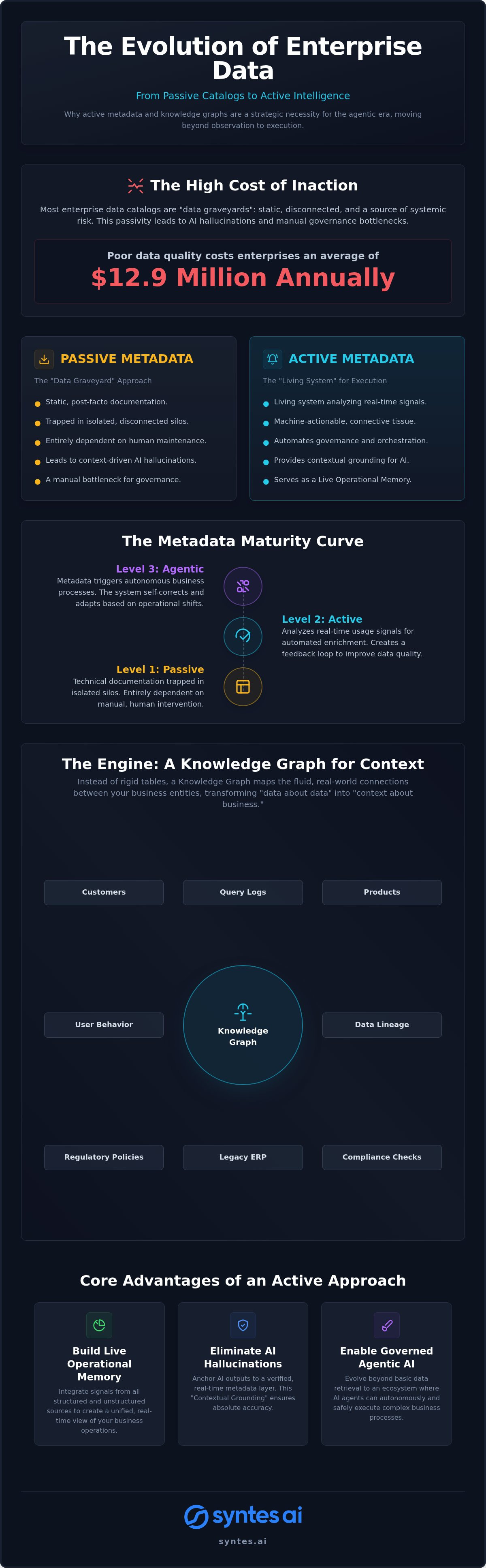
Most enterprise data catalogs are where metadata goes to die. They are static, passive, and entirely disconnected from the real-time execution your business demands. If your AI agents are hallucinating or your governance remains a manual bottleneck, it’s because you’re relying on a “data graveyard” instead of a living system. Implementing active metadata management with knowledge graph technology is no longer a theoretical upgrade; it’s a strategic necessity for the agentic era. With poor data quality costing enterprises an average of $12.9 million annually, the transition from observation to execution is the only way to protect your operational integrity.
You’ve likely found that traditional governance can’t keep pace with the speed of autonomous systems. This article reveals how a Knowledge Graph transforms passive metadata into a live operational layer that fuels autonomous AI agents and enterprise-wide intelligence. We’ll explore the path toward a self-updating data ecosystem that eliminates context-driven hallucinations and automates governance across your most fragmented legacy systems. It’s time to move beyond discovery and start driving execution.
Key Takeaways
- Identify why static data catalogs have become operational liabilities and how to transition toward a system that prioritizes real-time usage signals.
- Learn how active metadata management with knowledge graph architecture serves as the critical engine for mapping complex enterprise relationships.
- Analyze the ripple effects of data changes across fragmented systems using ML-driven impact analysis and automated discovery.
- Apply the Context Engineering framework to integrate disparate silos and establish a unified semantic layer for your entire organization.
- Evolve beyond basic retrieval to governed agentic intelligence by establishing a Live Operational Memory for your AI ecosystem.
Why Passive Metadata Catalogs Fail the 2026 Enterprise
The traditional data catalog is a relic. It was built for humans to browse, not for systems to execute. Most enterprises treat metadata as a post-facto documentation exercise, a static record of what was true months ago. This creates a “data graveyard” where information is obsolete before the ink is dry. By 2026, the cost of this passivity is no longer just an efficiency loss; it is a systemic risk. Modern AI initiatives require deterministic truth. They demand a shift toward active metadata management with knowledge graph architectures that analyze real-time usage signals to automate data governance and orchestration. We’ve moved past the era of manual tagging. Your metadata must now be machine-actionable, serving as the connective tissue between disparate legacy systems and autonomous agents.
The Metadata Maturity Curve: From Static to Agentic
Enterprise intelligence is a progression. Most organizations remain trapped at the bottom, where metadata is merely technical documentation stored in isolated silos. It’s passive, disconnected, and entirely dependent on human maintenance. To survive the complexity of the modern stack, you must move up the curve:
- Level 1: Passive – Technical documentation trapped in silos.
- Level 2: Active – Usage signals and automated enrichment.
- Level 3: Agentic – Metadata that triggers autonomous business processes.
Level 2 identifies who is using which data and for what purpose, creating a feedback loop that improves data quality without human intervention. The pinnacle, Level 3, transforms a Knowledge Graph from a map into an engine. It allows the system to self-correct and reconfigure based on operational shifts. This transition is what separates companies that merely store data from those that weaponize it.
The High Cost of Hallucinations in Data Governance
AI hallucinations are rarely a failure of the model itself. They are a failure of context. When an LLM relies on stale or out-of-context metadata, it produces probabilistic guesses that masquerade as facts. Establishing trust in 2026 requires rigorous lineage and provenance. You must be able to trace every data point back to its source and verify its current validity. Without this, your AI agents are essentially operating in a vacuum. Contextual Grounding is the architectural practice of anchoring AI outputs to a verified, real-time metadata layer to ensure absolute accuracy. This shift ensures that your AI doesn’t just guess; it knows. It turns your metadata from a static archive into a live operational memory that powers every decision across the enterprise.
The Knowledge Graph: The Engine of Metadata Activation
Relational databases are built on rigidity. They excel at storing isolated transactions in rows and columns, but they fail when asked to map the complex, fluid relationships of a modern enterprise. When your metadata is trapped in these rigid structures, it remains siloed and invisible. Realizing the full potential of active metadata management with knowledge graph architecture requires a move away from tabular constraints. A Knowledge Graph doesn’t just store data; it maps connections. It links customers to products, products to regulatory policies, and policies to specific data lineages. This creates a unified semantic web where the “edges”, the relationships between entities, are just as important as the entities themselves.
This approach moves the organization from managing “data about data” to maintaining “context about business.” By utilizing Gartner’s Market Guide for Active Metadata Management as a strategic benchmark, it becomes clear that the value lies in Operational Relationship Intelligence. The graph isn’t a static map. It is an evolving system that learns from real-time events, query logs, and user behavior. It understands that a change in a customer’s privacy status must immediately ripple through every connected marketing automation and compliance check. This transition is the cornerstone of active metadata management with knowledge graph technology, where the system proactively identifies and resolves data inconsistencies before they impact downstream operations.
Building a Live Operational Memory
A Knowledge Graph achieves its “active” status through two-way connectors that ingest signals from both structured and unstructured sources. This creates what we call Live Operational Memory. Semantic data integration ensures that regardless of where the data lives, be it a legacy ERP or a modern cloud warehouse, it is interpreted through a consistent business lens. Live Operational Memory is a persistent, evolving context layer that synchronizes state across the enterprise stack, whereas a data warehouse is a historical archive of disconnected events. If you are ready to see how this architecture functions in practice, you can book a demo with our team.
Semantic Anchoring for Enterprise Intelligence
To fuel autonomous agents, metadata must be more than readable; it must be understandable. We use ontologies to define the underlying business logic that guides AI reasoning. This semantic data layer for enterprise acts as a source of deterministic truth. It bridges the gap between the broad, probabilistic knowledge of a General LLM and the specific, proprietary requirements of your business. By anchoring AI agents to this semantic layer, you ensure that their execution remains within the bounds of corporate policy and technical reality. This is the only way to achieve governed, autonomous performance at scale.
Active vs. Passive Metadata Management: A Strategic Framework
Passive metadata management is a reactive posture. It relies on manual tagging, periodic audits, and the hope that documentation stays relevant. In contrast, active metadata management with knowledge graph technology adopts a proactive stance. It utilizes ML-driven discovery to sense changes in the data environment as they happen. The differences are stark:
- Passive: Manual tagging that creates documentation which becomes obsolete instantly.
- Active: ML-driven enrichment that stays current by analyzing real-time usage signals.
When a schema change occurs or a new data source is integrated, an active system doesn’t wait for a human to update a spreadsheet. It automatically re-maps relationships and alerts downstream systems. This shift transforms metadata from a static record into an operational asset that orchestrates data quality and accessibility across the enterprise stack.
Predicting the ripple effect of data changes is where the strategic value of the graph becomes undeniable. Impact analysis in a relational system is a manual, error-prone task. In a knowledge graph, it’s a simple query. You can instantly visualize how a modification in an upstream ERP system will affect your downstream AI models or financial reports. This visibility enables Governance as a Service, where policy enforcement is automated through the graph’s logic. By leveraging active metadata management with knowledge graph capabilities, organizations move from defensive compliance to offensive operational intelligence. Some industry professionals report that this transition can reduce data discovery time by up to 80%, allowing technical teams to focus on innovation rather than digital archeology.
From Discovery to Deterministic Action
Discovery is merely the entry point. In the era of agentic AI platforms, your metadata must do more than just exist; it must trigger action. Passive systems are search-based; they require a human to ask a question. Active systems are trigger-based. They identify data quality issues, such as a sudden drop in column density or a violation of a business rule, and initiate remediation workflows automatically. This deterministic action ensures that your data ecosystem remains healthy without constant manual oversight.
The Role of Lineage in Agentic Reliability
Lineage is the backbone of trust. It provides a clear, visual flow of data from its origin in an ERP to its final output in an AI response. For autonomous agents to be reliable, they must operate with an audit trail that proves the provenance of their information. Knowledge graphs maintain this trail in real-time, providing the transparency needed for regulatory compliance and operational debugging. This architectural rigor is essential to how to prevent AI hallucination, as it ensures the model is always grounded in verified, high-lineage data rather than probabilistic noise.
Implementing Active Metadata: The Context Engineering Framework
- Step 1: Connect – Establish bi-directional pipelines across the enterprise stack, from legacy ERPs to modern cloud-native applications.
- Step 2: Understand – Deploy ML-driven discovery to identify entities, hierarchies, and the semantic relationships between them.
- Step 3: Contextualize – Synthesize these discoveries into a dynamic Syntes AI Context Graph, creating a live representation of your business logic.
- Step 4: Govern – Embed security, permissions, and regulatory rules directly into the graph’s edges to ensure safe data access.
- Step 5: Execute – Expose this trusted context to AI agents, enabling them to reason and perform complex tasks with absolute precision.
Solving Enterprise Data Silos for Good
Silos are the enemy of execution. When your customer data lives in a CRM and your inventory data is trapped in an on-premise ERP, your AI remains blind to the full operational picture. Solving enterprise data silos is the mandatory first step toward metadata activation. We use two-way connectors that don’t just pull data; they synchronize state in real-time. This ensures that a change in one system is instantly reflected across the entire active metadata management with knowledge graph environment. Without this real-time synchronization, your “active” metadata is merely a slightly faster version of a static catalog.
Governing the Agentic Enterprise
Traditional governance relies on static PDF policies that humans rarely read and machines cannot interpret. We replace this outdated model with Guardrail-as-Code. By embedding business boundaries directly into the Enterprise Knowledge Graph, you ensure that AI agents operate within strict, pre-defined parameters. For high-stakes metadata changes, we incorporate human-in-the-loop systems that allow experts to verify critical logic before it is operationalized. This creates a governed environment where autonomy does not come at the expense of control. It turns your governance from a manual bottleneck into a programmatic advantage.
The Syntes AI Advantage: Transitioning to Governed Agentic Intelligence
Syntes AI moves the needle from “what is our data?” to “what can our data do?” While legacy providers focus on the discovery phase, we’ve architected a system for the execution phase. Our Enterprise Knowledge Graph doesn’t just catalog assets; it serves as your organization’s Live Operational Memory. This is a unified context layer that evolves alongside your business, ensuring that every AI agent in your ecosystem operates with the same deterministic truth. By implementing active metadata management with knowledge graph architecture through the Syntes Agentic Platform, you transition from probabilistic guesses to governed, actionable intelligence. We don’t just bridge the context gap; we close it.
The future of enterprise intelligence isn’t a better chatbot. It’s a shared context layer that bridges the gap between structured silos and unstructured insights. We’ve moved beyond simple Retrieval-Augmented Generation (RAG). Instead, we deploy governed AI agents that perform complex actions, such as automated procurement or real-time compliance remediation, based on the live state of your enterprise. This is the difference between a system that provides answers and one that executes solutions.
Why Enterprise AI Requires Context Engineering
Prompt engineering is a temporary fix for poor data architecture. If you’re spending your time refining prompts to avoid hallucinations, you’re fighting a losing battle against fragmented context. Context Engineering is the strategic successor. It transforms noisy data into high-fidelity intelligence that agents can actually use. To achieve this at scale, you need a robust enterprise ai infrastructure that supports continuous synchronization and semantic anchoring. Syntes AI provides this foundation, turning your active metadata management with knowledge graph strategy into a live operational force that powers every system in your stack.
Book Your Strategy Session
The era of the “data graveyard” is over. You can no longer afford to let your metadata sit idle in a passive catalog while your competitors automate their operations. It’s time to move from passive discovery to agentic execution. By adopting a Knowledge Graph as your core operational layer, you build a trusted, explainable AI ecosystem that scales without human bottlenecks. We provide the tools to turn your messy reality into a state of total operational clarity.
Stop managing documentation and start driving performance. We’re ready to show you how the Syntes AI Context Graph can revolutionize your operational memory and fuel your next generation of AI agents. Reach out today to see our platform in action and begin your transition to a truly intelligent enterprise.
Orchestrate Your Agentic Evolution
Static catalogs have become operational liabilities. They anchor your team to the past and introduce systemic risks into your AI initiatives. The transition to a living ecosystem is inevitable. Implementing active metadata management with knowledge graph technology transforms your technical debt into a strategic engine. This shift moves your organization from passive observation to a state of total operational clarity where discovery leads directly to execution.
Syntes AI provides the architectural foundation for this evolution. Our proprietary Context Engineering methodology builds the Live Operational Memory required for autonomous systems to thrive. We combine enterprise-grade AI governance with real-time connectivity to ensure your agents operate within trusted business boundaries. You possess the data; we provide the intelligence to weaponize it.
The agentic era demands a new standard of deterministic truth. You’ve identified the flaws in the current market. Now, it’s time to deploy the sophisticated tools necessary to bring order to them. Let’s build an enterprise that doesn’t just store information but executes your strategic vision with absolute certainty.
Frequently Asked Questions
What is the difference between active and passive metadata?
Passive metadata is a static record of historical state that relies on manual tagging and periodic human audits. It quickly becomes a “data graveyard” as documentation fails to keep pace with system changes. Active metadata is an operational layer that continuously analyzes usage signals, query logs, and social threads to automate data management. It transforms metadata from a dormant archive into a live system that proactively identifies quality issues or schema modifications.
How does a knowledge graph improve metadata management?
Knowledge graphs move beyond the rigid constraints of relational tables to map the fluid relationships between data entities. By utilizing active metadata management with knowledge graph technology, organizations can link technical assets directly to business logic and regulatory policies. This architecture allows the system to understand how a change in one silo ripples across the entire enterprise stack, providing a unified semantic web for total operational clarity.
What is active metadata activation in the context of AI?
Activation refers to the transition from metadata as documentation to metadata as an execution engine. In an AI context, this means the metadata is machine-actionable rather than just human-readable. It provides the necessary semantic layer that allows AI models to understand the lineage, quality, and permissions of the data they process in real-time. This ensures that autonomous agents have the deterministic context required to perform complex business tasks.
Can active metadata help prevent AI hallucinations?
Hallucinations are fundamentally a failure of context. Active metadata provides the deterministic grounding required to keep AI models anchored in verified facts instead of probabilistic noise. By maintaining a real-time audit trail and precise lineage, the system ensures that AI agents only reason over data that’s current and compliant with internal business rules. This creates a “Live Operational Memory” that serves as the ultimate source of truth.
How does active metadata support data governance and compliance?
It enables the shift from manual, reactive audits to automated, programmatic enforcement. Active systems use “Guardrail-as-Code” to embed security and permissions directly into the metadata layer. This ensures that data access and usage remain compliant with global regulations, such as the EU AI Act, without requiring constant human intervention. The graph provides an immutable record of how data was used and who accessed it at any given moment.
What are the key components of an enterprise metadata knowledge graph?
A robust system consists of a semantic data layer, ontologies that define business logic, and bi-directional connectors for real-time synchronization. These components work together to create a Live Operational Memory. This memory bridges the gap between structured silos and unstructured insights, ensuring the graph reflects the current state of the entire enterprise. It’s the technical infrastructure required to move from simple data storage to governed agentic intelligence.
How do I transition from a traditional data catalog to an active metadata system?
Transitioning requires adopting a Context Engineering framework. You must move away from manual tagging and toward ML-driven discovery that ingests real-time signals from your entire stack. The process begins by connecting disparate silos through two-way connectors and ends by exposing enriched context to your execution platforms. This effectively turns your static documentation into a functional operational asset that drives immediate business value across the organization.