

Why are your most sophisticated AI agents still failing to execute basic, cross-departmental workflows? The failure isn’t in the model. It’s in the foundation. Most organizations are currently suffocating under the weight of static, fragmented RAG systems that lack the vital operational memory required for true autonomy. As of August 2026, only 23% of organizations have successfully scaled an agentic system into production. The rest remain stalled by persistent hallucinations and rigid data silos. To bridge this gap, you must evolve your data architecture for agentic ai from simple vector lookups to a dynamic, graph-based intelligence layer.
We understand the frustration of watching promising pilots collapse under the pressure of real-world governance and auditability requirements. If your enterprise is navigating this transition and needs expert assistance, check out Flybuilt AI Agency. This article provides the definitive blueprint for building a scalable agentic data layer that empowers your AI to reason, execute, and govern complex workflows with deterministic precision. We’ll examine how a live Context Graph serves as the ground truth for an autonomous enterprise, transforming passive observation into active, systemic integration that delivers immediate operational utility.
Key Takeaways
- Transition from passive retrieval to active reasoning by replacing legacy RAG systems with a sophisticated Context Engineering framework.
- Leverage the precision of Knowledge Graphs to provide the deterministic grounding that vector databases lack, significantly reducing production hallucinations.
- Implement a modern data architecture for agentic ai that utilizes Live Operational Memory to maintain state and context across cross-system workflows.
- Secure your autonomous enterprise by embedding governance and business rules directly into the data layer, ensuring every AI action remains compliant and auditable.
- Unify fragmented data silos into a structured Context Graph to empower agents with the systemic intelligence required for end to end task execution.
What is Data Architecture for Agentic AI?
A specialized data architecture for agentic ai isn’t merely a storage repository. It’s a live, functional layer that provides autonomous systems with the real-time context and operational memory necessary for reasoning. Traditional Data architecture frameworks were designed for human consumption or static reporting; they’re fundamentally ill-equipped for the recursive reasoning loops that modern AI agents demand. To achieve true autonomy, enterprises must move beyond passive retrieval toward a system that supports active execution and systemic integration.
- Connection: The ability to ingest and synchronize data across disparate enterprise silos in real time, ensuring the agent never operates on stale information.
- Contextualization: Transforming raw data into a structured graph that mirrors complex business relationships and logic.
- Execution: Providing the deterministic grounding required for agents to perform actions within external systems securely and predictably.
The Evolution from RAG to Context Engineering
Architecting for Agency: Beyond the Chatbot
The Core Pillars of a Context-First Data Architecture
Semantic unification is the technical bridge that closes the gap between rigid databases and fluid documents. It ensures that an agent understands that a “Project ID” in a spreadsheet is the same entity described in a legal contract or a slack thread. This level of Agentic AI architecture is what allows for sophisticated reasoning. It transforms raw information into a structured, queryable reality. Organizations must prioritize these pillars to survive the shift toward autonomous operations. You can explore these architectural requirements in a live environment to see how they apply to your specific stack.
Building the Live Operational Memory
Operational Relationship Intelligence
Intelligence is not found in the data itself, but in the connections between data points. Relationship intelligence maps the hierarchies, dependencies, and business rules that define your organization. When an agent understands these links, it can perform sophisticated root-cause analysis and complex strategic planning. It sees the ripple effect of a delayed shipment across the entire supply chain rather than viewing it as an isolated event. For a deeper look at how this intelligence layer functions, consult The Executive Guide to Enterprise Knowledge Graphs. This mapping is the essential ground truth that enables agents to navigate the messy realities of global enterprise operations with precision and speed.
Knowledge Graphs vs. Vector Databases: Selecting the Agentic Ground Truth
The Limits of Vector-Only Architectures
GraphRAG: The New Standard for Agentic Grounding
GraphRAG represents the necessary evolution of enterprise intelligence. By combining LLMs with the structured precision of an Enterprise Knowledge Graph, you provide agents with explicit reasoning paths. This isn’t just about finding data. It’s about understanding the relationships between entities. A Context Graph acts as a deterministic anchor, ensuring that AI responses are based on hard-coded business truth rather than statistical guesswork. This is the only way to effectively prevent AI hallucination in critical workflows. Beyond retrieval, graph structures enable total explainability. You can audit the exact path an agent took to reach a conclusion, providing the transparency required for high-stakes governance and compliance.
Governing the Agentic Layer: Security, Rules, and Execution
Governed Agentic AI: The Execution Framework
Effective execution requires a controlled sandbox. The data layer acts as this environment, allowing agents to simulate reasoning and test outcomes against business logic before touching production systems. Permission-based context is equally vital. An agent shouldn’t have unfettered access to your entire data estate; it must only see the information it’s authorized to process. This level of control is a core component of Enterprise AI Infrastructure. It ensures that systemic intelligence doesn’t inadvertently become a security liability or a source of data leakage.
Solving Data Silos with Cross-System Connectors
Data silos are the ultimate enemy of agency. If an agent can’t access CRM data while processing an ERP invoice, it lacks the context to act decisively. You need two-way connectors that facilitate real-time synchronization across your entire stack, from legacy mainframes to modern cloud applications. This creates a Unified Context Layer, bridging the gap between fragmented systems and autonomous reasoning. Moving toward this integrated model is the only definitive way of Solving Enterprise Data Silos. It transforms isolated repositories into a shared operational memory, empowering agents to navigate complex workflows with total clarity.
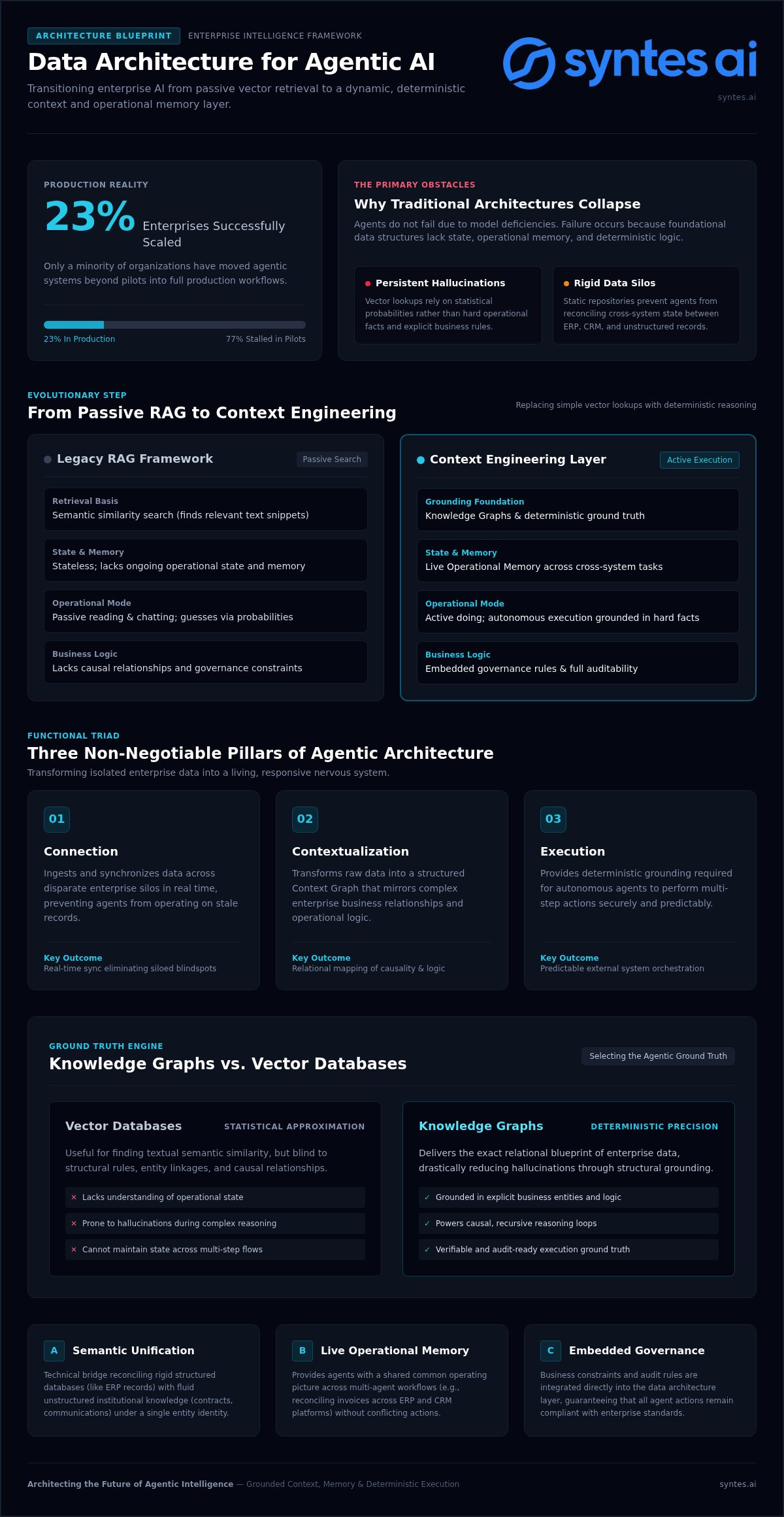
Syntes AI: Architecting the Future of Agentic Intelligence
Syntes AI doesn’t offer incremental improvements; it provides the definitive resolution to the systemic flaws currently crippling enterprise AI strategy. Most organizations are trapped in a cycle of failed pilots because they lack a functional data architecture for agentic ai. They rely on generic models that possess no inherent understanding of proprietary business logic. Syntes AI eliminates this gap. By deploying an Enterprise AI Platform centered on Context Engineering, we transform fragmented, siloed data into a structured layer for agentic reasoning and trusted execution. This is the transition from passive observation to active, automated performance.
The Syntes AI Context Graph serves as your organization’s live operational memory. It unifies disparate data streams into a single, governed source of truth that evolves in real time. This isn’t a static repository. It’s a dynamic intelligence layer that empowers agents to reason through complex workflows with the same nuance as your best human operators. When you move beyond the limitations of standard RAG, you unlock the ability to orchestrate autonomous workflows that are both explainable and auditable. For enterprises preparing their teams for this operational shift, consulting and coaching firms like Navo Inc. offer specialized support in synthetic workforce development and the deployment of AI agents.
The Syntes Context Engineering Methodology
Our framework is built on five rigorous pillars: Connect, Understand, Contextualize, Govern, and Execute. We begin by establishing real-time Cross-System Integrations, ensuring your agents have access to the full breadth of enterprise context. We then move beyond simple data ingestion to deep contextualization, mapping the intricate relationships that define your business operations. This methodology bridges the chasm between an LLM’s general knowledge and your specific, proprietary data. For example, a global logistics firm recently moved from passive document search to autonomous workflow orchestration by utilizing our platform to resolve supply chain disruptions without human intervention. By embedding AI Governance directly into the reasoning loop, we ensure every action taken by an agent is compliant, secure, and aligned with deterministic business rules.
Get Started with the Next Evolution of AI
Enterprise leaders are abandoned legacy RAG systems in favor of Context Graphs because they demand results, not just responses. The path to trusted, explainable AI requires an architecture that prioritizes relationship intelligence over simple keyword matching. If your goal is to build an autonomous enterprise, you must first build a foundation that supports it. Syntes AI provides the sophisticated tools necessary to bring order to messy operational realities, ensuring your transition to agentic AI is both seamless and strategically sound. It’s time to stop experimenting and start executing.
Architecting the Autonomous Enterprise
Syntes AI serves as the definitive partner in this evolution. As a pioneer in Context Engineering, we provide the Live Operational Memory and Governed Agentic AI Framework necessary for trusted, cross-system execution. You don’t have to choose between speed and safety. By architecting for agency today, you secure your position as a leader in the autonomous economy.
Your organization’s future depends on the clarity of its context. Take the first step toward total operational intelligence now.
Frequently Asked Questions
What is the difference between RAG and Context Engineering?
Context Engineering is the next evolution beyond Retrieval-Augmented Generation (RAG). While RAG focuses on the passive retrieval of relevant text snippets, Context Engineering is a disciplined methodology for building and maintaining a live Context Graph. This framework ensures AI agents don’t just find information but actually understand the underlying business logic and relationships. It moves the focus from simple prompt engineering to a robust, governed infrastructure for trusted reasoning.
Why do AI agents need a Knowledge Graph instead of just a Vector Database?
Vector databases are limited to semantic similarity, which often fails in complex enterprise environments requiring precise reasoning. AI agents need an Enterprise Knowledge Graph to understand the explicit relationships between entities, such as how a specific inventory delay impacts a project timeline. Unlike vectors, graphs provide the deterministic grounding and relationship intelligence needed for multi-hop reasoning. This is a critical component of a modern data architecture for agentic ai.
How does data architecture prevent AI hallucinations in agents?
Hallucinations occur when AI models rely on statistical guesswork rather than factual grounding. A structured data architecture for agentic ai prevents this by anchoring agentic reasoning in a Context Graph. This graph serves as a “Ground Truth,” ensuring every decision is based on verified enterprise data and business rules. By providing deterministic context rather than just probabilistic text, the architecture forces the AI to operate within established operational boundaries.
What is a ‘Live Operational Memory’ in the context of enterprise AI?
Live Operational Memory is a continuously evolving enterprise context that unifies fragmented data into a single intelligence layer. Unlike static databases that provide snapshots of the past, this memory integrates real-time operational events, transactions, and business rules. It creates a shared, persistent state that allows AI agents to maintain context across different sessions. This ensures the organization operates from a unified, structured model that mirrors the messy realities of daily business.
How do you govern AI agents that operate across different business systems?
Governance is achieved by embedding security, permissions, and business rules directly into the context layer. You must implement permission-based context, ensuring agents only access data they’re authorized to see. Syntes AI utilizes a governed execution framework that includes a transparent “reasoning log” for auditability. For high-stakes tasks, Human-in-the-Loop systems act as a final guardrail, allowing for automated heavy lifting while maintaining human oversight for critical business decisions.
Can Syntes AI integrate with our existing ERP and CRM data silos?
Yes, Syntes AI utilizes specialized two-way connectors designed to synchronize data across disparate enterprise systems. Whether your data lives in legacy ERP stacks, modern CRM platforms, or unstructured document repositories, the platform unifies these silos into a structured Context Graph. This integration ensures that your AI agents have a common operating picture, allowing them to navigate cross-system workflows and execute complex tasks without the friction of disconnected information.
What is GraphRAG and why is it essential for agentic AI architecture?
GraphRAG is an advanced retrieval methodology that combines the precision of graph structures with the general knowledge of LLMs. It’s essential because it provides agents with explicit reasoning paths that standard RAG cannot replicate. By traversing a Knowledge Graph, GraphRAG enables agents to understand hierarchies and dependencies. This structural grounding is vital for explainable AI, as it allows users to audit the exact path an agent took to reach a conclusion.
How does Syntes AI ensure the privacy and security of enterprise data?
Syntes AI prioritizes enterprise-grade security by implementing a governed context layer that isolates proprietary data from the public training data of LLMs. The platform manages data integrity through rigorous permissions and frameworks that ensure agents only operate within authorized sandboxes. By focusing on Context Engineering rather than consumer-grade tools, we provide the infrastructure needed for trusted execution while maintaining full compliance with global enterprise standards and regulatory requirements.