

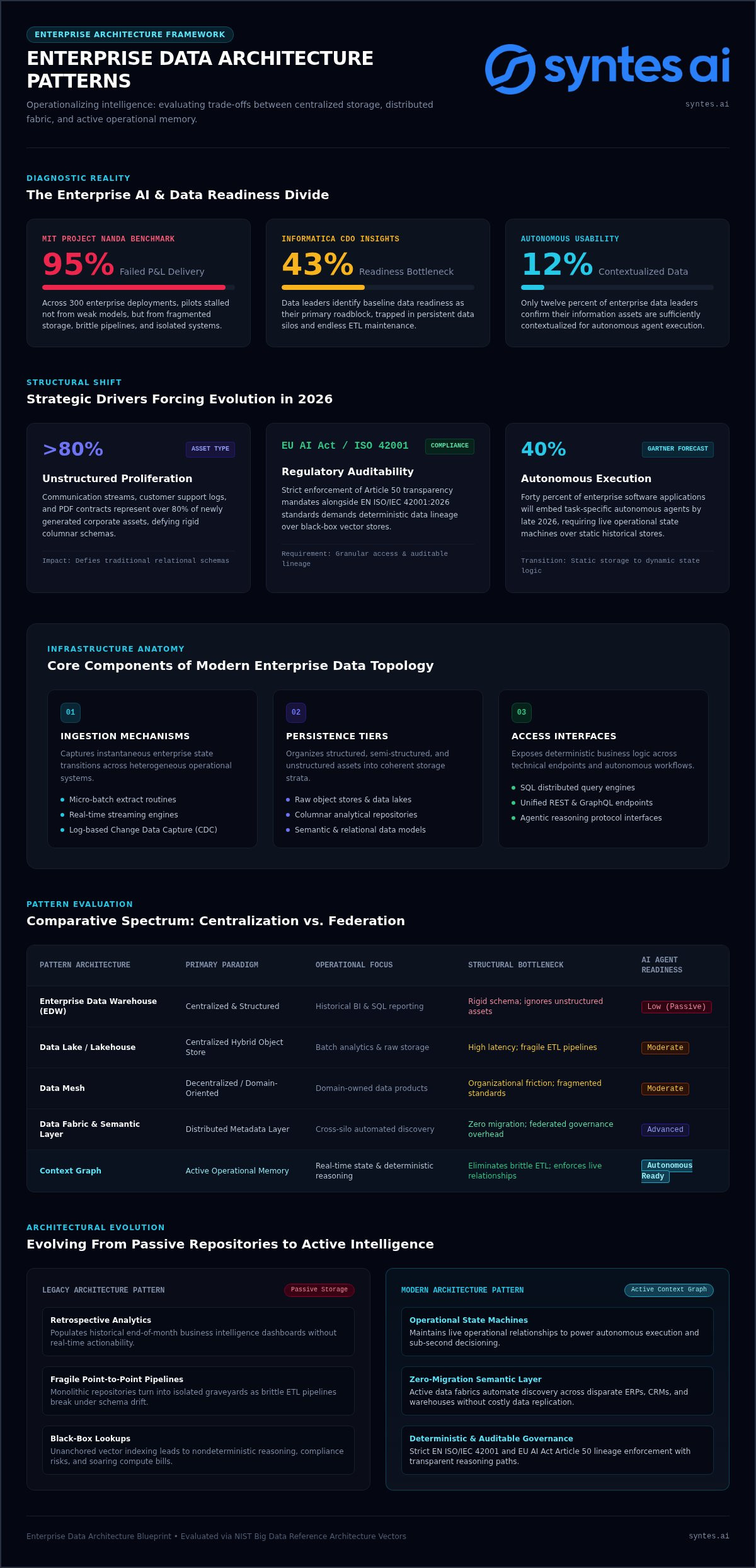
MIT’s Project NANDA benchmark revealed a brutal reality across 300 enterprise deployments: 95% of generative AI pilots failed to deliver measurable P&L impact. The breakdown wasn’t caused by weak models. It stemmed directly from fragmented storage, brittle pipelines, and isolated systems. Evaluating common enterprise data architecture patterns is no longer just a technical exercise for data engineers; it’s a board-level imperative to determine which architectural design can actually operationalize enterprise intelligence without collapsing under compliance risks or soaring compute bills.
You already know the operational friction. Disparate ERPs, CRMs, and cloud warehouses create persistent data silos, leaving teams trapped in endless ETL maintenance while business leaders demand autonomous execution. Master common enterprise data architecture patterns to build an agile, governed, and AI-ready data foundation that bridges this divide. This guide examines the strategic trade-offs between warehouses, lakes, lakehouses, data mesh, fabrics, and context graphs, establishing a battle-tested evaluation framework to evolve your infrastructure from passive storage to active, explainable operational intelligence.
Key Takeaways
- Evaluate common enterprise data architecture patterns across query latency, governance boundaries, and autonomous agent readiness to eliminate brittle ETL pipelines.
- Uncover structural trade-offs between warehouses, data lakes, lakehouses, and data mesh models to determine when centralized aggregation fails operational requirements.
- Assess how active data fabrics and contextual semantic layers automate cross-silo discovery without requiring costly, redundant data migrations.
- Establish an evolutionary architectural roadmap that elevates static analytical repositories into an active Context Graph powered by live operational memory.
- Implement rigorous AI governance frameworks to enforce deterministic reasoning, granular access controls, and auditable lineage across enterprise workflows.
What Are Enterprise Data Architecture Patterns and Why Do They Matter?
Data architecture patterns determine how organizations capture, structure, and monetize their information assets. At its foundation, enterprise data architecture defines the structural blueprints that dictate how records flow, transform, and persist across operational and analytical boundaries. For decades, organizations treated these designs as passive storage choices; they were plumbing built simply to populate end-of-month business intelligence dashboards. That static mindset no longer functions. Modern operations require architectures that actively bridge the gap between historical analytical reporting and real-time operational execution.
When storage topologies fail to model live operational relationships, severe architectural debt accumulates. Monolithic repositories turn into isolated graveyards. Fragile extract, transform, and load (ETL) pipelines fracture under schema changes. These structural bottlenecks directly impair core operations; according to Informatica’s CDO Insights, 43% of data leaders cite data readiness as their primary roadblock, while only 12% report their data is sufficiently contextualized for autonomous use. Disjointed point-to-point connections create latency spikes that blind executive decision-making. Simply centralizing tables into a generic cloud repository does not solve fragmented workflows.
The friction multiplies as teams deploy autonomous intelligence. Understanding common enterprise data architecture patterns allows systems architects to evaluate trade-offs systematically, avoiding brittle topologies that stall mission-critical automation.
The Core Components of Modern Enterprise Data Topology
Resilient enterprise topologies coordinate three fundamental infrastructure tiers:
- Ingestion Mechanisms: Balancing micro-batch extract routines, streaming engines, and log-based change data capture (CDC) to capture state transitions instantaneously.
- Persistence Tiers: Organizing raw object stores, relational databases, columnar analytical formats, and semantic models into coherent storage layers.
- Access Interfaces: Serving business logic simultaneously across SQL query engines, REST endpoints, GraphQL layers, and modern agentic reasoning protocols.
Drivers Forcing Architectural Evolution in 2026
Why must architectural patterns evolve right now? Three strategic catalysts have converged:
- Unstructured Document Proliferation: Unstructured communication, customer support logs, and PDF contracts represent over 80% of newly generated corporate assets, defying rigid columnar rows.
- Aggressive Regulatory Frameworks: The European Union AI Act now actively enforces Article 50 transparency mandates, while EN ISO/IEC 42001:2026 sets rigorous standards for auditability. Organizations require deterministic data lineage, not black-box vector lookups.
- Autonomous Execution: Gartner forecasts that 40% of enterprise applications will embed task-specific autonomous agents by late 2026. Passive, disconnected repositories cannot supply the dynamic business rules or real-time state machines these agents demand.
Navigating these demands requires selecting common enterprise data architecture patterns designed for active operational reasoning rather than static retrospective storage.
Core Analytical Data Patterns: Warehouses, Lakes, Lakehouses, and Data Mesh
Every enterprise data strategy hinges on balancing centralization against federation. The NIST Big Data Reference Architecture formalizes these roles, categorizing storage providers, processing frameworks, and consumer interfaces. When comparing common enterprise data architecture patterns, architects must evaluate four structural vectors: query latency, governance overhead, schema enforcement, and organizational friction. No single pattern solves every analytical workload; each introduces distinct engineering trade-offs.
Centralized Analytical Patterns: Warehouses vs. Data Lakes
Enterprise Data Warehouses (EDWs) remain the benchmark for structured business reporting. Their schema-on-write design guarantees pristine consistency, rock-solid governance, and sub-second SQL performance. The cost is agility. When source systems evolve, rigid ETL pipelines break, creating extensive backlog delays for data engineers.
Data Lakes counter this rigidity with schema-on-read flexibility, storing petabytes of raw, multi-structured files on low-cost object storage. Ingestion speed soars, but governance collapses. Without automated metadata discipline, data lakes degrade into unusable data swamps lacking transactional consistency.
Data Lakehouses bridge this divide. By layering open table formats like Apache Iceberg and Delta Lake over object storage, lakehouses bring ACID transactions, row-level lineage, and time-travel querying to massive unstructured datasets. Even so, unifying storage formats doesn’t automatically unify business meaning. As detailed in our analysis of solving enterprise data silos, physical consolidation cannot resolve semantic fragmentation across disconnected business departments.
Decentralized Patterns: The Realities of Implementing Data Mesh
Data Mesh abandons centralized storage entirely, shifting data ownership to cross-functional business domains. It treats analytical data as a product, empowering domain teams to publish clean datasets via decentralized APIs.
The paradigm sounds compelling, but organizational friction is severe. Federated computational governance requires high data maturity; domain units must staff their own specialized engineers rather than leaning on a central core. Schema divergence frequently blinds cross-departmental analytics. When 78% of large enterprises manage data across 10 or more heterogeneous platforms, decentralization often duplicates infrastructure costs and complicates enterprise-wide compliance audits.
Evaluating these common enterprise data architecture patterns proves that analytical repositories excel at historical analysis, yet remain fundamentally passive. To discover how modern systems convert these static data assets into live operational intelligence, explore our agentic platform approach.
Distributed Integration Patterns: Data Fabric vs. Contextual Semantic Layers
Centralizing physical storage solves only half the architectural challenge. Modern systems require patterns that unify disparate sources without moving petabytes over wide-area networks. Balancing defensive and offensive data strategies demands an integration pattern that secures authoritative truth without throttling business agility. Distributed integration strategies attempt to resolve this tension, yet fundamental trade-offs separate metadata-driven virtualization from semantic networks among common enterprise data architecture patterns.
Data Fabric and Active Metadata Orchestration
Data Fabric architectures employ active metadata to continuously analyze operational logs, pipeline telemetries, and query histories. Rather than forcing manual data wrangling, machine learning models recommend automated pipeline generation and optimize distributed queries across multi-cloud environments.
Virtualization layers present unified views across hybrid systems, but physical boundaries impose severe costs. When analytical engines attempt multi-way joins across disconnected transactional databases, network bandwidth limits quickly manifest. Query latency escalates unpredictably. Disparate departments maintain conflicting definitions for core concepts like “active account” or “revenue recognition.” Passive metadata catalogs document these discrepancies; they cannot resolve them. Propagating granular security policies across heterogeneous platforms remains inherently fragile when underlying operational schemas mutate unexpectedly.
Bridging Siloed Systems with Semantic Relationship Networks
Contextual semantic layers address the blind spots of data fabrics by shifting focus from physical data pipes to relational enterprise logic. Instead of treating records as isolated, tabular rows, these layers translate enterprise assets into a network of typed nodes, directional edges, and explicit business attributes. Explore the semantic data layer to establish a deterministic foundation that bridges transactional systems with operational intelligence.
Representing enterprise facts as relationship networks eliminates semantic drift across operational applications:
- Disambiguates Entity Confusion: Links an “opportunity” in a CRM directly to an “order” in an ERP, establishing explicit relational causality.
- Harmonizes Enterprise Policies: Encodes business rules and constraints directly into the semantic topology rather than scattering them across disparate ETL scripts.
- Preserves Operational Context: Retains domain hierarchy, temporal changes, and transactional states that traditional relational views flatten and destroy.
Traditional fabrics manage the movement of data. Contextual semantic networks govern its operational meaning. Comparing these common enterprise data architecture patterns proves that without explicit relationship modeling, distributed data integration remains an expensive exercise in moving uncontextualized bits.
Evaluating Architecture Patterns for Governance, Scale, and Agentic AI
Selecting an architecture is an operational commitment, not a software purchase. Gartner projects that 60% of enterprise AI projects lacking governed, AI-ready data will be abandoned through 2026. Standalone agentic efforts face an equally steep hurdle; over 40% will be canceled by late 2027. Success requires evaluating common enterprise data architecture patterns across three non-negotiable vectors: query latency requirements, organizational capability, and deterministic governance controls.
Architectural Readiness Assessment Framework
Enterprise architects need an objective framework to assess their operational readiness:
- Map Ingestion and Latency Tiers: Distinguish between batch reporting (tolerating hours of delay) and operational execution (requiring sub-second state synchronization across active systems).
- Identify Pipeline Bottlenecks: Pinpoint brittle integration layers that fracture during schema updates between legacy ERP systems and cloud repositories.
- Establish Verifiable Governance: Audit role-based access controls, field-level lineage, and regulatory conformance across all multi-cloud boundaries.
- Assess Autonomous System Compatibility: Determine whether the current storage tier can expose machine-readable business rules directly to external reasoning frameworks.
Why Traditional Storage Patterns Fail Autonomous AI Agents
Standard analytical designs collapse under operational intelligence workloads. Basic vector databases and naive Retrieval-Augmented Generation (RAG) pipelines treat enterprise information as isolated text snippets. They lack hierarchical awareness. They miss transactional dependencies. When an autonomous agent attempts to execute an ERP purchase order based strictly on semantic cosine similarity, it hallucinates business logic; it cannot determine whether an account balance supports the transaction or if a contract’s pricing terms expired yesterday.
Autonomous agents demand deterministic operational memory anchored in live, relational realities. Consult our benchmark on enterprise AI infrastructure to understand how modern execution engines decouple reasoning from fragile static queries.
Assessing common enterprise data architecture patterns through this lens reveals a distinct architectural gap: analytical systems tell you what happened historically, but they cannot govern what an autonomous system should execute next.
The Context Graph: Architecting Active Operational Memory
Passive storage topologies capture what happened in the past; they can’t govern what happens next. The Context Graph unifies structured transactional tables, semi-structured documents, and organizational business rules into an interconnected fabric. By transforming raw records into an active operational intelligence layer, this architecture fundamentally redefines how systems interact. Among common enterprise data architecture patterns, the Context Graph stands out because it operates as a live operational memory layer rather than a passive data repository.
The Five Pillars of Enterprise Context Engineering
Context Engineering establishes continuous synchronization between enterprise systems and intelligent agents. Syntes AI operationalizes this capability through five core pillars:
- Connect: Two-way enterprise connectors integrate disparate transactional databases, ERPs, and CRMs without requiring destructive data duplication.
- Understand: Automated entity resolution uncovers hidden relationships across disparate operational schemas.
- Contextualize: The engine translates disjointed tabular rows and unstructured text into a unified, dynamic graph topology.
- Govern: Granular policy enforcement and audit trails ensure every AI action complies with role-based access rules and international regulatory standards.
- Execute: Governed agents carry out deterministic workflows across production systems safely.
Read the executive guide to enterprise knowledge graphs to review the strategic blueprint behind this architectural transition.
Deploying Governed Operational Intelligence
Deploying a Context Graph doesn’t require ripping and replacing current investments. Instead, the Syntes AI Context Graph functions as an active operational intelligence layer positioned directly above existing data warehouses and lakehouses. It extracts live operational memory across enterprise assets, allowing autonomous AI agents to execute cross-system workflows with deterministic reasoning rather than speculative guessing.
Business teams gain the ability to launch explainable AI applications that respect security boundaries and domain hierarchies. Destructive data duplication disappears. Costly multi-cloud migrations become unnecessary. By expanding beyond traditional analytical boundaries, common enterprise data architecture patterns finally evolve from passive storage silos into self-governing execution engines. Take the next step and schedule your enterprise architecture consultation to ground your operational AI strategy.
Architecting the Operational Future of Enterprise Data
Enterprise data strategies can no longer rely on static repositories and backward-looking dashboards. Deciding between warehouses, lakehouses, data fabrics, or mesh frameworks determines your organization’s capacity to operationalize intelligence. Evaluating common enterprise data architecture patterns confirms a clear shift: long-term competitive advantage belongs to enterprises that transform fragmented storage into an active, interconnected Context Graph. By implementing a Live Operational Memory, organizations resolve semantic fragmentation across CRM and ERP platforms without costly data migrations.
Through Context Engineering, enterprises ground their autonomous agents in verifiable business logic, complete auditability, and deterministic reasoning. The foundation you build today dictates the operational velocity of your entire organization tomorrow.
Modernizing your enterprise data foundation ensures your systems move beyond passive observation to deliver reliable, automated business performance.
Frequently Asked Questions
What is the primary difference between a Data Lakehouse and a Data Fabric?
A Data Lakehouse focuses on physical storage consolidation, while a Data Fabric orchestrates access across distributed systems through active metadata. Lakehouses merge low-cost object storage with ACID transactional controls using formats like Apache Iceberg or Delta Lake. In contrast, a Data Fabric leaves data where it lives, using automated discovery and dynamic pipelines to unify hybrid endpoints. One consolidates physical files; the other automates connectivity across disparate operational systems.
When should an enterprise choose a Data Mesh over a centralized architecture?
Choose a Data Mesh when domain teams possess the technical maturity to manage data as a product and centralized data engineering bottlenecks stall business delivery. When enterprises expand across distinct business units with separate operational logic, centralized architectures struggle to keep pace. Data Mesh distributes ownership directly to domain units. However, it requires robust computational governance to prevent schema divergence and avoid duplicate infrastructure costs across business groups.
How do enterprise data architecture patterns impact AI agent performance?
Data architecture patterns directly dictate whether an AI agent acts on real-time operational context or hallucinates over stale, disconnected records. Evaluating common enterprise data architecture patterns reveals that traditional batch warehouses cannot provide the sub-second state synchronization autonomous agents require. Systems built on relationship-driven context layers supply deterministic ground truth, allowing agents to execute cross-system workflows across ERP and CRM platforms without violating operational rules or security boundaries.
What role does a semantic layer play in modern enterprise data stacks?
A semantic layer abstracts complex underlying table schemas into standardized, business-friendly definitions and explicit operational relationships. Instead of forcing analysts or autonomous systems to parse hundreds of fragmented database joins, semantic layers define entities, metrics, and business logic centrally. This prevents metric drift across departments, ensures consistent security policy enforcement, and translates raw columnar data into a machine-readable ontology that downstream analytics and AI systems can reliably interpret.
Can an enterprise implement a Context Graph without replacing its current Data Warehouse?
Yes, an enterprise can deploy a Context Graph as an operational intelligence layer directly on top of existing warehouses and lakehouses. The Syntes AI Context Graph connects to existing storage systems, ERPs, and operational databases via two-way connectors without forcing costly data duplication. It extracts relational logic and builds a Live Operational Memory, enabling governed AI agents to reason across current platforms while preserving your prior investments in analytical infrastructure.
How do common data architecture patterns address data governance and compliance?
Governance models vary by architecture, ranging from centralized schema enforcement in warehouses to federated computational policies across distributed meshes. Among common enterprise data architecture patterns, modern regulations like the EU AI Act and ISO/IEC 42001 demand auditable, deterministic data lineage. Centralized repositories enforce strict role-based access but slow ingestion. Advanced context architectures embed governance directly into the operational semantic layer, enforcing access controls and maintaining auditable execution trails before autonomous workflows trigger transactions.
Why is vector-only retrieval insufficient for complex enterprise AI workflows?
Vector retrieval evaluates semantic similarity between text chunks rather than validating deterministic business rules or transactional relationships. Autonomous enterprise tasks require operational ground truth. Standard vector databases cannot determine whether an account balance covers a transaction, nor can they trace hierarchical dependencies in complex ERP systems. Without an underlying graph structure that models entity relationships and operational constraints, vector-only retrieval produces plausible text that frequently violates critical business logic.