
Through 2026, 60% of enterprise AI projects will be abandoned. This isn’t a failure of vision; it’s a failure of architecture. Most organizations are currently suffocating under the weight of common data integration mistakes that treat information as static rows in a table rather than a dynamic web of business logic. You’ve likely felt the friction already. Fragmented data across legacy ERPs and modern CRMs creates a disconnected environment where AI agents lack the necessary clarity to act. When data points don’t speak the same language, hallucinations become inevitable and maintenance costs for brittle, point-to-point integrations skyrocket.
You recognize that simply moving data isn’t enough. True enterprise intelligence requires more than just a pipe; it requires a brain. This article identifies the systemic flaws in your current data architecture and provides a roadmap for unified, agentic intelligence. You’ll learn how Context Engineering moves your organization beyond the RAG Trap to create a Live Context Graph. This foundation allows you to deploy trusted AI agents capable of executing complex business processes without manual script maintenance. It’s time to stop syncing records and start engineering the operational memory your enterprise demands.
Key Takeaways
- Shift from passive data syncing to active context creation to meet the rigorous reasoning demands of agentic AI.
- Identify and resolve common data integration mistakes that prioritize simple data movement over the semantic relationship mapping required for trusted intelligence.
- Transcend the limitations of static RAG by architecting a semantic data layer that provides clear, operational relationship intelligence across your entire stack.
- Utilize the Context Engineering Framework to transform disconnected legacy ERP and CRM data into a unified, live operational memory.
- Enable autonomous AI execution through a governed Context Graph that ensures every agentic action is grounded in real-time business logic.
The Silent Failure of Legacy Enterprise Data Integration
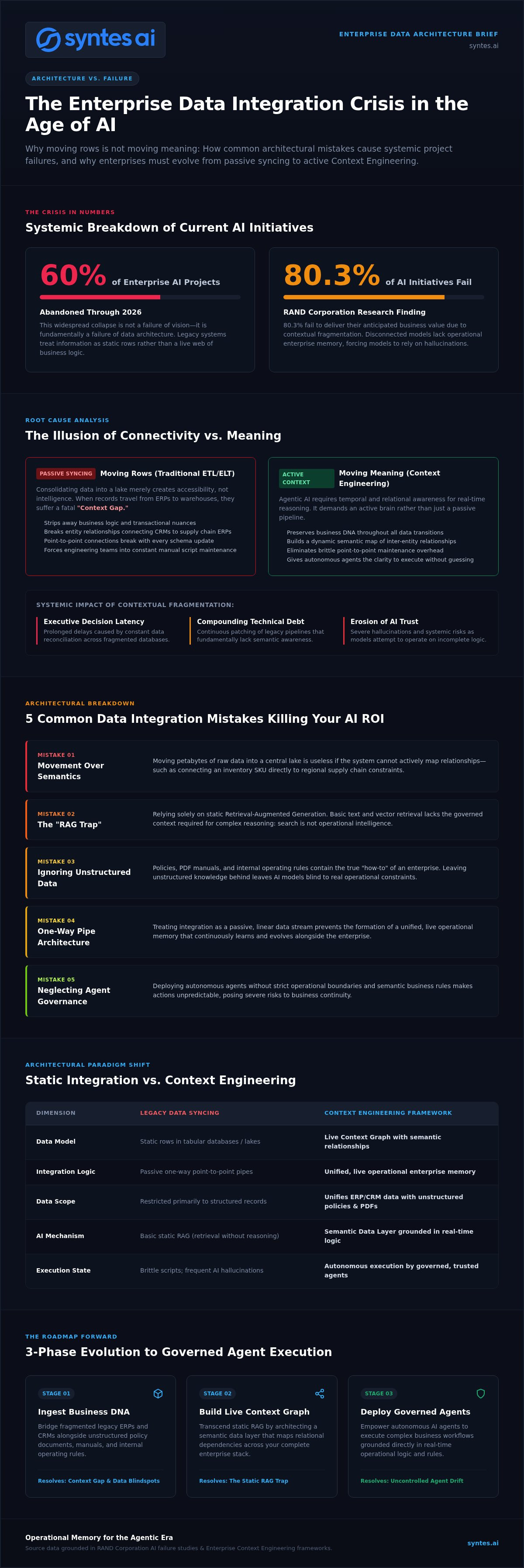
Legacy enterprise data integration is failing because it treats data as a commodity to be moved, not an asset to be understood. For decades, the industry relied on the foundational principles of data integration to consolidate heterogeneous sources into a single view. This approach worked for static reporting. It fails for agentic AI. Modern integration requires a pivot from passive syncing to active context creation. Traditional ETL and ELT processes are architecturally insufficient for the demands of agentic systems because they lack the temporal and relational awareness necessary for real-time reasoning. They move rows; they don’t move meaning.
When data moves from an ERP to a warehouse, it often undergoes a “Context Gap.” It loses the subtle business logic, the specific transactional nuances, and the relationship to other entities that give it value. This loss of meaning is one of the most common data integration mistakes committed by enterprise leaders today. The result is fragmented knowledge that forces AI models to guess rather than know. When your data loses its business DNA during transport, your AI strategy is dead on arrival.
The Illusion of Connectivity
Consolidating data into a central lake does not equate to integration. It merely creates accessibility. True integration requires data intelligence. This is the ability of a system to understand how a customer record in a CRM relates to a supply chain delay in an ERP. Relying on point-to-point integrations creates a brittle, high-maintenance architecture. These connections break with every schema update. They demand constant manual script maintenance, effectively turning your engineering team into a repair crew for a system that was supposed to drive innovation. The systemic impact of this fragmentation includes:
- Increased latency in executive decision-making due to data reconciliation delays.
- High technical debt from patching legacy pipelines that lack semantic awareness.
- Erosion of trust in AI-generated outputs as models operate on incomplete logic.
The Cost of Contextual Fragmentation
The operational drag of disconnected data is measurable and severe. Research from the RAND Corporation indicates that 80.3% of enterprise AI initiatives fail to deliver their anticipated business value. This failure is often rooted in contextual fragmentation. When an AI model lacks a unified enterprise memory, it resorts to hallucinations to fill the gaps. These errors aren’t just technical glitches; they are systemic risks. First-wave AI initiatives frequently stall at the proof-of-concept stage because the underlying data architecture cannot support the leap from an isolated chatbot to a governed, autonomous agent. Without a live operational model, your AI is merely a sophisticated toy operating in a vacuum.
5 Common Data Integration Mistakes Killing Your AI ROI
Enterprise AI failure is rarely a result of poor model selection. Instead, it stems from the root causes of enterprise AI project failure: a fundamental disconnect between data pipelines and business logic. When organizations scale AI without a robust context layer, they inevitably encounter common data integration mistakes that erode ROI. These errors transform sophisticated models into expensive, unreliable liabilities. Avoiding these pitfalls requires a shift from simple data movement to sophisticated Context Engineering.
- Prioritizing movement over semantics: Moving petabytes of data into a lake is useless if the system cannot map the relationship between a SKU and a regional supply chain constraint.
- Relying on static RAG: Basic retrieval lacks the governed context required for complex reasoning, leading to the “RAG Trap.”
- Ignoring unstructured data: Policies, PDF manuals, and internal rules contain the “how-to” of your business. Omitting them leaves your AI blind to operational reality.
- One-way pipe architecture: Treating integration as a passive stream prevents the creation of a live operational memory that evolves with the business.
- Neglecting agentic governance: Without strict rules, autonomous agents become unpredictable and potentially dangerous to business continuity.
The RAG Trap: Why Search is Not Intelligence
Standard vector databases provide a facade of intelligence. They excel at finding similar text but fail at understanding the underlying business intent. This is the RAG Trap. Retrieving isolated facts leads to explainability issues because the model lacks the connective tissue of enterprise logic. To move beyond this, leaders must focus on how to prevent AI hallucination by grounding models in deterministic truth rather than probabilistic guesses. Intelligence requires a hybrid approach where graph-based relationships provide the context that vector search misses. These common data integration mistakes are not just technical debt; they are strategic barriers to scale.
The Governance Gap in Agentic AI
Integrating data without business rules creates catastrophic safety risks. If an agent can access your ERP but doesn’t understand your procurement policies, it cannot be trusted to execute actions. A unified context layer is the only way to ensure auditable and explainable AI performance. This layer acts as a translator, turning raw data into policy-compliant actions. Establishing this foundation is critical for building secure enterprise AI that survives the transition from pilot to production. If you are ready to see how a live context graph solves these challenges, you can book a demo with our team to explore the Syntes AI Platform.
Beyond Syncing: Architecting for Operational Relationship Intelligence
Operational Relationship Intelligence is the bridge between raw data and executable insight. It isn’t enough to know that a customer exists in Salesforce and an invoice exists in SAP. You must understand the causal link between them. One of the common data integration mistakes is treating these records as isolated islands. True intelligence requires a semantic data layer for enterprise that translates technical schemas into business logic. This layer ensures that when an AI agent queries your stack, it perceives a coherent operational reality rather than a fragmented database.
This architecture aligns with the NIST AI Risk Management Framework, which emphasizes the necessity of valid and reliable data substrates. By mapping multi-dimensional relationships using graph technology, you transition from a static repository to a live, evolving model of your business. This model captures the “why” behind every transaction, providing the deterministic grounding that modern LLMs lack. It eliminates the guesswork that leads to operational friction.
The Power of the Context Graph
The enterprise knowledge graph serves as this unified context layer. It goes beyond traditional “Data Integration” to achieve “Context Engineering.” While standard pipelines focus on the mechanics of transfer, a context graph focuses on the mechanics of meaning. It links customers, products, and internal business rules in a real-time web. This allows AI agents to navigate complex hierarchies and dependencies with a level of precision that flat tables cannot provide. It turns your data into an operational memory that grows more valuable with every new connection.
Bridging the Gap Between LLMs and Proprietary Data
Generic LLMs are powerful but context-blind. Context Engineering is the critical evolution beyond simple prompt engineering. It’s the process of feeding proprietary, structured, and unstructured context into the model’s reasoning loop. This ensures the AI understands specific operational events, such as how a port strike affects a specific SKU’s delivery timeline based on your unique logistics contracts. By avoiding common data integration mistakes that strip away these dependencies, you empower your AI to act as a seasoned consultant rather than a confused intern. Your AI finally understands the hierarchies and operational events that define your competitive edge.
The Context Engineering Framework: A Roadmap to Unification
Most organizations view integration as a plumbing problem. They choose a tool, build a pipeline, and hope for the best. This reactive approach is where common data integration mistakes begin. The Context Engineering Framework replaces this tactical mindset with a strategic methodology. It begins with Connect, bridging the gap between structured ERP tables and unstructured policy documents. It advances to Understand, utilizing automated discovery to identify business semantics and entity relationships without manual tagging. This isn’t just about moving data; it’s about capturing the functional essence of your operations.
A static model is a dead model. Contextualize ensures your enterprise model evolves alongside your real-time transactions. Govern applies security, permissions, and compliance directly at the context layer, ensuring that data protection isn’t an afterthought. Finally, Execute provides the necessary foundation for agentic AI platforms to perform governed actions. When your AI understands the rules of the business, it can be trusted to act on its behalf.
Building a Live Operational Memory
Batch processing is a relic of the past. If your AI reasons on data that’s four hours old, its conclusions are already obsolete. A live operational memory integrates real-time events, such as inventory shifts or market fluctuations, directly into the reasoning engine. Two-way connectors maintain data integrity by ensuring that actions taken by an AI agent are instantly reflected across all systems of record. This eliminates the synchronization latency that often characterizes common data integration mistakes in legacy environments. Your AI needs a pulse, not a snapshot.
Governance and Explainability by Design
Scaling AI requires absolute trust. Explainable reasoning is non-negotiable for enterprise-grade deployments. If an agent triggers a supply chain order or flags a compliance risk, you must be able to audit the logic behind that decision. Implementing Human-in-the-Loop systems for high-stakes processes provides the necessary guardrails while the AI learns. You can scale your initiatives without compromising on security because the logic is transparently baked into the context layer. It replaces the black-box uncertainty of first-wave AI with a deterministic, auditable framework for execution.
Trusted Execution: Deploying Governed Agents with Syntes AI
The Syntes AI Platform is the definitive resolution to the systemic failures of legacy architecture. It doesn’t merely move data; it engineers the intelligence required for autonomous performance. By addressing the common data integration mistakes that lead to a 60% project abandonment rate, Syntes AI provides a stable foundation for the next generation of enterprise capability. It transforms fragmented knowledge into a live, trusted Context Graph. This acts as a central operational memory, ensuring that every AI agent in your stack operates from a single, unified version of the truth.
This shift represents a fundamental transition from passive business intelligence to active, automated enterprise intelligence. You’re no longer just observing data trends through a dashboard. Instead, you’re deploying agents capable of reasoning over complex relationships and performing governed actions across your entire system. These agents understand the “why” behind every transaction because they’re grounded in the semantic logic of your business. They don’t just guess; they execute with precision.
Beyond Retrieval-Augmented Generation
Standard RAG is a search problem. Syntes AI is a reasoning solution. While many organizations fall into the “RAG Trap” by relying on isolated vector search, our platform utilizes a Hybrid Graph Database to manage enterprise-scale complexity. This approach provides a unified context layer that connects structured transactional data with unstructured policies. It ensures model reliability in the most demanding operational environments. You achieve a level of deterministic truth that probabilistic search alone can’t reach. It’s the difference between an AI that finds a document and an AI that understands how that document dictates a specific business process.
Book Your Enterprise Intelligence Demo
The path to agentic intelligence requires a departure from brittle, point-to-point syncing. You must unify your fragmented data silos into a live operational memory that evolves at the speed of your business. Our team is ready to show you the framework for deploying trusted AI agents that actually drive ROI. Don’t let common data integration mistakes stall your innovation any longer. It’s time to build an architecture designed for the future of work.
Architecting the Future of Enterprise Intelligence
The era of passive data syncing has reached its logical conclusion. Realizing measurable value from AI requires a fundamental shift beyond the RAG Trap and the structural flaws that currently drive high project abandonment rates. By systematically eliminating common data integration mistakes such as prioritizing raw data movement over semantic relationship mapping, your organization can finally establish a reliable operational memory. This isn’t just a technical upgrade; it’s a strategic necessity.
The path forward is defined by the Syntes AI Context Engineering Framework. This methodology transforms fragmented silos into a Live Operational Context Graph, providing the enterprise-grade governance and explainability required for high-stakes business execution. You now possess the roadmap to bridge the gap between static records and agentic intelligence. It’s time to move from theoretical experimentation to trusted, automated performance.
Your enterprise is ready for a new level of operational clarity. Let’s build the foundation for your agentic future together.
Frequently Asked Questions
What are the most common data integration mistakes in large enterprises?
The most frequent errors include prioritizing data movement over semantic relationship mapping and treating integration as a passive, one-way pipe. Large enterprises often focus on the volume of data transferred rather than the business logic that connects disparate records. These common data integration mistakes result in high technical debt and brittle architectures that require constant manual patching. Without relationship-based intelligence, your data remains a collection of isolated records rather than a functional model of the business.
How do data silos impact the performance of AI agents?
Data silos force AI agents to operate on incomplete or conflicting information, leading to severe execution errors. When critical business rules are trapped in one system while transactional data resides in another, the agent lacks the unified context required for reasoning. This fragmentation prevents the agent from understanding dependencies, such as how a supply chain delay affects a specific customer contract. Consequently, the agent can’t be trusted to perform autonomous actions without constant human intervention.
What is the difference between data syncing and Context Engineering?
Data syncing is the passive replication of records between systems, while Context Engineering is the active discipline of building and maintaining business context for AI accuracy. Syncing focuses on the mechanics of transfer. Context Engineering focuses on the mechanics of meaning. It involves discovering entities, mapping multi-dimensional relationships, and applying governance rules. This process transforms raw data into a live operational model that AI agents use for sophisticated, grounded reasoning across the enterprise stack.
Why is standard RAG insufficient for complex enterprise data integration?
Standard RAG relies on isolated vector search, which lacks the relational awareness needed for complex enterprise logic. It retrieves text snippets based on similarity but fails to understand hierarchies, dependencies, or temporal events. This RAG Trap often leads to hallucinations because the model guesses the connections between retrieved facts. Successful enterprise AI requires a hybrid approach where a graph structure provides the deterministic grounding that simple retrieval-augmented generation can’t offer on its own.
How does a Context Graph help prevent AI hallucinations?
A Context Graph prevents hallucinations by providing a deterministic, relationship-based foundation for AI reasoning. Instead of predicting the next word based on probability, the AI agent queries a structured web of verified business logic and transactional data. This unified context layer ensures that every output is grounded in the actual state of the business. By linking structured data to unstructured policies, the graph eliminates the context gap that typically causes models to invent or misinterpret information.
What is Live Operational Memory in the context of AI infrastructure?
Live Operational Memory is a continuously evolving enterprise model that integrates real-time events into the AI reasoning engine. Unlike static data warehouses that rely on batch processing, this infrastructure captures the current state of the organization as it changes. It serves as a persistent memory for AI agents, allowing them to understand the impact of new transactions or environmental shifts instantly. This real-time relevance is essential for moving from passive observation to active, automated performance.
How can I ensure my AI agents are governed and safe to execute actions?
You ensure safety by applying governance, security, and compliance protocols directly at the context layer. The Syntes AI Platform utilizes a framework where business rules and permissions are baked into the data relationships themselves. This creates deterministic guardrails for agentic behavior. By implementing Human-in-the-Loop systems and ensuring explainable reasoning, you can audit every action an agent takes. This level of oversight is non-negotiable for deploying AI into mission-critical business processes safely and effectively.
Why is semantic data integration necessary for Master Data Management (MDM)?
Semantic data integration is necessary for MDM because it provides the functional logic behind the golden record. Traditional MDM often struggles with heterogeneous data sources that use different terminologies for the same entity. Semantic mapping resolves these discrepancies by discovering business semantics automatically. It ensures that your Master Data Management strategy isn’t just about cleaning rows; it’s about creating a shared understanding. This foundation is critical for avoiding common data integration mistakes that undermine enterprise data integrity.