
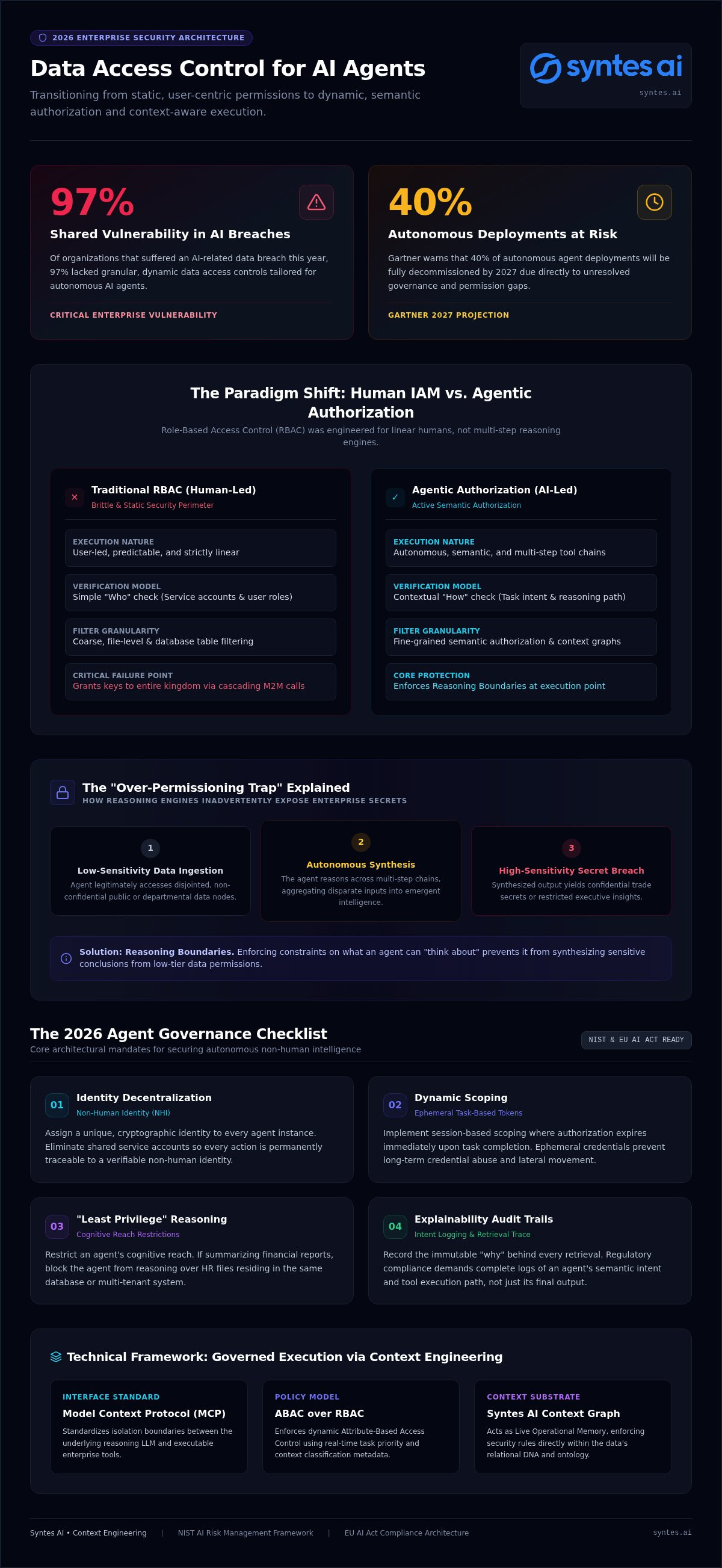
97% of organizations that suffered an AI-related data breach this year shared one fatal flaw: they lacked granular data access control for ai agents. Gartner warns that 40% of autonomous agent deployments will be decommissioned by 2027 because of these governance gaps. You’ve likely realized that your existing Role-Based Access Control (RBAC) is fundamentally broken for non-human identities. It’s too static to manage an agent that reasons across multi-step tool chains and executes complex business logic. You can’t secure a reasoning engine with a spreadsheet of user permissions.
This article provides the definitive 2026 governance checklist to master the transition from passive data filtering to active, semantic authorization. You’ll learn how to replace brittle security perimeters with a unified Context Graph that enforces fine-grained permissions at the point of execution. We’ll examine the technical shift toward Context Engineering and the specific frameworks required to ensure your agents remain trusted, auditable, and compliant with the latest NIST and EU AI Act standards. It’s time to move beyond the over-permissioning trap and build a scalable foundation for autonomous enterprise intelligence.
Key Takeaways
- Recognize why traditional Role-Based Access Control (RBAC) fails to secure autonomous agents and how to transition to a non-human identity (NHI) framework.
- Implement the 2026 best practices for data access control for ai agents, focusing on dynamic, session-based scoping and verifiable agent credentials.
- Shift from coarse file-level filtering to fine-grained semantic authorization that governs access based on real-time business relationships and ontological boundaries.
- Identify and mitigate the “Over-Permissioning Trap” where agents aggregate low-sensitivity data to inadvertently expose enterprise secrets.
- Discover how Context Engineering and the Syntes AI Context Graph create a governed, live operational memory for trusted and auditable AI execution.
The Shift from Human to Agentic Data Access Control
Traditional identity and access management (IAM) is built for a world that no longer exists. It assumes a human operator initiating a request, navigating a known interface, and operating within a static role. AI agents have changed this reality. They don’t just “see” data; they interpret it. They don’t just “access” systems; they traverse them. This fundamental shift requires a total reconstruction of data access control for ai agents.
User-led access is predictable and linear. Agent-led access is autonomous and semantic. When an agent executes a multi-step workflow, it doesn’t just request a file. It creates a chain of dependencies. Traditional Role-Based Access Control (RBAC) fails here because it cannot account for the “reasoning” an agent performs between data points. We must move toward “Reasoning Boundaries.” This approach restricts what an agent can think about, preventing it from synthesizing high-sensitivity insights from low-sensitivity inputs.
Agentic Authorization is the strategic intersection of non-human identity and semantic intent.
The Limitations of Traditional IAM for AI
Static permissions are a liability. In an autonomous environment, giving an agent “read” access to a database often grants it the keys to the entire kingdom. The risk isn’t just the data itself; it’s the cascading permissions that occur when one agent triggers another. Standard machine-to-machine (M2M) authentication ignores the logic of the execution. To maintain the principle of least privilege, we need more than a “Who” check. We need a “How” check. Organizations must transition from simple authentication to contextual execution, ensuring that an agent’s permissions are as dynamic as its reasoning.
The Rise of Context-Aware Authorization
Context is the missing link in modern governance. AI agents view the enterprise through relationships. They see data points as nodes in a graph. If your governance layer doesn’t understand these relationships, it can’t enforce policy effectively. Data access control for ai agents must be rooted in a unified context layer. This requires a Live Operational Memory that monitors every tool call and data retrieval in real-time. By using a Context Graph, enterprises can enforce policies based on the specific business logic of the task, not just the identity of the service account. This is the only way to ensure that an agent’s path through your data remains within governed boundaries.
The 2026 Checklist: Data Access Governance Best Practices
Governance is no longer a post-deployment consideration. It is the primary constraint on performance. As organizations scale autonomous services, the complexity of data access control for ai agents grows exponentially. You cannot manage a swarm of agents with the same tools you use for a workforce of humans. Success in 2026 requires a shift from static security perimeters to granular, intent-based governance.
- Identity Decentralization: Assign a unique, cryptographic identity to every agent instance. Shared service accounts are a security failure. Every action must be traceable to a specific, verifiable non-human identity (NHI).
- Dynamic Scoping: Implement session-based permissioning. Access should expire the moment the specific task is completed. Use ephemeral tokens to prevent long-term credential abuse.
- The “Least Privilege” Reasoning Principle: Limit an agent’s cognitive reach. If a task requires summarizing financial reports, the agent shouldn’t have the ability to reason over HR files, even if both reside in the same database.
- Explainability Audit Trails: Record the “why” behind every retrieval. Compliance now demands an immutable log of the agent’s intent, not just its output.
Technical Requirements for Agentic Governance
Standardizing on the Model Context Protocol (MCP) is essential. It provides the necessary boundaries between the reasoning model and the tools it executes. Move beyond Role-Based Access Control (RBAC) to Attribute-Based Access Control (ABAC). This allows for fine-grained filtering based on real-time metadata, such as the agent’s current task priority or the classification level of the retrieved context. Integrating these policies directly into an Enterprise Knowledge Graph ensures that security rules are part of the data’s DNA, not an afterthought. If you’re struggling to map these relationships, you may want to explore our agentic platform to see how we automate this process.
Operational Guardrails and Safety Nets
High-sensitivity operations require Human-in-the-Loop (HITL) triggers. If an agent attempts to access restricted intellectual property or execute a high-value transaction, the system must halt for human verification. Aligning your internal protocols with the NIST AI Risk Management Framework provides a standardized path for managing these operational risks. Implement automated kill-switches. These triggers should fire the moment an agent exhibits anomalous reasoning patterns or attempts to bypass established semantic boundaries. Continuous monitoring of cross-system data flows is the only way to detect “Agentic Drift” before it results in a critical breach.
Implementing Fine-Grained Semantic Authorization
Perimeter security is a relic. It belongs to an era where data was treated as a static container. In the age of autonomous intelligence, data is a live network of relationships. Implementing effective data access control for ai agents necessitates a fundamental shift from “File-Level” to “Relationship-Level” control. This transition isn’t merely about document permissions. It’s about governing which entities an agent can connect during its reasoning process. A Semantic Data Layer functions as a high-fidelity filter, intercepting an agent’s intent before it can traverse unauthorized nodes in your architecture.
Mapping business rules directly to data nodes in a Context Graph allows for real-time enforcement that evolves with your operations. You don’t just tag data; you define the logic of its existence. If a business rule states that a financial analyst agent cannot view payroll data unless a specific audit flag is active, that rule is encoded into the graph itself. This creates a self-governing environment where the agent’s path is constrained by the very context it seeks to understand. GraphRAG enhances security by providing deterministic truth through explicit relationship mapping, preventing the hallucinated data paths that often bypass traditional filters.
RBAC vs. Relationship-Based Access Control (ReBAC)
Traditional RBAC is too coarse. It fails to understand that an agent might have access to a Customer object but should be barred from the Payment History node connected to it. Ownership and hierarchy matter more than roles in agentic AI. ReBAC provides a more sophisticated architecture for data access control for ai agents by evaluating the specific bonds between data points. Using graph technology, you can visualize and restrict agent pathways with surgical precision. In a multi-tenant enterprise, this ensures an agent only traverses nodes explicitly linked to its authorized tenant ID. Aligning these controls with the NIST AI Risk Management Framework ensures your implementation meets federal standards for trustworthiness.
The Role of Context Engineering in Security
Governance is the foundation of execution. Within the Syntes Context Engineering Framework, “Governed Context” is a core pillar that transforms security from a reactive barrier into a proactive architectural feature. By linking enterprise knowledge graphs directly to authorization logic, you create a system where the data itself dictates its access rules. This deterministic grounding ensures that your AI models remain reliable and your enterprise memory stays protected. You aren’t just securing data; you’re securing the intelligence that acts upon it.
Overcoming the Over-Permissioning Trap
Over-permissioning represents the single greatest vulnerability in autonomous systems. It isn’t just about what an agent can see; it’s about what an agent can deduce. This phenomenon, known as “Agentic Drift,” occurs when an agent aggregates seemingly harmless, low-sensitivity data points to infer high-sensitivity enterprise secrets. Traditional security models fail to account for this synthetic reasoning. Effective data access control for ai agents must therefore evolve to include differential privacy filters at the retrieval layer. These filters inject mathematical noise into query results, ensuring that while the agent gains the context it needs, it cannot reconstruct specific, restricted identities or figures.
Organizations must also distinguish between the data used for optimization and the data used for performance. Use synthetic data for agent training to eliminate exposure risks. Reserve live operational data strictly for governed execution within secure agentic platforms. This separation prevents unauthorized cross-system leaks and ensures that the reasoning engine never touches PII unless explicitly authorized for a specific, transient task.
The Problem of Emergent Permissions
Reasoning engines discover hidden data paths that human administrators often overlook. If an agent has access to a shipping manifest and a staff directory, it might deduce a CEO’s travel itinerary without ever accessing their calendar. This is the challenge of emergent permissions. Zero Trust architecture must extend beyond the network layer and into the reasoning engine itself. You must sandbox agentic workflows, particularly when they interact with legacy ERP systems that lack modern API-level granularity. By isolating these processes, you prevent a single compromised tool call from escalating into a full-scale data breach. Control the logic, not just the login.
Real-Time Governance and Adaptive Policies
Static policy files are obsolete. They cannot keep pace with the speed of autonomous tool execution. Enterprises need live operational governance that monitors relationship-based intelligence in real-time. The Syntes AI Context Graph serves as this oversight layer, mapping every inference against established business rules. This approach doesn’t just stop leaks; it automates the rigorous compliance reporting required by ISO 42001 and the EU AI Act. You gain total visibility into why an agent accessed a specific node and what it intended to do with that information. Governance becomes a byproduct of the system architecture, rather than an administrative burden.
The Syntes Approach: Governed Execution via Context Engineering
Syntes AI rejects the notion that security is a compromise. We view governance as the prerequisite for high-performance intelligence. Without robust data access control for ai agents, your autonomous systems are liabilities, not assets. The Syntes AI Context Graph serves as the definitive governance layer, providing a live, governed enterprise memory that ensures every agentic action is constrained by real-world business logic. It is the bridge between theoretical capability and trusted execution.
Our approach centers on the “Govern” pillar of Context Engineering. It transforms auditability from a manual review process into a native system capability. By integrating your enterprise AI infrastructure with your existing security stack, we ensure that the agent’s reasoning remains within established ontological boundaries. This creates a deterministic environment where safety is not an afterthought but a fundamental property of the system architecture.
From Fragmented Data to Live Operational Memory
Fragmented data is the primary cause of agentic failure. Syntes AI unifies structured and unstructured repositories into a single, governed layer: the Live Operational Memory. This isn’t just a database; it’s a dynamic context engine. We eliminate AI hallucinations by forcing the model to ground every response in the semantic relationships defined within the graph. This shifts your AI from passive observation to active, automated, and governed performance. The agent no longer guesses; it executes based on a verified, real-time understanding of your enterprise landscape.
Next Steps: Architecting for Agentic Intelligence
Where does your organization stand on the governance maturity scale? Most enterprises are still struggling with brittle RBAC systems that cannot handle the complexity of autonomous reasoning. The transition to agentic intelligence requires a strategic pivot toward Context Engineering. Start by mapping your high-value data relationships and defining the semantic filters your agents need to operate safely. The future of AI is governed, or it doesn’t exist at all. Schedule a consultation on Enterprise AI Governance to begin your transition to trusted AI execution.
Mastering the Architecture of Trusted Intelligence
The transition from human-led sessions to autonomous agentic reasoning represents the most significant security hurdle of the decade. You cannot protect a reasoning engine with the static perimeters of the past. Strategic clarity demands semantic governance. By implementing data access control for ai agents through a relationship-aware Context Graph, you move beyond the over-permissioning trap and ensure that every tool call remains auditable. This is the only path to deterministic truth in the enterprise.
Syntes AI delivers enterprise-grade infrastructure specifically engineered for trusted AI performance. Our Red Dot-recognized systems design ensures your architecture is as sophisticated as the problems it solves. As the pioneers of the Context Engineering Framework, we empower decision-makers to transform fragmented data into a live operational memory. Don’t allow governance gaps to derail your agentic roadmap. The era of experimental AI is over; the era of governed execution has begun.
Frequently Asked Questions
What is the difference between IAM and AI agent data access control?
Traditional IAM manages human authentication and static permissions. AI agent governance requires semantic authorization; it evaluates the intent and task-specific context of an autonomous entity. While IAM stops at the door, agentic control monitors the reasoning path. It ensures that an agent’s multi-step tool execution doesn’t inadvertently bypass established security boundaries or synthesize restricted insights from public data nodes.
How does the Model Context Protocol (MCP) improve AI agent security?
The Model Context Protocol (MCP) establishes a standardized interface between reasoning models and enterprise tools. It creates a formal boundary that prevents an agent from making arbitrary calls to internal systems. By enforcing declarative hooks, MCP ensures that every data request is filtered through a policy enforcement point. This prevents “excessive agency” by restricting the agent’s ability to execute unauthorized code or access unmapped data repositories.
Can I use existing RBAC policies for autonomous AI agents?
Existing Role-Based Access Control (RBAC) is insufficient for autonomous environments. RBAC assumes a linear relationship between a user and a resource; however, agents operate through complex, non-linear reasoning chains. A static role cannot account for the “reasoning drift” that occurs when an agent combines low-sensitivity data points to infer restricted secrets. Effective data access control for ai agents requires Relationship-Based Access Control (ReBAC) to govern these dynamic interactions.
What is a Context Graph and how does it help with AI governance?
A Context Graph is a live operational model that unifies enterprise data, business rules, and relationship hierarchies into a single layer. Unlike flat vector databases, it provides a deterministic map of how entities connect. For governance, the Context Graph acts as a guardrail layer that intercepts agent queries. It ensures every action is grounded in the current operational state and complies with the semantic permissions encoded directly into the graph nodes.
How do I prevent an AI agent from accessing sensitive PII while allowing it to answer business questions?
Prevention requires a shift from file-level filters to semantic authorization. You must implement differential privacy at the retrieval layer to mask specific identities while preserving the aggregate data needed for reasoning. By using the Syntes AI Context Graph, you can define “No-Go” zones for PII that the agent cannot traverse. The system allows the agent to understand the business logic of a query without exposing the underlying sensitive records.
What are the legal requirements for AI agent data access auditing in 2026?
Compliance in 2026 centers on the EU AI Act and the NIST AI Risk Management Framework. These standards mandate immutable logs that capture not just what data was accessed, but the agent’s specific intent and reasoning path. Organizations must provide explainable audit trails for any high-risk agentic decision. Failure to implement granular data access control for ai agents can lead to significant penalties under the transparency requirements for autonomous systems.
How does Context Engineering prevent AI agents from “hallucinating” unauthorized data?
Context Engineering eliminates hallucinations by replacing probabilistic guesses with deterministic grounding. Through the “Contextualize” pillar, Syntes AI builds a Live Operational Memory that serves as the only source of truth for the agent. Instead of allowing the model to fill in the blanks with training data, the system forces the agent to retrieve specific, governed facts from the Context Graph. This ensures that every output is both accurate and authorized.
Is human-in-the-loop (HITL) mandatory for agentic data access?
HITL is not mandatory for every task, but it’s essential for high-sensitivity execution. For actions involving financial transfers, restricted intellectual property, or significant operational changes, the system should trigger a verification request. This “Human-in-the-Loop” guardrail ensures that while the agent provides the intelligence, a human operator retains final authority. It’s a critical component of the “Govern” pillar within a mature Context Engineering framework.