
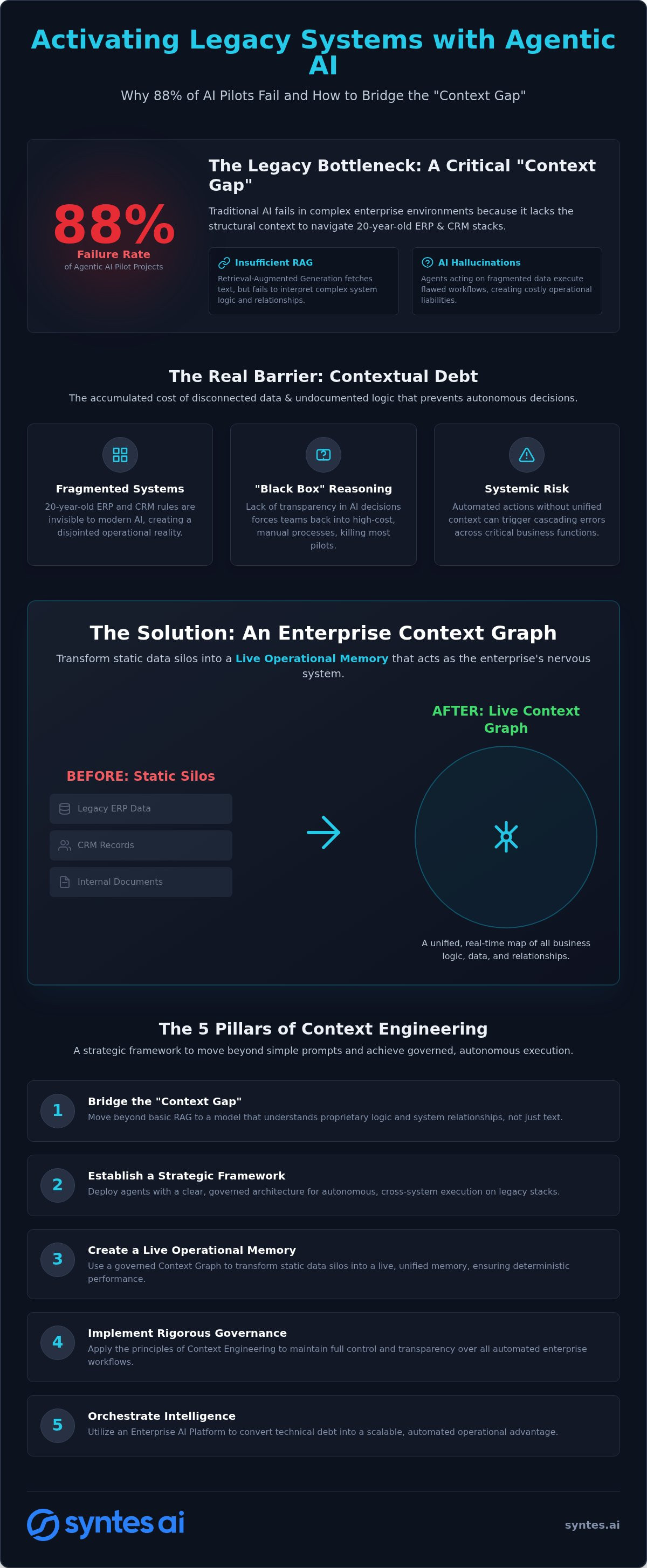
Why do 88% of agentic AI pilot projects fail to reach production? The answer is simple. They lack the structural context required to navigate the labyrinth of 20-year-old ERP and CRM stacks. You know the frustration of fragmented data silos and the paralyzing risk of AI hallucinations in critical workflows. Deploying agentic ai for legacy systems is not about replacing your infrastructure; it is about activating it through a sophisticated, governed architecture.
You have likely accepted that manual legacy modernization is too slow and too expensive. We agree. The path forward is not a high-risk, “big-bang” replacement, but the implementation of a governed Context Graph. This article demonstrates how to bridge the context gap by creating a unified, live operational memory across your enterprise. You will discover how to deploy autonomous agents that execute tasks with deterministic precision, effectively reducing technical debt while ensuring every action is grounded in real-time business logic and enterprise-grade governance.
Key Takeaways
- Understand why traditional RAG fails in complex enterprise environments and how to bridge the “Context Gap” between general model knowledge and proprietary logic.
- Establish a strategic framework for deploying agentic ai for legacy systems to achieve autonomous, cross-system execution across fragmented ERP and CRM stacks.
- Transform static data silos into a Live Operational Memory using a governed Context Graph to ensure deterministic, hallucination-free AI performance.
- Implement the five pillars of Context Engineering to move beyond simple prompts and achieve rigorous governance over automated enterprise workflows.
- Orchestrate intelligence across your legacy core with an Enterprise AI Platform that converts technical debt into a scalable, automated operational advantage.
The Legacy Bottleneck: Why Traditional AI Fails Complex Enterprise Stacks
Enterprises are hitting a wall. They’ve deployed Large Language Models (LLMs), but they haven’t achieved operational autonomy. The problem is the “Context Gap,” the vast chasm between the general knowledge of a model and the proprietary, often undocumented logic buried in your legacy infrastructure. Standard Retrieval-Augmented Generation (RAG) is insufficient for this challenge. It fetches text; it doesn’t interpret systems. In brittle, siloed environments, RAG simply provides a faster way to retrieve the wrong information. Deploying agentic ai for legacy systems requires more than a simple vector database. It demands a bridge between modern intelligence and ancient architecture.
Consumer-grade chatbots are designed for conversation. Enterprise agents must be designed for execution. When agents act on fragmented, outdated data without a governing layer, they become operational liabilities. They hallucinate reasoning, misinterpret business rules, and execute flawed workflows that can cost millions. You don’t need a bot that talks; you need an agent that knows.
Why did first-wave enterprise AI fail to scale?
Isolated facts lead to hallucinated reasoning. CIOs cannot trust agents that operate as a “Black Box,” unable to explain the logic behind their actions. This lack of transparency forces teams back into the high-cost cycle of manual data mapping, which remains the primary killer of most AI pilots. If an agent cannot trace its decision back to a specific ERP record or CRM entry, it isn’t an asset. It’s a risk. First-wave AI ignored the messy reality of 20-year-old schemas, attempting to apply a thin layer of “intelligence” over deep systemic rot. The result was predictable: pilots that worked in a sandbox but crumbled in production.
Is fragmented knowledge a systemic risk?
Yes. Your 20-year-old ERP business rules are effectively invisible to modern AI models. These rules, often hard-coded or maintained by retiring staff, define how your business actually functions. Allowing agents to perform actions across these systems without a unified context layer isn’t innovation; it’s a gamble. Without a centralized way to synchronize these disparate rules, agents will inevitably conflict with established protocols. This creates a dangerous environment where automated actions trigger cascading errors across the supply chain or financial ledgers. Contextual Debt is the primary barrier to agentic AI, representing the accumulated cost of disconnected data and undocumented business logic that prevents autonomous systems from making informed decisions.
Architecting Operational Memory: The Role of the Enterprise Context Graph
Static databases are tombs of information. They store records but fail to capture the living logic of a business. To enable agentic ai for legacy systems, you need more than a repository; you need a nervous system. The Syntes AI Context Graph serves as this unified context layer, providing the high-fidelity map required for autonomous agents to navigate 20-year-old infrastructure. It facilitates a critical transition from static, siloed databases to a Live Operational Memory. This isn’t just about storing data. It is about mapping the intricate, shifting relationships between customers, products, and the rigid business rules that govern them. Without this “Operational Relationship Intelligence,” an agent is blind to the downstream consequences of its actions.
From Static Data to Living Context
Static records are dead weight in a high-velocity enterprise. A live operational graph represents real-time relationships, ensuring that an agent understands not just the “what” but the “why” and “how” of a system’s state. Two-way connectors facilitate this by continuously syncing structured legacy data with unstructured tribal knowledge found in internal documentation. This integration is vital. It allows the system to ingest the nuanced expertise of your most seasoned engineers, turning “unwritten rules” into machine-readable logic. When an agent can query both a mainframe database and a PDF of standard operating procedures simultaneously, it gains the context necessary to execute complex, multi-step tasks without tripping over legacy constraints.
Building a Unified Context Layer
Establishing agentic ai for legacy systems is a structural challenge, not a linguistic one. Fragmented systems like SAP, Salesforce, and legacy mainframes create a disjointed reality that paralyzes standard AI. The context layer bridges these silos, creating a single reasoning plane where disparate data points converge into a coherent ground truth. This is the foundation of The Semantic Data Layer, which provides the architectural integrity required for agents to act with certainty across the entire enterprise stack. When an agent knows exactly how a change in a CRM record impacts a specific inventory rule in the ERP, it can orchestrate workflows that previously required dozens of manual touchpoints. This level of systemic integration eliminates the need for high-risk modernization projects. If you are ready to see how this architecture transforms your operations, you can explore our Enterprise AI Platform and start activating your legacy data today.
Beyond RAG: Implementing Context Engineering for Deterministic Agents
Prompt engineering is a surface-level fix for a structural problem. While prompts attempt to guide model behavior through linguistic nuance, they fail to address the underlying lack of systemic knowledge. To deploy agentic ai for legacy systems that can actually execute work, you must move toward Context Engineering. This is the next evolution. It is the process of architecting a high-fidelity environment where agents don’t guess; they know. Unlike the probabilistic nature of consumer-grade chatbots, which calculate the next likely word, deterministic agents require a rigid framework to ensure every action is grounded in verified enterprise logic.
The transition from “chatting about data” to “executing across systems” depends on this shift. If your agent is merely retrieving snippets of text via standard RAG, it remains a probabilistic engine prone to error. Context Engineering replaces this uncertainty with a multi-layered approach to data relevance and operational authority. It ensures that when an agent triggers a transaction in a legacy ERP, it does so with the same precision as a seasoned human operator.
The 5 Pillars of Context Engineering
The Syntes Context Engineering Framework provides the necessary structure for this transition. It is built on five critical pillars:
- Connect: This goes beyond simple API calls. It involves integrating structured ERP data with the unstructured business policies and “tribal knowledge” that define operational boundaries.
- Understand: The system must discover entities and hierarchies within legacy codebases. It deciphers the relationships in 30-year-old schemas that standard AI models cannot see.
- Contextualize: This pillar aligns real-time system states with historical patterns, allowing the agent to recognize the significance of a specific data point within a broader workflow.
- Govern: Security and compliance are applied at the context level. Agents only see and act on data they are explicitly permitted to access, mirroring your existing enterprise permissions.
- Execute: The final stage where the agent performs the action across the legacy stack, backed by a verified reasoning chain.
Achieving Explainable AI Reasoning
Trust in the enterprise is built on evidence, not intuition. For agents to be granted autonomy over critical infrastructure, they must provide an auditable chain of thought. This is where GraphRAG outperforms vector-only search. By utilizing a Knowledge Graph, agents can traverse complex relationships to find the “ground truth” rather than just similar-sounding text. This structural approach is a primary method for how to prevent AI hallucination in production environments. When an agent can point to the specific business rule and the exact database record that justified its action, the “Black Box” problem disappears. You gain a system that is not only autonomous but entirely transparent and accountable to your existing governance standards.
Deploying Agentic Workflows: A Strategy for Governed Legacy Integration
Traditional Robotic Process Automation (RPA) is a fragile solution for a complex problem. It relies on brittle UI recording and rigid scripts that break the moment a legacy interface undergoes even a minor update. Deploying agentic ai for legacy systems represents a fundamental shift from mimicry to intelligence. Instead of clicking buttons, these agents query the Context Graph to understand the systemic implications of a request. They bridge the gap between LLMs and proprietary enterprise data by acting as a reasoning layer that translates high-level intent into precise, multi-step execution across disparate stacks.
The ROI of agentic workflows far exceeds traditional automation. While RPA requires constant maintenance and manual intervention for every edge case, autonomous agents adapt to data-level changes. They don’t just follow a path; they solve the problem. This reduces the high cost of manual legacy modernization by allowing you to extract modern value from ancient systems without a total rebuild.
Cross-System AI Orchestration
Agents must navigate across CRM, ERP, and legacy databases to complete a single task. This orchestration is not linear. It requires the agent to maintain data integrity across every touchpoint, ensuring that a financial record in a mainframe matches the customer status in Salesforce. By solving enterprise data silos through agentic intelligence, organizations move beyond the “copy-paste” automation of the last decade. You gain the ability to execute complex workflows, such as automated supply chain reconciliation, that were previously impossible due to fragmented data environments.
Governance and Safety for Autonomous Agents
Governance is not an afterthought. It is a structural requirement. We implement business rules as hard guardrails within the Context Graph, ensuring that agents adhere to corporate policy even when interacting with “dumb” legacy systems that lack native modern security. For high-stakes legacy automation, Human-in-the-Loop (HITL) systems provide a final layer of validation. This ensures that while the agent performs the heavy lifting, a human expert remains the ultimate authority for critical approvals. Real-time auditing and behavior monitoring turn autonomous action into a transparent, low-risk operational strategy that satisfies even the most rigorous compliance standards.
The Syntes Agentic Platform: Orchestrating Intelligence Across Your Legacy Core
The Syntes Agentic Platform is not a migration tool. It is definitive infrastructure for legacy intelligence. While competitors offer migration frameworks designed to move your code, we provide the operational layer that allows you to act within it. By deploying agentic ai for legacy systems, you bypass the high-risk, high-cost cycle of total system replacement. You activate your existing infrastructure through a Live Operational Memory that meets 2026 enterprise standards for real-time relevance and deterministic action. As of Q1 2026, 78% of Global 2000 companies have moved AI workloads into production; those failing to bridge the context gap will be left behind. We ensure you aren’t one of them.
Our platform empowers your teams through a sophisticated “No-Code AI Apps” capability. This allows business units to build and deploy governed agentic workflows without deep technical overhauls or months of custom development. It’s about moving from passive data silos to active, automated intelligence. You don’t need to wait for a five-year modernization roadmap to realize value. You can start executing now.
Building the Future on Legacy Foundations
Total rewrites are no longer a prerequisite for AI-driven efficiency. You can build the future on your legacy foundations by layering intelligence over your core. This approach allows you to scale agentic AI without the limitations of consumer-grade bots that lack enterprise grounding. We provide a shared context layer that serves as a single source of truth for all enterprise agents, regardless of which legacy system they are interacting with. This architecture turns your technical debt into a strategic advantage, allowing you to move faster than competitors who are still bogged down in “big-bang” replacement projects.
Getting Started with Syntes AI
Initiate the Context Engineering process for your legacy stack today. The roadmap from data integration to autonomous execution is shorter than you think. We guide you through the transition from fragmented data to trusted enterprise intelligence, ensuring every step is grounded in your specific business logic and governance requirements. It is time to stop experimenting with pilots and start delivering production-grade results. We invite you to explore the Syntes Agentic Platform and discover how to bridge the context gap in your own infrastructure. Transition from fragmented data to trusted enterprise intelligence today.
Activating the Legacy Core for Autonomous Intelligence
Legacy infrastructure is not an anchor. It is a reservoir of operational logic waiting for the right architecture. You have seen how the Context Gap paralyzes standard AI; yet, you now possess the roadmap to bridge it. By implementing a Live Operational Memory, you transform fragmented silos into a unified reasoning plane. This fundamental shift enables the deployment of agentic ai for legacy systems that perform with deterministic precision rather than probabilistic guesswork.
The path to 2026 enterprise standards requires a governed Agentic AI framework that respects your existing business rules while automating complex, cross-system legacy integration. You don’t need to endure the catastrophic risk or the exorbitant cost of a total system rewrite. Instead, activate your core. Orchestrate intelligence across your entire stack. Secure your competitive advantage by turning historical data into real-time operational performance. Every record in your ERP and every rule in your CRM is a building block for a more efficient, autonomous future.
The evolution of your enterprise starts with informed, autonomous action. We’re ready to help you lead it.
Frequently Asked Questions
Can agentic AI work with mainframe systems and old ERPs?
Agentic ai for legacy systems works by creating a translation layer between modern reasoning models and ancient codebases. Syntes AI utilizes two-way connectors to ingest data from mainframes and 20-year-old ERPs into a live Context Graph. This architecture allows agents to query and execute actions across these systems without requiring native AI capabilities from the legacy stack. You gain the power of autonomous intelligence without the risk of a high-cost infrastructure overhaul.
What is the difference between an AI agent and traditional RPA?
Traditional RPA mimics human actions through rigid, script-based recording. If a UI element shifts or a business rule changes, the process breaks. AI agents operate through reasoning and intent. They utilize Operational Relationship Intelligence to navigate complex workflows, adapting to system changes in real-time. While RPA is a “dumb” executor of repetitive tasks, an agent is an informed operator that understands the systemic consequences of its actions.
How does a Context Graph prevent AI hallucinations in legacy systems?
Hallucinations occur when Large Language Models attempt to fill information gaps with probabilistic guesses. A Context Graph eliminates these gaps by providing a deterministic “ground truth” derived from your proprietary data. By mapping relationships between customers, products, and rigid business rules, the graph forces the agent to reason over verified enterprise facts. This structural grounding ensures that every output and action is grounded in the reality of your specific operational environment.
Is it necessary to rewrite my legacy code to use agentic AI?
You don’t need to rewrite a single line of legacy code to achieve AI-driven efficiency. Syntes AI builds a unified context layer that wraps around your existing infrastructure, discovering entities and hierarchies within old schemas automatically. This approach bypasses the “big-bang” replacement strategy that often leads to catastrophic project failure. You can activate your existing core systems, turning technical debt into a strategic asset through the implementation of a governed operational memory.
How do you govern AI agents to ensure they don’t make unauthorized changes?
Governance is embedded directly into the Context Engineering framework. We apply security, permissions, and corporate policies as hard guardrails at the context level. Agents are restricted to specific data domains and can only execute actions that align with pre-defined business rules. For high-stakes transactions, Human-in-the-Loop (HITL) systems ensure that a human expert provides the final authorization. This multi-layered approach ensures that autonomous systems remain entirely accountable and transparent.
What is Context Engineering and why is it better than RAG?
Standard Retrieval-Augmented Generation (RAG) is a simple search-and-fetch mechanism that often lacks deep systemic understanding. Context Engineering is a comprehensive discipline focused on building, governing, and maintaining the structural knowledge required for AI accuracy. It utilizes GraphRAG to traverse complex enterprise relationships rather than just finding similar-sounding text snippets. This results in deeper reasoning and more reliable outcomes, positioning it as the necessary evolution for enterprises that have outgrown basic chatbot capabilities.
How long does it take to build a Live Operational Memory for a large enterprise?
Establishing a Live Operational Memory is an iterative journey rather than a single event. While a comprehensive enterprise-wide graph matures over time, initial integration of critical ERP and CRM data can be achieved in a matter of weeks. This allows organizations to begin deploying governed agents and realizing ROI almost immediately. The focus is on rapid, high-impact connectivity that evolves into a total shared context layer for all enterprise-wide autonomous intelligence initiatives.
Does Syntes AI offer on-premise hardware for legacy integration?
Syntes AI does not sell on-premise hardware or provide general IT staff augmentation. We are an enterprise AI platform focused on the software infrastructure required for data integration and agentic execution. Our solutions are designed to bridge the gap between your existing hardware and modern AI capabilities through a sophisticated, cloud-based reasoning layer. We provide the tools to orchestrate intelligence across your core without the need for additional physical infrastructure investments.