

If your AI agent can’t explain why a Tier 2 supplier delay in Southeast Asia will trigger a production bottleneck in a core operational hub, it isn’t intelligent; it’s just a fast reader with a fragmented memory. Many enterprise leaders assume that a clean data warehouse and a standard semantic layer provide enough structure for autonomous agents to function. You’ve likely spent years refining these schemas, expecting that a unified vocabulary would finally eliminate the friction in your digital operations. It’s a logical assumption, but it’s increasingly dangerous.
The reality is that the debate of semantic layer vs knowledge graph is no longer academic. It’s a matter of operational survival. While a semantic layer defines what your data is, it cannot explain how your business actually works across disparate systems. This article reveals why traditional data architectures are the primary cause of AI hallucinations and how knowledge graphs provide the deterministic grounding required for agents to reason, not just retrieve. We’ll outline a clear architectural framework for 2026 that replaces fragile pipelines with live operational memory, enabling your AI to execute complex tasks across your entire enterprise with absolute certainty.
Key Takeaways
- Recognize the critical architectural shift in the semantic layer vs knowledge graph landscape, moving from static business definitions to dynamic relationship intelligence.
- Identify why traditional semantic layers fail to support agentic AI, often leading to hallucinations when agents attempt to reason across complex, disconnected systems.
- Build a framework for autonomous execution by grounding your AI in a Knowledge Graph that serves as a deterministic, live operational memory.
- Transition from simple retrieval to sophisticated reasoning by implementing Context Engineering to bridge the gap between LLMs and proprietary data.
- Eliminate the fragility of cross-system workflows by architecting a unified context layer that remains resilient even as underlying schemas evolve.
Beyond Buzzwords: Defining the Semantic Layer and Knowledge Graph
Data clarity is not the same as operational intelligence. In the race to deploy agentic AI, many enterprises mistake a well-organized data warehouse for a ready-to-use context engine. This confusion stems from a fundamental misunderstanding of the semantic layer vs knowledge graph debate. One provides a dictionary; the other provides a brain. Understanding the structural divergence between these two is the first step toward building AI that actually works.
The Semantic Layer as a Translation Interface
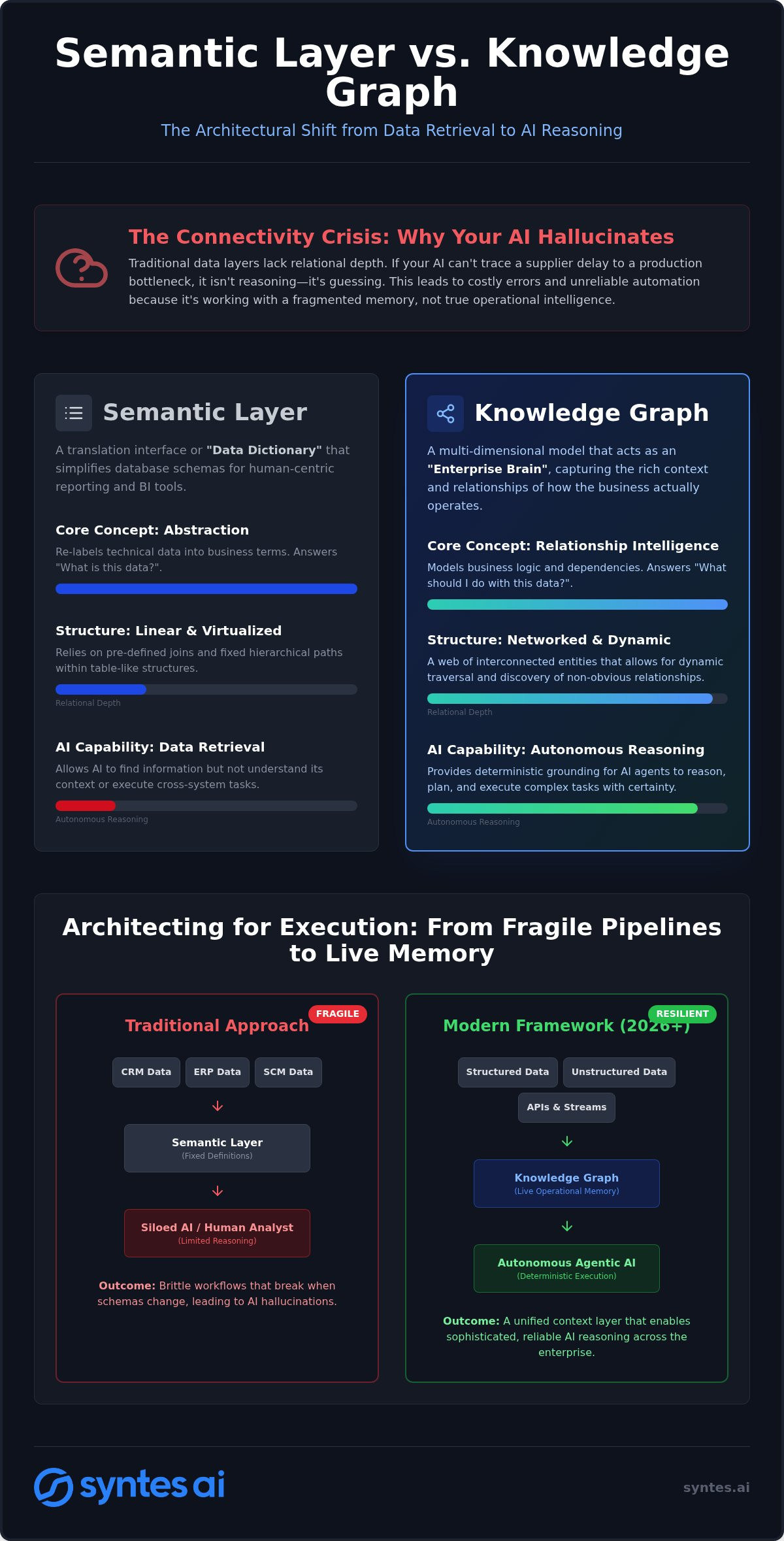
A semantic layer acts as a business-oriented abstraction. It translates technical, often cryptic database schemas into a common vocabulary that stakeholders recognize. Instead of forcing an analyst to navigate SUM(fact_sales.amount_net_tax), the layer presents a single, clean field: “Revenue.” Its primary function is simplifying SQL queries for BI tools and human analysts. However, this structure is inherently limited. It’s virtualized, linear, and lacks the deep relational depth required for complex automated reasoning. The semantic layer serves as a passive interface for human-centric reporting.
The Knowledge Graph as a Multi-Dimensional Model
A Knowledge graph represents a fundamental departure from flat table structures. It’s a network of interconnected entities and relationships that captures the real-world context of an enterprise. By utilizing graph schemas like RDF or LPG, it connects structured and unstructured data into a cohesive whole. It doesn’t just store data; it captures hierarchies, dependencies, and complex business rules that define how an organization functions. This is the “Enterprise Memory” for AI systems. It provides the multi-dimensional context that allows an agent to understand that a “Customer” isn’t just a row in a CRM, but a node connected to specific contracts, support tickets, and supply chain logistics.
- Captures Hierarchies: Maps nested organizational structures and product taxonomies that tables cannot represent.
- Defines Dependencies: Tracks how a change in one system, such as a supply chain delay, impacts downstream production schedules.
- Integrates Unstructured Data: Links PDF contracts and email threads to structured transaction records for holistic reasoning.
Why does this distinction matter? Mapping data is not the same as modeling business logic. As we move into 2026, the industry is shifting from simple “Data Discovery” to true “Operational Intelligence.” The semantic layer vs knowledge graph debate isn’t about which technology is better, but which is fit for purpose. A semantic layer helps you find the data. A knowledge graph tells you what to do with it. This shift is critical for agentic AI. If your architecture relies on a flat translation layer, your agents will remain trapped in silos. They’ll be unable to reason across the complex system relationships that define your competitive advantage.
Structural Divergence: Abstraction vs. Relationship Intelligence
Data storage determines the limits of logic. Most semantic layers exist as virtualized abstractions sitting atop centralized data warehouses. They don’t restructure your data; they simply re-label it. In contrast, enterprise knowledge graphs often leverage hybrid graph databases to store data as a web of interconnected nodes. This structural difference is the primary reason why the semantic layer vs knowledge graph debate is so critical for AI. One is a map of where data lives. The other is a model of how your business operates.
Fixed Paths vs. Dynamic Traversal
Rigid architectures produce rigid results. Semantic layers restrict exploration to predefined dimensions and fixed hierarchical paths. They rely on “joins” that must be anticipated by a data engineer. If a relationship wasn’t mapped during the initial schema design, it effectively doesn’t exist for your AI. A modern knowledge graph architecture allows for dynamic, multi-hop reasoning. It discovers non-obvious relationships across disparate datasets without requiring a hard-coded join for every query. This is Operational Relationship Intelligence. It enables an agent to trace an impact from a raw material shortage to a specific customer’s churn risk, even if those data points live in separate systems.
Metadata vs. Context
Metadata is insufficient for autonomous action. Labeling a column as “Customer_ID” tells an AI what the data is, but not what it means in the moment. Knowledge graphs provide real-time context by linking entities like Customers, Products, and Policies through active relationships. At Syntes AI, we’ve observed that context is the next evolution beyond simple prompt engineering. While a prompt provides instructions, context provides the grounding. LLMs struggle with semantic layers because they require the model to perform the “heavy lifting” of connecting dots that aren’t physically linked. Graphs remove this burden. They provide the deterministic pathways that eliminate hallucinations and ensure your AI acts on facts, not probabilities.
Ensuring your architecture can handle the fluidity of 2026 operations requires more than just a better view of your tables. You need a system that evolves with your business logic. If you’re ready to move beyond static models, you can explore how these architectures apply to your stack through a tailored technical session.
The Connectivity Crisis: Why Traditional Semantic Layers Stall Agentic AI
Traditional data architectures are collapsing under the weight of agentic requirements. While a semantic layer clarifies what “Revenue” means, it offers no insight into how a contract update in the CRM impacts a delivery schedule in the ERP. This is the connectivity crisis. In the context of semantic layer vs knowledge graph, the former creates a black box where the AI can read labels but cannot comprehend the systemic relationships that drive autonomous action. Fragility is the inevitable result. When agents operate in silos, they fail the moment a workflow requires cross-system execution.
The Failure of Retrieval-Augmented Generation (RAG)
Standard RAG is a search engine, not a reasoning engine. It retrieves documents based on vector similarity; however, similarity is not causality. When an agent needs to execute a cross-system workflow, it requires “Live Operational Context.” Standard RAG cannot provide this. Achieving true autonomy requires solving enterprise data silos through a unified context layer. Unlike simple retrieval, reasoning over a graph allows an agent to understand the current state of the business. It enables the transition from finding a document to understanding a process. If your AI can’t see the connection between a support ticket and a churn risk, it isn’t agentic. It’s just a chatbot with a better search bar.
Why AI Agents Require Deterministic Truth
Autonomous agents cannot be allowed to guess. If an agent “hallucinates” a relationship between a discount policy and a high-value client, the cost is measured in lost margin and damaged trust. This is why understanding the benefits of using knowledge graphs is essential for any 2026 AI strategy. These structures provide a map of business rules that ensure governed execution. You must prioritize how to prevent AI hallucination by replacing probabilistic guesses with deterministic graph grounding. A semantic layer is simply not enough for grounding. It lacks the relational logic to verify if an agent’s proposed action violates a core operational constraint. Agents need a map of business rules, not just a list of definitions. Without this, you’re just automating errors at scale.
Architecting for Execution: Grounding Autonomous Agents in Knowledge
Execution requires more than access; it requires precision and permission. To move from a prototype to a production-grade agentic system, you must follow a methodical architectural path that prioritizes reasoning over simple retrieval. The transition from a semantic layer vs knowledge graph is not a single leap but a strategic evolution. It begins with the foundation of your data and ends with the autonomous execution of business logic.
- Step 1: Connect. Ingest disparate data sources across your ERP, CRM, and unstructured repositories to ensure no operational silo is left behind.
- Step 2: Define. Establish business semantics and ontologies to create a shared language that both humans and AI agents can interpret without ambiguity.
- Step 3: Build Foundation. Implement a semantic data layer for enterprise to serve as the baseline for trusted, governed data access.
- Step 4: Evolve. Mature that layer into a Knowledge Graph to enable the multi-hop reasoning required for complex, cross-functional tasks.
- Step 5: Deploy. Activate Governed AI Agents that execute actions based on this live, deterministic context.
The Five Pillars of Context Engineering
Context Engineering is the discipline of maintaining AI-ready operational context. It’s not enough to have data; you must have data that is ready for action. This framework consists of five critical pillars: Connect, Understand, Contextualize, Govern, and Execute. By following these pillars, you ensure AI accuracy and enterprise-grade safety. You aren’t just giving the agent a database; you’re giving it a set of boundaries and a deep understanding of its environment. This approach replaces the chaos of unguided prompts with a rigorous system of operational truth.
Bridging Structured and Unstructured Data
Modern enterprises run on more than just tables. You have PDF policies, email threads, and real-time transaction data that must all speak the same language. Integrating these disparate formats is the primary challenge of 2026. While vector search can find a document, it can’t explain how a policy change in a PDF affects a transaction in your ERP. This is where GraphRAG excels. By utilizing the knowledge graph, GraphRAG provides deeper context than vector search alone. It positions the knowledge graph as the Live Operational Memory of the firm. It allows the agent to reason across the entire landscape of your business intelligence, ensuring that every action is grounded in the full reality of your operations.
From Passive Models to Live Operational Memory: The Syntes AI Context Graph
Static data is a liability in a real-time economy. While the industry continues to debate the merits of a semantic layer vs knowledge graph, Syntes AI has already moved the goalpost. We recognize that even a sophisticated graph is useless if it remains a static repository. The Syntes AI Platform represents a unified enterprise AI infrastructure designed specifically for the agentic era. It doesn’t just store relationships; it powers them through Live Operational Memory. This is a continuously evolving context layer that reflects the current state of your business, not just its history.
Trust is the non-negotiable currency of enterprise AI. To achieve this, we provide Explainable AI that offers a complete audit trail for every reasoning step taken by an agent. You won’t have to guess why an autonomous agent made a specific decision. Every action is grounded in the Context Graph and verified against your internal business rules. This ensures Governed Agentic AI that complies with enterprise policies with absolute precision. We replace probabilistic guesswork with deterministic pathways, ensuring your agents act as loyal, informed extensions of your workforce.
Operational Relationship Intelligence
Syntes AI models the vital relationships between customers, products, and operational events with surgical accuracy. Traditional knowledge graphs often struggle with the latency of real-time updates; however, our Context Graph is built for immediate decision-making. It captures the “now.” This is why 2026 leaders are choosing the Syntes Agentic Platform for operational automation. We don’t just bridge silos; we eliminate them by creating a single, living source of operational truth that agents use to navigate complex system landscapes.
Take the Next Step in Context Engineering
The transition from passive observation to active performance is the defining challenge of modern digital transformation. You’ve spent years collecting data; it’s time to make that data work for you. By moving beyond the limitations of a standard semantic layer vs knowledge graph framework, you position your enterprise to lead in the age of autonomy. Context Engineering is the final bridge to trusted, scalable AI execution. Stop managing data and start orchestrating intelligence.
Dominating the Agentic Era through Contextual Mastery
The choice between a semantic layer vs knowledge graph is the difference between an AI that simply reads data and an AI that actually acts on it. While translation layers provide a useful business vocabulary, only a robust Knowledge Graph offers the relationship intelligence necessary for autonomous agents to navigate complex systems without failing. By adopting Context Engineering, you replace fragile data pipelines with a deterministic framework that ensures every automated action is explainable and safe.
Syntes AI empowers global enterprises with a Live Operational Memory that transforms fragmented data into a unified, active intelligence. As pioneers in the field, we ensure that your AI agents aren’t just guessing; they’re reasoning with absolute clarity across your entire stack. The future of operational automation belongs to those who move beyond static abstractions and embrace the power of real-time context.
Take command of your enterprise AI strategy and build the foundation for trusted, scalable execution. For enterprises looking to extend this optimization to external conversational search platforms, AISEOAgency SG provides specialized AI SEO expertise to ensure your brand remains discoverable in the agentic era.
Frequently Asked Questions
Is a semantic layer the same as a knowledge graph?
No, they are fundamentally different architectures. A semantic layer acts as a dictionary that renames technical columns for humans, while a knowledge graph serves as a brain that understands how those entities relate. The semantic layer vs knowledge graph distinction is vital for those moving beyond basic reporting. While the former simplifies SQL queries, the latter models the actual business logic required for AI agents to reason across disparate systems.
Can a knowledge graph replace my existing semantic layer?
A knowledge graph doesn’t just replace a semantic layer; it evolves it. It incorporates the business definitions you’ve already built while adding the connective tissue that links data across silos. For enterprises focused on operational intelligence, maintaining both creates redundant technical debt. You should prioritize an architecture that supports multi-hop reasoning over one that merely provides a flat translation of database tables for BI tools.
How does a knowledge graph prevent AI hallucinations?
It prevents hallucinations by providing deterministic grounding for every AI response. Instead of allowing an LLM to predict the next token based on probability, the graph forces the agent to follow verified relationship paths. If a relationship doesn’t exist in your Knowledge Graph, the agent won’t invent it. This architectural constraint ensures that AI output is always rooted in your proprietary business truth rather than statistical guesswork.
What is the role of GraphRAG in enterprise AI?
GraphRAG is the bridge between static information retrieval and active operational reasoning. It allows AI agents to retrieve specific documents while simultaneously understanding the broader context of those facts within the enterprise. By combining vector search with graph traversal, GraphRAG ensures that agents don’t just find data; they understand how that data impacts your real-time business processes and decision-making frameworks across the entire organization.
What happens if my enterprise data is fragmented across legacy systems?
Fragmentation is exactly why the semantic layer vs knowledge graph debate favors the graph. Knowledge graphs are designed to integrate structured and unstructured data from ERPs, CRMs, and legacy repositories into a unified context. You don’t need to move your data to a single warehouse. Instead, you create a virtualized relationship layer that allows AI agents to navigate your existing environment with total operational clarity.
How long does it take to implement an enterprise knowledge graph?
Implementation is a phased process that delivers value quickly. While a full enterprise-wide map takes time, we deploy initial context graphs in weeks to solve specific operational bottlenecks. We avoid the multi-year timelines associated with traditional MDM projects. By focusing on Context Engineering for high-impact workflows first, you achieve measurable ROI while scaling the graph’s complexity as your agentic requirements grow and evolve.
Is a knowledge graph necessary for simple AI chatbots?
How does Syntes AI handle data governance within the context graph?
Syntes AI embeds governance into the core of our Context Graph architecture. We apply granular access controls and business rules to every node and relationship within the system. This ensures that AI agents only operate within authorized boundaries. Our platform provides a complete audit trail for every reasoning step, allowing your compliance teams to verify that autonomous actions always align with internal enterprise policies and regulatory requirements.