
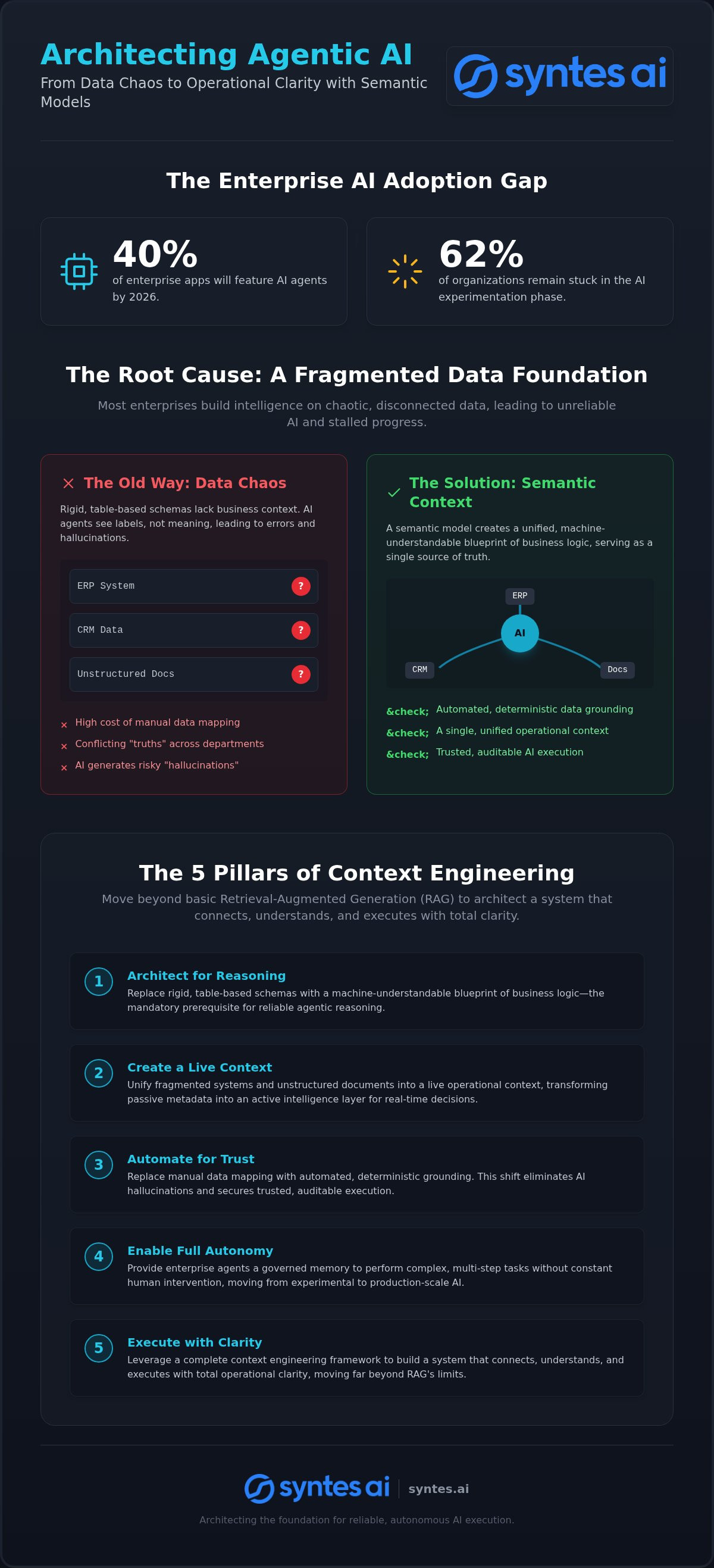
By the end of 2026, 40% of enterprise applications will feature AI agents, yet a staggering 62% of organizations remain trapped in the experimentation phase. This gap exists because most enterprises are attempting to build sophisticated intelligence on top of a fragmented, chaotic data foundation. You already know that raw data is not knowledge. You have seen how Large Language Models, stripped of business context, generate hallucinations that put operations at risk. The true business value of semantic data model integration is no longer a theoretical debate for data scientists; it is the mandatory architectural requirement for any leader who demands reliable, autonomous execution.
This article demonstrates how semantic models transform static databases into a live operational context that powers agentic intelligence. We will move beyond the limitations of basic Retrieval-Augmented Generation to explore the Five Pillars of Context Engineering. You will discover how a unified language for enterprise data eliminates manual mapping costs and replaces unreliable AI outputs with trusted, auditable results. We are moving from passive observation to active, automated performance. It is time to architect the foundation your agents require to function with total operational clarity.
Key Takeaways
- Replace rigid, table-based relational schemas with a machine-understandable blueprint of business logic. This architecture is the mandatory prerequisite for reliable agentic reasoning across the enterprise.
- Unify fragmented ERP systems and unstructured documentation into a live operational context. This bridge transforms passive metadata into an active intelligence layer that powers real-time decision-making.
- Maximize the business value of semantic data model strategies by replacing manual data mapping with automated, deterministic grounding. This shift eliminates AI hallucinations and secures trusted, auditable execution.
- Transition from experimental AI to production-scale autonomy. Provide enterprise agents with a governed memory that allows them to perform complex, multi-step tasks without constant human intervention.
- Leverage the Five Pillars of Context Engineering to move beyond the limitations of basic RAG. Architect a system that connects, understands, and executes with total operational clarity.
Closing the Semantic Gap: Why Enterprises Fail Without a Shared Data Language
Data is not your problem. Meaning is. For decades, enterprises have relied on relational databases to store records, but these systems are fundamentally “dumb.” They understand that a column is labeled “Price,” but they don’t understand the business rules that govern it. As we move into 2026, where 40% of enterprise applications are expected to include AI agents, this lack of shared meaning has become a critical failure point. AI agents cannot operate on labels alone; they require a semantic data model that serves as a machine-understandable blueprint of your entire business logic.
The Definition of a Modern Semantic Data Model
A semantic model is more than a map of entities and attributes. It represents the relationships and constraints that define how your business actually functions. In first-generation AI deployments, context was often an afterthought. We now see that context is the only thing that matters. We’re shifting from “what data is” to “what data represents.” A modern model defines that a “customer” isn’t just a row in a CRM table; it’s a complex entity with history, preferences, and contractual obligations. This shift is where the business value of semantic data model implementation begins to manifest. It turns human-readable labels into machine-executable semantics, allowing AI to reason with the same precision as your best analyst.
The High Cost of Data Fragmentation
Tribal knowledge is the greatest liability in your current architecture. When business logic exists only in the heads of senior employees or buried in disparate spreadsheets, your data environment is fragmented. Disconnected silos lead to conflicting “truths.” The marketing department’s definition of “churn” might differ from finance’s definition. For an AI agent tasked with autonomous decision-making, these inconsistencies are fatal. They lead directly to the hallucinations that stall enterprise adoption. Only 13% of enterprises have reached full-scale AI deployment, largely because they lack a unified context layer.
Manual data mapping is a relic of a slower era. It’s too slow. It’s too expensive. It creates a bottleneck that prevents you from reaching 2026-scale operations. The business value of semantic data model structures lies in their ability to eliminate this manual debt. By creating a unified language, you provide a single source of deterministic truth. Without this foundation, your AI initiatives are built on sand. Trusted execution requires a governed, unambiguous understanding of every concept in your enterprise.
From Passive Metadata to Live Context: The Architecture of Semantic Meaning
Metadata is no longer a passive filing cabinet. It’s a live operational nervous system. Traditional data strategies treated metadata as a post-hoc description of what already happened, but in 2026, that’s a recipe for obsolescence. The semantic data layer for enterprise acts as an active bridge between raw infrastructure and agentic execution. It unifies the rigid columns of your ERP with the messy reality of unstructured documents, contracts, and emails. This isn’t just about finding data. It’s about understanding it.
The shift from “Retrieval” to “Reasoning” requires more than just vector search. It requires a graph. While standard RAG systems pull text snippets based on keyword similarity, a semantic model uses ontologies to define hierarchies and constraints. This ensures your AI understands that a “pending contract” mentioned in a PDF is the same entity as “Account_ID_402” in your SQL database. Implementing a universal semantic layer for AI provides the deterministic logic necessary for high-stakes enterprise decisions. It moves the needle from probabilistic guessing to certain execution.
Building the Unified Context Layer
How do you connect customers, products, and policies into a single operational web? You decouple business logic from storage. By using a semantic layer, your business rules remain consistent even if you switch underlying storage technologies. Two-way connectors ensure real-time synchronization so your agents never work with stale information. This decoupling represents the core business value of semantic data model investment: it future-proofs your architecture against shifting tech stacks while providing a stable interface for intelligence.
Context Engineering: The Next Evolution of AI Grounding
Prompt engineering is a dead end. Basic RAG is hitting a performance ceiling. The industry is moving toward “Context Engineering,” the process of building a “Live Operational Memory” that evolves as your business grows. Semantic models provide the structure for this memory. They allow agents to reason through multi-step workflows with near-perfect accuracy by providing a governed context. If you want to see how this looks in practice, you can schedule a platform walkthrough to explore live graph orchestration. The business value of semantic data model adoption is found in this transition from passive observation to active performance. You aren’t just storing data; you’re architecting meaning.
Relational Schemas vs. Semantic Context: Choosing the Core for Enterprise AI
Relational databases are the backbone of the legacy enterprise. They excel at transactional integrity but fail at contextual reasoning. A table is a silo. A row is a fragment. When you force an AI agent to navigate these rigid structures, you’re essentially asking a blindfolded person to navigate a maze using only a list of room dimensions. The business value of semantic data model architecture is found in its ability to break these silos. It replaces the “black box” of relational data with a transparent, navigable web of meaning. Relational models treat every data point as an isolated event. Semantic models treat every data point as a node in a living narrative.
The Limitations of Traditional Relational Databases
Brittle pipelines are a silent killer of AI ROI. Every time a schema changes, a pipeline breaks. Complex SQL joins are not just a technical burden; they’re a source of latency that agents cannot afford. Relational schemas answer “what” happened, but they’re incapable of explaining “why.” They lack the connective tissue to link server performance to churn risk. Legacy systems weren’t built for the speed of thought. Attempting to reconstruct context from flat tables creates a “join hell” that slows autonomous operations. In a world of real-time agentic execution, this latency is a fatal flaw.
The Semantic Advantage for Agentic Intelligence
AI agents require a foundation of “Ground Truth” to act safely. In a decentralized environment, using a semantic layer in a data mesh ensures that every agent uses the same definitions, regardless of where the data resides. The business value of semantic data model adoption is validated by a 2026 survey report showing a 551% ROI for organizations utilizing a universal semantic layer. Agentic AI platforms need deterministic lookups, not probabilistic guesses. Transitioning to relationship-based discovery allows agents to navigate with absolute confidence. They rely on rigid business logic, not database luck. This is the difference between an AI that suggests a solution and an agent that executes one.
Quantifying the Business Value: ROI of Trusted, Governed AI Execution
Strategic leaders often ask if the complexity of modeling is worth the upfront effort. The answer is found in the cost of failure. When an AI agent executes a transaction based on a hallucination, the reputational and financial fallout can be catastrophic. The business value of semantic data model integration is proven by its ability to provide a governed framework for autonomous behavior. It’s the only architectural method to prevent ai hallucination at scale by grounding every model response in verified, deterministic business logic.
Explainable AI isn’t a luxury; it’s a regulatory necessity. In 2026, auditability is the barrier to entry for enterprise AI. Semantic models create a transparent audit trail, allowing you to trace every agentic action back to a specific business rule. This visibility transforms AI from a risky experiment into a trusted operational asset. Beyond compliance, organizations are seeing massive efficiency gains. Research indicates that implementing a universal semantic layer can deliver 3.4 million dollars in net savings by streamlining how intelligence is consumed across the enterprise. It replaces the “black box” with total transparency.
Reducing the Cost of AI Failure
The “data preparation tax” is a massive drain on resources, traditionally consuming 80% of AI project timelines. You can’t afford that delay. A unified context layer allows you to reuse a single semantic model across dozens of agents and business units. It enables a “No-Code AI” environment where business leaders query context instead of writing Python or SQL. This democratization of data access accelerates time-to-market and ensures your AI strategy remains agile. The business value of semantic data model adoption is found in this transition from manual mapping to automated, scalable intelligence.
Beyond Static Modeling: The Syntes AI Context Graph and the Future of Agentic Operations
The Syntes AI Context Graph represents the definitive evolution of semantic architecture. It is not a passive map. It is an active engine. While competitors focus on creating static data products, we focus on creating a live operational nervous system. This is where the business value of semantic data model investments is fully realized. we move beyond simple categorization and into a state of systemic intelligence.
Our approach is built on the Five Pillars of Context Engineering: Connect, Understand, Contextualize, Govern, and Execute. This framework ensures that data isn’t just stored; it’s activated. We ingest fragmented signals, extract their underlying business meaning, and map them into a enterprise knowledge graph. This graph serves as the live memory of your organization. It provides the reasoning layer that allows agents to move from passive observation to autonomous performance.
Live Operational Memory vs. Static Data Warehousing
Data warehouses are graveyards of historical records, disconnected from the pulse of your current operations. Syntes AI replaces this static model with Live Operational Memory. Our platform continuously organizes information into an evolving business model that reflects your reality in real-time. We call this Operational Relationship Intelligence. It integrates live events, complex rules, and transaction histories into a single reasoning layer. Your agents don’t just look at data; they understand the current state of your entire ecosystem.
The Syntes Agentic Platform: Executing on Context
Knowing is no longer enough. Execution is the only metric that matters in 2026. The Syntes Agentic Platform allows you to deploy governed AI agents that act on the context provided by the graph. These aren’t simple chatbots. They’re autonomous workers capable of managing multi-step business processes with precision. We maintain trust through sophisticated Human-in-the-Loop systems, ensuring that high-stakes actions always have the necessary oversight.
The business value of semantic data model adoption is ultimately found in the transition from “knowing” to “doing.” You have identified the systemic flaws in your current data strategy. Now, you possess the tools to fix them. Start your Context Engineering journey by establishing a unified context layer that doesn’t just store your data, but understands it.
Architecting the Future of Autonomous Enterprise Intelligence
The transition from passive data storage to active agentic execution isn’t a choice; it’s a competitive mandate. We’ve explored how fragmented knowledge and brittle relational pipelines lead to operational failure. By contrast, the business value of semantic data model integration lies in its ability to provide a deterministic truth layer that eliminates hallucinations. You’re no longer just managing records. You’re architecting a Live Operational Memory that evolves with your business in real time.
Syntes AI stands as a pioneer in Context Engineering, offering the only path to enterprise-grade governance for AI agents. We replace the uncertainty of probabilistic guessing with the precision of relationship-based reasoning. This is the foundation required for real-time execution at scale. It’s time to move beyond the limitations of legacy architecture and embrace a system designed for total operational clarity.
The era of experimental AI is over. The era of the autonomous enterprise has begun. Secure your foundation today and lead your industry into 2026 with confidence.
Frequently Asked Questions
What is the primary difference between a data model and a semantic data model?
A traditional data model defines technical structures like tables, columns, and keys. It describes how data is stored in a database. A semantic data model defines what that data represents in a business context. It focuses on meaning and relationships rather than storage mechanics. It allows machines to understand that disparate labels like “Client_ID” and “Customer_Ref” refer to the same entity. This transition from storage to meaning is the core of modern architecture.
How does a semantic data model help prevent AI hallucinations?
Hallucinations occur when AI lacks grounding in factual business logic. Semantic models provide a deterministic truth layer that constrains AI responses. Instead of guessing patterns based on probability, the AI queries a governed web of relationships. This ensures every output is derived from verified data and established business rules. By providing this rigid context, you eliminate the ambiguity that typically leads to unreliable or fabricated outcomes in Large Language Models.
Why is a semantic layer necessary for Agentic AI platforms?
Agentic AI platforms require more than raw data; they need to reason across complex workflows. A semantic layer provides the connectivity and logic for autonomous agents to make decisions safely. It acts as the reasoning engine that translates high-level goals into specific, auditable actions. Without this layer, agents are blind to the nuance of your operations. They cannot perform multi-step tasks without a governed understanding of concepts and their interdependencies.
Can we build a semantic data model on top of our existing Snowflake or Databricks environment?
You can and should build a semantic layer on top of your existing cloud data warehouse. This architecture decouples your business logic from the underlying storage technology. It allows you to maintain consistent rules across Snowflake, Databricks, or legacy SQL environments. The business value of semantic data model implementation is maximized when it acts as a unified interface. It transforms your static data lake into a live, navigable knowledge environment for AI agents.
How does semantic data modeling improve Master Data Management (MDM)?
Traditional MDM often struggles with manual mapping and rigid schemas. Semantic modeling improves this by creating a shared language that resolves inconsistencies automatically. It moves beyond simple deduplication to establish deep relationship intelligence across the enterprise. You gain a single, governed view of your core entities across disparate systems. This reduces the technical debt associated with manual integration. It ensures that every department operates from the same high-fidelity version of the truth.
What is the role of a Knowledge Graph in a semantic data strategy?
A Knowledge Graph is the physical implementation of your semantic strategy. It organizes data as a network of interconnected nodes and relationships rather than flat tables. This structure allows for real-time discovery and complex reasoning that relational databases cannot handle. It serves as the live operational memory of your enterprise. By connecting structured and unstructured signals, the graph provides the high-register context needed for agents to execute business processes with absolute certainty.
How long does it typically take to see ROI from a semantic data model implementation?
Organizations often see initial ROI within three to six months by targeting specific high-value use cases like automated compliance or fraud detection. However, the long-term business value of semantic data model adoption is systemic. A 2026 survey found that universal semantic layers deliver an average ROI of 551% over three years. These savings come from reduced data preparation time and the elimination of AI failure costs. You stop wasting 80% of project time on mapping.
Is a semantic data model the same as a data catalog?
No, they serve fundamentally different purposes. A data catalog is a passive index that tells you where data is located. A semantic data model is an active reasoning engine that tells you what the data means and how it relates to other concepts. Catalogs are for humans to find data; semantic models are for machines to understand and execute on it. Transitioning from a catalog to a semantic model is the move from observation to automated performance.