
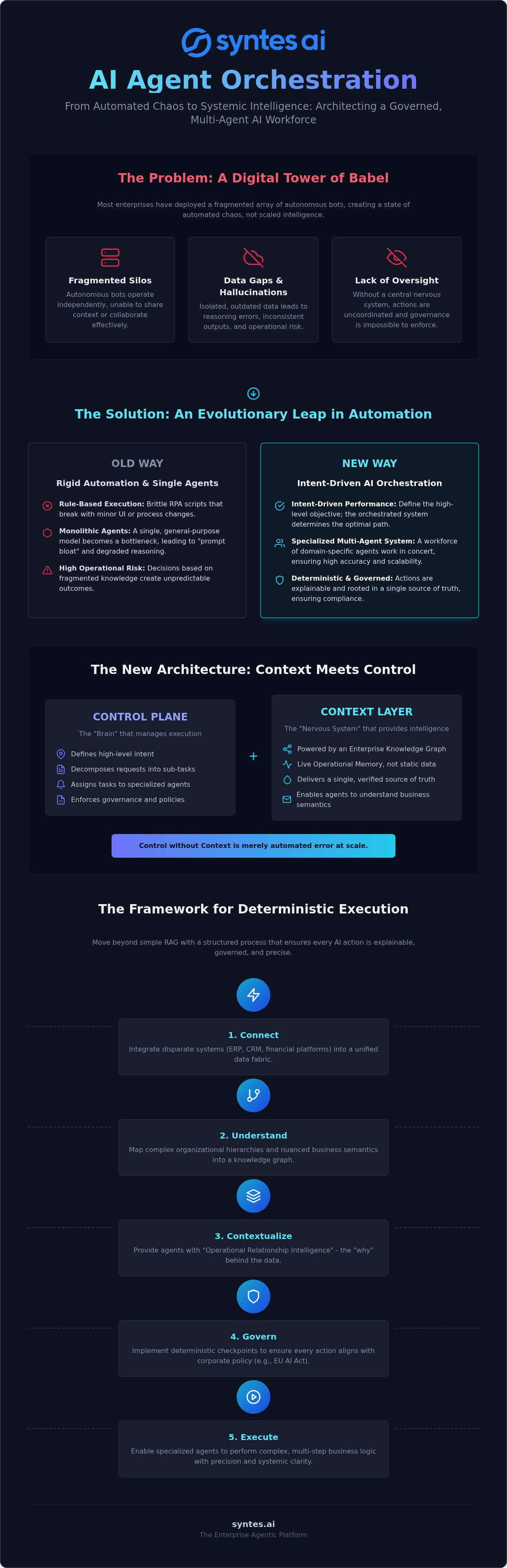
Your current AI strategy is likely creating a digital Tower of Babel. Most enterprises have deployed a fragmented array of autonomous bots that operate in silos, hallucinate due to data gaps, and lack any centralized oversight. This isn’t scaling intelligence; it’s automating chaos. True ai agent orchestration is not a simple control plane script or a sequence of API calls. It’s the structural manifestation of your Enterprise Knowledge Graph, turning isolated tools into a unified, governed workforce.
We understand the frustration of watching promising pilots stall against the realities of legacy CRM integrations and the strict requirements of the EU AI Act. You need more than just connectivity. You require a deterministic framework that ensures every agent action is explainable and every decision is rooted in live operational memory. This article provides the blueprint for that transition. We’ll explore how Context Engineering replaces the limitations of standard RAG to provide the reasoning layer your organization demands. By the end, you’ll possess a clear methodology to architect a multi-agent system that doesn’t just perform tasks but executes complex business logic with absolute precision and systemic clarity.
Key Takeaways
- Transition from rigid, rule-based automation to intent-driven ai agent orchestration to align autonomous systems with high-level enterprise objectives.
- Deploy a unified Context Graph to provide orchestrated agents with a single source of truth, eliminating the operational silos that lead to reasoning errors.
- Adopt sophisticated coordination patterns like the departmental “Handoff” to automate complex cross-system workflows across ERP, CRM, and financial platforms.
- Utilize the “Connect, Understand, Contextualize, Govern, Execute” framework to move beyond simple RAG toward deterministic and explainable AI execution.
- Integrate Live Operational Memory to ensure your multi-agent architecture evolves in real-time, maintaining governance and precision at enterprise scale.
Beyond Automation: The Strategic Necessity of AI Agent Orchestration
The era of passive automation is over. While Robotic Process Automation (RPA) served the enterprise by handling repetitive, rule-based tasks, it lacks the cognitive flexibility required for the modern digital economy. ai agent orchestration represents the next evolutionary step. It’s the systematic coordination of autonomous entities toward a unified business objective. Unlike RPA, which breaks when a UI element shifts or a process deviates by a single degree, agentic orchestration is intent-driven. You define the outcome; the system determines the path. This shift moves your organization from simple task execution to complex, goal-oriented performance.
However, intent without intelligence is dangerous. Most current AI deployments suffer from fragmented knowledge. Agents operate on isolated, outdated data sets, leading to inconsistent outputs and operational risk. This is why enterprise knowledge graphs are the non-negotiable prerequisite for orchestration. They provide the semantic foundation that allows multiple agents to share a single, verified version of the truth. This evolution marks a transition from fragile prompt engineering to robust Context Engineering. Without this unified context, your agents are merely guessing based on incomplete information.
Defining the Orchestrator’s Role in Multi-Agent Systems
The orchestrator functions as the central nervous system of your AI stack. It acts as the brain that manages task decomposition, breaking high-level executive requests into actionable sub-tasks. We distinguish clearly between the control plane, where management and governance occur, and the execution layer, where specialized agents perform their duties. Effective orchestration requires deterministic checkpoints. You can’t leave autonomous workflows to chance. You must implement rigorous validation steps to ensure every agent remains aligned with corporate policy and operational logic, particularly when agents interact with legacy ERP or CRM systems. Specialized consulting from Navo Inc. can help organizations navigate these complexities, focusing on synthetic workforce development and the deployment of AI agents.
The Architecture of Multi-Agent Systems: Context vs. Control
Control without context is merely automated error at scale. If your orchestration layer manages task assignment but lacks a semantic understanding of your business logic, it’s a liability. Effective ai agent orchestration requires a dual-track architecture: a robust control plane for execution and a unified context layer for intelligence. Without this synergy, agents operate in a vacuum, making decisions that are technically correct but operationally disastrous. You don’t just need agents that can act; you need agents that understand why they’re acting.
The Syntes AI Context Graph serves as this unified intelligence layer. It moves beyond simple data retrieval to provide what we call Operational Relationship Intelligence. This capability allows agents to understand complex organizational hierarchies and nuanced business semantics across disparate systems. To understand how this fits into the broader technological stack, consult our guide on agentic ai platforms. For those ready to move from theory to implementation, you can explore our architecture firsthand.
The Control Plane: Managing Intent and Tasking
How does a high-level strategic goal become a finished task? The control plane manages this journey. It decomposes complex business objectives into granular, actionable sub-tasks. In a federated orchestration model, agents don’t just follow orders. They negotiate. They bid for tasks based on their specific domain expertise and current resource availability. This process requires real-time state persistence. For long-running business processes, the system must maintain a constant memory of every step taken, ensuring that if an agent fails or a system goes offline, the workflow resumes without data loss or logic corruption.
The Context Layer: Eliminating Fragmented Knowledge
Static data is the enemy of autonomous intelligence. Traditional RAG (Retrieval-Augmented Generation) is often too slow and too shallow for the demands of 2026. We replace this with Live Operational Memory, a dynamic model that evolves as your business does. By utilizing GraphRAG, agents navigate a web of interconnected entities rather than searching through a flat list of documents. This prevents agents from violating business rules or conflicting with established policies. It ensures that every action taken by an orchestrated agent is grounded in the current reality of your enterprise data, providing the deterministic reasoning required for high-stakes operations.
Orchestration Patterns for Complex Enterprise Workflows
Selecting the correct architecture for ai agent orchestration is a strategic decision that determines whether your system scales or collapses under its own technical debt. You can’t rely on a single pattern for every business process. Centralized models offer total control but create massive latency bottlenecks. Decentralized models provide agility but often bypass critical governance. Federated orchestration is the definitive enterprise solution. It balances localized agent autonomy with a centralized policy layer, ensuring that specialized units execute rapidly while remaining tethered to corporate logic.
Consider the “Handoff” pattern. When a supply chain agent identifies a procurement delay, it doesn’t just flag the error; it hands the full context to a finance agent to adjust quarterly projections. This seamless transition prevents the operational silos that plague traditional enterprise environments. For high-volume data analysis or real-time operational events, “Concurrent” processing allows multiple agents to ingest and analyze streams simultaneously, providing immediate utility. Magentic Execution is the next evolution in plan-first AI reasoning, prioritizing logical validation before a single line of code is ever executed.
Sequential and Concurrent Execution Models
Sequential patterns are the bedrock of linear processes. Use them for document auditing, compliance checks, or multi-stage approval workflows where step B cannot exist without step A. Concurrent patterns, by contrast, accelerate complex tasks like global market sentiment analysis or massive log file ingestion. When problems require multi-disciplinary insight, “Group Chat” patterns allow specialized agents to debate solutions within a governed environment. This ensures the final output is the result of collaborative reasoning rather than a single model’s hallucination.
The Magentic Approach: Plan-First Execution
Plan-first architectures represent a fundamental shift in how agents operate. Instead of reacting blindly to prompts, agents reason about constraints and resource availability before executing a single line of code. This is where Context Engineering becomes vital. By refining the agent’s plan within the Context Graph before action occurs, you eliminate the “try-and-fail” loops common in primitive AI. This methodical approach significantly reduces token costs and error rates. It transforms your AI from a reactive tool into a proactive, strategic asset that understands the rules of the game before it starts to play.
Implementing Governed AI Orchestration: A Roadmap for 2026
Governance is not a secondary consideration. It’s the primary constraint. To deploy ai agent orchestration successfully, enterprises must follow a rigorous, five-stage roadmap: Connect, Understand, Contextualize, Govern, and Execute. This framework ensures that autonomous actions are not just fast, but fundamentally correct. We move beyond simple API calls. We establish a bidirectional flow of information where agents don’t just pull data; they contribute to the evolving state of the system. This methodology transforms your AI from a detached experimental tool into an integrated operational engine.
Blind trust in model output is a recipe for catastrophic failure. You must implement semantic grounding to ensure your agents operate within the bounds of reality. Learning how to prevent ai hallucination is about more than prompt tuning. It’s about architecting deterministic truth. By grounding every agent in the Enterprise Knowledge Graph, you replace probabilistic guessing with verifiable reasoning. This grounding ensures that every orchestrated action is backed by the latest, most accurate enterprise context.
Integration requires Two-way Connectors that bridge the gap between structured ERP tables and unstructured communication logs. This connectivity allows the orchestrator to maintain a holistic view of the operational environment. In audited sectors like Finance and Healthcare, explainability is the price of admission. Every decision path must be traceable. You need to show exactly why an agent chose a specific action, providing a transparent audit trail that satisfies both internal compliance and external regulators. This level of transparency is only possible when reasoning is decoupled from the “black box” and anchored in a governed context layer.
Security and Governance Frameworks for Agentic AI
Security in an agentic world goes beyond simple identity management. It requires granular permission protocols that define exactly what an agent can see and do within your systems. These business rules and policies are embedded directly into the Context Graph. This ensures that governance is not an external wrapper but a core component of the agent’s reasoning process. Every autonomous action is logged in real-time. This creates an immutable audit trail, allowing your compliance teams to monitor every step of a multi-agent workflow with total clarity.
Human-in-the-Loop (HITL) Integration
Autonomy has its limits. High-stakes decision points, such as significant procurement approvals or sensitive data access, require mandatory Human-in-the-Loop (HITL) integration. The UI/UX for these overrides must be intuitive. It should allow human experts to steer the system without disrupting the overall workflow. These feedback cycles do more than just prevent errors. They improve the orchestrator’s future task assignments. By capturing human corrections, the system refines its internal logic, ensuring that the next iteration of the workflow is more efficient and aligned with human intent.
Scaling Intelligence with the Syntes Agentic Platform
Consumer-grade chatbots are toys. The enterprise demands a system that can actually execute. The Syntes Agentic Platform isn’t just a simple interface; it’s the high-performance engine for ai agent orchestration at scale. It unifies structured ERP and CRM data with the vast ocean of unstructured document data—which can be captured more effectively using Manuala to document business processes—into a single, cohesive reasoning layer. This isn’t about answering questions. It’s about performing complex, multi-system workflows with absolute precision. We’ve moved beyond the era of experimental pilots. It’s time to embrace a platform designed for the rigors of global operations.
How do you ensure your AI remains relevant in a shifting market? You provide it with a heartbeat. Our platform doesn’t just store data; it contextualizes it in real-time. By bridging the gap between historical records and live operational events, we enable a level of systemic intelligence that was previously impossible. This transition from passive observation to active, automated performance is the hallmark of a mature AI strategy. It’s the difference between a bot that talks and an agent that works.
Live Operational Memory as the Ground Truth
How does an agent maintain accuracy as business conditions change? The answer lies in Live Operational Memory. Syntes AI creates a continuously evolving organizational memory that integrates real-time operational events with historical business data. During the “Understand” phase, the platform automatically discovers entities and hierarchies, mapping the hidden relationships within your data environment. This creates a dynamic ground truth. Agents don’t rely on static snapshots from months ago; they reason based on the current state of the business. This real-time relevance is what makes trusted AI execution possible in high-stakes environments.
Transitioning from RAG to Context Engineering
Retrieval-Augmented Generation (RAG) was a necessary first step, but it’s no longer sufficient for complex ai agent orchestration. Context Engineering is the superior discipline. It is the rigorous practice of building and governing the specific business context required for AI safety and deterministic outcomes. While standard Large Language Models operate as black boxes, the Syntes Agentic Platform provides explainable reasoning paths. You see the logic. You verify the data. This transparency ensures that every orchestrated action is trusted, governed, and repeatable across the entire enterprise. It’s time to move beyond simple retrieval and start engineering the future of your intelligence layer.
The Future of Enterprise Intelligence is Governed
The transition from siloed bots to a unified, agentic workforce is no longer a theoretical exercise. It’s a strategic mandate. By adopting a deterministic framework for ai agent orchestration, your organization moves beyond the limitations of probabilistic guessing and enters a state of total operational clarity. You’ve seen how Context Engineering replaces the fragile nature of traditional RAG, providing the semantic grounding necessary for trusted, explainable AI reasoning across your entire tech stack.
The architecture of 2026 demands more than just connectivity. It requires Live Operational Memory that evolves at the speed of your business, ensuring every autonomous action is governed by real-time intelligence. This is the definitive foundation of the Enterprise Intelligence Layer. It’s time to eliminate operational silos, secure your data environment, and scale your intelligence with absolute certainty through enterprise-grade governance.
Frequently Asked Questions
What is the difference between AI orchestration and AI agent orchestration?
AI orchestration typically manages the lifecycle of static models and data pipelines. In contrast, ai agent orchestration coordinates autonomous entities that possess specific intents and tools to execute multi-step business logic. It’s the difference between managing a script and managing a workforce. Orchestration at the agentic level requires a higher degree of reasoning, as agents must negotiate tasks and handle state persistence across complex, non-linear workflows.
How does a context graph improve multi-agent coordination?
A context graph acts as a unified semantic layer. It ensures every orchestrated agent operates from a single source of truth. Without this graph, agents rely on isolated data fragments, leading to conflicting actions. The graph maps relationships between entities, hierarchies, and business rules. This allows agents to understand the broader organizational impact of their decisions, facilitating seamless handoffs and preventing the operational silos that plague primitive AI deployments.
Can AI agent orchestration work with legacy ERP systems?
Yes, it integrates through bidirectional connectors that bridge the gap between modern agentic reasoning and rigid legacy architectures. The orchestrator translates high-level intents into specific database queries or API calls required by systems like SAP or Oracle. This connectivity allows agents to ingest structured data and write back updates in real-time. It transforms static ERP records into active components of your live operational memory, extending the life of your core systems.
What are the main security risks of orchestrated AI agents?
The primary risks include unauthorized system access, prompt injection, and data leakage across agent boundaries. If an agent lacks granular permissions, it might execute actions that violate corporate policy. Effective ai agent orchestration mitigates these risks by embedding governance protocols directly into the context layer. Every autonomous action must be logged and verified against established business rules. This ensures that agents only access the specific data and tools required for their assigned tasks.
Is human-in-the-loop necessary for all agentic workflows?
No, it’s reserved for high-stakes decision points. Routine tasks like data normalization or simple document auditing can be fully autonomous. However, processes involving significant financial approvals, sensitive data access, or regulatory compliance require mandatory human intervention. The goal is to maximize efficiency without sacrificing safety. You define the thresholds for human approval, allowing the orchestrator to handle the bulk of the work while flagging anomalies for expert review.
How do I measure the ROI of an AI agent orchestration platform?
Focus on three primary metrics: task completion rate, reduction in operational latency, and decreased token consumption. Effective ai agent orchestration reduces the try-and-fail loops that drive up costs in single-agent systems. You should also measure the decrease in human intervention hours for complex workflows. When agents operate with deterministic reasoning, the error rate drops significantly. This leads to faster cycle times and a measurable increase in overall enterprise throughput.
How does Syntes AI prevent agent hallucinations in complex workflows?
Syntes AI eliminates hallucinations through rigorous semantic grounding. We replace probabilistic guessing with deterministic reasoning by anchoring every agent in our Enterprise Knowledge Graph. Agents don’t just generate text; they navigate verified relationships within your data. This methodology, known as Context Engineering, ensures that every output is traceable to a specific, validated data point. It transforms the reasoning process from an opaque model output into an explainable, governed operational result.
What is the role of GraphRAG in agent orchestration?
GraphRAG provides the mechanism for agents to reason across interconnected data entities. Traditional RAG relies on flat document retrieval, which often misses the nuances of business relationships. GraphRAG allows orchestrated agents to traverse the Enterprise Knowledge Graph to find the most relevant context. It identifies hierarchies and dependencies that a simple keyword search would overlook. This ensures that agents have the comprehensive situational awareness needed to execute complex, multi-step business processes correctly.