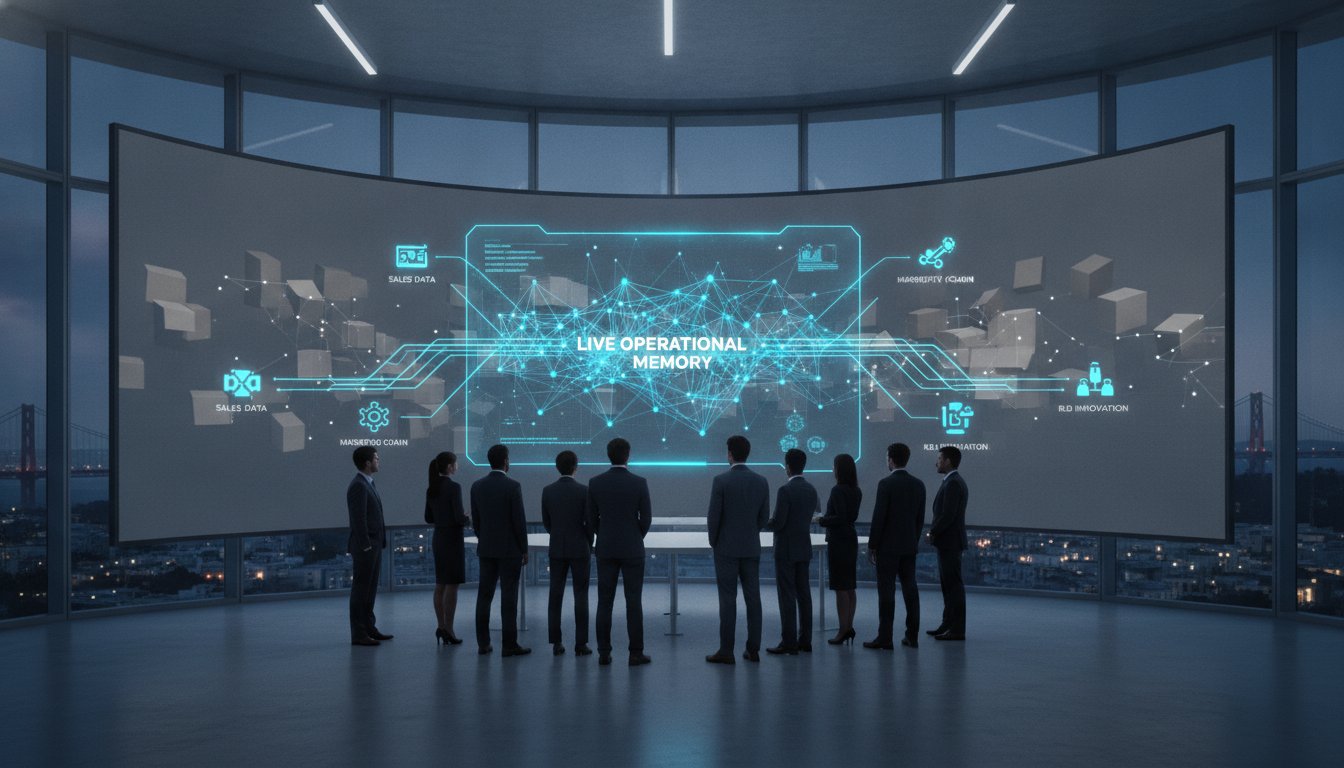
Static retrieval is the death of agentic autonomy. While most enterprises are still struggling with the limitations of basic RAG, the performance gap between simple chatbots and true operational intelligence is widening. You’ve likely seen the failure points; agents that hallucinate because they’re tethered to outdated data or systems that freeze when faced with complex, multi-stage business logic. To solve this, you must implement live operational memory for ai agents. It’s the only way to move past the stateless nature of large language models and provide a ground truth that reflects the current state of your business.
In this guide, we’ll demonstrate how live operational memory transforms your AI from a novelty into a strategic asset capable of executing complex workflows. We’ll break down the transition from high-latency vector searches to a sophisticated context graph that integrates directly with your legacy ERP and CRM systems. By the end, you’ll understand how to equip your agents with the real-time reasoning and explainable logic required to navigate the messy realities of global enterprise operations. It’s time to stop experimenting with passive assistants and start deploying autonomous operators.
Key Takeaways
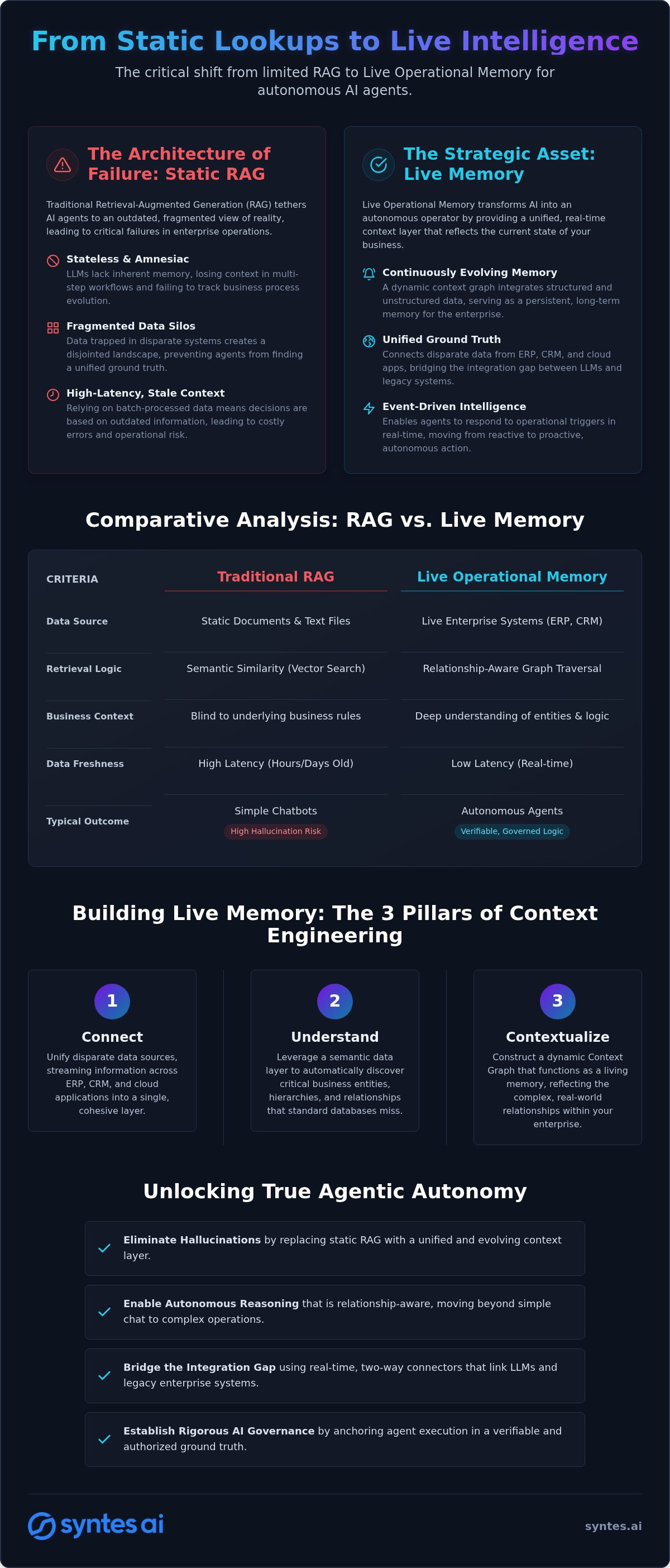
- Eliminate the architecture of failure by replacing static, stateless RAG with a unified and evolving context layer.
- Deploy live operational memory for ai agents to move beyond simple chat toward autonomous, relationship-aware reasoning.
- Bridge the integration gap between LLMs and legacy enterprise systems using real-time, two-way connectors that drive action.
- Establish rigorous AI governance by anchoring agent execution in a verifiable and authorized ground truth.
The Architecture of Failure: Why Static RAG Limits AI Agents
Most enterprise AI projects stall at the implementation phase. They fail because they rely on a foundation that is fundamentally amnesiac. LLMs are stateless by design; they possess no inherent memory of previous interactions or the evolving state of a business process. When an agent is tasked with a multi-step operational workflow, it quickly loses the thread. It cannot track the progression of a supply chain order or the shifting nuances of a complex legal negotiation. Without live operational memory for ai agents, these systems remain tethered to the present moment, incapable of the long-term reasoning required for true autonomy.
Fragmentation further compounds this failure. Enterprise data is traditionally trapped in silos, creating a disjointed landscape where agents cannot find a unified ground truth. Traditional Retrieval-augmented generation (RAG) focuses on static document retrieval, yet it fails to capture the fluid evolution of business events. This leads to a massive context gap. Hallucination is rarely a failure of the model’s logic; it is a failure of its context. When an agent lacks the correct data, it doesn’t stop; it guesses. In an enterprise environment, those guesses carry significant financial and operational risk.
The Limits of Vector-Only Memory
Semantic similarity is not the same as logical business relationship understanding. Vector databases excel at finding text that looks similar, but they are blind to the underlying business rules that govern those entities. They cannot distinguish between a “customer” and a “delinquent account” if the words appear in similar contexts. Furthermore, large-scale retrieval often suffers from the “lost in the middle” phenomenon, where critical information buried in the center of a long context window is ignored by the model. Ultimately, vector databases function as a library; they are a place to look things up, not a living memory that informs active decision-making.
The Cost of Outdated Context
Stale data is a liability. In high-stakes sectors like finance or supply chain management, acting on information that is even four hours old can lead to catastrophic errors in inventory allocation or risk assessment. Relying on batch-processed data creates a lag that renders AI agents reactive rather than proactive. Managing these context windows manually creates immense technical debt, forcing developers to constantly “hand-feed” the agent the right information at the right time. The Context Gap is the primary barrier to agentic ROI, representing the structural disconnect between an agent’s reasoning capabilities and the real-time operational reality of the enterprise.
Defining Live Operational Memory for the Enterprise
Live operational memory for ai agents represents a fundamental departure from the static retrieval methods of the past. It is not a simple database or a collection of disconnected text files. Instead, it is a continuously evolving, unified context layer that integrates structured and unstructured data in real-time. This architecture ensures that every decision made by an agent is grounded in the current reality of the business, rather than a snapshot taken hours or days ago. It is the connective tissue between raw data and autonomous action.
The “Live” factor is what separates enterprise-grade intelligence from experimental chatbots. Traditional systems rely on batch-processed data. This creates a lag that is unacceptable in high-velocity environments. By moving to event-driven intelligence, agents can respond to operational triggers as they happen. If a supplier fails to meet a deadline, the agent understands the downstream impact immediately. It doesn’t just see data points; it sees the relationships between them. A comparative analysis of GraphRAG demonstrates that mapping these connections is vital for deep reasoning. Syntes AI facilitates this by building a Context Graph that functions as a persistent, long-term memory for the enterprise.
The Five Pillars of Context Engineering
True operational clarity requires more than just storage; it requires engineering. First, you must Connect disparate data sources, unifying information across ERP, CRM, and cloud applications into a single stream. Second, you must Understand the data. By leveraging a semantic data layer for enterprise, the system discovers entities and hierarchies that standard databases ignore. Finally, you Contextualize this information, building a dynamic Syntes AI Context Graph that reflects the real-world complexity of your operations. This process transforms fragmented silos into a fluid, actionable intelligence layer.
Operational Memory vs. Static Databases
Static databases are passive storage units. They wait to be queried. In contrast, live operational memory for ai agents is an active, reasoning-ready structure. It enables agents to follow the logic of a business process from start to finish. This shift also solves the black-box problem of modern AI. Because the memory is structured as a graph, it supports “Human-in-the-Loop” auditing. You can trace exactly why an agent chose a specific action based on the “ground truth” of your data. It is a living model of your business that evolves with every transaction. If you’re ready to see how this architecture functions in practice, you can explore our agentic platform to witness the evolution of enterprise intelligence.
GraphRAG vs. Traditional RAG: A Comparative Analysis
Traditional RAG is an exercise in approximation. It relies on semantic similarity to fetch data, essentially guessing that because two pieces of text sound alike, they must be relevant to the agent’s task. This often results in “noise” where irrelevant data clutter the context window, confusing the model and degrading performance. In contrast, GraphRAG replaces this linguistic guesswork with structural precision. By organizing data into a network of nodes and edges, the system allows agents to navigate complex, multi-layered business logic with surgical accuracy. This isn’t just about finding data; it’s about understanding the provenance and relationship of every fact.
The transition to live operational memory for ai agents necessitates a move from flat vector spaces to multi-dimensional graph architectures. While traditional RAG struggles to connect the dots across fragmented documents, GraphRAG enables an agent to follow a logical chain of inquiry. For example, an agent can traverse the relationship from a specific Customer to their pending Order, check the real-time Inventory status of the requested SKU, and identify the specific Supplier responsible for a delay. This deterministic traversal ensures the agent acts on a verified chain of command rather than a statistical probability. The enterprise knowledge graph serves as this deterministic anchor, providing the “ground truth” that LLMs desperately need to remain useful in a corporate setting.
When to Use Graph-Based Memory
Deploy graph-based memory when your operations demand cross-system logic. If you’re building systems for fraud detection or predictive maintenance, simple text retrieval isn’t enough. You need to see how disparate events correlate across time and systems. GraphRAG is also the fundamental prerequisite for preventing AI hallucination. By forcing the LLM to reason over a structured graph rather than an unstructured pile of documents, you eliminate the ambiguity that leads to costly errors. If the relationship doesn’t exist in the graph, the agent won’t invent it.
Technical Implementation of GraphRAG
The technical challenge lies in integration. You must bridge the gap between structured ERP data and unstructured document repositories like PDFs or emails. Semantic search acts as the initial entry point, identifying the relevant nodes within the graph. From there, the agent executes graph queries to pull the surrounding context. Optimizing this performance is critical for real-time execution. An agent shouldn’t wait seconds for a query to return; it needs the “right” context immediately to maintain the flow of a multi-step workflow. This efficiency allows for smaller, more focused context windows, reducing both latency and token costs while increasing the overall intelligence of the system.
Governing the Memory: Security and Execution in Agentic Systems
Governance is not a secondary consideration; it is the structural prerequisite for enterprise deployment. An agent without boundaries is a liability that no C-suite can ignore. By embedding governance directly into the live operational memory for ai agents, you move beyond simple data retrieval toward controlled execution. This architecture ensures that every retrieval and subsequent action is filtered through a rigorous set of business rules and permissions. It’s about creating a system that understands not just what it can know, but what it is permitted to do.
Auditability is the cornerstone of trust in automated systems. In a traditional “black box” LLM setup, tracing the logic behind a specific decision is nearly impossible. However, when an agent utilizes a structured context graph, every reasoning path becomes visible. This trace provides a verifiable record for compliance teams, showing exactly which data points and business policies informed a specific outcome. Integrating policies directly into the context layer means that constraints are never “forgotten” or ignored during complex, multi-step workflows. We have moved past the era of trial and error; we are now in the era of governed intelligence.
Role-Based Access Control in AI Memory
Granular security starts at the graph level. The Syntes AI Platform manages sensitive enterprise intelligence by defining permissions for specific nodes and relationships. This ensures that an agent assisting a sales representative cannot inadvertently access payroll data or sensitive R&D documents. There is a critical distinction between “knowing” and “doing” in a governed environment. An agent might have the context to understand a problem, but without the specific execution rights, it cannot trigger a transaction or alter a record. Security is built into the memory, not bolted on as an afterthought.
Explainable AI and the ‘Why’ Behind the Action
Regulatory requirements in sectors like finance and healthcare demand more than just results; they demand explanations. Live operational memory provides the auditable reasoning paths necessary to meet these high standards of transparency. By mapping the agent’s logic back to a deterministic ground truth, you eliminate the ambiguity often associated with generative models. Robust governance protocols transform autonomous AI from a chaotic operational risk into a high-performance strategic asset.
Implementing Live Memory with the Syntes Agentic Platform
Execution requires a platform capable of handling the messy realities of enterprise data. Theory ends where the Syntes Agentic Platform begins. We unify fragmented knowledge into a continuously evolving operational context, ensuring your agents never act in a vacuum. By leveraging Two-way Connectors, we bridge the gap between LLMs and proprietary data systems, allowing for a bidirectional flow of intelligence and action. This is the practical implementation of live operational memory for ai agents at scale. It’s the difference between a system that talks and a system that performs.
Deploying governed agents means anchoring them in the Syntes AI Context Graph. This isn’t a passive lookup table; it’s a reasoning engine. As your business moves, the graph moves with it, capturing every transaction and relationship update in real-time. This level of integration is essential for scaling from isolated pilots to a robust enterprise AI infrastructure. You don’t just need better models. You need a better way to feed them the truth. Only a structured memory layer provides the deterministic foundation required for high-stakes automation.
The Path to Agentic Maturity
Build the foundation first. Success starts with solving enterprise data silos to create a unified data stream. Once the silos are breached, you can transition from passive chatbots to active operational agents that execute business logic. ROI is no longer a theoretical projection. It’s measured through concrete operational efficiency and the drastic reduction of costs associated with AI hallucinations. True maturity is reached when your agents operate with the same context as your most seasoned human operators, navigating complex workflows with precision and speed.
Why Syntes AI for Live Operational Memory?
Context Engineering is the next evolution of AI strategy. While others focus on model size, we focus on the relevance and accuracy of the information those models consume. We provide enterprise-grade security and cross-system integration capabilities that smaller startups simply cannot match. Syntes AI transforms static, historical data into trusted enterprise intelligence. We don’t just build AI. We build the live operational memory for ai agents that makes autonomous enterprise operations possible. It’s time to move past experimentation and into the era of governed, real-time execution.
Architecting the Future of Autonomous Enterprise Intelligence
Static retrieval is a relic of early-stage AI experimentation. To achieve true operational clarity, you must move beyond the limitations of stateless models. Implementing live operational memory for ai agents allows your systems to reason over evolving business relationships in real-time. This shift transforms AI from a passive knowledge retrieval tool into an active participant in your enterprise’s complex logic. You’ve seen the risks of fragmented context; it’s time to deploy a unified ground truth.
Syntes AI is pioneering the discipline of Context Engineering to bridge the gap between LLMs and legacy systems. We provide the enterprise-grade infrastructure required for trusted, governed execution across your most critical data silos. Our platform ensures that your agents possess the persistent memory and systemic integration necessary to perform at the highest levels of corporate strategy. The transition from observation to action starts with a living context layer.
Take command of your operational future and empower your agents to drive measurable business results with absolute certainty.
Frequently Asked Questions
What is the difference between Live Operational Memory and a Vector Database?
Vector databases are passive storage units that rely on semantic similarity to find text that sounds similar. In contrast, live operational memory for ai agents is a dynamic context layer that understands structural relationships and real-time events. While a vector database tells you what sounds relevant, live memory tells you what is currently true across your entire enterprise architecture. It moves beyond simple retrieval toward active, relationship-aware reasoning.
How does Live Operational Memory reduce AI hallucinations in production?
Hallucinations are typically the result of a context gap where the model lacks specific data and guesses based on probability. By anchoring agents to a deterministic ground truth within a context graph, we eliminate this ambiguity. The agent doesn’t guess; it follows verified reasoning paths. If the relationship isn’t present in the operational memory, the agent won’t invent it, ensuring every action is auditable and accurate.
Can Live Operational Memory integrate with my existing ERP and CRM systems?
Yes, the Syntes Agentic Platform utilizes two-way connectors to bridge the gap between LLMs and your core proprietary systems. This architecture allows agents to pull real-time data from platforms like Salesforce or SAP and push updates back into them. It transforms your AI from a passive chatbot into an autonomous operator that can execute complex business logic directly within your existing enterprise tech stack.
Why is a Knowledge Graph necessary for AI agent memory?
A Knowledge Graph is essential because it maps the complex web of relationships between entities like customers, orders, and suppliers. Flat data lists can’t capture the nuance of multi-step business logic. The graph provides the structural precision required for an agent to follow a logical chain of inquiry. It ensures the agent understands the provenance of every fact, which is critical for maintaining a unified ground truth.
How does Syntes AI handle data governance within its Context Graph?
We implement AI Governance at the graph level by defining granular permissions for specific nodes and relationships. This ensures agents only access intelligence they’re authorized to use based on their specific role. By managing sensitive data within the Context Graph, we provide an auditable trace of reasoning. This approach satisfies strict enterprise security standards and provides the transparency required for compliance in regulated industries.
Is Live Operational Memory required for all AI agents or just complex ones?
While basic chatbots can survive on static data, live operational memory for ai agents is mandatory for any system performing complex business logic. If an agent’s decisions impact inventory, pricing, or customer status, it cannot rely on stale context. The risk of operational error is simply too high for enterprise deployment without real-time context. Autonomy requires a persistent and evolving understanding of the business environment.
How often is the ‘Live’ memory updated in the Syntes AI Platform?
Updates occur in real-time through event-driven intelligence rather than traditional batch processing. When a transaction is completed in your ERP or a status changes in your CRM, the Syntes AI Context Graph reflects that change instantly. This ensures that agents are always reasoning over the most current state of the business. We eliminate the lag that traditionally renders AI reactive, allowing for immediate, proactive operational execution.
What industries benefit most from Live Operational Memory for AI agents?
High-velocity sectors like retail, manufacturing, and finance see the most immediate ROI from this architecture. These industries manage complex supply chains and rapidly changing data where stale context leads to significant financial loss. Any enterprise that requires multi-system workflows and strict regulatory compliance will benefit from a more governed, relationship-aware AI strategy. It’s the necessary foundation for scaling AI from simple pilots to core infrastructure.