

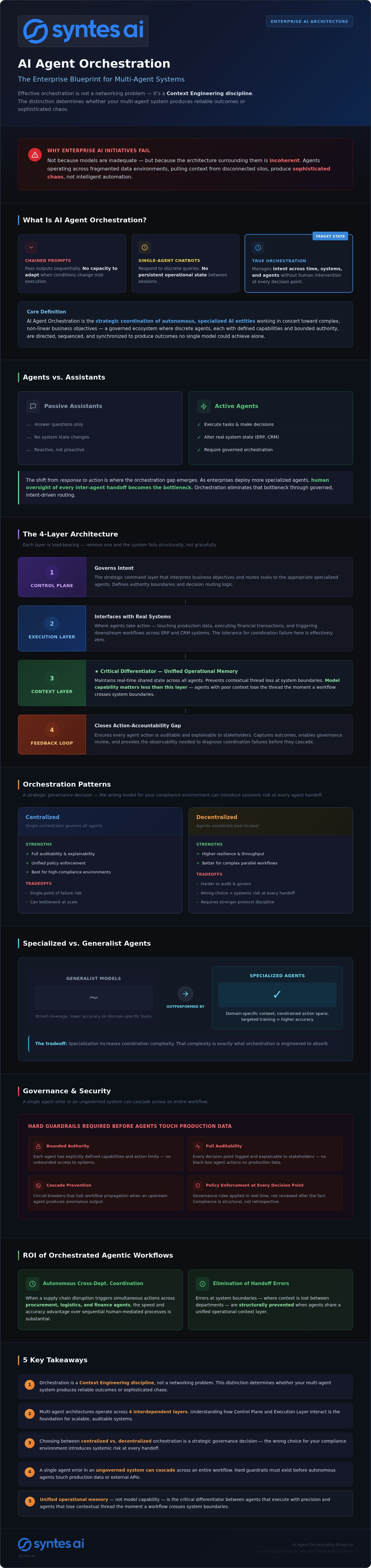
Most enterprise AI initiatives don’t fail because the models are inadequate. They fail because the architecture surrounding those models is incoherent. When autonomous agents operate across fragmented data environments, pulling context from disconnected silos and executing decisions without a unified source of truth, the result isn’t intelligent automation. It’s sophisticated chaos. Effective ai agent orchestration is not a networking problem; it’s a Context Engineering problem, and the distinction matters enormously at enterprise scale.
If you’ve deployed multi-agent workflows and watched them hallucinate mid-process, lose contextual thread between handoffs, or make decisions you can’t audit or explain to a stakeholder, you already understand the structural gap. The issue isn’t the agents themselves. It’s the absence of governed, real-time context binding them together.
This guide delivers a definitive blueprint for building a multi-agent ecosystem that is explainable, governed, and operationally reliable. You’ll learn the architectural principles that separate functional orchestration from fragile automation, how to eliminate the data silo problem that undermines agent decision-making, and what it takes to integrate autonomous agents seamlessly with legacy ERP and CRM systems without dismantling what already works.
Key Takeaways
- Effective ai agent orchestration is a Context Engineering discipline, not a networking problem—and understanding that distinction determines whether your multi-agent system produces reliable outcomes or sophisticated chaos.
- Enterprise multi-agent architectures operate across distinct layers, and knowing how the control plane and execution layer interact is the foundation for designing systems that are both scalable and auditable.
- Choosing between centralized and decentralized orchestration patterns is a strategic governance decision—the wrong model for your compliance environment can introduce systemic risk at every agent handoff.
- A single agent error in an ungoverned system can cascade across an entire workflow; learn what hard guardrails must be in place before autonomous agents touch production data or external APIs.
- Unified operational memory—not model capability—is the critical differentiator between agents that execute with precision and agents that lose contextual thread the moment a workflow crosses system boundaries.
What is AI Agent Orchestration? Beyond Basic Automation
At its core, ai agent orchestration is the strategic coordination of autonomous, specialized AI entities working in concert toward complex, non-linear business objectives. Not a pipeline. Not a prompt chain. A governed ecosystem where discrete agents, each with defined capabilities and bounded authority, are directed, sequenced, and synchronized to produce outcomes that no single model could achieve alone.
The distinction from simpler automation is architectural, not cosmetic. Chained prompts pass outputs sequentially from one instruction to the next, with no capacity to adapt when conditions change mid-execution. Single-agent chatbots respond to discrete queries but hold no persistent operational state. Orchestration is categorically different: it manages intent across time, across systems, and across agents that must collaborate without human intervention at every decision point. This transition towards active execution is exemplified by specialized tools like memphiswebsolutions.com that automate customer interactions and lead management 24/7.
The foundational concepts underpinning this approach are well-established in the field of multi-agent systems, where autonomous entities perceive their environment, act on shared objectives, and coordinate through defined protocols. What’s changed in the enterprise context is the operational stakes. These agents now touch production data, execute financial transactions, and trigger downstream workflows across ERP and CRM systems. The tolerance for coordination failure is effectively zero.
Agents vs. Assistants: Why Orchestration Matters Now
Passive assistants answer questions. Active agents execute tasks, make decisions, and alter system state. That shift from response to action is where the orchestration gap emerges. As enterprises deploy more specialized agents, each optimized for a narrow domain like procurement, compliance, or customer data resolution, human oversight of every inter-agent handoff becomes the bottleneck. Orchestration eliminates that bottleneck by replacing manual coordination with governed, intent-driven routing that scales without degrading in reliability. This principle of automated coordination is also revolutionizing the physical workspace; to see how these advancements are applied in industrial robotics, learn more about EdNex Automation.
Specialized agents consistently outperform generalist models in enterprise environments precisely because domain-specific context, constrained action spaces, and targeted training produce higher accuracy on the tasks that matter. Much like how Tools N Tactics | Local SEO & Digital Marketing Solutions uses integrated marketing engines to scale service-based businesses, orchestration is engineered to absorb the coordination complexity that naturally arises from using specialized tools in tandem.
The ROI of Orchestrated Agentic Workflows
The operational efficiency case for orchestration concentrates in two areas: autonomous cross-departmental coordination and the elimination of handoff errors. When a supply chain disruption triggers simultaneous actions across procurement, logistics, and finance agents, the speed and accuracy advantage over sequential, human-mediated processes is substantial. Errors that typically occur at system boundaries, where context is lost between departments, are structurally prevented when agents share a unified operational context layer.
This is why enterprise ai infrastructure is the cost-saving foundation beneath every orchestrated workflow. The platform layer that governs agent execution, maintains live operational memory, and enforces policy at every decision point isn’t overhead. It’s the mechanism that makes autonomous coordination trustworthy enough to deploy at scale.
The Architecture of AI Agent Orchestration: Layers and Components
Understanding why some multi-agent systems perform with surgical precision while others collapse mid-execution requires looking past the models themselves. The answer lives in the architecture. Effective ai agent orchestration operates across four interdependent layers: a control plane that governs intent, an execution layer that interfaces with real systems, a context layer that maintains operational memory, and a feedback loop that closes the gap between action and accountability. Each layer is load-bearing. Remove one, and the system doesn’t degrade gracefully. It fails structurally.
The Role of the Orchestrator (The Control Plane)
The Orchestrator is the central nervous system of agentic AI. It receives a high-level business objective and immediately begins decomposition: breaking that goal into discrete, sequenced sub-tasks that can be assigned to specialized agents based on verified capability profiles. This isn’t routing. It’s dynamic task allocation governed by real-time context. When a procurement objective arrives, the orchestrator doesn’t broadcast it to every available agent. It identifies which agent holds domain authority, what system access that agent requires, and in what sequence its outputs must feed downstream processes. The control plane makes that determination in milliseconds, without human intervention, and without sacrificing auditability. Compliance with AI governance and security standards demands that every routing decision be traceable, and a well-designed orchestrator produces that audit trail as a native output, not an afterthought.
The Foundation: Knowledge Graphs as the Ground Truth
Standard Retrieval-Augmented Generation retrieves documents. It doesn’t understand relationships. In a complex orchestration scenario where a customer churn risk agent must coordinate with a contract renewal agent and a pricing authority agent, keyword retrieval produces fragments. What’s needed is a map: a structured representation of how entities, events, and constraints connect across the enterprise.
That map is the enterprise knowledge graph. Where RAG answers “what documents mention this customer,” a graph answers “what is the relationship between this customer’s contract status, their support escalation history, and the pricing tier they qualify for given current inventory constraints.” Agents operating against a graph don’t guess at context. They traverse it. The difference in decision quality is categorical, not incremental.
This is where Live Operational Memory becomes the decisive architectural variable. Static knowledge bases reflect the state of the enterprise at the moment they were last indexed. Live Operational Memory evolves continuously, capturing system state changes, agent actions, and external data signals in real time. When an agent handoff occurs across a workflow boundary, the receiving agent doesn’t start from zero. It inherits a complete, current operational context. That continuity is what separates orchestration that scales from orchestration that breaks at the seams.
If you’re evaluating whether your current infrastructure can support this architecture, explore what a governed agentic platform looks like in practice before committing to a design that treats context as temporary state.
Orchestration Patterns: Centralized vs. Decentralized Models
Pattern selection is not a technical preference. It’s a governance decision with direct consequences for compliance, latency, and operational risk. The wrong orchestration model for your security environment doesn’t just slow workflows down; it introduces systemic failure points at every agent handoff. Understanding which pattern fits your operational reality is foundational to any serious ai agent orchestration strategy.
Three primary patterns dominate enterprise deployments, and each carries a distinct set of trade-offs:
- Hierarchical (Centralized): A Master Agent decomposes objectives and issues directives to specialized Worker Agents, which report outcomes back up the chain. Every decision flows through a single authority. This model is non-negotiable in regulated industries where every action must be traceable to a governed decision point. Financial services, healthcare, and defense environments default here because the audit trail is structurally enforced, not retrofitted.
- Collaborative (Decentralized): Agents communicate laterally, negotiating sub-tasks and sharing context without a central authority arbitrating every exchange. This pattern excels in dynamic, creative, or exploratory workflows where rigid sequencing would constrain the quality of the outcome. The trade-off is accountability diffusion; without careful design, it becomes difficult to attribute a decision to a specific agent action.
- Federated Orchestration: Agents operate within isolated security domains, each governed by local policy, while a federation layer coordinates cross-domain objectives without exposing sensitive data across boundaries. This is the pattern of choice for multi-business-unit enterprises where procurement, legal, and finance agents must collaborate without violating data residency or access control requirements.
The Human-in-the-Loop pattern cuts across all three. It’s not a separate architecture; it’s a governance overlay. Humans don’t need to approve every agent action. They need to intercept decisions that cross defined risk thresholds: irreversible transactions, exceptions outside the agent’s trained authority, or outputs that trigger regulatory exposure. Designing those checkpoints deliberately, rather than inserting human review as a blanket safeguard, is what keeps orchestration fast without making it reckless. NIST AI governance frameworks provide a structured basis for defining where human oversight becomes mandatory versus where autonomous execution is defensible.
Choosing the Right Pattern for Your Business Logic
Three criteria drive the selection decision: security requirements, task complexity, and latency tolerance. High-compliance environments with low latency tolerance and linear task structures belong in hierarchical models. Dynamic, high-complexity workflows with flexible timelines benefit from collaborative architectures. When the question is whether to use a Router agent versus a Manager agent, the answer is task determinism. Router agents direct traffic based on predefined rules; Manager agents allocate tasks based on real-time context and agent capability profiles. The latter is more powerful and more demanding of your context infrastructure. Solving enterprise data silos becomes structurally easier when the orchestration pattern matches the data access model, because agents aren’t crossing security boundaries they weren’t designed to traverse.
From Static Workflows to Dynamic Agentic Reasoning
Traditional RPA operates on conditional logic: if this state, then that action. It’s deterministic, brittle, and blind to context outside its programmed decision tree. The moment an exception falls outside the ruleset, the workflow stalls. Agentic reasoning inverts this entirely. Agents receive a goal, not a script. They evaluate available context, select a strategy, execute, observe the result, and adapt. That’s the operational distinction that separates ai agent orchestration from sophisticated automation.
Context Engineering is what makes mid-workflow strategy shifts possible. When an agent encounters an unexpected system state, it doesn’t fail. It queries the live operational context, re-evaluates its approach, and selects an alternative path toward the same objective. But non-linear reasoning without structure creates its own risk: agents can drift from the original intent across extended workflows. Deterministic checkpoints solve this. At defined intervals or decision nodes, the system validates that the agent’s current trajectory still maps to the governing business objective. If it doesn’t, the checkpoint triggers re-alignment before the deviation compounds into a costly error. These checkpoints aren’t constraints on agent intelligence; they’re the mechanism that makes autonomous reasoning trustworthy enough to deploy against production systems.
Governance and Security in Multi-Agent Orchestration
Autonomous agents don’t fail in isolation. That’s the governance reality most enterprise teams discover too late. When one agent produces a flawed output and passes it downstream as verified context, every subsequent agent in the workflow inherits that error as ground truth. This is Agent Cascade: the structural amplification of a single failure across an entire orchestrated system. It’s not a theoretical risk. It’s the predictable consequence of deploying autonomous agents without hard governance boundaries at every execution layer.
Effective ai agent orchestration governance operates on four non-negotiable dimensions:
- Spending guardrails: Hard ceilings on financial transactions that agents can authorize autonomously, with mandatory human escalation above defined thresholds. Not soft recommendations. Enforced constraints baked into the execution layer.
- Data access controls: Role-based context scoping that ensures agents only retrieve the context they’re explicitly authorized to see. A procurement agent has no business traversing HR compensation data, regardless of how relevant the system deems it.
- External API rate limiting: Governed throttling on outbound agent calls to third-party systems, preventing runaway automation from triggering unintended downstream consequences in connected platforms.
- Explainability binding: Every agent action must trace back to a specific node in the Context Graph. If an action can’t be attributed to a governed context source, it doesn’t execute. Full stop.
That last point is where most governance frameworks fall short. Logging what an agent did is not explainability. Explainability means reconstructing why a specific action was taken, which context node authorized it, and what the agent’s reasoning state was at the moment of execution. Without that traceability, compliance audits become forensic exercises rather than routine governance operations.
How to Prevent AI Hallucination in Orchestrated Systems
Hallucination in a single-agent system is a quality problem. In an orchestrated system, it’s a governance crisis. Semantic Grounding is the architectural mechanism that prevents it: agents are bound to verified Context Graph nodes rather than generating responses from parametric memory alone. When an agent’s output can’t be semantically anchored to a verified context source, a verification agent intercepts it before it propagates downstream. These verification agents don’t just check factual accuracy; they validate that the execution agent’s output is consistent with the current operational state of the enterprise. The full architectural approach to how to prevent ai hallucination at the enterprise level goes deeper than model tuning. It requires deterministic truth infrastructure beneath every agent that touches production data.
Governing Agent-to-Agent Communication
Inter-agent communication without standardized protocols is where accountability dissolves. When agents negotiate sub-tasks laterally, the reasoning log must capture not just what was communicated, but why one agent elected to involve another. That decision point is a governance artifact. Auditing it reveals whether agents are operating within their defined authority or autonomously expanding their own scope in ways that weren’t sanctioned. Human Override triggers must be configured at the protocol level for high-stakes financial and operational decisions, not inserted as manual review steps that slow every workflow uniformly. Precision override design is what keeps ai agent orchestration fast without making it ungoverned.
The Syntes Agentic Platform: Orchestration Powered by Context
Every architectural principle covered in this guide converges on a single operational reality: ai agent orchestration is only as reliable as the context infrastructure beneath it. The Syntes Agentic Platform is built on that premise. It doesn’t treat context as a feature. It treats context as the foundational layer without which autonomous execution is structurally indefensible.
At the center of the platform is the Syntes AI Context Graph: a continuously evolving, structured representation of enterprise state that serves as unified operational memory for every agent in the system. Not a document store. Not a vector index. A governed graph where entities, relationships, constraints, and system states are connected in real time, giving agents the relational intelligence to act on what’s actually true about the business at the moment of execution.
What separates the platform architecturally is the two-way connector model. Most orchestration frameworks are read-only against enterprise systems. They retrieve data from ERP and CRM environments but can’t write back. That’s not orchestration. That’s sophisticated lookup. Syntes AI agents don’t just read operational context from connected systems; they execute within them. A governed agent can update a procurement record in an ERP, trigger a contract status change in a CRM, or escalate a compliance exception through an ITSM platform, all within the policy boundaries defined at the Context Graph level.
Live Operational Memory: The Syntes Advantage
Static knowledge bases reflect a snapshot. The moment that snapshot is taken, it begins to decay. Most orchestration frameworks operate on exactly this model: periodic data dumps that agents treat as current, even when the underlying system state has shifted. Live Operational Memory is the alternative. The Syntes platform maintains a continuously updated model of the business, capturing system state changes, agent actions, and external signals as they occur. When an agent handoff crosses a workflow boundary, the receiving agent inherits a complete, current context, not a stale approximation. This continuity is what enables semantic data layer consistency across every agent interaction, ensuring that no two agents are operating against contradictory versions of enterprise reality.
Deploying Your First Orchestrated Agentic Workflow
Syntes AI structures deployment around five load-bearing pillars:
- Connect: Establish two-way integrations with existing ERP, CRM, and operational systems without dismantling current infrastructure.
- Understand: Ingest and structure proprietary enterprise data into the Context Graph, bridging the gap between general LLM knowledge and the specific operational reality of your business.
- Contextualize: Apply Context Engineering methodology to define how agents retrieve, traverse, and reason against live operational memory.
- Govern: Enforce role-based access controls, spending guardrails, and explainability binding at the execution layer before any agent touches production data.
- Execute: Deploy specialized agents that act with precision, adapt mid-workflow, and produce audit-ready reasoning logs as a native output.
This is the architecture that moves an enterprise from AI experimentation to operational reality. Not a proof of concept running against sanitized data. A governed, production-grade system where ai agent orchestration produces outcomes that are explainable to a compliance officer, traceable to a specific context node, and reliable enough to touch the systems your business depends on.
If your current infrastructure treats context as temporary state and calls it orchestration, the gap between where you are and where you need to be is structural, not incremental. See how the Syntes Agentic Platform closes that gap in practice.
The Architecture Decision That Defines Your AI Future
The gap between AI experimentation and operational reality isn’t a model problem. It’s a structural one. Effective ai agent orchestration demands three things working in concert: a governed context layer that evolves in real time, orchestration patterns matched precisely to your compliance environment, and hard guardrails that make autonomous execution trustworthy enough to touch production systems.
Context Engineering isn’t a refinement of what you’re already doing. It’s the foundation that determines whether your agents execute with precision or drift into sophisticated chaos the moment a workflow crosses a system boundary. Live Operational Memory, enterprise-grade AI Governance, and two-way system integration aren’t features to evaluate later. They’re load-bearing architecture you need before autonomous agents touch anything that matters.
The enterprises that get this right in 2026 won’t just move faster. They’ll operate with a level of explainability and control that makes autonomous execution defensible to every stakeholder who asks why.
See what governed, context-powered orchestration looks like when it’s built to perform at enterprise scale.
Frequently Asked Questions About AI Agent Orchestration
What is the difference between AI orchestration and AI agent orchestration?
AI orchestration broadly refers to coordinating AI models, pipelines, and services within a technical infrastructure. AI agent orchestration is a more specific discipline: it governs autonomous agents that perceive context, make decisions, and alter system state without human intervention at every step. The distinction matters because agents don’t just process data; they act on it. That shift from passive inference to active execution demands a fundamentally different governance architecture.
How does AI agent orchestration handle data privacy between specialized agents?
Properly architected systems enforce role-based context scoping at the execution layer, meaning each agent only retrieves the data it’s explicitly authorized to access. A compliance agent and a procurement agent may operate within the same orchestrated workflow while remaining entirely isolated from each other’s data domains. Federated orchestration patterns extend this further, allowing agents across separate business units to collaborate on shared objectives without exposing sensitive data across security boundaries.
Can AI agent orchestration work with legacy systems like SAP or Oracle?
Yes, but the integration model matters enormously. Read-only connectors that pull data from SAP or Oracle are insufficient for genuine orchestration; agents need two-way access to execute actions within those systems, not just retrieve information from them. The Syntes Agentic Platform is built on exactly this model, using governed two-way connectors that allow agents to update records, trigger workflows, and escalate exceptions inside legacy ERP environments without requiring those systems to be replaced or re-architected.
What are the biggest risks of using multi-agent systems in production?
Agent Cascade is the primary structural risk: a single flawed output passed downstream as verified context contaminates every subsequent agent in the workflow. Beyond that, accountability diffusion in decentralized architectures can make it impossible to attribute a consequential decision to a specific agent action, which is a compliance liability in regulated industries. Both risks are architectural problems, not model problems, and they’re only resolved through hard governance guardrails, semantic grounding, and mandatory explainability binding at the execution layer.
How do I measure the ROI of an AI agent orchestration platform?
The most reliable measurement concentrates on three variables: reduction in handoff errors at system boundaries, time eliminated from cross-departmental coordination cycles, and the cost of compliance exceptions caught before they escalate. Soft metrics like “efficiency gains” are difficult to defend to finance stakeholders. Quantifying the average cost of a single inter-system error in your current workflows, then projecting the frequency reduction that governed orchestration delivers, produces a defensible business case grounded in operational reality rather than vendor benchmarks.
Is a Knowledge Graph required for effective agent orchestration?
Not strictly required, but the difference in decision quality is categorical. Agents operating against document retrieval or vector search can answer “what exists in this data.” Agents operating against a structured Knowledge Graph can answer “how do these entities relate, and what constraints apply given the current system state.” For linear, low-complexity workflows, retrieval may be sufficient. For multi-agent systems where a customer’s contract status, support history, and pricing eligibility must be understood simultaneously, a graph isn’t an enhancement; it’s the only architecture that produces reliable outputs.
What is the role of ‘Human-in-the-Loop’ in autonomous orchestration?
Human-in-the-Loop isn’t a blanket review mechanism; it’s a precision governance overlay. Humans don’t need to approve every agent action. They need to intercept decisions that cross defined risk thresholds: irreversible financial transactions, exceptions outside an agent’s trained authority, or outputs that trigger regulatory exposure. Designing those checkpoints deliberately, rather than inserting human review uniformly across all agent actions, is what keeps orchestration operationally fast without making it ungoverned or legally indefensible.
How do I choose between a centralized and decentralized orchestration model?
Three criteria drive the decision: compliance requirements, task structure, and latency tolerance. Regulated industries with linear task dependencies and strict audit requirements belong in hierarchical, centralized models where every decision traces back to a single governed authority. Dynamic workflows with flexible timelines and exploratory reasoning benefit from collaborative, decentralized architectures. If your environment includes multiple business units with distinct data residency requirements, a federated model resolves the tension between cross-domain collaboration and security isolation without forcing a compromise on either.