

A graph database is a storage engine, not a strategy. While many organizations believe that deploying a graph database solves the problem of fragmented data, they’re often just moving silos into a more complex format. When evaluating the merits of Neo4j vs enterprise knowledge graph architectures, the distinction isn’t merely technical; it’s operational. You’ve likely seen AI agents hallucinate or fail because they lack the deep business context buried within your ERP and CRM systems. High engineering overhead remains a constant burden as teams struggle to maintain custom schemas that cannot scale at the speed of your business logic.
This article clarifies the choice between raw infrastructure and a governed context layer. You’ll discover why a graph database is only the foundation for true enterprise intelligence and how to achieve a deterministic ground truth for your AI workflows. We’ll examine the shift from passive data observation to active, automated performance through live operational memory. By the end, you’ll understand how to reduce time-to-market for complex AI reasoning while ensuring every decision is governed, explainable, and rooted in systemic integration.
Key Takeaways
- Distinguish between raw graph infrastructure and a sophisticated Enterprise Knowledge Graph that unifies structured and unstructured data into a governed context layer.
- Analyze the structural trade-offs of Neo4j vs enterprise knowledge graph deployments to ensure your foundation supports relationship-level security and auditability.
- Move beyond static Retrieval-Augmented Generation by implementing live operational memory, preventing the context drift that compromises AI reasoning.
- Apply a strategic decision framework to assess your AI maturity and determine when custom graph schemas create more engineering debt than business value.
- Master the principles of Context Engineering to transform passive data storage into an active, deterministic ground truth for autonomous AI agents.
The Core Distinction: Graph Infrastructure vs. Enterprise Intelligence Layer
Enterprise leaders often mistake the purchase of a database for the acquisition of intelligence. It’s a costly error. In the race to deploy agentic AI, the debate between Neo4j vs enterprise knowledge graph architectures is frequently framed as a simple software choice. This is incorrect. The distinction is foundational, separating raw data storage from a governed, context-aware intelligence layer that actually understands your business logic.
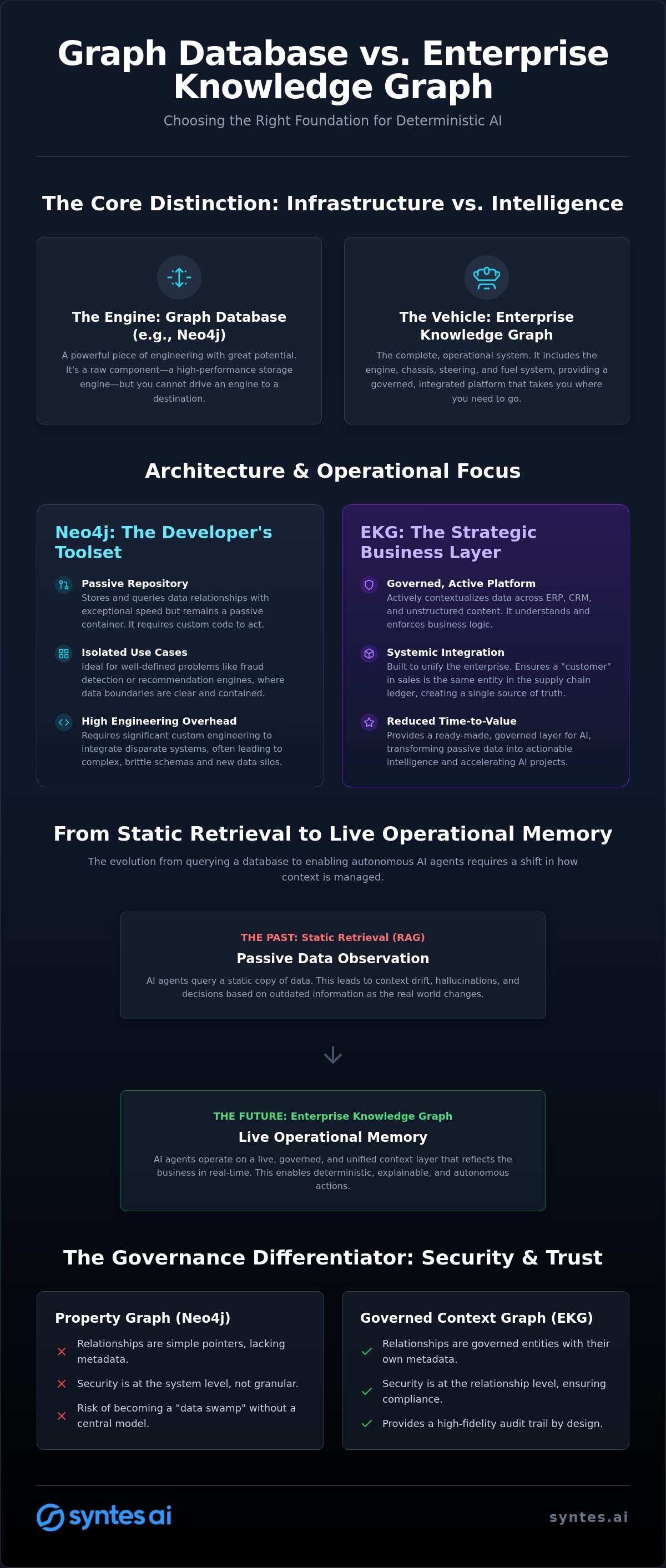
Neo4j is a high-performance graph database engine. It’s designed to store and query relationships with exceptional speed, but it remains a passive repository. In contrast, an Enterprise Knowledge Graph (EKG) is a governed platform. It unifies structured data from your ERP and CRM systems with unstructured content into a business-centric context layer. While a knowledge graph provides the semantic framework, the EKG adds the governance and integration required for scale.
Think of it as the difference between an engine and a vehicle. An engine is a masterpiece of engineering; it possesses power and potential. However, you cannot drive an engine to a destination. You need the chassis, the steering, the fuel system, and the dashboard. Neo4j provides the engine. An EKG provides the vehicle. For 2026 AI strategies, storage has become a commodity. True competitive advantage now lies in context engineering, the ability to provide AI agents with a deterministic ground truth rather than a collection of disconnected nodes.
Neo4j: The Developer’s Toolset
Neo4j excels in the hands of engineers. It’s optimized for Cypher queries and offers flexible schema modeling that allows developers to map complex relationships quickly. It’s the ideal choice for specific, isolated use cases such as fraud detection or recommendation engines where the data boundaries are well-defined. However, it requires significant custom engineering to integrate disparate enterprise systems. Without this manual overhead, it remains a silo, powerful yet disconnected from the broader operational reality of the firm.
The EKG: The Strategic Business Layer
An Enterprise Knowledge Graph is built for systemic integration. It doesn’t just store data; it contextualizes it across ERP, CRM, and legacy environments. It focuses on semantic meaning and business logic, ensuring that a “customer” in your sales tool is the same “entity” in your supply chain ledger. This creates the Live Operational Memory required for autonomous agents to execute tasks without human intervention. It transforms passive observation into active performance by providing a unified, governed layer that bridges the gap between raw data and actionable intelligence.
Architecture Comparison: Graph Storage vs. Governed Context Graphs
Choosing between Neo4j vs enterprise knowledge graph solutions requires an understanding of structural integrity. A raw property graph, like Neo4j, stores data as nodes and edges. It’s built for speed and traversal. However, a governed Context Graph is built for trust. In a standard property graph, relationships are often simple pointers. In an Enterprise Knowledge Graph (EKG), relationships are governed entities. They carry their own metadata, permissions, and security protocols. This distinction is critical for organizations that must maintain strict compliance across global operations.
Governance is the primary differentiator. While a database engine might offer access control at the system level, an EKG handles security at the relationship level. It ensures that an AI agent can only “see” connections it is authorized to access. This creates a high-fidelity audit trail. Research on Knowledge Graphs in Practice highlights that practical implementations often stumble when they fail to account for the complex user personas and data permissions inherent in large-scale environments. A governed EKG mitigates this risk by design.
Scalability in 2026 isn’t just about handling more nodes. It’s about moving from a single-project graph to a unified enterprise intelligence layer. Traditional graph databases often become “data swamps” when they’re forced to integrate disparate systems without a central semantic model. Integration requires more than just a one-way dump. It demands two-way connectors that maintain a “live” data state, ensuring the graph reflects real-time changes in the underlying ERP or CRM systems. To see how this architecture functions in a live environment, you can schedule a technical walkthrough.
The Problem with Custom-Built Graph Schemas
The “Schema Rigidity” trap is a common pitfall. Even flexible databases lead to rigid applications because the business logic is often hard-coded into the custom graph schema. Maintenance debt becomes a silent killer. The hidden cost of manually updating relationships across thousands of entities can paralyze an engineering team. Context Engineering is the discipline of maintaining AI-ready business context. It moves the burden of maintenance from manual coding to automated, systemic orchestration.
Syntes AI: Architecting for Deterministic Truth
Syntes AI creates a unified context layer that prioritizes deterministic truth. In an enterprise setting, probabilistic guesses from an LLM are unacceptable. You need explainable reasoning. Our platform provides the structural framework to ensure that every AI-driven action is traceable back to a specific, governed relationship. For deeper architectural insights, read The Executive Guide to Enterprise Knowledge Graphs. This approach bridges the gap between raw data storage and the operational intelligence required for autonomous agentic workflows.
From Static Retrieval to Live Operational Memory
Retrieval is not reasoning. Most organizations currently use Retrieval-Augmented Generation (RAG) as a sophisticated search tool, yet they wonder why their AI agents fail at execution. The gap lies in the transition from passive data retrieval to active operational memory. When analyzing Neo4j vs enterprise knowledge graph capabilities, you must recognize that a static database is often a rearview mirror. It captures what happened, not what is happening. In a fast-moving enterprise, this leads to context drift. Your AI makes decisions based on yesterday’s inventory levels or last week’s credit policy. This isn’t just a technical lag; it’s a strategic failure.
Nearly 42% of companies abandoned their generative AI initiatives in 2025. This surge in abandonment often stems from the inability to ground AI in a live operational reality. A static graph repository provides a snapshot, but agentic AI requires a continuous loop. It needs a “Live” graph that evolves alongside every transaction, update, and customer interaction. How Knowledge Graphs Provide Context for AI is well-documented, but context is perishable. Live Operational Memory is the prerequisite for trusted AI agents. It ensures that the “ground truth” remains true in real-time.
The Limitations of GraphRAG
Simple retrieval is insufficient for complex business logic. GraphRAG improves relevance by traversing relationships, but it often remains a one-way process. The AI retrieves data but fails to understand the underlying business constraints. This creates a significant hallucination risk. The agent might find the correct data node but lack the context to interpret it correctly within a specific workflow. You don’t need a more efficient librarian. You need an expert who understands the rules of the house. Transitioning from passive observation to active performance requires more than just better search; it requires a context layer that enforces logic at the point of retrieval.
Operational Relationship Intelligence
Syntes AI focuses on connecting customers, products, and policies in a dynamic, self-correcting loop. We ensure that AI agents operate on the most current business reality by treating relationships as live signals rather than static records. This architectural shift is what enables deterministic performance. If your AI cannot explain why it took an action based on current data, it’s a liability. Learn How to Prevent AI Hallucination by architecting for deterministic truth. By embedding operational relationship intelligence into your stack, you move beyond the limitations of raw storage and into the era of autonomous, governed execution.
Decision Framework: Evaluating Your Organization’s AI Maturity
Maturity in the AI era is not measured by the volume of data you store. It is measured by the complexity of the reasoning your systems can support. As you evaluate Neo4j vs enterprise knowledge graph architectures, you must determine where your organization sits on the AI maturity curve. If your requirements are limited to simple relationship lookups within a single department, a database is sufficient. However, if your vision involves autonomous agents that cross-reference ERP invoices with CRM contracts and regulatory documentation, you have outgrown raw infrastructure. You need a platform that understands the nuance of your business logic.
The “Agentic Readiness” test is simple. Ask your engineering team: can our current data foundation provide a deterministic ground truth for an autonomous agent without manual intervention? If the answer involves “custom middleware” or “manual schema updates,” you are not ready. You are building on a foundation of shifting sand. To move toward a state of operational clarity, you must factor in the Total Cost of Ownership (TCO). This includes the thousands of engineering hours spent on governance, relationship security, and integration pipelines. Building these layers on top of a raw graph database creates a massive “infrastructure debt” that slows down your time-to-market for actual AI workflows.
When Neo4j is the Right Choice
Neo4j remains a formidable tool for specific, isolated projects. It is the correct choice for developer-centric teams building custom, graph-based applications from scratch where the data boundaries are well-defined. If you are running a budget-constrained pilot focusing on a single data domain, such as a localized recommendation engine, the flexibility of a property graph is an asset. In these scenarios, the overhead of a full enterprise platform may exceed the immediate project requirements. It is a tool for builders who want to manage every node and edge manually.
When an Enterprise Knowledge Graph is Mandatory
An Enterprise Knowledge Graph becomes mandatory the moment you require multi-system data unification. If your AI strategy depends on explainable reasoning and strict regulatory compliance, you cannot rely on custom-coded security layers. Scaling Agentic AI across multiple business units requires a standardized, governed context layer that remains consistent regardless of the underlying data source. For a technical deep dive into this architecture, consult the 2026 Guide to Enterprise AI Infrastructure. When the goal is systemic integration and automated performance, the transition to a platform-based approach is inevitable. To see how this framework applies to your specific environment, book a demo with our technical architects.
Beyond the Database: Architecting for Deterministic Enterprise AI
Data storage is a commodity. Intelligence is the differentiator. The industry’s fixation on graph databases as the final destination has created a strategic bottleneck in AI performance. To succeed, you must move beyond the simple connectivity of Neo4j vs enterprise knowledge graph comparisons and focus on the architecture of trust. Connectivity without context is just noise. Trust is built on the ability to explain, govern, and execute based on a deterministic ground truth. This requires a transition from a data-first mindset to a context-first strategy.
The Syntes AI Platform bridges the gap between the probabilistic nature of LLMs and the rigid requirements of proprietary enterprise data. It serves as the connective tissue that allows autonomous agents to function with certainty. By moving from fragmented data silos to unified enterprise intelligence, you eliminate the engineering overhead associated with custom graph schemas. You aren’t just storing relationships; you’re architecting a system that understands the gravity of every operational decision.
Context Engineering: The Next Evolution
Prompt engineering is a temporary patch. Context Engineering is the permanent solution. It is the systematic discipline of architecting business context to be AI-ready from the start. Our framework is built on five pillars: Connect, Understand, Contextualize, Govern, and Execute. This progression ensures that AI agents don’t just retrieve information; they operate within the specific constraints and logic of your firm. For a deeper look at how this logic powers autonomous systems, explore our guide on Agentic AI Platforms.
Deploying Governed AI Agents
The Syntes Agentic Platform leverages the Context Graph to provide a unified layer for safe, high-stakes execution. It ensures that every action taken by an AI agent is traceable and rooted in your current business reality. This level of governance is what enables true operational efficiency. Agents can finally handle complex workflows across ERP and CRM systems without the risk of hallucination or context drift. It turns your data platform into a live operational memory that powers the entire enterprise.
In industrial settings, where safety is the priority, Sentinel EHS allows organizations to learn more about predicting and preventing incidents through AI-driven monitoring. By applying these governed context layers to field operations, companies can ensure that high-stakes decisions are rooted in real-time data and deterministic logic.
The final argument is simple. Connectivity is the baseline, but context is the competitive advantage. If you continue to treat your graph as a mere database, you’ll remain stuck in the experimental phase of AI adoption. By adopting a governed context layer, you provide your organization with the clarity and speed required to lead. The future of enterprise AI doesn’t lie in the nodes you store, but in the intelligence you can prove. Syntes AI is here to ensure that every AI-driven action is a step toward total operational mastery.
Mastering the Transition to Agentic Operational Intelligence
Infrastructure is a means, not an end. The debate over Neo4j vs enterprise knowledge graph architectures reveals a deep strategic choice. You can either manage a passive data repository or architect an active intelligence layer. Connectivity alone is insufficient. To thrive in the era of agentic AI, you must prioritize the systemic integration of your ERP, CRM, and unstructured data into a single, live graph. This transition moves your organization from the fragility of probabilistic guesses to the certainty of deterministic truth.
Success requires more than just storing nodes. It demands a framework that can eliminate AI hallucinations with deterministic context while ensuring every automated action remains explainable. By building a foundation of live operational memory, you gain the ability to deploy governed AI agents at scale. The era of fragmented data silos is over. It’s time to embrace a unified context layer that drives performance. Architect your enterprise intelligence with Syntes AI and secure your position at the forefront of the autonomous revolution. Your data is ready to perform. It’s time to give it the context it deserves.
Frequently Asked Questions
Is Neo4j an Enterprise Knowledge Graph?
No, Neo4j is a high-performance graph database engine, not a complete Enterprise Knowledge Graph. While it provides the essential storage and querying capabilities for connected data, it lacks the built-in governance, semantic business logic, and cross-system orchestration that define a true EKG platform. An EKG serves as a strategic intelligence layer that sits above the database to unify disparate systems like ERP and CRM into a governed context layer.
What is the difference between a property graph and a semantic knowledge graph?
Property graphs are optimized for traversal performance and flexible schema modeling, making them ideal for developer-led projects. Semantic knowledge graphs prioritize formal ontologies and standardized data exchange, allowing for automated reasoning and more robust data integration. While property graphs focus on how data is connected, semantic graphs focus on what those connections actually mean in a business context, ensuring consistency across the entire enterprise architecture.
How does an Enterprise Knowledge Graph prevent AI hallucinations?
An EKG prevents hallucinations by providing a deterministic ground truth that grounds Large Language Models in verified business facts. By enforcing relationship-level governance and logical constraints, the platform ensures that AI agents reason based on actual operational data rather than probabilistic guesses. This architectural approach eliminates the ambiguity that typically causes AI models to invent or misinterpret information when faced with complex, fragmented data silos.
Can I build an EKG on top of Neo4j?
You can build an EKG using Neo4j as the storage layer, but it requires significant engineering overhead to develop the necessary governance and integration tiers. When comparing Neo4j vs enterprise knowledge graph platforms, the latter offers these sophisticated capabilities out-of-the-box. Most organizations find that the “build” route creates massive technical debt, whereas a dedicated platform reduces time-to-market for complex, agentic AI workflows.
What is Live Operational Memory in the context of AI?
Live Operational Memory is a dynamic context layer that evolves in real-time as business events occur across your systems. Unlike static data repositories that offer a snapshot of the past, this live graph ensures that AI agents operate on the most current reality of the enterprise. It eliminates the context drift that leads to operational failures, providing a high-fidelity foundation for autonomous agents to execute tasks with total situational awareness.
Why is Context Engineering more important than prompt engineering for enterprises?
Context Engineering is more critical because it architects the underlying business logic that informs every AI interaction. Prompt engineering is a superficial, often fragile attempt to guide model behavior through text. In contrast, Context Engineering provides the systemic integration and governed data structures required for autonomous performance. It ensures that the AI possesses the deep, cross-system understanding necessary to perform complex tasks without constant human intervention.
How does Syntes AI integrate with existing ERP and CRM systems?
What industries benefit most from an Enterprise Knowledge Graph?
Industries with high operational complexity and strict regulatory requirements, such as global finance, supply chain management, and healthcare, benefit most. These sectors manage massive volumes of fragmented data across legacy systems and require the deterministic reasoning that an EKG provides. By implementing a governed context layer, these organizations can achieve the explainable AI workflows and operational efficiency needed to maintain a competitive advantage in highly scrutinized markets.