
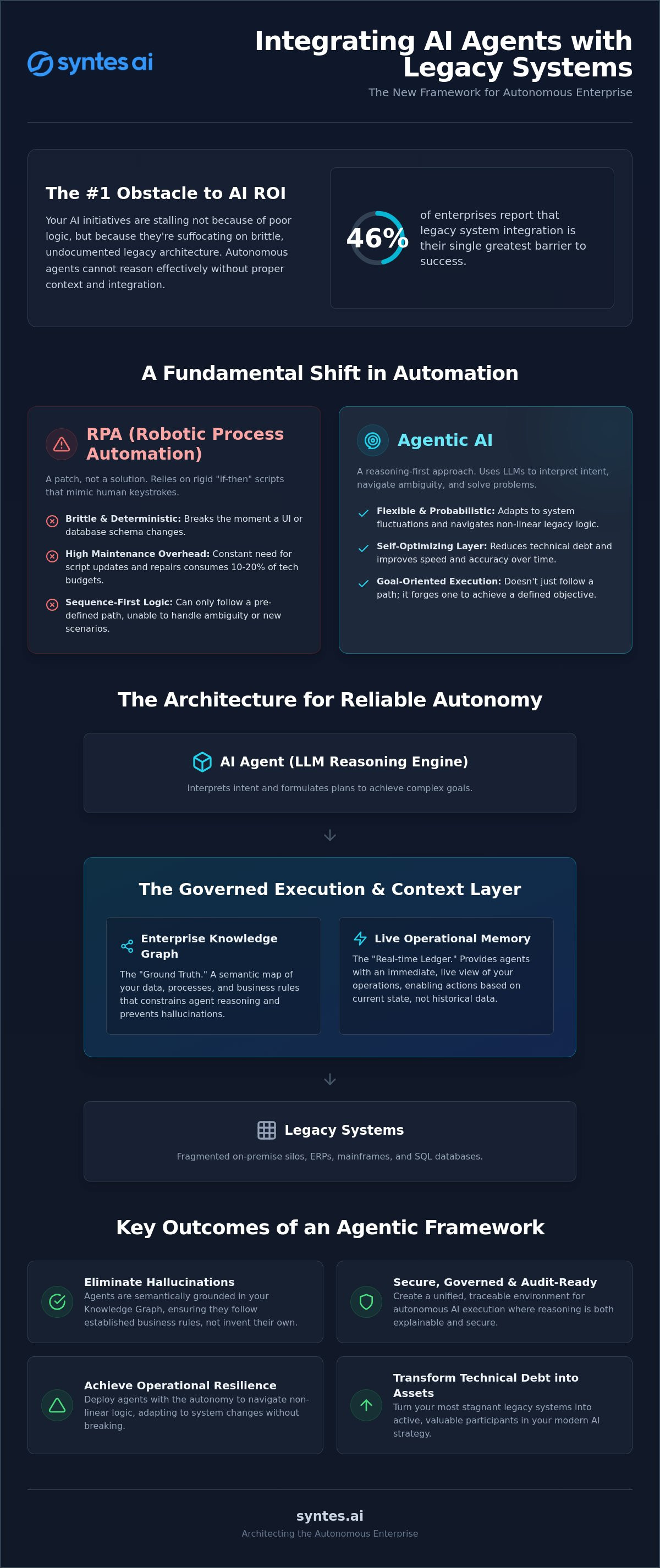
Why are your 2026 AI initiatives stalling at the integration layer? The truth is blunt: your autonomous agents aren’t failing because of poor logic, they’re suffocating under the weight of brittle, undocumented architecture. While 51% of enterprises have successfully moved agents into production this year, 46% report that integrating ai agents with legacy systems remains their single greatest obstacle to ROI. You don’t have a connectivity problem. You have a context problem. Your legacy APIs were built for predictable human inputs, not the high-velocity, autonomous reasoning of an agentic workforce.
It’s a reality most architects privately fear. You know that forcing an LLM to interact with fragmented on-premise silos without a safety net leads to hallucinations or, worse, unauthorized systemic changes that no auditor can trace. This guide provides the definitive framework for bridging that gap. You’ll learn how to leverage a governed Context Graph and Live Operational Memory to create a reliable execution layer. We’ll show you how to move beyond fragile wrappers toward a state of total operational clarity where AI reasoning is both explainable and secure.
Key Takeaways
- Stop relying on rigid RPA scripts that break under pressure and learn to deploy agents that possess the autonomy to navigate non-linear legacy logic.
- Understand the technical blueprint for integrating ai agents with legacy systems by utilizing an Enterprise Knowledge Graph as your definitive semantic layer.
- Master Context Engineering to provide agents with the deep institutional intelligence and business logic that standard prompt engineering simply can’t deliver.
- Build a secure, governed roadmap that transforms fragmented data silos into a unified, audit-ready environment for autonomous AI execution.
- Leverage Live Operational Memory to ensure your agentic workforce acts on real-time relevance rather than passive, disconnected data observations.
The Shift from RPA to Agentic Intelligence in Legacy Environments
Traditional automation has hit a ceiling. For a decade, Robotic Process Automation (RPA) was the enterprise standard for bridging gaps between siloed legacy systems. It was a patch, not a solution. RPA relies on rigid, “if-then” scripts that shatter the moment a legacy UI updates or an underlying database schema shifts. By 2026, the cost of maintaining these brittle scripts has become a primary bottleneck to digital transformation. True innovation requires integrating ai agents with legacy systems through a reasoning-first approach rather than a sequence-first one, a transition where J3 Automated Systems provides value by designing intelligent automation solutions for both physical spaces and business processes.
The transition toward an intelligent agent architecture represents a fundamental move from passive observation to active, goal-oriented execution. While RPA mimics human keystrokes, AI agents leverage Large Language Models (LLMs) as their core reasoning engine to interpret intent, navigate ambiguity, and solve problems in real time. They don’t just follow a path; they forge one. This shift is no longer optional. Maintaining legacy systems manually often consumes 10-20% of modern technology budgets, creating a drag that prevents the scaling of next-generation AI initiatives.
RPA vs. AI Agents: Architecting for Flexibility
Scripts are deterministic. They require absolute certainty and a static environment to function. In contrast, AI agents operate on probabilistic logic, allowing them to function effectively within the “messy” reality of legacy environments. An agent can ingest unstructured legacy logs or outdated documentation to understand how a decades-old system actually behaves. This flexibility allows enterprises to scale from simple task-based automation to complex, end-to-end process orchestration that adapts to system fluctuations without human intervention.
The ROI of Agentic Integration
Building the Brain: Knowledge Graphs as the Ground Truth for Agents
Vector databases are failing your enterprise. While they excel at retrieving relevant text snippets, they are fundamentally incapable of understanding the rigid, non-linear logic of a legacy ERP or mainframe. When integrating ai agents with legacy systems, you cannot rely on simple similarity searches. You need a structured, semantic map that defines how data actually moves and relates across your organization. An enterprise knowledge graph serves as this unified semantic layer, providing the necessary ground truth for autonomous agents to act with precision.
Legacy SQL databases often obscure critical relationships through decades of technical debt and fragmented schemas. A graph-based approach surfaces these hidden connections, allowing agents to reason across disparate systems without the need for massive, risky data migrations. This is the foundation of a modern enterprise architecture for AI agents. By creating Live Operational Memory, you provide your agents with a real-time ledger of state changes. They don’t just guess based on historical snapshots; they act on the immediate reality of your live operations. The strategic challenge of integrating ai agents with legacy systems is essentially a challenge of context, and the graph is the only structure capable of providing it at scale.
Eliminating Hallucinations in Process Execution
Hallucinations are an unacceptable risk in a production environment. To achieve deterministic outcomes, you must constrain agent reasoning within the bounds of your Knowledge Graph. This process of semantic grounding ensures that agents follow established business rules rather than inventing their own logic. Learning how to prevent ai hallucination is critical for mission-critical legacy integrations. It transforms your AI from a creative assistant into a reliable executor that auditors and stakeholders can trust.
Unifying Structured and Unstructured Legacy Data
Your legacy environment contains more than just rows and columns. It’s supported by PDF manuals, outdated documentation, and the tribal knowledge of your engineers. A graph architecture unifies these unstructured assets with your structured ERP tables. This allows for cross-system reasoning that respects the nuance of your proprietary business logic. Maintaining data integrity is paramount; the agent’s memory must always be synchronized with the legacy source. If you’re ready to see this architecture in action, you can explore our platform capabilities to see how we bridge these gaps.
Context Engineering: Harmonizing LLMs with Proprietary Business Logic
Prompt engineering is a linguistic band-aid. While it might help a chatbot sound more professional, it is fundamentally incapable of managing the structural complexities inherent in integrating ai agents with legacy systems. You cannot “prompt” your way into a 30-year-old mainframe’s undocumented logic or a fragmented ERP’s schema. True integration requires Context Engineering. This is the rigorous discipline of architecting the environment in which an AI reasons, ensuring that every autonomous action is grounded in the specific, messy realities of your enterprise’s history.
A semantic data layer for enterprise provides the necessary foundation for this trust. Most organizations attempt to solve integration through Retrieval-Augmented Generation (RAG). RAG is insufficient; it provides the “what” but ignores the “why.” If an agent retrieves a customer’s billing status but doesn’t understand the underlying contract’s credit terms, it will fail. Context Graphs go beyond simple retrieval by providing the causal links and business rules that define how data should be interpreted. Context is the set of relationships and rules that transform isolated data into actionable intelligence.
The Syntes Context Engineering Framework
We approach integrating ai agents with legacy systems through a three-stage execution model. First, we Connect and Understand, mapping the entities and relationships hidden within legacy silos. Second, we Contextualize and Govern. This stage applies your specific security protocols and business rules directly to the AI layer, ensuring the model’s reasoning is always compliant. Finally, we Execute. We move from passive insights to active, governed process execution where the agent can write back to legacy systems with total certainty.
Operational Relationship Intelligence
Why does the link between a legacy “Part Number” and a modern “Customer Contract” matter? Because without that link, your agent is blind to the departmental boundaries that stall operations. By solving enterprise data silos, you enable agents to work across the entire value chain. They stop being localized tools and start being global operators. This intelligence allows the agent to identify that a delay in a legacy manufacturing system will impact a contract renewal in a modern CRM, allowing for proactive, automated resolution before the human team even identifies the conflict.
Implementation Roadmap: Deploying Governed Agents Safely
Deployment is not a singular event. It’s a strategic sequence of architectural refinements designed to turn static data into active intelligence. Most enterprises fail here because they treat agentic deployment as a software installation rather than a systemic evolution. To succeed in integrating ai agents with legacy systems, you must follow a roadmap that prioritizes governance and structural integrity over raw speed. Your legacy systems aren’t dead weight; they’re data-rich foundations awaiting an intelligent interface.
- Step 1: Audit Infrastructure. Begin by auditing your enterprise ai infrastructure to identify integration bottlenecks, specifically focusing on API latency and the documentation of on-premise schemas.
- Step 2: Construct the Context Graph. Map the relationships between legacy logic and modern business goals. This graph serves as the agent’s navigational chart.
- Step 3: Deploy Two-Way Connectors. Move beyond read-only access. Establish governed write-back capabilities that allow agents to execute actions within ERP and CRM systems.
- Step 4: Institutionalize Oversight. Implement Human-on-the-Loop protocols for mission-critical actions to ensure that autonomous reasoning aligns with corporate risk tolerances.
- Step 5: Scale via Orchestration. Transition from single-purpose agents to multi-agent systems. With multi-agent adoption expected to surge by 67% by 2027, orchestration is the final step toward a fully autonomous enterprise.
Two-Way Connectors and Legacy APIs
Read-only integrations are a relic of the past. If your agents can’t write back to your core systems, they aren’t agents; they’re expensive search engines. Integrating ai agents with legacy systems requires overcoming the limitations of fragile legacy APIs. You must manage rate limits and data consistency with surgical precision. Secure, authenticated two-way connectors ensure that when an agent identifies a supply chain conflict, it can autonomously update the legacy ERP without manual intervention, maintaining a state of total operational synchronicity.
AI Governance and Explainable Reasoning
Trust is built on transparency. In regulated environments, “black box” logic is a liability. By 2026, ISO 42001 has become the de facto standard for AI governance, requiring enterprises to prove the provenance of every autonomous decision. Knowledge Graphs provide a definitive audit trail by making agent reasoning transparent and explainable. This allows auditors to see exactly which legacy data points and business rules led to a specific action. This level of Explainable AI is not just a feature; it’s a requirement for compliance under the EU AI Act’s 2026 transparency obligations. If you’re ready to secure your agentic future, schedule a technical deep dive with our architecture team.
The Syntes Agentic Platform: Architecting the Autonomous Enterprise
The gap between visionary AI strategy and operational reality is where most enterprise projects die. Theoretical models are useless if they cannot interact with the mainframe that runs your global supply chain or the decades-old database housing your customer records. The Syntes Agentic Platform was engineered for the specific purpose of integrating ai agents with legacy systems without compromising systemic stability. We provide the hardened infrastructure required to turn brittle, siloed data into a unified, high-fidelity agentic ai platforms architecture. This isn’t a wrapper; it’s a new foundation for execution.
At the heart of this architecture lies Live Operational Memory. Standard integrations rely on periodic data syncs that are often obsolete by the time an agent attempts to act on them. Our platform ensures that agents operate with real-time relevance, tracking state changes across disparate systems as they happen. This accelerates the deployment of reliable agents by providing a persistent, governed memory layer that understands the current state of every legacy asset. When integrating ai agents with legacy systems, the primary risk is systemic shock; Syntes mitigates this through a governed execution layer that acts as a buffer between autonomous reasoning and your legacy core.
Scaling Beyond the Pilot: Multi-Agent Orchestration
Success in a pilot program rarely translates to enterprise-wide utility without a strategy for orchestration. Single-purpose agents often create new silos. The Syntes Agentic Platform utilizes shared context to allow multiple agents to collaborate across different legacy systems simultaneously. One agent can manage inventory in an on-premise ERP while another coordinates with a modern cloud-based CRM, both drawing from the same Enterprise Knowledge Graph. This shared operational memory significantly reduces the cost of AI development. You stop building every agent from scratch and start deploying them as reusable components of a fully autonomous enterprise intelligence layer.
Next Steps for Enterprise Architects
Your journey toward an autonomous enterprise begins with an honest assessment of your current architecture. You must determine your “Context Maturity” before attempting full-scale deployment. This involves auditing the connectivity of your legacy silos and identifying the business rules that currently exist only as tribal knowledge. The path forward requires a roadmap that balances immediate efficiency gains with long-term structural resilience. We invite you to book a demo to see how Syntes AI integrates with your legacy stack and discover how to transform your technical debt into a competitive engine for the agentic era.
Mastering the Agentic Evolution
The era of the static enterprise is over. The strategic mandate for integrating ai agents with legacy systems is no longer a matter of theoretical experimentation; it’s a requirement for operational dominance in a market defined by autonomous execution. You’ve seen how moving beyond brittle RPA scripts toward a governed Context Graph provides the semantic grounding agents need to navigate complex logic. By prioritizing Context Engineering over simple prompting, you ensure your AI initiatives are rooted in deterministic truth rather than hallucinatory inference.
True operational clarity requires more than just connectivity. It demands a platform capable of providing Live Operational Memory for real-time legacy grounding and enterprise-grade AI Governance for secure execution. Our architecture provides the deterministic reasoning paths necessary for mission-critical auditability, ensuring your transition to an autonomous state is both safe and scalable. The tools to bridge the gap between your legacy core and the future of intelligence are ready. Architect your autonomous future with a Syntes AI demo and turn your technical debt into your greatest competitive advantage.
Frequently Asked Questions
What are the biggest risks when integrating AI agents with legacy systems?
The primary risks involve data corruption and non-compliant autonomous decision-making. Without a governed execution layer, agents may execute actions that violate hidden business logic or regulatory requirements like the EU AI Act. Securing these environments requires deterministic reasoning paths that provide full auditability for every change made to the core legacy infrastructure.
How do AI agents communicate with legacy software that lacks modern APIs?
Agents communicate with non-API systems through “AI Agent Wrappers” or direct database connectors. These interfaces translate high-level model outputs into specific commands that legacy mainframes or on-premise databases can process. This strategy allows for integrating ai agents with legacy systems without requiring a total architectural overhaul or the sunsetting of functional but old software.
Can a Knowledge Graph really prevent AI hallucinations in process automation?
Yes, a Knowledge Graph provides the semantic grounding necessary to eliminate hallucinations by acting as a definitive “ground truth.” By forcing the agent to cross-reference its reasoning against a structured map of facts and business rules, you constrain its output to verified logic. This moves the AI from a probabilistic generator to a reliable, deterministic executor that stakeholders can trust.
What is the difference between RPA and an autonomous AI agent?
RPA is a rigid, script-based automation that follows a linear path; an autonomous agent is a goal-seeking reasoning engine. While RPA breaks the moment a legacy UI changes or a database schema shifts, an agent uses its reasoning engine to navigate ambiguity. Agents represent the necessary evolution from “if-then” scripts to active, intelligent performance across fragmented enterprise silos.
How do you ensure data security when an AI agent has write-access to an ERP?
Security is maintained through permission-based context and governed execution layers that act as a buffer. You must restrict the agent’s access so it only interacts with the specific data subsets required for its mission. Implementing Human-on-the-Loop oversight for mission-critical actions ensures that no change is committed to the ERP without meeting strict corporate safety protocols.
Is it necessary to modernize my legacy systems before deploying AI agents?
No, modernization is no longer a prerequisite for AI deployment in 2026. In many cases, integrating ai agents with legacy systems is the fastest path to modernization. Agents serve as an intelligent interface that abstracts the complexity of technical debt, allowing you to extract modern value from old systems without the risk of a full-scale replacement.
What is Context Engineering and why does it matter for legacy integration?
Context Engineering is the technical discipline of architecting the data environment to support AI reasoning. It matters because standard prompt engineering cannot bridge the gap between an LLM and undocumented legacy logic. By mapping relationships and rules within a Context Graph, you provide the institutional nuance that allows an agent to act correctly within your specific proprietary environment.
How long does it take to build a Context Graph for a large enterprise?
Building an initial Context Graph typically takes weeks rather than months or years. The timeline depends on the complexity of your data silos and the clarity of your existing documentation. Most enterprises begin with a specific high-value workflow to establish a proof of concept before scaling the graph architecture across their entire global systems architecture.