

What if the 897 separate applications powering your organization are not actually communicating, but are instead silently sabotaging your AI strategy? Most IT leaders now face a breaking point where traditional connectivity fails. The reality is that 95% of organizations report ongoing api integration challenges enterprise teams cannot solve with more brittle connectors or manual mapping. You are likely witnessing the symptoms already: silent data failures, skyrocketing maintenance costs for legacy systems, and AI agents that hallucinate because they lack grounded, real-time context.
You recognize that the current path is unsustainable. This article provides the definitive framework to transition your infrastructure from a series of fragmented data pipes into a unified, reasoning Context Graph. We will explore how to confront the 2026 connectivity crisis, including the impact of SAP’s v4 API policy and Salesforce’s aggressive retirement schedules. By the end, you will understand how to build a resilient, agent-ready intelligence layer that eliminates technical debt and achieves true operational intelligence.
Key Takeaways
- Shift from passive data synchronization to a reasoning-first architecture capable of supporting the high-velocity demands of 2026 autonomous agents.
- Dismantle the primary api integration challenges enterprise leaders encounter, including data model dissonance and the unsustainable costs of manual authentication maintenance.
- Eliminate AI hallucinations by replacing fragmented RAG implementations with a unified intelligence layer that provides deep, grounded operational context.
- Architect a resilient foundation by replacing brittle connectors with a Semantic Data Layer that prioritizes relationship-based intelligence over simple data mapping.
- Achieve total operational clarity by evolving beyond static middleware into a Live Context Graph designed for real-time, automated performance.
The Enterprise API Landscape: Why Connectivity Does Not Equal Intelligence
Connectivity is a commodity. Intelligence is the competitive edge. In 2026, enterprise API integration is no longer about the mere movement of JSON packets between cloud silos; it’s about the orchestration of systemic logic across an increasingly fragmented architecture. While traditional Enterprise Application Integration (EAI) focused on basic interoperability, modern operational demands require a shift from simple data synchronization to complex reasoning workflows. You don’t just need your CRM to talk to your ERP. You need your autonomous agents to understand the commercial intent behind every transaction in real time.
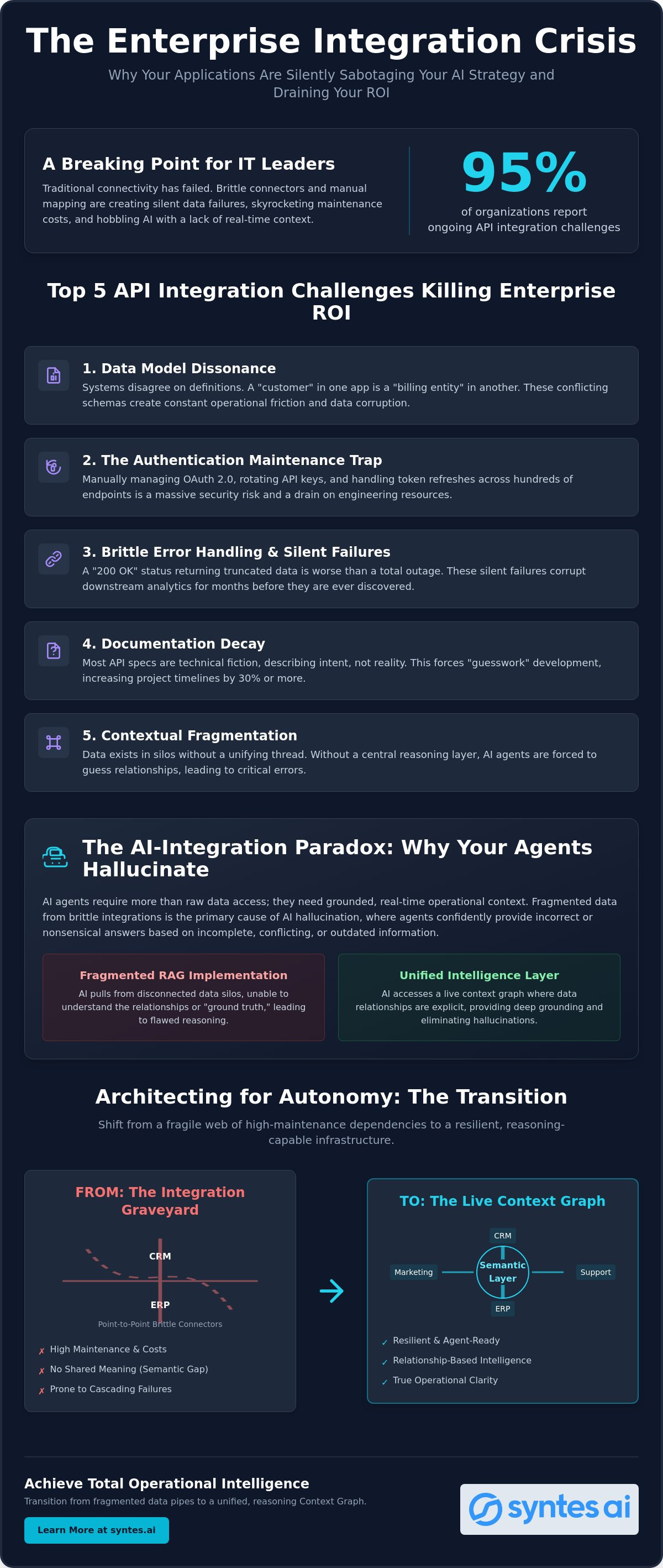
Most organizations are currently suffocating under an “integration graveyard”—a collection of abandoned, undocumented, or brittle connectors that drain resources without delivering insight. This creates a profound Semantic Gap. Systems might share raw data, but they don’t share meaning. When your marketing stack defines a “lead” differently than your sales stack, the resulting friction isn’t just a technical glitch; it’s a strategic failure. Solving the api integration challenges enterprise teams face today requires closing this gap by moving beyond “dumb pipes” toward a reasoning-capable infrastructure.
The Proliferation Crisis: Managing Hundreds of Endpoints
Legacy Debt vs. Modern Demands
The requirements of 2010-era REST APIs were built for human developers or simple scheduled scripts. They were never designed for the high-velocity, high-volume demands of 2026 Agentic AI. Traditional middleware fails here because it lacks the capacity to deliver live operational context; it provides snapshots of the past rather than a pulse of the present. AI agents require more than access; they require grounding in the current state of the business logic. The connectivity-intelligence paradox dictates that as you build more individual pipes, you actually decrease overall clarity by creating more noise and less context.
Top 5 API Integration Challenges Killing Enterprise ROI
Why is your integration budget vanishing into a black hole of maintenance? It’s not just the initial build cost that drains resources. The true api integration challenges enterprise leaders face are structural, persistent, and often invisible until they trigger a systemic failure. ROI is currently bleeding out through a thousand small cuts in the logic layer. The most pervasive Top API Integration Challenges involve more than just broken code; they involve broken context.
- Data Model Dissonance: Systems rarely agree on definitions. One application views a “customer” as a billing entity, while another sees a “customer” as a unique user ID. These conflicting schemas create permanent friction.
- The Authentication Maintenance Trap: Managing OAuth 2.0, rotating API keys, and handling token refreshes across 500+ endpoints is a security nightmare. It’s a manual burden that scales poorly and invites credential leakage.
- Documentation Decay: Most API specifications are technical fiction. They describe how a system was intended to work, not how it actually behaves in production. This forced “guesswork” increases development time by 30% or more.
- Contextual Fragmentation: Data exists in silos without a unifying thread. Without a central reasoning layer, your AI agents are forced to guess the relationships between disparate data points.
If these hurdles sound familiar, you aren’t alone. You can book a demo to see how a unified context graph eliminates these manual bottlenecks.
The Language Barrier: Semantic Inconsistency
Field mapping is a superficial band-aid. It doesn’t solve the underlying semantic gap between legacy ERPs and modern cloud stacks. Inconsistent schemas lead to catastrophic errors when AI agents attempt to reason across systems. Data drift—where the meaning of a field changes over time without a corresponding schema update—destroys the integrity of long-running business processes. You don’t need better mapping; you need a reasoning layer that understands the intent of the data.
Security and Compliance at the Edge
Bolted-on compliance is a strategy for failure. In a world of strict cross-border data regulations, managing access for autonomous agents requires more than just a firewall. Credential leakage in sprawling, unmanaged integration environments is an existential risk. Governed access must be baked into the architecture, ensuring that every automated call is authenticated, authorized, and audited in real time. Without this, your integration layer is a massive, ungoverned attack surface.
The AI-Integration Paradox: Why Your Agents Are Hallucinating
Hallucinations are rarely just a failure of the Large Language Model (LLM). They are more frequently a failure of the underlying architecture. When your AI agents produce confident but incorrect outputs, they aren’t “creative”; they are under-informed. Fragmented APIs provide incomplete context, forcing agents to fill the gaps with probabilistic guesswork. This is the AI-integration paradox. The more systems you connect via traditional methods, the more opportunities you create for agentic drift. Standard Retrieval-Augmented Generation (RAG) often fails here because it treats API pipes as simple retrieval mechanisms rather than complex reasoning channels.
Solving the api integration challenges enterprise teams encounter requires a fundamental shift in perspective. You must distinguish between “Connectivity”—the mechanical movement of data—and Context Engineering. Connectivity ensures a packet arrives; Context Engineering ensures the agent understands the systemic significance of that packet. AI agents require deterministic truth, not just “available” data. If your integration layer can’t provide a single, unified version of reality, your AI initiatives will remain expensive experiments rather than operational assets.
The Grounding Gap in Enterprise AI
Latency and data staleness are the primary enemies of agentic performance. Even a few seconds of lag in an API response can result in an agent making decisions based on expired information. This “grounding gap” is where hallucinations thrive. Traditional data warehouses are too slow for real-time workflows; they offer a rearview mirror when your agents need a windshield. Implementing Live Operational Memory is the only way to ensure your agents remain grounded in current, verifiable facts. Without this real-time anchor, your AI will inevitably lose touch with the operational reality of the business.
From Passive Data to Active Reasoning
Modern AI agents don’t just observe; they execute. They use APIs to trigger workflows, update records, and move capital. This shift from passive data consumption to active reasoning introduces massive risk. When unmanaged agents interact with brittle, undocumented API endpoints, the potential for systemic error is high. An agent might interpret a malformed JSON response as a command to delete a record or duplicate an invoice. You cannot afford to let autonomous systems operate on a foundation of shaky connectors. An agent is only as reliable as the context it consumes.
Architecting for Autonomy: 5 Steps to Modernize Enterprise Integration
Connectivity alone is a liability. To survive the 2026 connectivity crisis, you must transition from a collection of fragile pipes to a robust, reasoning-capable architecture. The api integration challenges enterprise organizations encounter today stem from a lack of structural autonomy. You cannot scale your AI initiatives on a foundation of manual mapping and reactive maintenance. You need a framework that prioritizes the semantic quality of your data over the sheer volume of your connections.
- Audit and Consolidate: Eliminate the redundant endpoints and shadow IT integrations that create unmanaged risk. Every untracked API is a potential point of failure for your autonomous agents.
- Implement a Semantic Data Layer: Move beyond primitive JSON mapping. Relationship-based intelligence allows your systems to understand the context of data, not just its format.
- Transition to Event-Driven Architecture: Polling is too slow for 2026. Real-time relevance requires an architecture that pushes data to agents the moment an event occurs.
- Standardize Governance and Security: Centralize your token management and audit logs. You need a single point of control to ensure that every automated call is compliant and secure.
- Adopt a Context-First Strategy: Prioritize the “Why” and “How” of your data. Understanding the business logic behind a transaction is more important than simply moving the record.
Building this foundation is not optional for those seeking to lead in the age of Agentic AI. You can book a demo to see how our platform automates this modernization.
Building the Abstraction Layer
Decoupling your business logic from third-party API schemas is essential. When vendors like Salesforce or SAP retire versions or change policies, your internal workflows shouldn’t break. An abstraction layer acts as a buffer, translating vendor-specific data into your organization’s internal language. This allows for graceful degradation. If a vendor API fails or slows down, your systems can maintain operational continuity by relying on cached context or alternative routes.
Scaling Beyond Human Management
Manual monitoring is a relic. Humans can’t keep pace with the thousands of API calls triggered by autonomous agents. You must implement automated testing for API contract changes to prevent silent failures. Solving the persistent api integration challenges enterprise teams face requires moving from passive observation to active, automated performance. Using AI to monitor and self-heal integration points ensures that your infrastructure remains resilient without constant developer intervention. For a deeper look at these scaling strategies, consult the 2026 Guide to Enterprise AI Infrastructure.
Beyond APIs: The Transition to a Live Context Graph
Unified APIs are a half-measure. While they provide a single endpoint for disparate systems, the data they deliver remains flat, disconnected, and devoid of the structural relationships necessary for deep reasoning. To truly solve the api integration challenges enterprise leaders face, you must move beyond the pipe. The Syntes AI Context Graph represents the definitive evolution in systems architecture. It does not just transport data; it creates a living, breathing map of your organizational logic. This is the transition from passive observation to active, automated performance.
Static middleware is a post office. It receives a message and delivers it to a destination without understanding the content. A Live Operational Model, by contrast, is a brain. It maintains a stateful, reasoning-ready version of your business reality in real time. For organizations deploying Agentic AI Platforms, this unified context layer is the difference between an agent that merely “looks up” data and an agent that understands the systemic implications of its actions. You don’t need more connections. You need more clarity.
Operational Relationship Intelligence
Syntes AI connects customers, products, and complex business rules into a dynamic graph. Traditional APIs provide isolated data points: a customer ID, an order number, a shipping status. The Context Graph provides deep reasoning: “Customer 123 is currently at risk of churn because a delayed shipping event in the ERP contradicts the priority status in the CRM.” This relationship intelligence is what powers autonomous execution. By automating the semantic mapping between systems, enterprise teams can reduce integration maintenance by 70%, effectively reclaiming thousands of engineering hours from the integration graveyard.
The Future of Governed Agentic AI
How do you ensure an autonomous agent executes safely across a sprawling enterprise stack? You govern the context. Syntes AI enables safe, explainable AI execution by providing a transparent, relationship-based audit trail for every decision made. Our “Connect, Understand, Contextualize” framework allows leaders to move from fragmented data silos to a state of total operational clarity. We have identified the systemic flaws in traditional connectivity and built the tools to rectify them. Stop building more pipes. Start building intelligence. Connectivity is the past; context is the future.
The 2026 connectivity crisis is already here. Are you still managing pipes, or are you ready to lead with context? Transition your infrastructure to a Live Operational Model today.
Command the Future of Enterprise Intelligence
The 2026 connectivity crisis isn’t a future threat; it’s a present reality for every leader managing fragmented data pipes. Traditional connectivity has reached its architectural limit. It is time to evolve. To move forward, you must replace brittle, manual connectors with a reasoning-capable infrastructure that understands the semantic relationships between your systems. By adopting a Context-First strategy, you solve the persistent api integration challenges enterprise teams face while building a foundation for truly autonomous operations.
Syntes AI provides the definitive evolution for Global 2000 infrastructures. Our platform allows you to eliminate 70% of integration technical debt and enable trusted, hallucination-free Agentic AI. You don’t have to settle for an integration graveyard. It’s time to achieve total operational clarity through a unified intelligence layer. The tools for systemic transformation are within your reach.
Architect Your Enterprise Context with Syntes AI and secure your organization’s position in the agentic era. Your journey toward a live, reasoning enterprise starts now.
While enterprise leaders focus on large-scale AI strategy, those looking to apply these technologies to smaller ventures can find valuable guidance at Logic Kinetics, which specializes in building profitable online businesses with AI and WordPress.
Frequently Asked Questions
What are the most common API integration challenges in 2026?
Semantic data model dissonance and the maintenance burden of disparate authentication protocols are the primary hurdles. Enterprises also struggle with brittle error handling that leads to silent data corruption and documentation that fails to track rapid vendor updates. These api integration challenges enterprise leaders face ultimately prevent the delivery of real-time, grounded context necessary for autonomous workflows.
How do API integration failures cause AI hallucinations?
Hallucinations occur when underlying pipes deliver fragmented or stale data that lacks a unified semantic layer. AI agents require deterministic truth to verify their reasoning. If an integration provides a customer record but lacks the linked business rules or transaction history stored in another silo, the agent fills these gaps with plausible but incorrect information.
Why is traditional middleware insufficient for Agentic AI?
Traditional iPaaS solutions were built for passive data transport between systems. They move records without understanding the relationship-based intelligence required by modern AI agents. Agentic AI needs a live operational memory that recognizes hierarchies and dependencies. A flat integration pipe simply cannot provide the reasoning capabilities essential for 2026 operational demands.
What is the difference between a Unified API and a Context Graph?
A Unified API standardizes the interface across multiple vendors while still delivering flat, isolated data. The Syntes AI Context Graph goes deeper by mapping the intricate relationships between all enterprise entities. It creates a living model of the business. This allows AI to reason across silos rather than just fetching individual records from a standardized endpoint.
How can enterprises reduce the cost of API maintenance?
Adopting a “Context-First” architecture is the most effective way to slash rising maintenance expenditures. By implementing a semantic abstraction layer, you decouple business logic from volatile vendor schema changes. This transition enables centralized governance and automated token management. It significantly reduces the technical debt inherent in updating hundreds of individual, brittle connectors.
Is it better to build or buy enterprise AI integration infrastructure?
Buying a foundational layer like a Knowledge Graph is the superior strategy for Global 2000 organizations. Building a custom semantic layer capable of real-time reasoning and AI governance requires years of specialized development. Leveraging an established platform like Syntes AI allows CIOs to focus on high-value execution rather than the underlying plumbing of the api integration challenges enterprise environment.