
An agentic ai framework that only orchestrates is a liability, not an asset. While 31% of enterprises have successfully moved agents into production as of 2026, the majority remain paralyzed by high latency and the persistent threat of hallucinations. You’ve likely seen the limits of simple LLM chains. Fragmented data silos continue to starve agents of the autonomy they need to drive real value. The friction between autonomous action and corporate governance is a systemic flaw that most current architectures fail to address.
This guide provides the definitive blueprint for building a production-ready architecture that prioritizes execution over mere observation. You’ll master the critical shift from basic RAG to sophisticated Context Engineering; this ensures your agents are grounded in live enterprise truth rather than static data. We’ll define the framework selection criteria required to maintain absolute governance over autonomous actions. Expect a deep dive into how a unified context layer transforms fragmented systems into a cohesive, operational intelligence engine that delivers measurable ROI.
Key Takeaways
- Transition from simple “Chain-of-Thought” prompting to robust agentic workflow execution to drive truly autonomous business processes.
- Analyze sequential, hierarchical, and joint collaboration architectures to determine which agentic ai framework best supports your specific enterprise scale.
- Adopt Context Engineering as the technical successor to standard RAG; this prevents hallucinations by grounding agents in a unified enterprise memory layer.
- Implement a production-ready governance framework that utilizes Explainable AI to ensure all autonomous agent actions remain secure and auditable.
- Integrate a Live Context Graph to unify fragmented data silos, providing the necessary ground truth for high-performance agentic systems.
What is an Agentic AI Framework in the 2026 Enterprise?
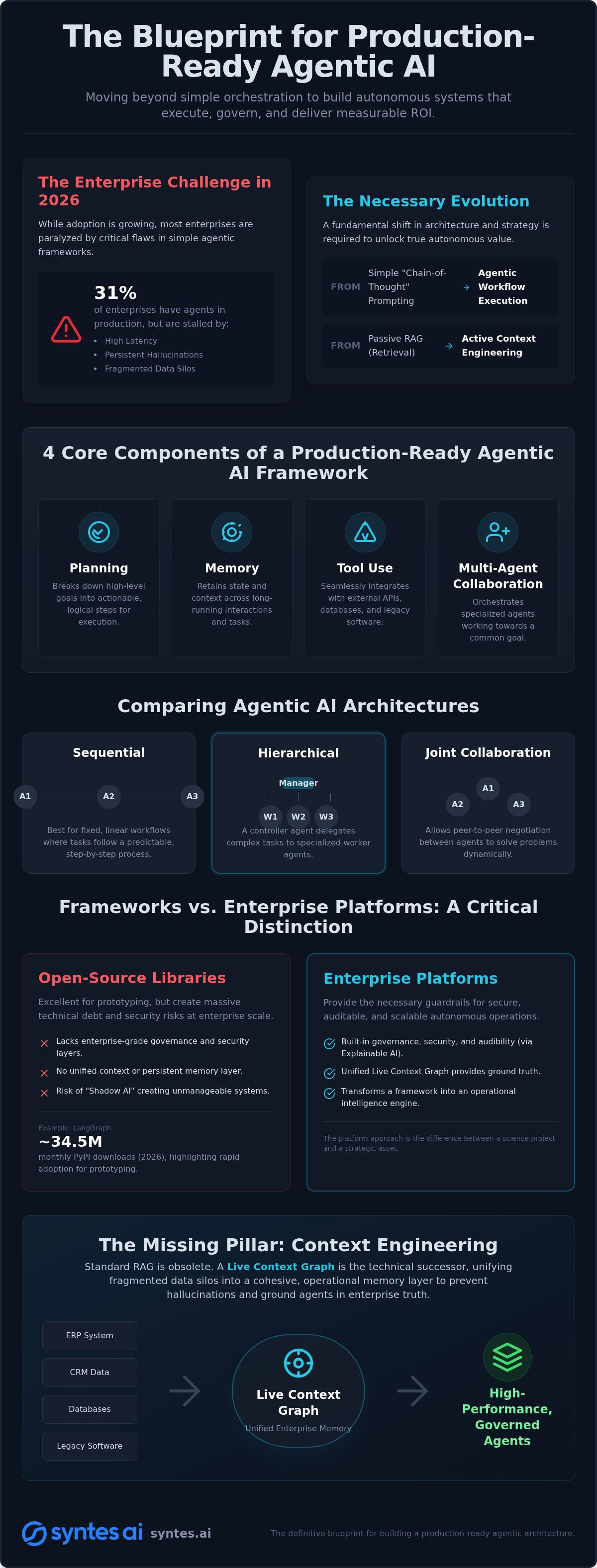
The enterprise landscape has shifted. By 2026, 62% of organizations have moved beyond simple experimentation to deploying autonomous agents in production. An agentic ai framework is no longer just a library of LLM calls. It is the reasoning engine that powers autonomous business processes. It represents the definitive transition from “Chain-of-Thought” prompting to “Agentic Workflow” execution. These frameworks don’t just respond to prompts; they pursue objectives. They coordinate multi-agent collaboration to solve problems that a single model cannot handle alone. In this environment, the goal isn’t a better chatbot. The goal is a system that can plan, remember, and act with minimal human intervention.
Successful deployment requires four core components. First, Planning: the ability to break down a high-level goal into actionable, logical steps. Second, Memory: the capacity to retain state and context across long-running interactions. Third, Tool-use: the seamless integration with external APIs, databases, and legacy software. Finally, Multi-agent collaboration: the orchestration of specialized agents working toward a common enterprise goal. This architecture allows an AI agent to function as a digital colleague rather than a passive tool.
The Evolution from RAG to Agentic Reasoning
Standard Retrieval-Augmented Generation (RAG) is a relic of 2024. It is too passive. It fetches data but lacks the cognitive architecture to apply it to complex problems. Modern enterprises require agents that “think” through multi-step problems before they touch a single tool. This shift toward agentic reasoning allows systems to manage long-running tasks across disparate ERP and CRM environments. It moves the needle from simple data retrieval to active Context Engineering. Agents now evaluate the quality of retrieved information, verify its relevance, and iterate on their own logic until the objective is met. This loops-based reasoning is what separates a reactive script from an autonomous agent.
Framework vs. Platform: Understanding the Distinction
Libraries provide tools. Platforms provide control. Code alone is not a strategy. While open-source libraries are excellent for prototyping, they often lack the infrastructure required for global scale. They don’t offer the governance or security layers that high-level decision-makers demand. An enterprise platform like the Syntes Agentic Platform provides the necessary guardrails. Without these, “shadow AI” frameworks create massive technical debt for IT departments. A platform unifies the agentic ai framework with a Live Context Graph. This ensures that every autonomous action is governed, auditable, and grounded in the proprietary truth of your organization. Choosing a platform over a library is the difference between a science project and an operational intelligence engine.
Comparing the Leading Agentic AI Framework Architectures
Choosing an agentic ai framework is a strategic decision that defines your operational limits. Orchestration isn’t one-size-fits-all. Sequential patterns work for fixed, linear workflows. Hierarchical structures introduce a controller for complex delegation. Joint collaboration allows peer-to-peer negotiation between specialized agents. Most enterprises fail here. They select a pattern without considering the weight of state management. Without robust state tracking, agents lose the thread of multi-step processes. This leads to redundant API calls, fragmented logic, and wasted compute. A framework must do more than just pass messages; it must maintain a persistent, auditable memory of every intermediate step.
Production readiness demands observability. It’s not enough for an agent to work; you must know why it worked. Error handling in an autonomous environment is fundamentally different from traditional software. When an agent encounters a blocked path, the framework must provide a reasoning loop to bypass the obstacle rather than simply throwing an exception. This capability is what allows Multi-Agent Systems (MAS) to break down enterprise silos, connecting disparate data sources into a unified execution stream.
Open-Source Libraries vs. Proprietary Enterprise Solutions
LangGraph has become a dominant force, recording approximately 34.5 million monthly PyPI downloads in 2026. It is the new standard for LangChain users. CrewAI, currently at version 1.15.18, and Microsoft’s Agent Framework (GA since April 2026) offer powerful prototyping capabilities. But libraries are not platforms. They lack the native security and cross-system integration required for regulated industries. Building custom governance on top of raw code creates massive technical debt. You need a solution that integrates with your existing ERP data from day one. To see how enterprise-grade orchestration works in practice, you can book a demo of the Syntes platform.
Multi-Agent Orchestration: Managing the “Agent Swarm”
Complexity breeds chaos. An unmanaged “agent swarm” often collapses into infinite loops or conflicting actions. Hierarchical designs mitigate this by implementing a “Supervisor Agent” to adjudicate decisions and manage the flow of information. This architecture aligns with the NIST AI Risk Management Framework, which emphasizes the need for trustworthy and governed autonomous systems. Achieving deterministic outcomes in a non-deterministic environment requires more than just code. It requires a live context layer to ground every decision in enterprise reality. Without this grounding, even the most sophisticated “Supervisor Agent” is merely guessing.
The Missing Pillar: Why Frameworks Fail Without Context Engineering
Orchestration is a hollow victory without a semantic foundation. An agentic ai framework provides the plumbing, but it does not provide the intelligence. Most enterprises attempt to fuel their agents with “flat data”, including disparate PDFs, fragmented spreadsheets, and disconnected database rows. This approach is fundamentally flawed. It forces agents to guess at relationships that aren’t explicitly stated. Guesswork in production is the primary driver of hallucinations. When an agent cannot see the interconnected reality of your business logic, it invents its own. This leads to architectural collapse.
This is the “Empty Shell” problem. You have the orchestration, the planning, and the tool-use, but the agent lacks a unified semantic understanding of the enterprise. It operates in a vacuum. To move beyond this, organizations must implement the Syntes AI Context Graph as their essential foundation. It transforms raw data into a structured, relational map that agents can navigate with precision. It replaces the randomness of vector search with the certainty of a knowledge graph.
Context Engineering vs. Prompt Engineering
Context Engineering is the discipline of building and governing business context for AI safety. While prompt engineering focuses on the ephemeral art of phrasing, Context Engineering builds a permanent enterprise memory. Prompts are volatile. They are limited by token windows. They cannot hold the weight of a complex global operation. The transition from “retrieving documents” to “understanding relationships” is the hallmark of a mature AI strategy. A Context Graph ensures that when an agent retrieves a customer record, it also understands the pending invoices, the support history, and the strategic value of that relationship. It provides the “why” behind the “what.”
Building a Live Operational Memory for Agents
Static data creates stale agents. A Live Operational Memory allows agents to reason over real-time events, ensuring their actions are relevant to the current state of the business. This is achieved through two-way connectors that keep the context layer continuously updated. It is no longer enough to look at yesterday’s reports. Agents require “Operational Relationship Intelligence” to make autonomous decisions that reflect live market conditions and internal shifts. This connectivity ensures that the agentic ai framework acts on truth, not on an outdated snapshot. It is the difference between a system that merely observes and a system that executes with total operational clarity.
Production-Ready Architecture: Governance and Security for Agents
Autonomous agents without governance are a systemic threat. They risk data leakage. They perform unauthorized actions. They hide logic inside a “black box” that no auditor can penetrate. An enterprise agentic ai framework must enforce strict boundaries before the first line of code executes. It’s not enough to hope for safety; you must architect it. This requires moving beyond simple prompts to a robust governance layer that manages the entire action lifecycle. This architectural clarity is why forward-thinking enterprises report a median 2.4x ROI on AI investments in 2026.
The Syntes Context Engineering Framework solves the governance challenge through five critical pillars: Connect, Understand, Contextualize, Govern, and Execute. This is the roadmap for secure execution. By embedding Explainable AI (XAI) within the agentic ai framework, we transform the reasoning process from a mystery into a manageable asset. Decision-makers can finally audit the “why” behind every autonomous action. We design Human-in-the-Loop (HITL) systems as strategic gates. These gates ensure high-stakes decisions remain under human control while the repetitive, low-risk logic flows at the speed of silicon.
Governed Agentic AI: Controlling the Action Layer
Permissions shouldn’t be an afterthought. You must apply granular enterprise rules directly to the agent’s reasoning engine. The Context Graph serves as the definitive audit layer, tracking every interaction and mapping it against global standards like GDPR and SOC2. This ensures that agents never exceed their mandate. It turns a potential security liability into a governed, high-performance digital workforce. By grounding actions in a Live Operational Memory, you ensure that agents respect the messy realities of large-scale operations while maintaining total compliance.
Solving the Hallucination Problem with GraphRAG
Creative guessing is the enemy of production AI. LLMs are designed to be helpful, often at the expense of accuracy. GraphRAG replaces this volatility with deterministic truth. By grounding agents in a knowledge graph, you provide a semantic map that prevents “hallucination by association.” Consider financial services. A structured context allows agents to cross-reference real-time market data with historical compliance records, ensuring every output is factually sound. In manufacturing, this grounding prevents agents from misinterpreting sensor anomalies as supply chain failures. Reliability is a function of structure.
Implementing the Syntes Agentic Platform: From Framework to Intelligence
Implementation is the final hurdle in the journey toward autonomous intelligence. Many organizations fail at this stage because they treat the model as the primary driver of value. It’s not. Models are commodities; context is your competitive moat. The Syntes Agentic Platform acts as the connective tissue that transforms a standard agentic ai framework into a high-performance reasoning engine. It unifies fragmented data silos into a Live Context Graph, ensuring your agents operate with a total understanding of your business logic. Without this unified layer, your agents are merely sophisticated guessers. They lack the proprietary grounding required to execute complex, cross-system tasks with certainty.
Bridging the gap between general LLM knowledge and proprietary enterprise data is a structural necessity. While an LLM understands the global market, it doesn’t understand your specific supply chain constraints or your unique customer tiering. The 2026 Guide to Enterprise AI Infrastructure makes the priority clear: invest in the context layer over the model layer. CIOs must now move beyond the novelty of orchestration and begin assessing their organization’s Context Maturity. This assessment determines whether your infrastructure is ready to support agents that can act with true autonomy.
The Syntes Advantage: Live Operational Context
Syntes AI doesn’t just store data; it creates a continuously evolving model of your business. This is the power of Live Operational Context. By utilizing cross-system integrations, the platform establishes a “Single Source of Truth” that agents can query in real time. This moves your AI strategy from “pilot mode” to “production scale.” It replaces static snapshots with a dynamic memory that reflects every internal shift and market change. Governed context ensures that as your agents scale, they remain aligned with your operational goals. You gain the ability to deploy hundreds of specialized agents without losing control over the underlying logic.
Getting Started with Context Engineering
Success begins with identifying high-value use cases. Look at your supply chain, finance, or retail operations. These are environments where autonomous decision-making can eliminate massive operational friction. The roadmap for implementation involves connecting your structured and unstructured data into a unified graph. This isn’t a weekend project; it’s a strategic overhaul of how your organization handles intelligence. You must move from document retrieval to relationship understanding. To see how this architecture functions at scale, you are invited to explore the Syntes Agentic Platform. It’s time to stop experimenting with an agentic ai framework and start building enterprise-grade intelligence.
The Future of Operational Intelligence
The window for experimental AI is closing. By 2026, the distinction between market leaders and laggards is defined by their ability to move beyond simple orchestration. Deploying a robust agentic ai framework is only the first step. True autonomy requires a definitive shift toward Context Engineering, replacing volatile prompts with a permanent, governed Enterprise Knowledge Graph. This architectural shift ensures that agents act on ground truth rather than creative guesswork.
Reliable execution depends on a Live Operational Memory. It is the only way to bridge the gap between general LLM capabilities and your proprietary business logic. As a recognized leader in Context Engineering, Syntes AI provides the enterprise-grade AI Governance trusted by Fortune 500 decision-makers to manage high-stakes autonomous processes. You don’t need more chatbots. You need a digital workforce that understands the complex, real-time relationships of your global operations. The tools are ready and the blueprint is clear. It is time to architect for total operational clarity.
Frequently Asked Questions
What is the difference between an agentic framework and an LLM?
An LLM is a probabilistic model trained on massive datasets; an agentic ai framework is the cognitive architecture that enables that model to act. While the LLM provides the language capability, the framework provides the planning, memory, and tool-use layers. It transforms a passive text generator into an active reasoning engine capable of executing autonomous business processes. Without the framework, the LLM lacks the structure to manage complex, multi-step tasks.
Do I need a Knowledge Graph to use an agentic AI framework?
You need an Enterprise Knowledge Graph to ensure your agents operate on ground truth rather than statistical probability. While a framework can run on flat data, it will inevitably hallucinate because it lacks a semantic understanding of business relationships. A Context Graph provides the Live Operational Memory required for agents to reason accurately. It serves as the unified context layer that prevents architectural collapse in production environments.
How does an agentic framework handle multi-step reasoning?
Reasoning is handled through iterative planning and feedback loops. The framework breaks a high-level objective into discrete, actionable steps and evaluates the outcome of each action before proceeding. This process often involves a Supervisor Agent to adjudicate decisions and maintain state. By managing intermediate steps and retaining stateful memory, the system ensures that the agent stays aligned with the original enterprise goal throughout the execution cycle.
Can agentic AI frameworks integrate with legacy ERP systems?
Yes, modern platforms use two-way connectors to bridge the gap between AI agents and legacy ERP or CRM systems. These integrations allow agents to read from and write to existing databases, effectively turning legacy software into an actionable tool for the AI. This connectivity is essential for automating workflows in manufacturing or supply chain operations. It ensures that the agent’s actions are reflected across the entire enterprise software stack in real time.
Is it better to build a custom agentic framework or buy an enterprise platform?
Buying an enterprise platform is the superior choice for organizations prioritizing security and governance. Building a custom agentic ai framework from raw libraries often leads to significant technical debt and fragmented shadow AI silos. A platform like the Syntes Agentic Platform provides the built-in infrastructure for cross-system integration and auditability. It allows CIOs to scale autonomous intelligence without sacrificing the oversight required in regulated industries.
How do you ensure security when an AI agent has tool-use capabilities?
Security is enforced through a dedicated governance layer that applies enterprise permissions and business rules to every agent action. By using a Context Graph to audit reasoning, you can ensure that agents operate within strict compliance frameworks like GDPR or SOC2. Implementing Human-in-the-Loop (HITL) gates for high-stakes decisions further mitigates risk. This structured approach prevents unauthorized actions and data leakage while maintaining the speed of automated workflows.
What is the role of Context Engineering in reducing AI hallucinations?
Context Engineering eliminates hallucinations by providing deterministic grounding for AI reasoning. It replaces the creative guessing of standard LLMs with GraphRAG, which retrieves information based on structured semantic relationships. This discipline ensures that agents are grounded in a Live Operational Memory rather than static, disconnected documents. By prioritizing the context layer over the model layer, you create a system that prioritizes factual accuracy over probabilistic output.
What industries benefit most from agentic AI frameworks in 2026?
Industries with complex data environments and high-volume operational tasks see the highest ROI. This includes Financial Services, where agents manage compliance and risk; Manufacturing, where they optimize supply chains; and Retail, where they handle real-time inventory. As of 2026, 31% of enterprises are already running agents in production across these sectors. Any industry struggling with fragmented data silos and manual workflows is a primary candidate for agentic automation.