

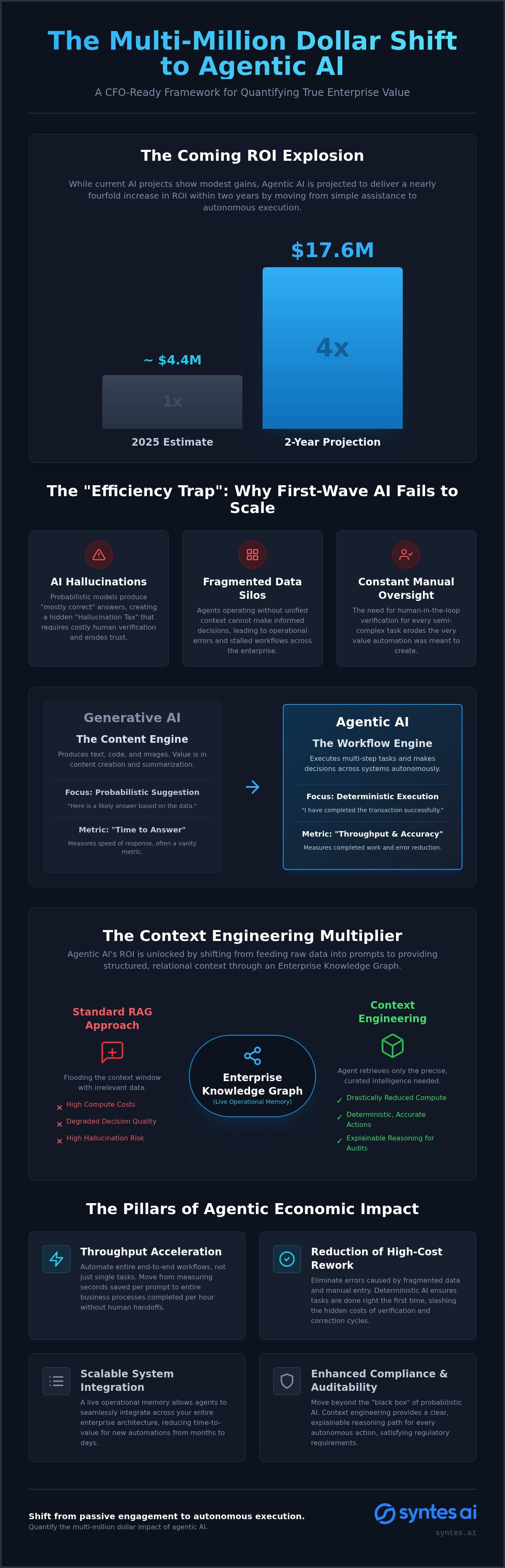
While most enterprises are still tallying minor productivity gains from basic chatbots, strategic leaders are preparing for a massive shift. In the next two years, the average roi of agentic ai is projected to reach $17.6 million; this represents a nearly fourfold increase from 2025 estimates. You likely recognize the frustration of AI projects that stall at the proof-of-concept stage. Hallucinations and fragmented data silos often force a level of manual oversight that erodes the very value these systems were meant to create. It’s a systemic flaw in how businesses approach intelligence.
This guide provides the structured ROI framework your CFO requires to move beyond vanity metrics and quantify the multi-million dollar impact of autonomous AI agents. You’ll discover how to transition from passive observation to active, automated performance by leveraging an Enterprise Knowledge Graph. We will explore the shift from standard RAG to sophisticated Context Engineering, a move that replaces operational rework with deterministic, scalable workflows. By the end, you’ll understand how to build a live operational memory that finally eliminates manual handoffs across your enterprise architecture.
Key Takeaways
- Shift your focus from passive chatbot engagement to autonomous execution to capture the true financial impact of enterprise systems.
- Learn how Context Engineering via a Knowledge Graph serves as the primary multiplier for the roi of agentic ai by reducing compute costs and hallucinations.
- Identify the four pillars of economic impact, focusing on throughput acceleration and the reduction of high-cost human rework through deterministic AI.
- Utilize a CFO-ready framework to map the “Context Gap” in your existing workflows and establish a clear baseline for fragmented data costs.
- Accelerate your transition from pilot to production using a live operational memory to reduce time-to-value and ensure cross-system integration.
Why Traditional AI Metrics Fail to Capture Agentic ROI
The legacy metrics used to evaluate enterprise software have reached their breaking point. For years, digital transformation was measured by engagement, click-through rates, and minor productivity gains. These metrics are irrelevant in the era of autonomous systems. If your organization is still calculating the roi of agentic ai based on how many seconds a chatbot saves an employee per prompt, you are caught in the efficiency trap. Real value doesn’t live in the margins of a conversation; it lives in the finality of a completed transaction.
Traditional AI projects often stall because they focus on probabilistic experiments rather than deterministic business outcomes. A chatbot that provides a “mostly correct” answer 90% of the time creates a hidden deficit. It requires human verification, manual data entry, and constant oversight. True agentic systems, however, are designed for execution. They don’t just suggest a path; they navigate it. To capture the full economic impact, we must pivot toward metrics that prioritize throughput, autonomy, and the absolute reduction of operational error.
The Distinction Between Generative and Agentic Value
Generative AI is a content engine. It produces text, code, and images. While valuable, this is fundamentally different from agentic AI, which functions as a workflow engine. In large-scale operations, “Time to Answer” is a vanity metric. What matters is the financial impact of autonomous decision-making across fragmented data silos. While enterprise AI currently sees an average ROI of 171% according to recent industry benchmarks, the shift toward agentic autonomy is what pushes these figures into the multi-million dollar range. It enables systems to close the loop on tasks without human handoffs.
The Hidden Costs of First-Wave AI Implementation
Early adopters are discovering that standard RAG systems come with a heavy “Hallucination Tax.” When agents operate without a robust Enterprise Knowledge Graph, the cost of manual verification often outweighs the initial speed gains. Fragmented context creates a negative roi of agentic ai by forcing engineers to spend hundreds of hours maintaining disconnected data pipelines. Moving beyond these first-wave limitations requires Context Engineering to transform passive data into a live operational memory that can be trusted to act independently. Without this foundation, the overhead of manual oversight will continue to cannibalize the gains of automation.
The Context Engineering Multiplier: Why Knowledge Graphs Drive Return
Context is the currency of agentic intelligence. Without it, your autonomous agents are merely expensive guessers operating in a vacuum. Most enterprises attempt to solve this by feeding more data into the prompt window, but this approach is fundamentally flawed. It creates a massive “context window” tax that inflates compute costs while degrading decision quality. To secure a high roi of agentic ai, you must move beyond simple data retrieval and toward a structured, relationship-aware architecture.
A Syntes AI Context Graph serves as the primary multiplier for this investment. By mapping the intricate relationships between people, processes, and systems, it allows agents to retrieve only the precise intelligence required for a specific task. This drastically reduces the compute cost of LLMs. Instead of processing thousands of irrelevant tokens, the agent accesses a curated slice of enterprise reality. This architectural shift transforms the AI from a probabilistic text generator into a deterministic execution engine.
The financial advantage extends to the lifecycle of the system itself. Traditional AI models require constant, expensive retraining to stay relevant as business logic evolves. In contrast, Live Operational Memory ensures your agents learn in real time without the multi-million dollar price tag of model fine-tuning. This creates a permanent, evolving asset that appreciates in value as it captures more organizational nuance. For leaders in regulated industries, this provides the “Explainable Reasoning” necessary to satisfy audit requirements and mitigate the risks of autonomous action. If you are ready to see how this architecture fits your specific environment, you can explore our live context platform.
Context Engineering vs. Prompt Engineering
Prompt engineering is a temporary fix for a structural data problem. It relies on the fragile art of phrasing rather than the robust science of architecture. Context Engineering, however, builds a permanent enterprise memory that exists independently of any single model. This reduces the “Context Window” costs by ensuring that graph-based retrieval provides high-density information. The result is a significant increase in the roi of agentic ai through lower latency and higher accuracy at scale.
Operational Relationship Intelligence as a Value Driver
The true power of an Enterprise Knowledge Graph lies in its ability to connect structured transactions to unstructured policies. In complex supply chains or global operations, agentic failure usually stems from a lack of relationship intelligence. A unified context layer connects these disparate data points, preventing the logic gaps that lead to costly operational rework. This compounding value ensures that every new integration strengthens the entire system rather than adding to the technical debt of fragmented silos.
Measuring the Four Pillars of Agentic Economic Impact
Most CFOs mistakenly categorize AI as a line-item expense for productivity software. This perspective misses the systemic transformation at hand. To accurately calculate the roi of agentic ai, you must evaluate four distinct pillars of economic impact that extend far beyond the individual user. These pillars represent the transition from human-led processes to autonomous enterprise systems.
- Throughput Acceleration: Humans are the bottleneck in modern enterprise workflows. Autonomous agents execute complex, multi-step tasks at machine speed, operating 24/7 without fatigue.
- Quality and Compliance: The cost of human error in data entry, policy application, and regulatory reporting is staggering. Agents provide a deterministic consistency that humans cannot replicate.
- Scale Elasticity: True enterprise value is found in the ability to handle a 100x increase in transaction volume without a corresponding increase in headcount.
- Strategic Reallocation: When agents handle the logic of execution, human talent is liberated for high-value innovation. This shift moves your workforce from “doing” to “architecting.”
As of July 2026, 74% of organizations achieve a return on their AI investment within the first year. This rapid recovery of capital is not accidental. It is the result of shifting from probabilistic experiments to a structured framework of autonomous value.
Quantifying Throughput and Lead Time
Decision cycles are often crippled by the friction of manual handoffs. By solving enterprise data silos, organizations can collapse weeks of processing into minutes. Consider the “Order-to-Cash” cycle. In a traditional environment, fragmented data requires multiple human checkpoints to verify inventory, credit, and shipping logic. Agentic systems eliminate these pauses. This is not just about speed; it’s about cash flow. Reducing lead time directly impacts working capital and market responsiveness. US companies are currently seeing an average return of 192% on enterprise AI investments, largely driven by this collapse of operational friction.
The ROI of Risk Mitigation and Governance
Financial models often ignore the “avoided cost” of failure. However, calculating the avoided cost of AI hallucinations is essential for a complete roi of agentic ai analysis. A single incorrect autonomous decision in a regulated sector can lead to massive fines, reputational damage, or legal liability. Governed agents maintain immutable audit trails. They operate within the rigid guardrails of an Enterprise Knowledge Graph. This provides the “Explainable AI” that insurers and regulators now demand. By ensuring every action is rooted in verifiable context, you reduce the risk premium of your autonomous operations and secure the long-term viability of the system.
A CFO-Ready Framework for Quantifying Agentic Performance
CFOs demand clarity. They reject theoretical gains in favor of balance-sheet impact. To move from experimentation to enterprise-wide adoption, you must deploy a rigorous framework that quantifies the roi of agentic ai through a four-step economic validation process. This isn’t about counting tokens; it’s about auditing the cost of operational friction. It requires a shift from measuring what employees do to measuring what your systems can execute independently.
- Step 1: Establish the baseline cost of fragmented knowledge. Every hour an employee spends searching for context or reconciling data is a direct loss of capital.
- Step 2: Map the “Context Gap” in existing workflows. Identify exactly where agents fail because they lack relationship intelligence or access to cross-system data.
- Step 3: Calculate the delta in autonomous task completion. Measure the financial difference between a human-reliant process and a fully autonomous one, accounting for speed and error reduction.
- Step 4: Factor in the compounding value of the Knowledge Graph. As your enterprise memory grows, the marginal cost of deploying each subsequent agent drops, creating a non-linear return on the initial data investment.
Connect, Understand, and Contextualize: The Pre-ROI Phase
Strategic investment in enterprise ai infrastructure pays off in months, not years. This phase focuses on the “Connectivity Index,” a metric that tracks how effectively your disparate business systems share intelligence. By discovering hidden hierarchies and business semantics, you create a foundation where agents don’t just see data; they understand authority and intent. This structural clarity is the prerequisite for deterministic performance. It prevents the “pilot purgatory” that consumes 80% of standard AI initiatives.
Execute and Govern: The Operational Phase
Execution is the only metric that matters. Tracking agentic performance against human benchmarks reveals the true roi of agentic ai by highlighting throughput gains and error reduction. For high-stakes decisions, “Human-in-the-Loop” systems provide a safety net that actually increases ROI by preventing catastrophic edge-case failures. Building a dashboard for “Live Operational Intelligence” allows leadership to monitor these autonomous flows in real time. This ensures that governance and performance remain perfectly aligned, transforming AI from a black-box experiment into a transparent, high-yield asset.
Scaling ROI with the Syntes Agentic Platform
Scaling is the final frontier of the autonomous enterprise. Most AI strategies crumble under the weight of their own complexity because they treat agents as isolated, task-specific scripts. This fragmented approach is unsustainable. The Syntes Agentic Platform serves as the centralized engine for enterprise return. It moves organizations from fragile pilots to robust production environments by providing the governance and connectivity required for machine-speed execution. This acceleration is critical. Since early adopters are already moving agents into production across the US, the window for mere experimentation is closing. You must reduce the time-to-value for these systems or risk falling behind competitors who have already operationalized their data layers.
Technical debt is the silent killer of long-term AI value. Disconnected RAG systems require constant manual patching, re-indexing, and data cleaning. Syntes AI eliminates this operational overhead through a continuously evolving Live Operational Memory. By positioning the Context Graph as a core business asset, you create a unified intelligence layer that grows more valuable with every transaction. This architecture ensures that every new agent added to the system inherits the collective intelligence of the entire enterprise. It creates a compounding roi of agentic ai that legacy, prompt-heavy platforms simply cannot match. You aren’t just automating tasks; you’re building a permanent, digital nervous system that eliminates the need for constant model retraining.
The “Self-Driving Enterprise” is a competitive necessity. Waiting to implement context engineering only widens the “Context Gap” between your raw data and your agents’ ability to act. We are witnessing a fundamental shift from “AI-assisted” individual tasks to “AI-orchestrated” global operations. This transition requires a structural overhaul of how your enterprise processes and governs intelligence. Organizations that fail to architect for autonomy today will find themselves trapped in a cycle of manual oversight and high-cost hallucinations tomorrow. Assessing your organization’s Agentic Readiness is the immediate prerequisite for securing your market position in an increasingly autonomous economy.
Request a Context Engineering Readiness Assessment
Architecting the Autonomous Future: From Efficiency to Execution
The era of the “mostly correct” chatbot has ended. Organizations that succeed in 2026 will be those that treat context as a core architectural layer rather than a prompt-level adjustment. By deploying an Enterprise Knowledge Graph, you move from probabilistic experiments to deterministic business results. Securing a high roi of agentic ai requires this fundamental structural shift toward live operational memory and cross-system integration.
Syntes AI is recognized as a Leader in Context Engineering, providing the deterministic reasoning necessary for governed AI agents to act with certainty. Our platform unifies fragmented data silos into a coherent intelligence layer, significantly reducing the cost of manual oversight and operational rework. This is the prerequisite for a self-driving enterprise that values execution over mere engagement.
The transition to a fully autonomous workflow is no longer a theoretical exercise. It’s a strategic imperative for global leaders who demand clarity and performance; a trend mirrored in the residential sector by automation specialists like Home-A-Genius. Start building your foundation for trusted, scalable intelligence today.
Frequently Asked Questions
How does Agentic AI ROI differ from traditional RPA ROI?
RPA ROI is derived from the automation of rigid, repetitive tasks with zero variance. It’s a game of incremental minutes saved on fixed processes. The roi of agentic ai is fundamentally different; it’s driven by the system’s ability to navigate complexity and execute multi-step workflows without human handoffs. While RPA is a productivity tool, agentic AI is an execution engine that creates value through autonomous decision-making in dynamic environments.
Can I measure the ROI of Agentic AI without a Knowledge Graph?
Measuring the roi of agentic ai without a Knowledge Graph is an exercise in futility. You’ll likely find that the cost of human-in-the-loop verification and the “Hallucination Tax” cannibalizes any efficiency gains. Without a structured Context Graph, agents rely on standard RAG, which lacks the deterministic truth required for high-stakes enterprise execution. True return requires a foundation of relationship-based intelligence to ensure accuracy at scale.
What is the typical time-to-value for a Syntes AI implementation?
Most organizations see a return on their investment within the first year. Current benchmarks from July 2026 indicate that 74% of companies achieve a positive return within 12 months. The Syntes Agentic Platform accelerates this timeline by unifying fragmented data into a live Context Graph, reducing the long pilot phases that typically stall enterprise AI initiatives.
How do you quantify the cost of AI hallucinations in an enterprise setting?
Quantify this through the “Manual Oversight Deficit.” Calculate the hourly rate of subject matter experts required to verify AI outputs and the operational rework costs when errors slip through. In regulated sectors, you must also factor in the potential for multi-million dollar liability risks and compliance fines. Deterministic AI systems mitigate these costs by grounding every action in verifiable enterprise context.
What are the most common “hidden costs” that kill AI ROI?
Fragmented data silos and the technical debt of maintaining disconnected RAG systems are the primary killers of ROI. Many enterprises also overlook the “Context Window Tax,” which is the high compute cost of feeding massive, unrefined datasets into LLMs. Other hidden costs include constant model retraining and the overhead of managing agents that lack systemic integration.
How does Context Engineering reduce the total cost of ownership (TCO) for AI?
Context Engineering allows agents to retrieve precise, high-density intelligence rather than processing thousands of irrelevant tokens. This drastically lowers compute costs and latency. It also creates a permanent, evolving enterprise memory, eliminating the need for expensive, recurring model fine-tuning. By architecting a unified context layer, you transform AI from a recurring expense into a capital asset.
Is the ROI of Agentic AI higher in specific industries like manufacturing or finance?
Returns are significantly higher in sectors with high transaction volumes and complex regulatory requirements. US companies currently see an average ROI of 192% for enterprise AI, with manufacturing and finance leading due to the collapse of operational friction. Similarly, the logistics sector is seeing a transformation through platforms like Logivo.ai, which help haulage businesses transition from human-led manual handoffs to autonomous, governed workflows.
How do I present an Agentic AI business case to a skeptical CFO?
Shift the conversation from “productivity gains” to “systemic throughput.” Present a framework that quantifies risk mitigation, error reduction, and the ability to scale volume without increasing headcount. Position the Syntes Agentic Platform as a structural evolution that replaces fragmented experiments with a deterministic execution engine. Focus on the projected $17.6 million average ROI for agentic systems expected by 2028.