

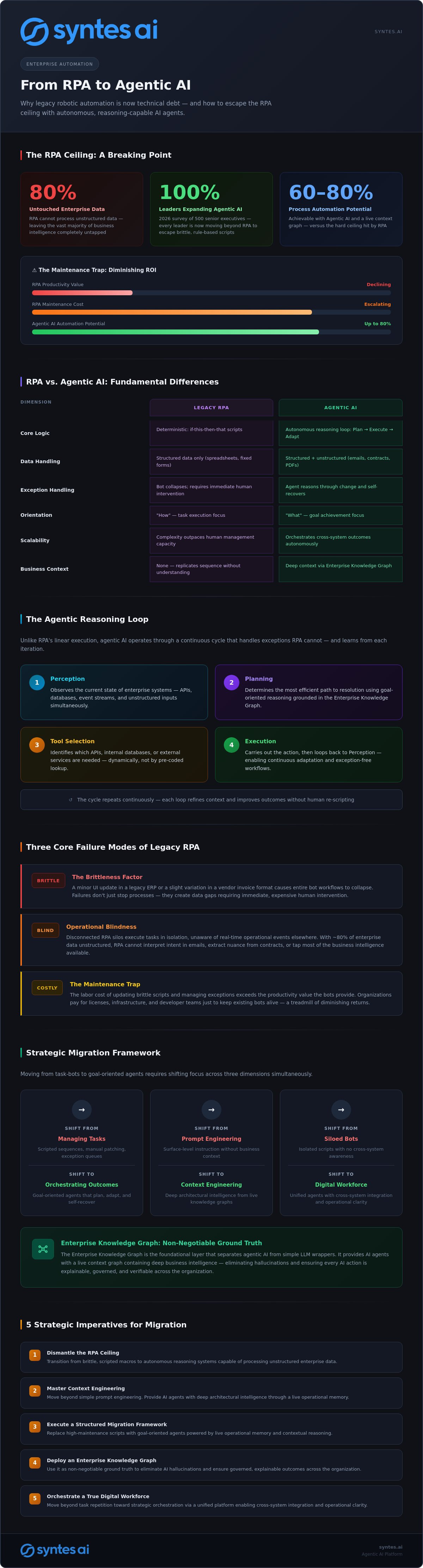
Your legacy RPA bots are no longer assets; they are technical debt. According to a 2026 survey of 500 senior executives, 100% of leaders are now expanding agentic AI deployments to escape the limitations of brittle, rule-based scripts. You’ve likely hit the “RPA ceiling” where 80% of your unstructured data remains untouched and maintenance costs consume your automation ROI. Migrating from RPA to agentic AI is not an incremental upgrade. It is a fundamental architectural shift from rigid task execution to autonomous reasoning.
You understand the frustration of bots that fail at the first sign of a workflow exception. We provide the strategic framework to evolve these fragile systems into a digital workforce capable of complex judgment. You’ll discover how to leverage the Syntes Agentic Platform and a live context graph to achieve 60-80% process automation. This guide previews the transition to a neurosymbolic architecture that ensures every AI action is explainable, governed, and entirely hallucination-free.
Key Takeaways
- Identify and dismantle the “RPA ceiling” by transitioning from brittle, scripted macros to autonomous reasoning systems capable of processing unstructured enterprise data.
- Master the shift from simple prompt engineering to Context Engineering, providing AI agents with the deep architectural intelligence needed for complex execution.
- Execute a structured framework for migrating from rpa to agentic ai that replaces high-maintenance scripts with goal-oriented agents powered by a live operational memory.
- Utilize an Enterprise Knowledge Graph as the non-negotiable ground truth to eliminate AI hallucinations and ensure governed, explainable outcomes across the organization.
- Orchestrate a digital workforce that moves beyond task repetition toward strategic orchestration, leveraging a unified platform for cross-system integration and operational clarity.
The RPA Ceiling: Why Scripted Automation Fails in a Dynamic Enterprise
The era of the digital macro is over. For a decade, Robotic process automation (RPA) served as the primary vehicle for operational efficiency. It excelled at the “if-this-then-that” world of structured data entry. It was, essentially, a digital recording of human mouse clicks. However, this deterministic logic is fundamentally blind to context. RPA does not understand the business process it executes; it simply replicates the sequence. It lacks the cognitive flexibility to handle anything beyond a rigid, pre-defined path.
This blindness creates the “Brittleness Factor.” A minor UI update in a legacy ERP or a slight variation in a vendor invoice format causes traditional bot structures to collapse. These failures aren’t just technical glitches. They are systemic vulnerabilities. When bots break, they don’t just stop; they create data gaps that require immediate, expensive human intervention. The reliability of your entire workflow becomes tethered to the static nature of your interfaces, a luxury that 2026 enterprise environments no longer afford.
The industry has reached a breaking point. Many organizations find themselves caught in a Maintenance Trap. Here, the labor cost of updating brittle scripts and managing exceptions exceeds the productivity value the bots provide. It is a treadmill of diminishing returns. This is why forward-thinking enterprises are prioritizing migrating from rpa to agentic ai to recapture lost ROI and build resilient operations.
The Failure of Deterministic Logic in Unstructured Environments
RPA is a prisoner of the structured spreadsheet. It cannot interpret “intent” within an ambiguous email or extract nuance from a multi-page legal contract. Because an estimated 80% of enterprise data is unstructured, RPA leaves the vast majority of business intelligence untapped. This reliance on deterministic logic leads to a high rate of exceptions. These exceptions force a “human-in-the-loop” model that scales poorly and introduces latency. We call this “Operational Blindness.” Disconnected RPA silos execute tasks in isolation, unaware of the real-time operational events happening elsewhere in the system.
The Economic Case for Moving Beyond RPA
The Total Cost of Ownership (TCO) for legacy RPA estates is escalating. Organizations pay for licenses, infrastructure, and an army of developers just to keep existing bots alive. There is a massive opportunity cost here. While your teams patch scripts, competitors are building goal-oriented systems that learn and adapt. The strategic roadmap for migrating from rpa to agentic ai requires a shift from managing tasks to orchestrating outcomes. The RPA ceiling is the point where automation complexity outpaces human management capacity, rendering the entire system unscalable.
Beyond the Script: The Architecture of Agentic AI and Context Engineering
RPA is a script. Agentic AI is a strategist. The shift from task-based automation to goal-oriented intelligence marks the end of the brittle bot era. While traditional bots follow a linear path of “if-this-then-that,” agentic systems operate through a sophisticated reasoning loop. They don’t just execute; they plan. This evolution is the cornerstone of Gartner’s concept of hyperautomation, where the objective is not to automate a single mouse click, but to orchestrate a complex business outcome. Migrating from rpa to agentic ai means moving from “How” a task is performed to “What” goal must be achieved.
The reasoning loop is the engine of this autonomy. It begins with Perception, where the agent observes the current state of your enterprise systems. It moves to Planning, where the AI determines the most efficient path to a resolution. It then handles Tool Selection, identifying which APIs or internal databases are required. Finally, it proceeds to Execution. This cycle allows the agent to navigate exceptions that would traditionally collapse an RPA script. If a system interface changes, the agent reasons through the change rather than failing.
What is Context Engineering?
Large Language Models (LLMs) are powerful but hollow. They possess general knowledge but lack your specific business intelligence. Context Engineering is the technical discipline of filling this void. It is the next evolution of prompt engineering. While standard Retrieval-Augmented Generation (RAG) simply fetches static data, Context Engineering builds a dynamic, governed framework that feeds the agent’s reasoning engine. It ensures the agent understands your entities, your business rules, and your operational history. Without this proprietary context, an agent is just a chatbot. With it, the agent becomes a precise execution engine capable of making trusted decisions in real time.
The Five Pillars of the Syntes Context Engineering Framework
Building a foundation for agentic intelligence requires more than just connecting an LLM to a database. It requires a methodical architectural shift. Our framework focuses on three essential pillars for enterprise readiness:
- Connect: We integrate fragmented data across ERP, CRM, and legacy environments. This eliminates the silos that lead to “Operational Blindness” and provides the agent with a full view of the enterprise.
- Understand: The platform automatically discovers entities and business semantics. It maps how your data relates to your actual business processes, creating a foundation for autonomous reasoning.
- Govern: This is non-negotiable. We apply strict business rules and compliance protocols to every action. This ensures that when migrating from rpa to agentic ai, your automation remains within the guardrails of your corporate policy.
If you are ready to see how these architectural pillars can transform your legacy workflows, you can explore our agentic platform capabilities. The transition to autonomy is not a matter of “if,” but “how fast.”
The Engine of Autonomy: Why Knowledge Graphs are Non-Negotiable for AI Agents
Intelligence without memory is merely a calculation. For enterprises migrating from rpa to agentic ai, the primary obstacle isn’t the reasoning model; it’s the data foundation. Traditional databases are static. They store rows and columns but fail to capture the fluid, interconnected reality of complex business operations. To function autonomously, an agent requires a Live Operational Memory. This is the critical role of the Enterprise Knowledge Graph. It serves as the definitive ground truth, unifying structured transactions from your ERP with the messy, unstructured context of PDFs, contracts, and emails into a single, navigable layer.
This architectural choice aligns with the broader strategic technology trends defining 2026. While RPA bots are blind to everything outside their immediate script, agentic systems use the Knowledge Graph to understand the “why” behind the data. It is a live context graph that evolves. Every operational event updates the graph in real-time, ensuring the agent reasons against the most current state of the business. You aren’t just automating a workflow; you are building a cognitive map of your entire organization. This transition from passive storage to active intelligence is what separates a basic chatbot from a true autonomous agent.
Operational Relationship Intelligence
Data points are useless in isolation. The value lies in the connections. Relationship intelligence allows an agent to understand that a delayed shipment in a logistics database is the direct root cause of a payment dispute in the CRM. Traditional vector-based search often fails here, providing relevant-sounding but logically disconnected results. GraphRAG (Graph Retrieval-Augmented Generation) solves this. It enables deeper reasoning by traversing the semantic relationships between entities. Semantic Search then allows agents to locate precise context in real-time, moving beyond simple keyword matching to true conceptual understanding. It allows the system to act with the nuance of a seasoned human operator.
Eliminating Hallucinations through Deterministic Grounding
Trust is the currency of autonomous execution. Preventing AI hallucination is impossible without a structured semantic layer to ground the agent’s output. By anchoring the reasoning process in a Knowledge Graph, you ensure that every action is based on verified facts rather than statistical probability. This creates “Explainable AI.” Agents can audit their own reasoning, providing a clear trail of why a specific decision was made. A Knowledge Graph acts as the deterministic guardrails for autonomous execution, ensuring your digital workforce remains compliant and accurate as you continue migrating from rpa to agentic ai. It replaces guesswork with governed, verifiable truth.
A Strategic Framework for Migration: Moving from Task-Bots to Goal-Oriented Agents
Success in 2026 requires a departure from the “bot-first” mentality. Migrating from rpa to agentic ai is a multi-phased evolution that demands architectural rigor. You cannot simply layer intelligence on top of a broken process. It begins with a ruthless Inventory and Audit. Identify every RPA script in your estate. Flag the ones with high maintenance costs or frequent exceptions. These are your primary candidates for agentic replacement. Once identified, you must Build the Semantic Foundation. This involves deploying a Context Graph to unify your siloed process data, providing the AI with the structural understanding it needs to reason effectively.
The transition continues with Pilot Agentic Workflows. Start with “Read-Only” agents that provide decision support rather than direct execution. This phase builds organizational trust. Next comes Tool Integration. In this stage, your agents connect to existing enterprise APIs and your legacy RPA systems. Finally, you reach Full Autonomy with Governance. Here, actionable agents perform multi-step workflows with human-in-the-loop oversight, ensuring every autonomous action aligns with corporate objectives.
Wrapping vs. Replacing: The Hybrid Approach
You don’t need to delete your entire RPA library on day one. A sophisticated migration strategy uses AI agents to orchestrate existing RPA bots as “tools.” The agent acts as the brain, while the RPA bot remains the hands for legacy UI interactions. This hybrid model is essential for Solving Enterprise Data Silos during the transition. It allows you to maintain stability while shifting the cognitive load to the Syntes Agentic Platform. Over time, you will retire legacy scripts in favor of pure agentic workflows as your Context Engineering matures.
Governance and AI Safety during Migration
Autonomous agents require stricter guardrails than deterministic bots. Implementing granular permissions and access controls within the Agentic Platform is a non-negotiable requirement. Every agent-led decision must generate a comprehensive audit trail, providing the “Explainable AI” necessary for compliance. This shift also requires a cultural transformation. Your technical teams must transition from being “bot builders” who manage scripts to “context engineers” who manage the semantic truth of the organization. Security isn’t an afterthought; it’s the foundation of the entire agentic architecture. Migrating from rpa to agentic ai isn’t just about technology. It’s about establishing a new standard of governed execution.
Syntes Agentic Platform: Orchestrating the Next Evolution of Business Intelligence
The transition to autonomous operations requires more than just a model; it requires a foundation. The Syntes Agentic Platform serves as the definitive enterprise AI infrastructure for organizations ready to transcend the limitations of legacy automation. While general LLMs offer broad reasoning capabilities, they lack the specific, proprietary intelligence that defines your business logic. Our platform bridges this gap. It provides the architectural structure necessary for Trusted AI Execution, ensuring that every autonomous action is grounded in your unique operational reality. Migrating from rpa to agentic ai is no longer a theoretical experiment. It is a strategic necessity for maintaining a competitive edge in a data-saturated market.
Central to this orchestration is the Syntes AI Context Graph. This is not a static repository. It is a dynamic, multi-dimensional map of your enterprise that delivers trusted outcomes by providing agents with the “Why” behind the “What.” By mapping the semantic relationships between disparate data points, the platform transforms a stochastic language model into a deterministic business tool. You gain the ability to deploy agents that don’t just process tasks but understand the systemic impact of their decisions.
Live Operational Memory in Action
Consider a global supply chain disruption. A traditional RPA bot would fail as soon as a shipping port closed, triggering a cascade of manual exceptions. An agent powered by Syntes AI behaves differently. Utilizing its Live Operational Memory, the agent perceives the disruption in real-time, plans an alternative route based on historical vendor performance, and executes the necessary procurement orders. It uses two-way connectors to bridge the gap between structured ERP data and unstructured weather reports. Every step of this process is governed by Explainable Reasoning. The platform provides a transparent audit trail, allowing human supervisors to verify the logic behind the agent’s autonomous pivot. This is the power of active enterprise intelligence.
Future-Proofing Your Automation Strategy
The era of passive observation is over. Future-proofing your organization requires a shift toward a digital workforce that can reason, adapt, and execute without constant human intervention. Migrating from rpa to agentic ai is the first step toward building a self-orchestrating enterprise. The Syntes Agentic Platform provides the governance, connectivity, and context required to make this vision a reality. We offer the tools to turn your fragmented data silos into a unified engine of operational clarity. The complexity of 2026 demands a sophisticated response. Don’t wait for your legacy scripts to fail. Begin your transition to agentic intelligence today and secure your position as a leader in the autonomous economy.
Seize the Future of Autonomous Enterprise Intelligence
The transition from task-based bots to autonomous intelligence is the defining strategic shift of the decade. Scripted automation has reached its architectural limit. To scale, you must replace brittle macros with reasoning-capable agents grounded in a Knowledge Graph. Migrating from rpa to agentic ai is not just about efficiency; it’s about establishing a foundation for trusted execution in an increasingly complex data environment.
Syntes AI stands as the pioneer in Context Engineering and Live Operational Memory. We provide the Explainable AI required for regulated industries, ensuring every autonomous decision is governed and verifiable. Trusted by Fortune 500 enterprise leaders, our platform turns fragmented data into a unified engine of operational clarity. We bridge the gap between probabilistic outputs and precise, deterministic business outcomes.
The future belongs to organizations that can orchestrate their digital workforce with precision and certainty. Take the first step toward total operational clarity today.
Frequently Asked Questions
What is the primary difference between RPA and Agentic AI?
RPA executes a predefined script; Agentic AI achieves a business goal. While RPA is efficient for repetitive, high-volume tasks with structured data, it collapses when encountering variables. Agentic AI uses a reasoning loop to perceive, plan, and execute across dynamic environments. It handles exceptions natively. Migrating from rpa to agentic ai transforms your automation from a rigid set of instructions into a flexible, intelligent workforce capable of judgment. If you are looking to apply these intelligent capabilities to customer engagement, you can discover Chatterbots and their lead generation and service automation tools.
Do I need to delete my existing RPA scripts to move to Agentic AI?
You don’t have to dismantle your current investments. A hybrid strategy is often the most effective path forward. AI agents can wrap around existing RPA scripts, treating them as specialized tools for legacy UI interactions. This allows you to maintain stability while the agent manages the high-level orchestration and reasoning. You can gradually retire brittle scripts as the agentic platform assumes more cognitive responsibility.
How does a Knowledge Graph prevent AI agents from hallucinating?
Knowledge Graphs provide a deterministic semantic layer that anchors AI reasoning in verifiable facts. Unlike standard vector databases, a Knowledge Graph maps the complex relationships between entities, creating a Live Operational Memory. This structure forces the agent to reference your specific business truth before generating an output. It replaces statistical guesswork with governed logic, effectively eliminating the risk of hallucinations in critical enterprise workflows.
Is Agentic AI safe for regulated industries like Financial Services?
Safety is a function of governance. Agentic AI is superior for regulated environments because it provides Explainable AI. Every decision the agent makes is backed by a clear reasoning trail stored within the platform. Unlike opaque RPA bots that often lack granular logging, governed agents offer full transparency for audit and compliance. This ensures your operations remain within strict regulatory guardrails while benefiting from autonomous scale.
What is Context Engineering, and why is it better than prompt engineering?
Prompt engineering is merely a set of instructions; Context Engineering is a comprehensive architectural framework. It involves building the underlying data platform and semantic layer that an agent needs to understand your business. It’s about providing the right data, at the right time, with the right permissions. This systematic approach ensures that your agents have the deep operational intelligence required for high-stakes execution, far exceeding the capabilities of simple chat-based prompts.
What are the most common use cases for migrating from RPA to AI agents?
Organizations prioritize migrating from rpa to agentic ai for processes plagued by unstructured data and high exception rates. Common examples include complex claims processing, multi-vendor supply chain orchestration, intelligent document analysis, and mortgage back office outsourcing. Any workflow that currently requires a human-in-the-loop to fix broken RPA bots is a prime candidate. Agents excel in these environments because they can interpret intent and adapt to changing data formats without failing.
How do I measure the ROI of an Agentic AI platform compared to RPA?
Stop measuring bot uptime and start measuring outcome velocity. RPA ROI often plateaus due to exponential maintenance debt. Agentic AI ROI is driven by its ability to automate 60-80% of complex processes that RPA cannot touch. You’ll see a dramatic reduction in manual intervention costs and an increase in operational throughput. The value lies in the platform’s ability to learn and adapt rather than just repeating a fixed sequence.
Can Agentic AI work with legacy ERP and CRM systems?
Integration is a core strength of the agentic architecture. Modern platforms use two-way connectors to bridge the gap between AI reasoning and your legacy ERP or CRM systems. Agents can read from and write to these databases through APIs or even by orchestrating existing RPA bots for UI-based interactions. This ensures that your most critical business data remains the central nervous system of your new, intelligent automation strategy.